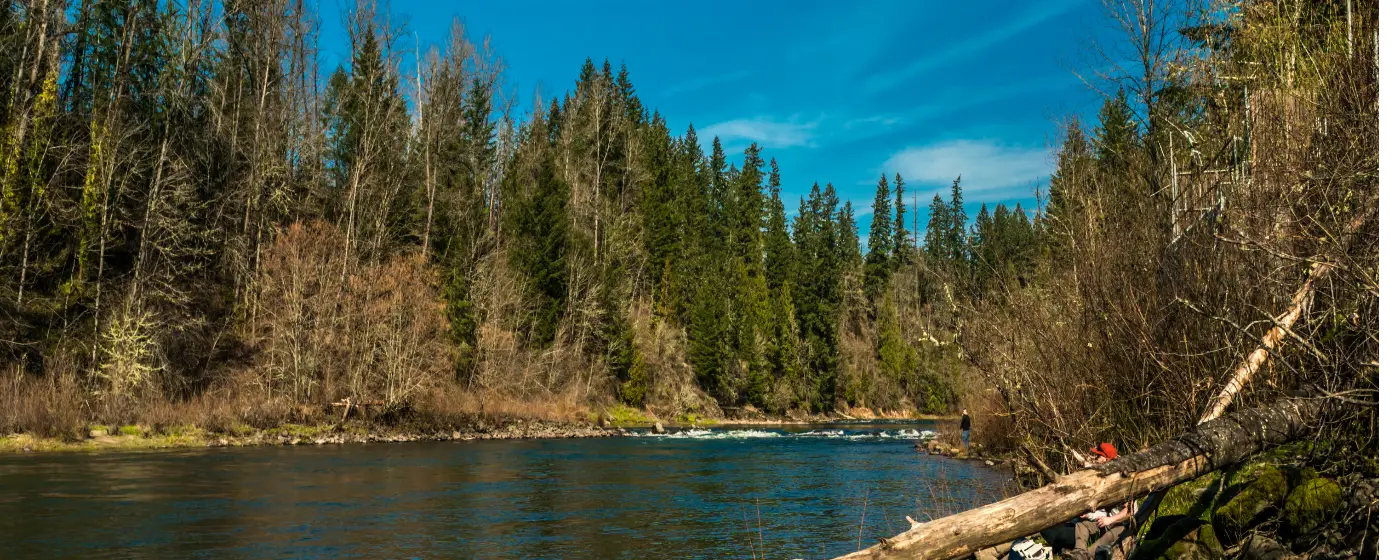
Most people who retire to Estacada didn't plan on it. They came to fish the Clackamas River, or drove out one fall weekend to see the foliage, and something clicked. A population of 5,421, a forested valley just about 45 minutes to Portland, and home prices that, while not cheap, still sit meaningfully below the inner-metro norm — the math made sense in a way it hadn't for years. What nobody tells you upfront is that this is a rural retirement, and that distinction shapes almost everything: how far you drive for a specialist, whether you walk to coffee or drive, how much community you have to build versus how much comes ready-made.
The economic backbone here is thin by urban standards — the school district, the city, Portland General Electric, and the U.S. Forest Service account for most of the local employer base. But that also means Estacada has stayed largely itself: a working timber-country town with a genuine farmers market, a handful of independent restaurants and coffee shops, and a senior center that punches well above its weight for a city this size. Retirees who move here tend to be outdoors-oriented, self-sufficient, and done with traffic — not people looking for a retirement community with a pool and a social director.
The typical home price here stood at $544,421 as of July 2026 (Zillow Home Value Index), which puts it in a realistic range for buyers downsizing from larger Oregon or Washington markets but above what a fixed income alone typically supports — see the full breakdown at the cost-of-living page. Oregon's tax treatment of retirement income is genuinely favorable: Social Security is exempt from state income tax, and there are income-qualified property-tax deferral programs for qualifying seniors. Daily life costs reflect a small-town Oregon reality — groceries and dining options are limited locally, and a serious shopping run means leaving town.
Whether you're seriously considering Estacada for retirement or comparing it against Sandy, Oregon City, or other nearby options, the sections below cover healthcare access, the retiree budget, walkability and senior community life, downsizing realities, and an honest side-by-side with nearby retirement destinations.

Why Retirees Are Choosing Estacada
Estacada earns its retirement converts almost entirely on lifestyle. If your version of a good retirement involves a kayak on the Clackamas River, hiking into Mt. Hood National Forest, watching chinook salmon return to the fish hatchery at Milo McIver State Park, and not hearing a neighbor through your wall — this is a credible place to land. The pace is slow, the scenery is constant, and the community, though small, is tight.
The honest caveat: Estacada is not a retirement destination for people who want services close at hand. Specialist medical care requires a drive. The local dining and retail footprint is modest. If mobility becomes a real concern in your later years, the car dependency here — which is significant — becomes a genuine constraint rather than an inconvenience. Retirees who thrive here tend to arrive active and stay that way; the town doesn't offer much of a soft landing if that changes.
At a typical home price of $544,421 (July 2026, Zillow Home Value Index), Estacada is not a budget play in absolute terms. But for buyers trading equity out of Portland or the westside suburbs, the relative value is real, and the single-family housing stock includes the kind of settled, lower-maintenance homes that make downsizing practical without feeling like a compromise.
Healthcare & Medical Access in Estacada
The Closest Hospital
Legacy Mount Hood Medical Center in Gresham is the nearest hospital — about 19 miles from Estacada. It is a full-service, 115-bed nonprofit community hospital with 24/7 emergency care, and it offers robotic-assisted surgery, cancer treatment, cardiology, orthopedics and rehabilitation, and gastrointestinal care as part of the broader Legacy Health system.
For a planned procedure or a scheduled specialty appointment, that distance is manageable. For a cardiac event or a stroke in the middle of the night, 19 miles on a winding two-lane highway is a different calculation. This is the central healthcare trade-off in Estacada, and retirees with serious cardiovascular or neurological risk factors should think carefully about it before committing.
Specialty Depth and What It Means Day to Day
Legacy Mount Hood covers the core hospital specialties — oncology, orthopedics, cardiology — but for deeper subspecialty care (complex cardiac surgery, level-one trauma, tertiary oncology), the drive extends further into the Portland metro. That's not unusual for a rural Oregon community; it's just the reality to plan around.
Primary care access in Estacada itself is limited, as it is in most towns this size. Residents report a mix of local clinic options and provider relationships maintained in Gresham or Oregon City. Telehealth has helped meaningfully here, particularly for routine follow-ups and prescription management.
The Practical Takeaway
Retirees who are broadly healthy, maintain primary care relationships, and plan for medical transport in a genuine emergency can make Estacada work without feeling exposed. Retirees managing multiple serious chronic conditions who want specialists nearby are better served by Oregon City or the Portland suburbs, where the healthcare infrastructure is considerably denser.

The Retiree Budget in Estacada
Oregon's Tax Climate for Retirees
Oregon's handling of retirement income is more favorable than its reputation suggests. Social Security benefits are entirely exempt from state income tax, regardless of income level — a significant advantage for retirees who rely on Social Security as a primary source. Residents age 62 and older who received taxable retirement income may also qualify for Oregon's retirement income credit, and taxpayers 65 or older receive an additional standard deduction on their state return.
Oregon has no sales tax, which quietly reduces the daily cost of groceries, clothing, and routine purchases in a way that compounds over a year. The state does carry a meaningful income tax on pension and investment income, so retirees drawing heavily from IRAs or pensions should model their Oregon tax liability carefully — the Social Security exemption helps, but it doesn't shelter everything.
Property Taxes and the Deferral Option
Estacada's effective property tax rate runs approximately 0.96% — close to the Oregon statewide norm and below many inner-Portland neighborhoods. Oregon has no statewide homestead exemption based on age or income alone; the deferral program is the primary tool available to qualifying seniors.
That program allows homeowners age 62 or older to defer property taxes until the home is sold or the owner passes — a meaningful cash-flow option for retirees on a fixed income. The program is income-qualified, so it's worth checking current eligibility thresholds with the Oregon Department of Revenue before your first tax bill arrives, particularly if you're drawing primarily from Social Security or a modest pension.
Day-to-Day Costs on a Fixed Income
Estacada's cost of living reflects its rural character. Groceries and everyday supplies are available locally, but the selection is limited; a more complete shopping run means driving toward Oregon City or the metro. Dining out is affordable by Oregon standards — the independent restaurants here don't carry Portland pricing — and the outdoor recreation that defines daily life in Estacada is largely free. For retirees with a paid-off home and modest income needs, the monthly overhead can be kept genuinely reasonable. For the full cost picture, see the cost-of-living page.
Looking to buy in Estacada? Estimate your payment.
Enter your numbers to see an estimated monthly mortgage payment.
Estimate only. Excludes HOA fees and mortgage insurance. The interest rate above is a starting point, not a quoted rate — replace it with your own to see real numbers. Insurance is a flat placeholder, not a Estacada quote.
Walkability, Community & Staying Active in Estacada
The Walkability Reality
Downtown Estacada has a compact commercial strip — a few blocks where errands on foot are genuinely possible — but Estacada is a rural community, and daily life requires a car for most things. This is not a place where you park the car and live on foot. The streets are quiet and the topography is manageable, but the gaps between destinations are real.
Where Estacada earns its mobility credit is outdoors. Timber Park's TRACK Trail runs lakeshore paths through riparian, field, and forest habitats along Estacada Lake, and the ADA-compliant loop trail at Eagle Fern Park — the largest park in Clackamas County — crosses Eagle Creek on a suspension bridge and is flat enough to be accessible for a wide range of mobility levels. These are the genuine walking assets here, not the sidewalk grid.
The Clackamas County Connects Shuttle links Estacada to Clackamas Community College on weekdays, with all buses wheelchair-lift-equipped and priority seating available for seniors and people with disabilities. It is not a substitute for a car, but it provides a meaningful option for medical appointments and errands for retirees who don't drive.
Senior Community Life
The Estacada Community Center — also known locally as the Estacada Senior Center — is the social anchor for older adults in town. It is a nonprofit hub offering congregate meals, Meals on Wheels, transportation assistance, fitness and wellness services, social activities, and healthcare equipment loans. For a city of 5,421, the range of services is genuinely impressive, and many retirees point to it as the reason they feel less isolated than they expected.
Beyond the senior center, Estacada's active life runs through its parks. Milo McIver State Park draws disc golfers year-round — the Riverbend Disc Golf Course has 27 holes and is frequently used for tournaments. Timber Park's picnic shelters and Estacada Farmers Market give the community its gathering rhythm through the warmer months. It's not a busy calendar, but for retirees who came here to slow down, that's the point.
Right-Sizing: Downsizing in Estacada
What the Housing Stock Looks Like
Estacada's residential inventory is almost entirely single-family homes, with a mix of older ranch-style construction and newer builds in neighborhoods like Cascadia Ridge, Campanella Estates, and Currin Creek Estates. For retirees seeking single-level living, the ranch stock is real and reasonably well-represented — but it requires active searching, because the market is small and turnover is limited.
Condos and patio-home communities are not a defining feature of Estacada's housing landscape the way they are in larger Oregon retirement markets. Buyers accustomed to a turnkey, low-maintenance condo product will find the selection thin. The trade-off is that a single-family home here comes with the space and privacy that drew most people to this part of Oregon in the first place.
55+ Communities
No 55+ communities were found in Estacada. The search extends to nearby cities like Oregon City for age-restricted active-adult options, and the regional senior-living market does include independent and assisted-living facilities within reasonable driving distance — but within the city limits, that product simply doesn't exist yet.
For retirees whose downsizing plan depends on a 55+ community with on-site amenities, Estacada is not currently the right fit. For retirees whose plan is a well-maintained single-family home in a quiet setting, with the senior center and the outdoors as their social infrastructure, Estacada delivers that consistently. The downsizing calculus here is less about the housing type and more about the lifestyle commitment — you are choosing a place, not a community product.
Estacada vs Nearby Retirement Destinations
| City | Cost vs Estacada | Primary Hospital | Walkability | Senior Living Depth | Overall Retirement Fit |
|---|---|---|---|---|---|
| Estacada | Anchor | Legacy Mount Hood (Gresham, ~19 mi) | Car-dependent; strong trail access | Senior center; no 55+ communities | Strong for active, outdoors-oriented retirees |
| Sandy | About the same | Legacy Mount Hood (Gresham, closer) | Car-dependent; small-town walkable core | Limited; similar to Estacada | Comparable rural retirement; slightly better shopping access |
| Oregon City | Somewhat higher | Providence Willamette Falls (in-city) | Hilly but more walkable than Estacada | Better; more senior-living facilities and services | Strong for retirees prioritizing healthcare proximity |
| Molalla | Somewhat lower | Similar distance to regional hospitals | Car-dependent; flat rural town | Thin; small senior services base | Budget-conscious rural retirement; fewer amenities |
| Boring | About the same | Legacy Mount Hood (similar distance) | Car-dependent; very rural | Minimal | Best for buyers wanting maximum rural quiet; fewer services |
| Eagle Creek | About the same | Legacy Mount Hood (similar distance) | Car-dependent; unincorporated area | Very limited | Works for retirees who want rural acreage; no town center |
Oregon City is the clearest alternative for retirees who want hospital access within the city limits and a denser senior-services network — the price premium is real but so is the difference in daily convenience. Sandy offers a genuinely similar rural feel to Estacada at a comparable price, with slightly better access to the wider Gresham-Troutdale retail corridor.
Molalla gives cost-conscious retirees a lower entry point into rural Clackamas County living, though it offers even less in the way of amenities and services than Estacada. Boring and Eagle Creek appeal to buyers who want maximum quiet and space, but neither has the community infrastructure — the senior center, the park system, the small-town commercial core — that gives Estacada its retirement coherence.
For the retiree who has made peace with driving and wants a forested, low-density life with a real sense of community, Estacada competes well. For the retiree who wants to age in place with services tightening around them as mobility decreases, Oregon City is the more durable long-term choice.

Local Expert Takeaway: Estacada retirement works best when you arrive active and plan ahead. The Estacada Community Center is a genuine resource — Meals on Wheels, fitness programs, transportation assistance, and equipment loans in a city of just 5,421 — but it doesn't replace specialist healthcare, and the 19-mile drive to Legacy Mount Hood in Gresham is the one variable every retiree here learns to plan around. Oregon's Social Security exemption and an income-qualified property-tax deferral program make the tax picture materially friendlier than most people expect. If your retirement looks like fly fishing the Clackamas, walking the Timber Park TRACK Trail, and knowing your neighbors at the farmers market, this is a town that delivers on that promise.
Quick Takeaways & FAQs
✅ Oregon exempts Social Security from state income tax entirely, and Estacada's effective property tax rate of approximately 0.96% is among the more manageable in the Clackamas County region.
⚠️ No 55+ communities exist within Estacada city limits, and specialist medical care requires a 19-mile drive to Legacy Mount Hood in Gresham — two real constraints for retirees who need services close at hand.
📍 The Estacada Community Center doubles as the city's senior center, offering Meals on Wheels, fitness, transportation, and healthcare equipment loans — a notably robust operation for a city this size.
Is Estacada a good place to retire if I have ongoing medical needs?
Does Oregon tax Social Security benefits for retirees?
Are there 55+ or active-adult communities in Estacada?
What is the property tax situation for seniors in Estacada?
What does daily life look like for retirees in Estacada without a car?
Moving to Oregon?
Tell us what you need help with and we'll connect you with local resources.
