What Is Living in Sandy, Oregon Like?
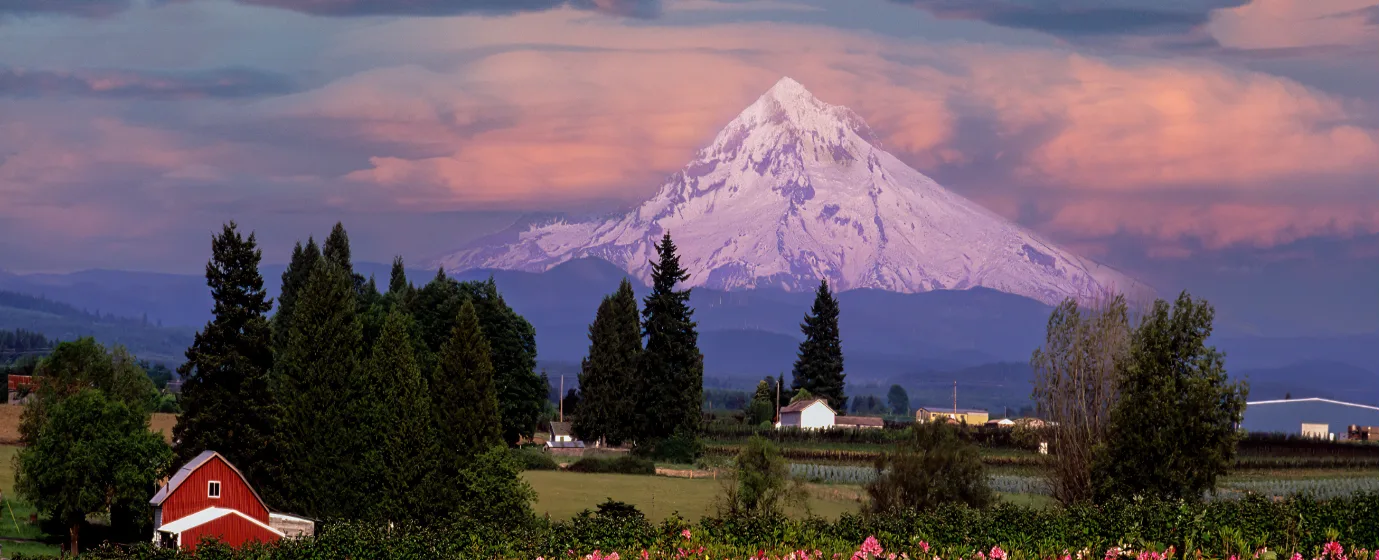
Maybe you've been priced out of Portland and someone mentioned Sandy. Maybe you drove US-26 on a ski weekend, watched Mount Hood fill the windshield, and started doing the math. Either way, the central tension of buying here is real and worth understanding upfront: Sandy sits about 45 minutes to Portland by way of US-26, which is also the highway that carries 30,000 vehicles a day through the middle of town. That same road that makes the commute possible also makes downtown Sandy feel more like a throughway than a destination — until you turn off the main corridor and find the neighborhoods tucked into the Cascade foothills above it. Elevations range from 750 to over 1,000 feet, and the geography alone filters the buyer pool considerably.
The economic backbone here is public-sector steady. The Oregon Trail School District is the city's anchor employer, followed by the City of Sandy itself and Clackamas County municipal operations. Fred Meyer anchors retail. The Oregon Trail School District holds a B rating, according to Niche, and 4,147 students enrolled in 2025-26 across a collection of schools that draws families specifically for the smaller-town feel paired with genuine athletic and extracurricular programming — Sandy High's Pioneers field active OSAA athletics programs and Friday night football genuinely fills the stands. The city is also the commercial hub for an eastern Clackamas County market area of roughly 42,000 people, which means it punches above its population of 13,300 in terms of services, dining, and retail density.
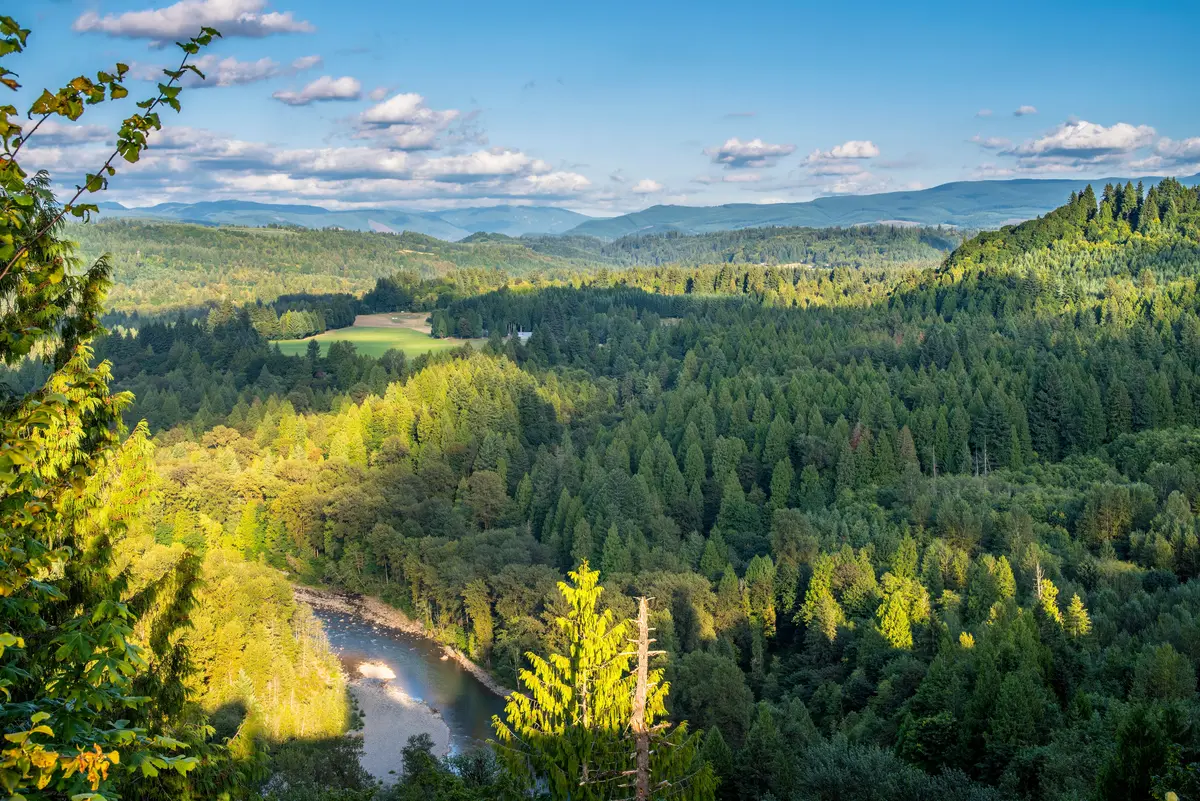
On cost of living, Sandy sits at a price point that is noticeably more accessible than Portland or Lake Oswego, though buyers should understand that the median household income here — at $108,984 — runs below what's needed to purchase the typical home without financial stretching. The outdoor amenity list, on the other hand, is hard to overstate: the Sandy River runs through the city's edge, the Mount Hood National Forest opens up immediately east of town, and the Sandy Ridge Trail System has become a destination in its own right for mountain bikers from across the region. The city averages 141 sunny days a year — not the blue-sky abundance the Willamette Valley sometimes markets itself on, but respectable for the foothills, and Mount Hood's mass actually shelters Sandy from the ice storms that batter the Columbia River Gorge to the north.
Whether you're seriously evaluating a move or just starting to research the area, the sections below break down Sandy's neighborhoods, the housing market, what the commute actually looks like, the local school picture, and what day-to-day life feels like once you've settled in at the western gateway to Mount Hood.
Sandy at a Glance
Looking to buy in Sandy? Estimate your payment.
Enter your numbers to see an estimated monthly mortgage payment.
Estimate only. Excludes HOA fees and mortgage insurance. The interest rate above is a starting point, not a quoted rate — replace it with your own to see real numbers. Insurance is a flat placeholder, not a Sandy quote.
Why Are People Moving to Sandy?
The pitch for Sandy writes itself: a house with a Mount Hood view, a yard, a school district with a B rating according to Niche, and a price tag well below what the same square footage would cost in Gresham or Clackamas. Families with school-age children keep showing up here because the Oregon Trail School District's 4,147-student enrollment gives kids a smaller-community experience without the isolation of a truly rural district.
Sandy also functions as something genuinely rare in the Portland metro — a real commercial hub that isn't trying to become a suburb. As the commercial center for about 42,000 people across eastern Clackamas County, it has the services to support daily life: groceries, medical offices, hardware, and a restaurant scene that goes beyond fast food. That self-sufficiency is a draw for buyers who don't want to drive to Gresham every time they need something.
The Oregon Trail Connection
Sandy's identity is rooted in the fact that the Barlow Road — the final overland leg of the Oregon Trail — ran directly through what is now downtown. Roughly 50,000 pioneers passed through the site where the Sandy Historical Museum now stands. That history isn't just a tourism talking point; it shapes the community's sense of itself. The Sandy Mountain Festival each year celebrates pioneer and logging heritage in a way that feels genuinely local rather than manufactured.
Who Actually Moves Here
| Buyer Type | What Draws Them | Best Fit |
|---|---|---|
| Families with school-age children | Oregon Trail SD's B rating, smaller school community, active OSAA athletics | Families School |
| Outdoor enthusiasts | Sandy Ridge Trail System, Sandy River, direct Mount Hood National Forest access | Nature Views |
| Remote workers | Space, quiet, mountain setting at a price Portland can't match | Privacy Value |
| Portland commuters priced out west | about 45 minutes to Portland via US-26, lower price point than closer suburbs | Commuter Value |
| First-time buyers | Entry point into homeownership below Portland-area alternatives | First-Time Value |
| Downsizers from larger cities | Small-town pace, walkable downtown core, community events | Quiet Walkable |
The honest downside: buyers who move here expecting a quick, easy commute often recalibrate after their first winter. US-26 through the Cascades is a mountain highway, and weather delays are part of the deal — see the commute section for the full picture.
For a closer look at how Sandy's schools and youth programs factor into the decision, the schools page covers the district in detail.
What Daily Life Feels Like in Sandy
Life in Sandy operates on a different clock than Portland. The morning pace is genuinely unhurried — pickup trucks outnumber Priuses, people hold doors, and the line at a local coffee shop moves because the barista knows half the regulars. That small-town texture is real, and it's the thing most newcomers say they didn't fully expect until they were six months in.
Downtown and the US-26 Reality
The US-26 corridor through Sandy carries real commercial weight — this is where you'll find Fred Meyer, the pharmacy, the gas stations, and most of the service businesses that handle daily errands. The downtown core along Pioneer Boulevard sits slightly apart from that throughway energy, with flower baskets overhead in summer and street-tree lighting at the holidays. The city's Façade Improvement grant program has supported more than 50 buildings since 2011, and downtown's overall condition is markedly better than many small Oregon highway towns of similar size.
A redevelopment on Pioneer Boulevard — a former derelict boarding house demolished in 2024 — received site-plan approval for a three-story building that will include leasable art studios, classroom space, gallery events, and a ground-floor coffee shop. Downtown is a work in progress, but the direction is clear.
Community Calendar
Sandy punches above its weight on community events. The Sandy Mountain Festival anchors the summer with pioneer and logging heritage programming. Winterfest keeps the calendar active in the cold months. The Summer Sounds Concert Series draws residents out in warm weather, and Easter Egg Hunts at Meinig Memorial Park are an annual fixture for families. These aren't perfunctory small-town events — they're the reason longtime residents show up and stay.
The Seasonal Quirk Newcomers Miss
What nobody warns you about before the first November: US-26 can close or slow to a crawl during significant snow events, and it does so with little notice. Locals stock up before a storm, keep chains or good snow tires on the car, and don't schedule anything east of Sandy on a day when the mountain is getting hammered. That seasonal rhythm becomes second nature within a year, but it catches newcomers flat-footed more than once.
Sandy's parks and outdoor recreation scene — from Meinig Memorial Park to the Sandy River corridor — is covered in full on the parks page.
Safety context: Sandy registers a violent crime rate of 0.6 per 1,000 residents and a property crime rate of 15 per 1,000 residents — both well below state averages. The full comparison is on the safety page.
The Sandy Housing Market Right Now
The typical home in Sandy was priced at $526,368 as of July 2026 (Zillow Home Value Index). That figure puts Sandy noticeably below Portland's close-in suburbs while still representing a meaningful ask — especially given that the median household income here runs below what's needed to carry that purchase without financial stretching. First-time buyers in particular should go in clear-eyed about the gap between income and price. The cost-of-living page breaks down what the full monthly picture looks like, and the first-time homebuyer page covers financing options in detail.
What the Stock Looks Like
Sandy's housing supply tilts toward single-family homes on real lots — not the townhouse-dense infill that dominates closer-in Portland suburbs. Older ranch homes from the 1970s and 1980s anchor the lower end of the market. Newer construction, including some planned subdivisions on the city's edges, pushes toward the upper range. The city adopted an 8-year Housing Production Strategy in November 2025 specifically to address a documented shortage of housing capacity, so supply growth is a stated municipal priority.
Renters find a typical two-bedroom in the $2,010–$2,450 range. Compared to Portland or Gresham, that's a meaningful difference — though the rental supply in Sandy is thinner, meaning available units move when they hit the market. Some areas of town carry higher price points than others, though the full neighborhood breakdown lives on the best neighborhoods page.
Buying in a Mountain Highway Town
One thing the comparable-sales data doesn't capture: location within Sandy matters more than it might in a flat suburb. A house on or immediately adjacent to the US-26 corridor is a different product than one set back in Salmon Creek Estates or Hamilton Ridge. Buyers who don't visit at rush hour — and on a weekday, when 30,000 vehicles are moving through — sometimes make offers without fully registering the noise and traffic dynamic on the highway-adjacent blocks.
The effective property tax rate runs approximately 0.96%, which is close to the Oregon state norm. For everything else about taxes and cost comparisons, see the cost-of-living page.
Sandy Neighborhoods
Sandy has several distinct areas — each with its own character and appeal. Here’s a breakdown to help you narrow down where to focus your home search.
🏡 Downtown Sandy
The historic core along Pioneer Boulevard, where the Oregon Trail's Barlow Road once ran and the Sandy Historical Museum now sits — best suited to buyers who want walkable access to coffee, dining, and community events, and who appreciate a downtown with visible investment momentum.
🏠 Sandy Bluff
A hillside area sitting above the US-26 corridor with elevated views and a quieter residential character — appeals to buyers looking for single-family homes with some separation from the main throughway noise.
🌳 Bornstedt Village / Cascadia Village
Planned residential areas on Sandy's newer-development edges with more consistent housing stock and accessible neighborhood layouts, well suited to families with school-age children.
🏘 Hamilton Ridge
An established neighborhood with larger lots and a quieter pace that attracts buyers — including downsizers — who want space without leaving city limits, set back from the commercial energy of the main highway corridor.
🏔 Salmon Creek Estates
A residential area near the Salmon Creek corridor with a natural, creek-adjacent setting that appeals to buyers who want outdoor access and a genuinely suburban-rural feel within Sandy's city limits.
🌆 Alder Creek
A quieter residential pocket that draws buyers looking for a low-traffic neighborhood setting and proximity to the forested edges of Sandy, particularly suited to those who prioritize outdoor access over downtown walkability.
Pros & Cons of Living in Sandy
The Pros
- Dramatic Mt. Hood views and easy access to year-round outdoor recreation
- Municipal gigabit-speed internet (SandyNet) available citywide
- Small-town community feel with strong local events like the Sandy Mountain Festival
- Reasonable commuting distance to Portland's job market
The Cons
- Home prices and cost of living run above the national and Oregon averages
- Limited nightlife, shopping, and dining variety compared to Portland proper
- Highway 26 traffic can back up heavily during weekend Mt. Hood ski/recreation traffic
Getting Around & Commuting in Sandy
Sandy's commute story is dominated by US-26, the Mount Hood Highway. It is the only arterial carrying traffic west toward Portland, which means there is no alternate route on a bad morning — a fender-bender near Boring, a snow closure near Rhododendron, or a weekend ski exodus can turn a manageable drive into something much longer. The baseline commute is about 45 minutes to Portland under normal conditions. Seasoned Sandy commuters add buffer.
The US-26 Reality
More than 30,000 vehicles travel US-26 through Sandy daily. In the morning, that traffic flows west toward Gresham and Portland. In the evening it stacks back east — and on winter Fridays, when Portland is emptying toward the mountain, the inbound direction clogs as well. OR-211 provides a secondary connection toward Estacada and the southern county, but it does not offer a meaningful alternative for westbound Portland commuters.
What locals actually do: the most common adaptation is shifting departure times — leaving before 7:00 a.m. or after 9:00 a.m. makes a measurable difference on US-26. Remote work has changed the calculus for a significant share of Sandy residents who now commute two or three days a week rather than five. Mt. Hood Community College, located in Gresham, draws students and faculty from Sandy who manage that stretch regularly. For buyers whose employer has a firm five-day in-office expectation in central Portland, the math deserves serious thought before closing.
Within Sandy
Daily errands — Fred Meyer, the post office, a local restaurant — are car trips in almost every case. The downtown core along Pioneer Boulevard is compact enough to navigate on foot once you're parked, but Sandy's overall street grid does not support leaving the car at home for a full day's worth of tasks. Most residents describe it the same way: you pick up everything in one loop, and you plan your route around the US-26 intersections.
Airport Access
Portland International Airport (PDX) sits approximately 28 miles from Sandy. In light traffic that's a straightforward drive west on US-26. During peak morning or evening hours, or on a storm day, the same route takes considerably longer. Residents who travel frequently for work often schedule early flights and leave earlier than the apps suggest.
| Destination | Route | Typical Drive | Notes |
|---|---|---|---|
| Portland (downtown) | US-26 W | About 45 minutes | Weather and ski traffic add significant time |
| Gresham | US-26 W | ~20 minutes | Mt. Hood Community College located here |
| Estacada | OR-211 S | ~25 minutes | Southern county connection; not a Portland bypass |
| Portland Int'l Airport (PDX) | US-26 W to I-205 | ~45–60 minutes | Allow extra time during morning rush or storms |
| Government Camp / Ski Areas | US-26 E | ~25 minutes | Same highway, opposite direction; clears fast |
| Welches / Mount Hood Village | US-26 E | ~15 minutes | Services, dining, and recreation just up the mountain |
No passenger rail or light-rail service reaches Sandy. Residents rely on personal vehicles for virtually all transportation. For buyers coming from a transit-accessible part of Portland, that shift is the most significant lifestyle adjustment Sandy asks of you.
Schools in Sandy
Families relocating to Sandy have public, private, and higher-education options nearby. Here’s a quick overview.
🎓 School District
Oregon Trail School District serves K–12 students across Sandy and the surrounding area. Rated B (source: Niche.com).
🏆 Graduation Rate
The 4-year high-school graduation rate here is approximately 96.3%.
📚 Higher Education
Oregon’s public universities — the University of Oregon, Oregon State University, and Portland State University — offer four-year degrees statewide, with a network of 17 community colleges providing two-year and workforce programs.
🌐 Online Learning
Oregon State University Ecampus and Portland State University Online offer fully accredited online degrees for remote learners across the state.
Safety in Sandy
A quick look at how Sandy compares on the numbers that matter most when weighing a neighborhood or a move.
🛡 Violent Crime
Approximately 0.6 per 1,000 residents.
🔒 Property Crime
Approximately 15 per 1,000 residents.
Compared to the most recent national figures from the Bureau of Justice Statistics (2024), Sandy’s violent crime is below the national average (about 3.7 per 1,000), and property crime is below the national average (about 18.4 per 1,000).
Against Oregon as a whole, Sandy’s violent crime is roughly a quarter of the state average, and property crime is roughly two-thirds of the state average (Bureau of Justice Statistics, Crime Known to Law Enforcement, 2024 (tables 2 and 3)).
Crime rates can vary a lot within a single city, so the citywide numbers above are only a starting point. Some neighborhoods in Sandy run well below these averages, while others run higher — the kind of block-by-block detail that matters most when you’re actually choosing where to live. The full guide below breaks it down neighborhood by neighborhood.
Working in Sandy
Sandy’s largest employers span several industries — here are some of the anchors of the local job market.
🎓 Oregon Trail School District
Education
🏛 City of Sandy
Municipal government
🏛 Clackamas County
Municipal government
🛒 Fred Meyer
Retail
🎓 Mt. Hood Community College
Education, located in Gresham
Parks & Recreation in Sandy
Some of the outdoor spaces that shape everyday life in Sandy.
🌱 Sandy River
🌱 Barlow Road/Oregon Trail historic route
🌱 Meinig Memorial Park
Sandy residents don’t have to go far for green space — spots like Sandy River and Barlow Road/Oregon Trail historic route are part of everyday life here, whether that’s a morning walk, a weekend hike, or just somewhere to unwind outside. The full guide below covers more of what Sandy has to offer for parks and outdoor recreation.
Retiring in Sandy
Sandy draws retirees for its balance of amenities, outdoor access, and cost. Here’s what to weigh.
🌤 Climate
Sandy averages 141 sunny days a year, with Mount Hood's mass providing meaningful shelter from the ice storms that sweep through the Columbia River Gorge to the north. Winters bring genuine cold and periodic snow, and the US-26 corridor can close or slow during significant mountain weather events. Spring and fall are mild and often spectacular, with the surrounding forests putting on a visible seasonal show.
🍴 Lifestyle
Sandy has a walkable downtown core with independent coffee shops, a mix of sit-down restaurants, and community events anchored in Meinig Memorial Park. The Mount Hood Farmers Market runs through the warm months, and the Summer Sounds Concert Series draws residents out regularly. For retirees who want outdoor access built into daily life, the Sandy River and Mount Hood National Forest are essentially at the doorstep.
🏚 55+ Communities
No 55+ communities were found in Sandy. Retirees typically purchase single-family homes in established neighborhoods such as Hamilton Ridge or Salmon Creek Estates, where lots are generous and the pace is quieter than the US-26 corridor. The full retirement picture for Sandy is covered on the retiring page.
✈ Getting Around
Daily life in Sandy requires a car for virtually all errands and appointments. Portland International Airport (PDX) is approximately 28 miles away — a manageable drive in light traffic, though peak-hour and storm conditions extend that meaningfully. For retirees who no longer commute daily, the mountain highway dynamic is far more manageable than for five-day-a-week commuters.
🏛 Oregon Taxes for Retirees — What to Know
- Social Security is not taxed — Oregon does not tax Social Security or Railroad Retirement benefits. Any amount included in your federal adjusted gross income is subtracted back out on the Oregon return.
- But other retirement income IS taxed — This is the trade-off that surprises people moving from Washington or Texas. Pension distributions and 401(k)/IRA withdrawals are taxed as ordinary income at Oregon’s regular rates — there is no blanket retirement-income exclusion.
- Graduated income tax — Oregon has four brackets — 4.75%, 6.75%, 8.75% and 9.9%. The 4.75% rate covers the first $10,000 of taxable income for a single filer ($20,000 filing jointly); the 8.75% rate starts at $125,000 ($250,000 jointly); and the top 9.9% rate applies above $250,000 ($500,000 jointly).
- No sales tax — Oregon levies no general sales tax.
- Property taxes, with senior deferral — Oregon’s Senior and Disabled Property Tax Deferral lets qualifying homeowners have the state pay their county property taxes, with a lien recorded against the home. The 2026 household income limit is $70,000, and deferred balances accrue 6% simple interest — it defers the bill rather than forgiving it.
- Estate tax — the one to plan for — Oregon has its own estate tax with a $1 million filing threshold — far below the federal exemption, and NOT indexed for inflation, so it reaches more estates every year in real terms. Retirement accounts and a long-held home count toward the taxable estate, so estates that feel modest can cross the line without the owner expecting it.
- No inheritance tax — Oregon has no separate inheritance tax and no gift tax.
Tax laws change frequently and individual situations vary. This is general information, not tax advice — always consult a qualified Oregon tax professional or CPA for personalized retirement tax planning.
Weekends & Local Favorites in Sandy
Sandy's weekend identity is split between the outdoor world immediately east of town and a small but committed local scene downtown. Most residents do both on the same day without much effort — the mountain and the main street are not competing pulls, they're complementary ones.
On the Trails
The Sandy Ridge Trail System is a legitimate regional destination. Managed by the Bureau of Land Management and maintained by the Northwest Trail Alliance, it offers 17 miles of purpose-built, directional mountain bike singletrack running from beginner-accessible flow trails to double-black-diamond lines — and it's widely recognized as one of the first modern, purpose-built mountain bike systems on public land in Oregon. On a Saturday morning in summer or fall, the trailhead draws riders from across the metro. The Sandy River offers fishing, kayaking, and swimming from multiple access points, with the river fed by glacial melt off the Sandy Glacier on Mount Hood's flank 56 miles upstream. The Mount Hood National Forest opens immediately east of the city limits, putting hiking, camping, and winter skiing within a short drive of virtually any address in town.
The Viewpoint
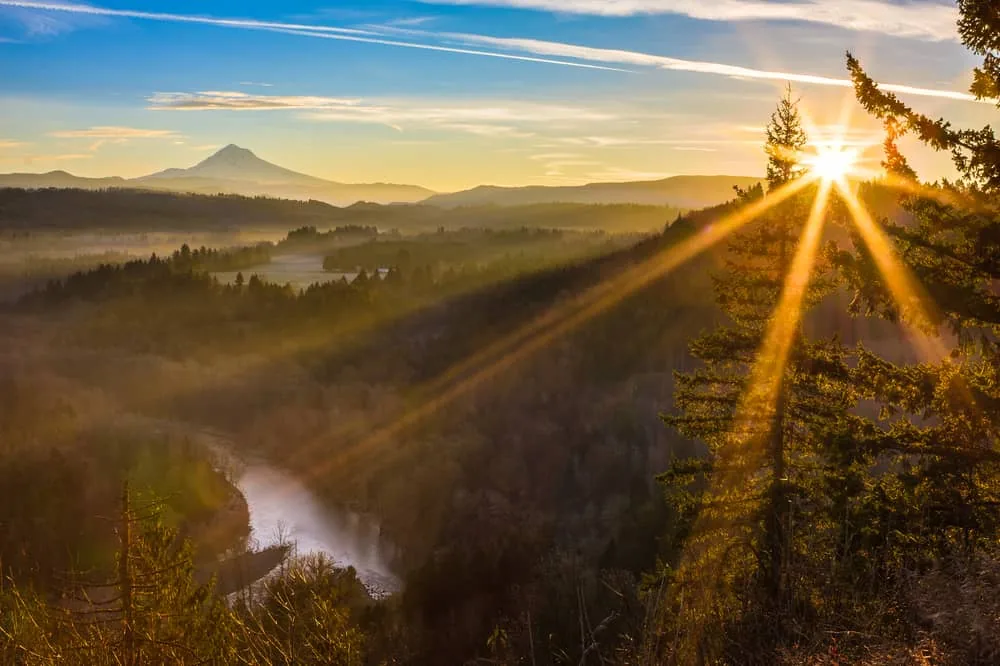
Jonsrud Viewpoint Park — a nearly 5-acre park on the Mt. Hood Scenic Byway — is where locals take out-of-town visitors when they want to make the mountain's scale land. Telescopes and Oregon Trail interpretive plaques dot the viewpoint, and on a clear morning it's one of the most direct, unobstructed looks at Hood available from an accessible roadside stop. It never gets old for people who live here, which is its own kind of quality-of-life metric.
Downtown Dining and Coffee
The local food and coffee scene is smaller than Gresham's but more interesting than a highway-town of 13,300 has any obligation to be. Tollgate Inn Restaurant & Saloon and Tollgate Inn Bakery anchor the historic end of the dining scene — the bakery is a genuine morning institution. Sandy Family Restaurant & Ria's Bar handles the diner-and-bar combination that every small Oregon town needs and Sandy has done well. Smoky Hearth Restaurant Bar & Grill rounds out the sit-down options with a heavier, wood-fired approach. Thai Home Restaurant covers the category with consistency that earns repeat visits. On the coffee side, Mountain Moka, AntFarm Cafe and Bakery, Real Time Roasters, and Coffee Slingers give residents more independent options than you'd expect — and AntFarm doubles as a genuine bakery, which matters on a cold winter morning when the mountain has a foot of fresh snow and nobody is going anywhere fast.
The Farmers Market and Community Events
The Mount Hood Farmers Market runs through the warm season and draws producers from across the eastern Clackamas County area. It's a reliable weekly anchor for residents who want to shop local without driving to a larger market. The Summer Sounds Concert Series brings music into the downtown corridor in a way that feels genuinely community-organized rather than municipal-programmed. Meinig Memorial Park — with its riverside setting — is where a lot of that informal community life concentrates on a warm weekend afternoon.
What newcomers often miss in the first year: Sandy's outdoor proximity means weekends here have a low barrier to spontaneity. You don't have to plan a camping trip three weeks out to end up in the Mount Hood National Forest. That ease of access is something residents list consistently when asked what they'd miss most if they left.
Local favorites in Sandy
Restaurants
- Tollgate Inn Bakery
- Tollgate Inn Restaurant & Saloon
- Sandy Family Restaurant & Ria's Bar
- Smoky Hearth Restaurant Bar & Grill
- Thai Home Restaurant
Outdoors
- Sandy Ridge Trail System
- Jonsrud Viewpoint Park
- Sandy River
Coffee
- Mountain Moka
- AntFarm Cafe and Bakery
- Real Time Roasters
- Coffee Slingers
Farmers Markets
- Mount Hood Farmers Market
Top Things Locals Say About Sandy
The best intel about a city comes from the people who actually live there. Here’s what Sandy residents say when newcomers ask the questions everyone’s thinking.
“I knew the commute was going to be real, but I told myself it was fine. By February I had completely reorganized my work schedule to avoid US-26 at peak hours — I leave by 6:30 or I work from home. Nobody mentioned the ski Fridays where eastbound traffic backs up through town while you're trying to get home from work going the other direction.”
— Recent Sandy home buyer
“What's the most surprising thing about living in Sandy?”
How much the mountain shapes the calendar. You don't just look at Mount Hood — you plan around it. The first heavy snowfall changes how people drive, shop, and schedule. After one winter you stop making commitments that depend on US-26 being clear on a January evening. It becomes second nature, but it genuinely surprised me how much the weather on the mountain reaches into daily life down here in town.
“What do locals love most about Sandy?”
The proximity to the outdoors without the tourist-town premium. Sandy is the gateway to Mount Hood, but it's a working town, not a resort town. You can be at the Sandy Ridge trailhead or on the Sandy River in minutes from most addresses, and on a weekday morning in the off-season those places feel like they belong to you. The community events — the Mountain Festival, the Summer Sounds concerts at Meinig Park — feel genuinely local, not organized for visitors.
“What should newcomers to Sandy know?”
Learn the US-26 patterns before you commit to a schedule. There are times when the highway flows well and times when it doesn't, and the difference between leaving at 6:45 and 7:30 in the morning can be 20 minutes. Stock up before a mountain storm — the grocery run you put off becomes a much bigger deal when the highway is snow-packed. And give downtown a chance beyond the first drive-through impression; the stretch along Pioneer Boulevard has more going on than it looks at 40 miles an hour.
“How much do you need a car in Sandy?”
A car is essentially required for daily life in Sandy. Most errands — groceries at Fred Meyer, any appointment, the farmers market — mean driving. The downtown core along Pioneer Boulevard is compact enough to walk once you've parked, but you're parking a car to get there. For the commute to Portland, driving US-26 is the only realistic option. Residents who work from home or have flexible schedules have the most freedom, but even they describe Sandy as a car-first town for anything beyond a walk around the neighborhood.
Cities Near Sandy
Other communities near Sandy worth a look — each with its own character and price point.
| City | Distance | Best For | Vibe | Median Rent | Median Buy |
|---|---|---|---|---|---|
| Gresham | 15 mi | Commuters, transit access, urban amenities | Larger, busier, more suburban | $1,611 | $470,730 |
| Boring | 7 mi | Rural feel, large lots, quiet living | Spread out, agricultural, unhurried | $1,700 | $550,000 |
| Welches | 20 mi | Mountain lifestyle, vacation-home buyers | Resort-adjacent, forested, small-scale | $1,600 | $480,000 |
More Helpful Guides for Sandy
Going deeper on Sandy? Our blog series covers everything from first-time buying to retiring here — explore the guides below.
Local Expert Takeaway: Sandy rewards buyers who do their homework on the commute before falling in love with the mountain views. The typical home price of $526,368 (July 2026) is genuinely more accessible than Portland's close-in suburbs, and the outdoor amenity list — Sandy Ridge trails, the Sandy River, the Mount Hood National Forest at your doorstep — is hard to replicate anywhere in the metro. But US-26 is the single thread the commute hangs on, and it tightens on bad weather days and ski Fridays. Buy here because you've driven it in January and made peace with it, not because the Zillow estimate looked good on a Tuesday afternoon in August.
Quick Takeaways & FAQs
✅ Sandy gives you Mount Hood National Forest access, the Sandy Ridge Trail System, and a smaller-town school community at a price point noticeably below Portland's western suburbs.
⚠️ US-26 is the only route west to Portland, and a winter storm or weekend ski traffic can stretch that about-45-minutes commute significantly — there is no alternate path.
📍 The Barlow Road, the final overland segment of the Oregon Trail, ran directly through what is now downtown Sandy — the Sandy Historical Museum sits on the original route, and the city still organizes its community identity around that pioneer history.
How far is Sandy, Oregon from Portland?
What are home prices like in Sandy, OR?
How are the schools in Sandy, Oregon?
Is Sandy, Oregon a good place to raise a family?
What outdoor activities are available in and around Sandy, Oregon?
Helpful Links for Moving to Sandy
Moving to Oregon?
Tell us what you need help with and we'll connect you with local resources.
