
Maybe you've found a home you love on the Oregon coast and the school question is the last one standing. Maybe you moved here for the lifestyle and now your kids are school age. Either way, the Brookings-Harbor School District is the only public option in town, and understanding what it is — and what it is not — matters more here than in a metro where families can shop across district lines or drive to a magnet school. This is a genuinely small coastal district spread across just three campuses. That intimacy is real, and it shapes everything from class sizes to how loudly Friday night football echoes through town.
The district's honest picture is a mixed one. Brookings-Harbor School District 17C holds a C- rating, according to Niche, and on 2024-25 state assessments, 20.2% of students reached math proficiency and 35.6% reached reading proficiency — figures that sit well below state averages. At the same time, the district offers career and technical education pathways that are rare for a town this size, and has built college-credit partnerships with Southern Oregon University, Oregon Institute of Technology, and Southwestern Oregon Community College. The picture is not uniformly grim, but it is not one to gloss over either.
The broader family context here is coastal and tight-knit. Brookings, population 6,703, sits along US-101 near the California border, and the community that gathers around its schools is the same one that fills Azalea Park on weekends and lines the bleachers at Bruin home games. Youth sports leagues draw participation well beyond what a city this size might suggest, partly because there is not much competing for kids' time on a drizzly coast Tuesday evening. The Southwestern Oregon Community College Curry Campus, located in Brookings itself, adds a post-secondary option that matters when the nearest four-year university is a long drive up the coast.
Whether you are weighing a move or already under contract, the sections below cover the district's structure and academic profile, the three schools in more depth, the CTE and dual-credit programs that make the high school worth a closer look, youth sports from recreational soccer to Little League, and an honest assessment of who this district is not the right fit for.
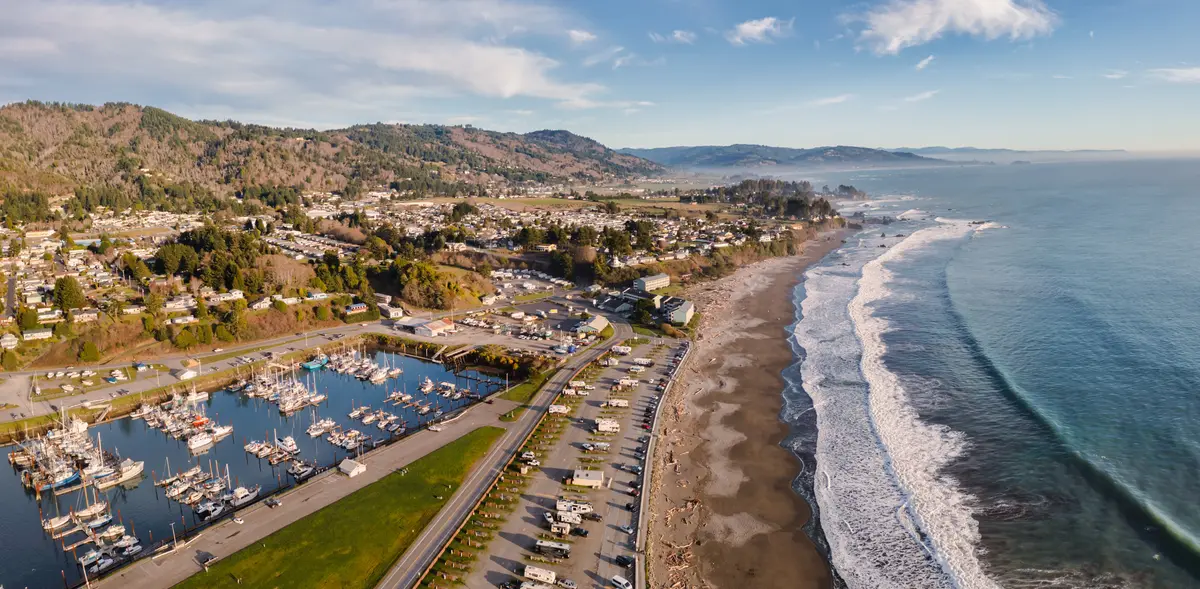
Brookings-Harbor School District: The Honest Overview
Three schools serve every grade from pre-kindergarten through twelfth grade. That is the entire district. Kalmiopsis Elementary handles K–5, Azalea Middle School takes grades 6–8, and Brookings-Harbor High School carries students through graduation. There are no magnet programs, no alternative public schools, and no district-within-a-district options to seek out. What you see is what you get.
The district holds a C- rating, according to Niche. That is the honest starting point, and families moving from higher-rated suburban districts in the Willamette Valley or from California should sit with it rather than explain it away. The academic proficiency numbers from 2024-25 state assessments — 20.2% of students reached math proficiency and 35.6% reached reading proficiency — reflect real structural challenges in a small, economically diverse coastal community where a substantial share of students qualify for free and reduced-price meals.
Classes run small. In a three-school district, teachers know their students by name well before the end of September — that kind of relationship continuity is one of the genuine assets here, even when the aggregate academic numbers are difficult. The district also provides free breakfast and lunch to all students every school day, a detail that carries more weight than it might seem in a community where household budgets are stretched.
For families with high academic expectations and a preference for competitive, AP-heavy coursework in a resource-rich environment, this profile is a real consideration. For families who value small-school relationships, hands-on CTE pathways, and a community where the school is genuinely the center of civic life, the same profile looks quite different. Both readings are honest.
| Category | Brookings-Harbor SD | Context |
|---|---|---|
| Overall Rating (Niche) | C- | Below most Willamette Valley districts |
| Math Proficiency (2024-25) | 20.2% | Well below state average |
| Reading Proficiency (2024-25) | 35.6% | Below state average |
| Class Size | Small (runs lean) | Teachers know students by name early |
| Free Meals Program | All students, daily | No eligibility paperwork required |
| Schools in District | 3 | No magnet or alternative schools |
| CTE Pathways | 5 tracks | Rare breadth for a district this size |
The district's community feel and safety are real assets — for a fuller look at Brookings-wide crime and safety figures, that page has the detailed breakdown.
The Three Schools: What Each One Is Actually Like
Kalmiopsis Elementary (K–5)
Kalmiopsis is the largest campus in the district, serving the full K–5 population for a city of 6,703. For an elementary school in a town this size, that is a meaningful enrollment — the campus draws from the full city footprint, which means most kids arrive already knowing their neighbors. The free breakfast and lunch program runs here alongside the rest of the district, so families do not need to navigate eligibility paperwork each year.
Elementary teachers in a district this small tend to stay. Staff turnover is always worth asking about in any relocation conversation, but a small coastal district with limited local housing stock self-selects for educators who came here intentionally. That is worth something at the elementary level where relationship continuity matters most.
Azalea Middle School (6–8)
Azalea is the smallest campus by enrollment. The middle school years in a district this size carry a particular dynamic: your child will know virtually every student in their grade by the end of sixth grade. That can be a genuine comfort or a genuine frustration depending on the kid. There is no fresh start available by switching schools within the district.
The middle school feeds directly into the high school's CTE pipeline — students who show early interest in health occupations or construction pathways can begin building toward those programs before they reach ninth grade. That continuity between Azalea and the high school is one of the district's structural strengths.
Brookings-Harbor High School (the Bruins)
The high school is where the district's genuine assets concentrate. Dual-enrollment and college-credit courses run through partnerships with Southern Oregon University, Oregon Institute of Technology, and Southwestern Oregon Community College — meaning a motivated junior or senior can arrive at a four-year university with transferable credits already in hand. For a family weighing the long-term cost of college, that is a real financial calculation worth making.
Career and Technical Education pathways include Business, Health Occupations, Metals and Manufacturing, Construction, and Wildland Firefighting. The Wildland Firefighting pathway in particular reflects the regional economy of southwest Oregon in a way that no suburban district would think to offer. A new synthetic-turf sports complex opened at the high school in fall 2024, adding a facility that the community has rallied around. The Bruins carry active OSAA athletics programs, and the stadium draws a crowd on game nights that you would not expect from a school this size.
Best for: Students who thrive in a close-knit environment and want real hands-on pathways — especially those interested in health, trades, or earning college credit before graduation.
College & Post-Secondary Options Without Leaving Town
One detail that catches families off guard: Brookings has a community college campus. The Southwestern Oregon Community College Curry Campus is located in Brookings and offers certifications and associate degrees across multiple fields. That is meaningful for a small coastal city — it means families and recent graduates do not have to leave the area to begin post-secondary education.
For high school students, the SWOCC connection runs in both directions. The dual-enrollment partnership through the high school lets Bruins take college-credit coursework before graduation, and the Curry Campus provides a natural continuation point for those who want to stay on the coast after twelfth grade. Some CTE pathway graduates move directly into local employment — the Health Occupations track feeds into the regional healthcare workforce — while others use the associate degree as a stepping stone toward transfer to Oregon Institute of Technology or Southern Oregon University.
None of this turns a C- rated district into a high-powered academic machine. But it does mean that a student who engages seriously with what the district offers has access to real credentials and real college credit before they leave Brookings. That is the honest version of what the post-secondary pipeline looks like here.
Looking to buy in Brookings? Estimate your payment.
Enter your numbers to see an estimated monthly mortgage payment.
Estimate only. Excludes HOA fees and mortgage insurance. The interest rate above is a starting point, not a quoted rate — replace it with your own to see real numbers. Insurance is a flat placeholder, not a Brookings quote.
Youth Sports & Kids Activities in Brookings
Youth sports in Brookings punch above the city's population in terms of participation, partly because the coast concentrates community life in ways that a suburb with a dozen competing activity options does not. When the recreational soccer league draws hundreds of participants in a city of 6,703, that is not a typo — it is a reflection of how much these programs mean to families here.
Soccer
Two organizations cover the full spectrum. The Brookings Harbor Youth Soccer League is the recreational entry point, designed for kids who want to play without the pressure or travel commitment of competitive club soccer. Wild Rivers Soccer Club is the select program, affiliated with Oregon Youth Soccer and the USSF, for players who want a higher level of training and competition. Wild Rivers holds fall season games at Azalea Park, which sits at the center of Brookings and gives those matches a genuine community feel. If your child is competitive-minded, the club pathway is real — just understand that higher-level tournaments will require driving well outside the area.
Baseball & Softball
Brookings Harbor Little League covers both sports with a spring season. The recreational structure is straightforward. For players who want to advance into tournament play, Little League's district structure requires travel to the Medford and Grants Pass region — a 2.5 to 3-hour drive that means overnight stays, not day trips. Families considering serious competitive baseball or softball should factor that travel reality into their planning before the first registration opens.
Basketball
Organized youth basketball exists in Brookings, but it is the thinnest of the major sports in terms of formal recreational league structure for younger kids. Verify current offerings directly with the city's parks and recreation department before relying on it — what is available in a given season can shift in a small community more readily than in a larger city. See the parks and recreation page for the full picture on facilities and programs.
High School Athletics
Brookings-Harbor High School carries active OSAA athletics programs across multiple sports. The new synthetic-turf complex that opened in fall 2024 raised the profile of the school's athletic facilities significantly. Friday night football at the Bruins stadium draws the kind of crowd that fills the stands and spills into the parking lot — it is one of the more reliable community gathering points in a city where public life tends to concentrate around a handful of anchors.
The Travel Reality
This is the piece that surprises families most after their first competitive season. Any sport that moves beyond recreational or OSAA school play requires driving to Medford for tournaments, regional competitions, or higher-level club matches. That is roughly 2.5 to 3 hours each way, and tournament weekends regularly mean an overnight stay. Families who have relocated from a metro where competitive sports were a short drive to the next suburb describe the first tournament trip as a genuine recalibration. Budget the time and cost accordingly, and decide early what level of commitment makes sense for your family in this geography.
Who This District Is NOT the Right Fit For
This section exists because the honest answer to that question saves families from a difficult decision made on incomplete information.
If your child thrives in an academically competitive environment with a deep AP or IB course catalog, multiple foreign language sequences, and peer groups oriented toward selective university admissions, Brookings-Harbor is not that district. The high school's dual-enrollment and CTE strengths are real, but they are different in kind from what a well-resourced suburban district with a much larger high school enrollment can offer. A student aiming for highly selective universities will need to do significant self-directed academic work beyond what the district provides.
If you have a child with specialized learning needs that require substantial support staff, specialized therapists, or a range of district programs to choose from, the limited scale of a three-school district is a real constraint. A district serving a small coastal community cannot staff the breadth of specialists that larger districts maintain. The district makes every effort, but the resource base is finite.
If competitive travel sports at the club or select level are central to your family's life, the geography compounds every team sport. Medford is the nearest hub for most tournament and league play, and that drive is a recurring commitment rather than an occasional one. Families who relocated here from Portland or the Bay Area describe the first full competitive season as a logistical adjustment they did not fully anticipate.
None of this means Brookings is the wrong choice. It means the choice should be made with clear eyes about what the district is and what the geography imposes. Families who match well here — and many do — tend to be ones who value the small-school environment, engage actively with what the CTE and dual-enrollment programs offer, and are at peace with a community where the school truly is the center of kids' social world. For cost of living context on what that family budget looks like in Brookings, the cost of living page has the full breakdown.
What Families Actually Say After a Year Here
Six months in, most families from larger metros say the same thing: the school is smaller than they imagined, and that smallness is both better and harder than they expected. Better, because teachers genuinely know their kids and call home proactively. Harder, because social dynamics in a small grade are more intense than in a large one — there is no escaping a rough friendship patch by drifting to a different friend group.
The other recurring observation is about the high school's CTE programs. Families who arrived skeptical of anything vocational — because they came from districts where those pathways carried a stigma — describe watching their teenagers engage seriously with the Wildland Firefighting or Health Occupations tracks in a way they never engaged with AP Chemistry. The coastal economy normalizes those careers in a way that shifts the social calculus.
What families who move OUT consistently cite: the academic ceiling at the high school feels low for a student with university ambitions, and the social world in a district this small can feel suffocating by junior year. A teenager who wants to reinvent themselves has limited room to do that when everyone they have known since kindergarten is in the same building. That is a real reason families return to larger metro areas after a few years, and it deserves to be said plainly.
Families considering the broader neighborhood context alongside the school question will find the neighborhoods page useful for understanding how the community is actually laid out across Brookings and Harbor.
Local Expert Takeaway: Brookings-Harbor School District is a small, honest, coastal district that works well for families who want close teacher relationships, hands-on CTE pathways, and a community where the school is the center of kids' lives — and works less well for families expecting a resource-rich academic environment comparable to a larger Oregon district. The dual-enrollment partnerships with Southern Oregon University and Oregon Institute of Technology are real assets at the high school level. Youth sports are deeply community-rooted, with soccer drawing hundreds of participants and Bruin game nights filling the new synthetic-turf complex. The catch for competitive sports families is geographic: any tournament play beyond OSAA school athletics means a 2.5 to 3-hour drive to Medford and overnight stays. Know the trade-offs going in, and you can make the right call for your family.
Quick Takeaways & FAQs
✅ Brookings-Harbor High School offers genuine dual-enrollment college credit through partnerships with Southern Oregon University, Oregon Institute of Technology, and Southwestern Oregon Community College — rare for a coastal district this size.
⚠️ The district holds a C- rating according to Niche, with 2024-25 state assessment proficiency of 20.2% in math and 35.6% in reading — figures families with high academic expectations should weigh carefully before committing.
📍 Youth soccer draws hundreds of participants in a city of 6,703, and the new synthetic-turf sports complex at the high school opened in fall 2024 — but any competitive tournament play means a 2.5 to 3-hour drive to Medford and overnight stays.
How many schools are in the Brookings-Harbor School District?
What is the Brookings-Harbor School District's rating?
Does Brookings-Harbor High School offer advanced or college-level courses?
What youth sports leagues exist in Brookings for kids?
Is there a community college or post-secondary option in Brookings?
Moving to Oregon?
Tell us what you need help with and we'll connect you with local resources.
