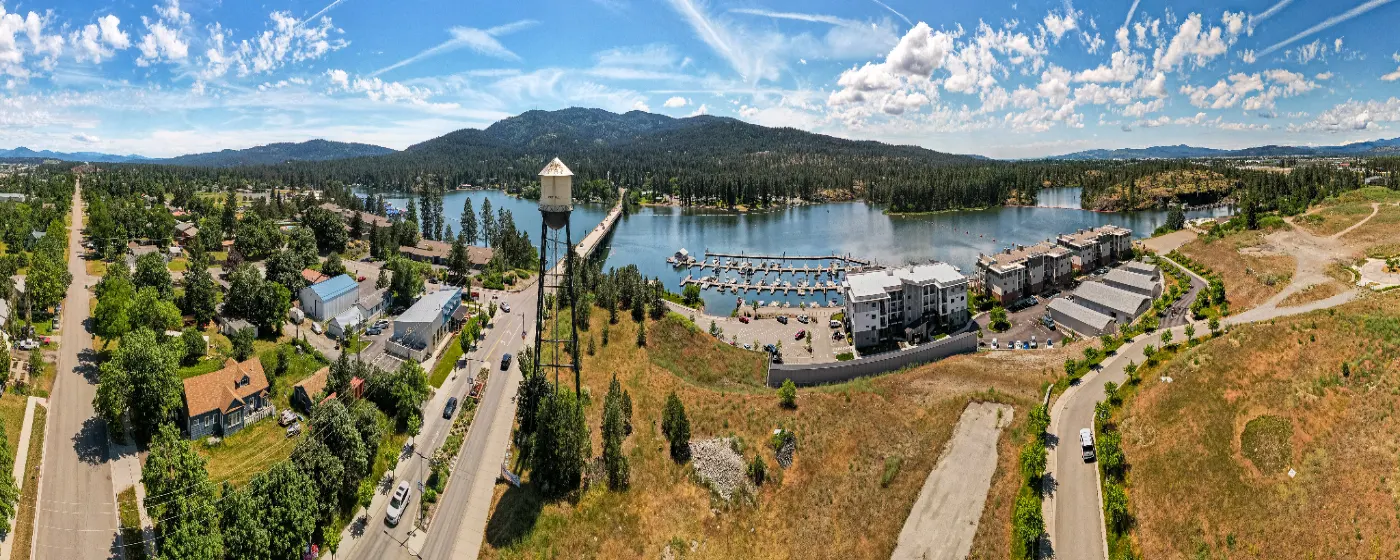
What Is Living in Post Falls, Idaho Like?
Maybe you've been priced out of the Seattle suburbs and someone mentioned North Idaho. Maybe your company is based in Spokane and you want to plant roots somewhere that doesn't feel like a satellite office park. Or maybe you drove through Post Falls on I-90 and thought it looked smaller than it actually is. The surprise most newcomers hit by month three: Post Falls isn't a quiet bedroom town anymore. With 18.6% population growth between 2020 and 2024 — ranking it 70th among the fastest-growing U.S. cities — this city on the Idaho-Washington border is actively figuring out what it wants to be when it grows up. It sits on the Spokane River, bisected east-west by Interstate 90, with Coeur d'Alene 10 miles to the east and Spokane roughly 25 miles to the west. That corridor is the central fact of daily life here.
The economic backbone is more varied than the city's size suggests. Buck Knives relocated its headquarters here decades ago and remains a point of local pride in manufacturing. Ground Force Manufacturing builds construction equipment a few miles from where Buck stamps blades. Sysco Systems runs a major distribution operation. Cabela's anchors a retail draw that pulls shoppers from three counties. Beyond those names, the real employment story is the regional labor market: more than 14,000 Post Falls residents commute to Coeur d'Alene, Spokane, and surrounding areas every day, and the regional workforce within 45 miles exceeds 300,400 people. Post Falls School District #273 holds a B- rating, according to Niche, which is honest — it's a district in transition as the city's growth outpaces school capacity planning.
Housing here runs noticeably below what you'd find in Coeur d'Alene, and dramatically below the Boise metro — see the full breakdown at the cost-of-living page. The effective property tax rate of 0.60% is one of the consistent draws for Washington state transplants, who give up sales-tax-free shopping but gain a lighter annual property bill. Day-to-day life mixes outdoor access that punches well above the city's weight — the North Idaho Centennial Trail, Q'emiln Park on the river, and a 500-acre community forest — with the practical reality that almost everything requires a car. Transit is minimal. Freeway congestion through the city has grown alongside the population.
Whether you're seriously considering a move or still in the research phase, the sections below break down Post Falls's employment landscape, housing market, commute patterns, neighborhood character, and what weekends and daily life actually look like here.
Post Falls at a Glance
Looking to buy in Post Falls? Estimate your payment.
Enter your numbers to see an estimated monthly mortgage payment.
Estimate only. Excludes HOA fees and mortgage insurance. The interest rate above is a starting point, not a quoted rate — replace it with your own to see real numbers. Insurance is a flat placeholder, not a Post Falls quote.
Why Are People Moving to Post Falls?
The short version: Spokane wages, Idaho taxes, North Idaho scenery. That combination has been pulling Washington state residents across the state line for years, and it's not slowing down.
The Idaho Tax Equation
Washington has no state income tax, which sounds like a reason to stay put. But Post Falls draws workers who are employed in Spokane and discover that Idaho's lower cost of land, its 0.60% effective property tax rate, and the overall cost structure more than offset what they'd spend on a commute. It's a documented pattern — the Idaho-Washington border is one of the more deliberate tax-driven relocations in the Mountain West.
For Californians, the math is even more obvious. Property values here are a fraction of coastal California, the pace is quieter, and politically and culturally the region skews conservative in ways that feel familiar to inland California transplants. The moving from California page covers that specific comparison in detail.
What the Employers Actually Look Like
Post Falls isn't a single-employer town, which matters for long-term stability. Buck Knives has been part of the city's manufacturing identity for generations. Ground Force Manufacturing produces heavy construction equipment and represents the kind of industrial anchor that doesn't relocate easily. Sysco's distribution operation employs a significant workforce in logistics and operations.
The retail employment picture is anchored by Cabela's — a regional draw, not just a local store. A major regional health system also employs a substantial share of residents, though for a full picture of healthcare employment and services, the retiring in Post Falls page covers that in depth.
Who Actually Moves Here
| Buyer Type | Why Post Falls Works | Best Fit |
|---|---|---|
| Spokane commuters | ~22-minute average commute, Idaho tax environment, more land per dollar | Commuter |
| Remote workers | High-speed internet available, dramatic outdoor access, lower cost than Coeur d'Alene | Nature Value |
| Washington state transplants | Border proximity, Idaho income tax offset, familiar Spokane metro culture | Commuter First-Time |
| Young families | Newer subdivisions with larger lots, Q'emiln Park, IHSAA youth sports programs | Families |
| Retirees downsizing from Coeur d'Alene | Lower price points, same lake and river access, quieter pace in established areas | Quiet Value |
| Trade and manufacturing workers | Direct employment at Buck Knives, Ground Force, Sysco; North Idaho College trades training | Value |
| Outdoor-first buyers | Immediate trail access, Spokane River, 500-acre community forest, proximity to ski areas | Nature |
The one buyer type that tends to leave disappointed: people expecting a downtown core with walkable restaurants, independent retail, and urban energy. Post Falls is growing fast, but it's still fundamentally a car-dependent community.
The Growth Question Nobody Asks Until It's Too Late
City planners project Post Falls could approach 100,000 residents by 2045 — more than double its current size. The 2025 Transportation Master Plan is being updated specifically to account for that trajectory. If you're buying here, you're buying into a city that is still actively being built, with all the construction noise, new subdivisions, and infrastructure catch-up that implies.
What Daily Life Feels Like in Post Falls
Longtime residents describe the first few months here as a recalibration. You expected smaller and quieter. What you got was a city that still feels approachable but is unmistakably in motion.
The Geographic Reality
Interstate 90 isn't just infrastructure — it's a psychological divide. The areas south of the freeway tend to feel more established and connected to the Spokane River corridor, while growth is pushing hard to the north and west into newer subdivisions. The Spokane River itself anchors the city's southern edge in a way that makes the geography feel more purposeful than most Idaho cities of this size.
Treaty Rock Park preserves the pictographs from the 1871 land agreement between Frederick Post and Chief Andrew Seltice of the Coeur d'Alene Tribe — a reminder that this city has a more layered history than its newer subdivisions suggest. Falls Park and Q'emiln Park both sit on the river and serve as the city's primary gathering places on weekends. Q'emiln in particular — with its splash pad, off-leash dog park, pickleball courts, and 4-acre event lawn — is where you'll find families with young kids on summer Saturday mornings.
What Locals Actually Do on a Tuesday Night
Post Falls Brewing Company on N Spokane St draws a regular crowd of after-work regulars who live within a few miles of downtown. Republic Kitchen+Taphouse on E 4th Ave runs a fuller food program and tends to attract the date-night crowd. Neither is a sprawling entertainment complex — they're neighborhood spots in the truest sense, which is either what you're looking for or it isn't.
For anything beyond that — a broader restaurant scene, independent retail, a music venue — most residents drive to Coeur d'Alene or into Spokane. That's not a complaint for most people who chose Post Falls deliberately; it's the compromise they made for the yard, the price, and the trail access.
The Seasonal Surprise
Newcomers from California or the Pacific Coast consistently underestimate the winters. Post Falls sits at roughly 2,200 feet elevation, and the Spokane River valley funnels cold air through the city from November through February. Snow is real and roads ice over. The flip side: summers along the river are genuinely spectacular, and the North Idaho Centennial Trail — with roughly 10 miles of its 23-mile length running through Post Falls — is among the most heavily used recreational corridors in the region from May through October. The crowd on the trail in July versus the same trail in January is a 180-degree contrast that still catches out-of-state transplants off guard.
Schools and Family Life in Practice
Post Falls School District #273 holds a B- rating, according to Niche — solid but not exceptional, and boundaries shift as new schools come online to handle enrollment growth. Families with school-age children should check current attendance boundaries carefully before committing to a neighborhood, as a subdivision that feeds one school this year may feed a different one after a boundary adjustment. Youth sports through the IHSAA are well-organized and genuinely important to local social life; the recreational leagues at Q'emiln Park fill that role on the younger end. For a full breakdown of schools and district performance, the schools page covers it in detail.
The Post Falls Housing Market Right Now
The market here has a specific personality: competitive enough to require preparation, but not so frenzied that buyers feel completely shut out — at least compared to what's happening further west.
The Zillow Home Value Index put the typical home value at $518,467 in February 2026, and Redfin's data through May 2026 shows a median sold price of $525,000, up 4.4% year-over-year, with homes going under contract in an average of 14 days. Redfin scores the market 82 out of 100 for competitiveness. That's not a slow market. For renters evaluating the buy-vs-rent calculation, the full picture on both home prices and rent ranges is on the cost-of-living page.
What the Numbers Mean in Practice
Fourteen days on market means well-priced homes don't sit. Buyers coming from slower markets — or who've spent the last six months watching Coeur d'Alene listings — sometimes assume Post Falls will be more forgiving because the prices are lower. It often isn't. Some areas command prices above the city-wide figure; established riverfront areas and newer master-planned neighborhoods both push above the typical range. For a neighborhood-by-neighborhood read, the best neighborhoods page breaks it down.
Who the Market Rewards and Who It Catches Off Guard
Buyers who move quickly and have done their neighborhood research tend to do well here. Buyers who spend two weeks deciding on a home they already toured often find it gone. That pace is the most consistent piece of feedback from people who've recently purchased in Post Falls — not the price, but the speed.
The upside of that competition: values have held. Post Falls didn't see the sharp correction in 2023 that hit some overheated Sun Belt markets. Sustained demand from Washington transplants and a genuinely constrained supply of buildable riverfront and established-area parcels have kept the floor firm. For buyers thinking about the financing and purchase process, that page covers what to prepare before making an offer in a 14-day market.
Post Falls Neighborhoods
Post Falls has several distinct areas — each with its own character and appeal. Here’s a breakdown to help you narrow down where to focus your home search.
🏡 Prairie Falls
Prairie Falls is a newer master-planned area in the northern part of the city with curvilinear streets, larger lots, and a suburban residential feel that attracts families with school-age children. The neighborhood has grown quickly alongside the city's broader northward expansion.
🏠 The Highlands
The Highlands sits on elevated ground and draws buyers who want slightly more space and separation from the busier commercial corridors — a quieter residential character with views that remind you why people pay a premium for elevation in North Idaho.
🌳 Riverside Harbor
Riverside Harbor is the city's closest thing to a waterfront neighborhood, positioned near the Spokane River and the trail network that connects to Q'emiln Park — it suits outdoor-focused buyers who want the trail literally out the back gate.
🏘 Foxtail
Foxtail is a newer residential development with a mix of single-family homes and a neighborhood scale that suits first-time buyers and young families looking for newer construction without the Coeur d'Alene price tag.
🏔 Milltown
Milltown is one of Post Falls's more established areas, with older housing stock, mature trees, and a neighborhood feel that reflects the city's pre-boom identity — it's where you find the longer-tenured residents and a quieter, less construction-adjacent pace.
🌆 North Prairie
North Prairie is on the city's growing northern edge, where newer subdivisions are being built at pace to absorb demand — it offers some of the more affordable entry points in the city but comes with the trade-off of longer drives to the river corridor and downtown amenities.
Pros & Cons of Living in Post Falls
The Pros
- Easy commute to Spokane metro with lower cost of living
- Abundant riverfront parks and outdoor recreation access
- Strong school district with 91% graduation rate
- Family-friendly atmosphere with new housing developments
The Cons
- Rapid growth straining schools and infrastructure
- Limited urban amenities compared to nearby Spokane and Coeur d'Alene
- Property crime slightly above average
Getting Around & Commuting in Post Falls
Post Falls is built around the car. There is no getting around that, and buyers who accept it early make better location decisions than those who convince themselves the trail system covers the gap.
The I-90 Corridor
Interstate 90 is the organizing fact of daily commuting life. Running east-west through the heart of the city, it connects Post Falls directly to Coeur d'Alene in about 10 minutes on a clear day and to downtown Spokane in roughly 25 to 30 minutes. The average commute time for Post Falls workers is approximately 22 minutes — a number that looks great on paper but reflects the full range, from the five-minute local commute to the 40-minute slog when the freeway through the Fourth of July Pass backs up after an accident or snowfall.
The Chokepoints Worth Knowing Before You Buy
The Fourth of July Pass on US-95 south toward Coeur d'Alene isn't a Post Falls issue, but the freeway on-ramp congestion at peak hours — particularly the Spokane Street interchange — surprises buyers who tested the commute on a Saturday afternoon. The Seltice Way corridor through the south side of the city carries heavy commercial traffic that compounds during the morning rush. Where you buy within Post Falls determines whether these are abstract concerns or daily frustrations.
Spokane Access
Spokane International Airport is approximately 30 minutes from most Post Falls addresses — meaningfully closer than driving from Coeur d'Alene, which matters for frequent travelers. The Spokane metro's employment base (healthcare, aerospace, education, logistics) is the primary draw for the more than 14,000 Post Falls residents who commute west daily. For that group, living in Post Falls rather than Spokane Valley is a deliberate choice: Idaho's tax environment in exchange for a slightly longer drive.
Transit and Walkability
Bus service exists but is limited in frequency and coverage. The North Idaho Centennial Trail — Idaho's designated Millennium Legacy Trail — runs approximately 10 miles through Post Falls east to west, connecting Q'emiln Park to the Coeur d'Alene trail network on one end and toward Spokane on the other. Realistically, the trail serves recreational riders and walkers more than it serves commuters. Buyers expecting to live without a car will find Post Falls genuinely difficult. Buyers who want to supplement driving with trail access for weekend rides and after-work runs will find the infrastructure excellent.
Commute Snapshot
| Destination | Typical Drive Time | Notes |
|---|---|---|
| Coeur d'Alene (downtown) | 10–15 min | I-90 east; backs up during events and ski season |
| Spokane (downtown) | 25–35 min | I-90 west; weather-dependent in winter |
| Spokane International Airport | ~30 min | Closer than CdA for most Post Falls addresses |
| Hayden | 10–15 min | US-95 north; light traffic most hours |
| Rathdrum | ~15 min | Highway 41 north; rural corridor |
| Liberty Lake, WA | ~10 min | Directly west on I-90; major employment hub |
Liberty Lake is worth flagging specifically: it's the closest Washington employment cluster to Post Falls, and several large employers including corporate campuses and distribution centers sit there. For Post Falls residents working in Liberty Lake, the commute is shorter than Spokane proper.
Schools in Post Falls
Families relocating to Post Falls have public, private, and higher-education options nearby. Here’s a quick overview.
🎓 School District
Post Falls School District #273 serves K–12 students across Post Falls and the surrounding area. Rated B- (source: Niche.com).
🏆 Graduation Rate
The 4-year high-school graduation rate here is approximately 91.9%.
📚 Higher Education
Idaho’s public universities — Boise State, the University of Idaho, and Idaho State — offer four-year degrees statewide, with community colleges (CWI, CSI, NIC) providing two-year and workforce programs.
🌐 Online Learning
Boise State Online and University of Idaho Online offer fully accredited online degrees for remote learners across the state.
Safety in Post Falls
A quick look at how Post Falls compares on the numbers that matter most when weighing a neighborhood or a move.
🛡 Violent Crime
Approximately 2.3 per 1,000 residents.
🔒 Property Crime
Approximately 13.9 per 1,000 residents.
Compared to the FBI’s most recent national data (2024), Post Falls’s violent crime is below the national average (about 3.6 per 1,000), and property crime is below the national average (about 17.6 per 1,000).
Against Idaho as a whole, Post Falls’s violent crime is about the same as the state average, and property crime is about double the state average (Bureau of Justice Statistics, Crime Known to Law Enforcement, 2024 (tables 2 and 3)).
Crime rates can vary a lot within a single city, so the citywide numbers above are only a starting point. Some neighborhoods in Post Falls run well below these averages, while others run higher — the kind of block-by-block detail that matters most when you’re actually choosing where to live. The full guide below breaks it down neighborhood by neighborhood.
Working in Post Falls
Post Falls’s largest employers span several industries — here are some of the anchors of the local job market.
🏭 Buck Knives
Manufacturing
💼 Sysco Systems
Distribution
🛒 Cabela's
Retail
🏥 Northwest Specialty Hospital
Healthcare
💼 Ground Force Manufacturing
Construction equipment
Parks & Recreation in Post Falls
Some of the outdoor spaces that shape everyday life in Post Falls.
🌱 Falls Park
🌱 Q'emiln Park
🌱 Treaty Rock Park
🌱 North Idaho Centennial Trail
🌱 Post Falls Dam
🌱 Spokane River
🌱 Post Falls Community Forest
Post Falls residents don’t have to go far for green space — spots like Falls Park and Q'emiln Park are part of everyday life here, whether that’s a morning walk, a weekend hike, or just somewhere to unwind outside. The full guide below covers more of what Post Falls has to offer for parks and outdoor recreation.
Retiring in Post Falls
Post Falls draws retirees for its balance of amenities, outdoor access, and cost. Here’s what to weigh.
🌤 Climate
Post Falls has four distinct seasons. Summers are warm and dry along the Spokane River, with July highs typically in the mid-80s and long daylight hours ideal for outdoor activity. Winters bring real snow and hard freezes — the river valley channels cold air, and roads ice reliably from November through February. Spring and fall are mild and genuinely beautiful.
🍴 Lifestyle
Daily life here centers on outdoor access — trails, river, and community parks — rather than a restaurant or shopping district. Q'emiln Park's pickleball courts have become a genuine social hub for active adults. The city's dining options are growing, with spots like Republic Kitchen+Taphouse on E 4th Ave for sit-down meals and Post Falls Brewing Company for casual evenings, supplemented by easy access to Coeur d'Alene's broader scene.
🏚 55+ Communities
Post Falls has seen growth in active-adult and 55-plus communities, particularly in newer planned developments north and west of the I-90 corridor. Options range from age-restricted single-family neighborhoods to maintenance-free townhome communities. For a full picture of senior living options and healthcare proximity, the retiring in Post Falls page covers both.
✈ Getting Around
A car is essential here. Most errands, medical appointments, and dining require driving, and the city's layout rewards those comfortable behind the wheel. Spokane International Airport is approximately 30 minutes away — a meaningful advantage for retirees who travel regularly. The North Idaho Centennial Trail offers a car-free option for recreation and light errands in the river corridor.
🏛 Idaho Taxes for Retirees — What to Know
- Social Security is not taxed — Idaho does not tax Social Security benefits at the state level, regardless of income.
- Flat state income tax — Idaho has a flat income tax (5.3% for 2026). Other retirement income — pension distributions and 401(k)/IRA withdrawals — is taxed as ordinary income at that rate.
- Narrow retirement deduction — Idaho’s Retirement Benefits Deduction is limited: it reaches only certain government pensions (federal CSRS, Idaho firefighter/police, and military retirement) for those 65+ (or 62+ if disabled), and is reduced by Social Security received.
- Sales tax is the tradeoff — The state sales tax is 6.0%, and Post Falls adds no local sales tax on general retail, so the combined rate is 6.0% (Idaho State Tax Commission, 2026). Groceries are taxed, but a grocery tax credit offsets part of it; prescription drugs are exempt. A small number of resort cities add a local option tax, usually on lodging, alcohol, and prepared food rather than general retail.
- Low property taxes, with senior relief — Idaho property taxes are relatively low. Homeowners 65+ who own and occupy their home may qualify for the “circuit breaker” Property Tax Reduction based on income.
- No estate or inheritance tax — Idaho has no estate, inheritance, or gift tax.
- Capital gains — Capital gains are taxed as ordinary income, though Idaho allows a deduction of up to 60% of the net gain on qualifying Idaho property.
Tax laws change frequently and individual situations vary. This is general information, not tax advice — always consult a qualified Idaho tax professional or CPA for personalized retirement tax planning.
Weekends & Local Favorites in Post Falls
Post Falls doesn't have a packed entertainment district, and it doesn't pretend to. What it does have is immediate outdoor access that residents of comparably sized cities would drive two hours to reach.
On the River
Q'emiln Park is the city's social anchor. On a summer weekend, the splash pad fills with families with young kids, the dog park draws the after-work crowd from Friday through Sunday, and the pickleball courts run pickup games that spill into the evening. The 4-acre event lawn hosts concerts and community events that can draw up to 5,000 people — a scale that surprises visitors who assumed a city this size wouldn't have infrastructure like this.
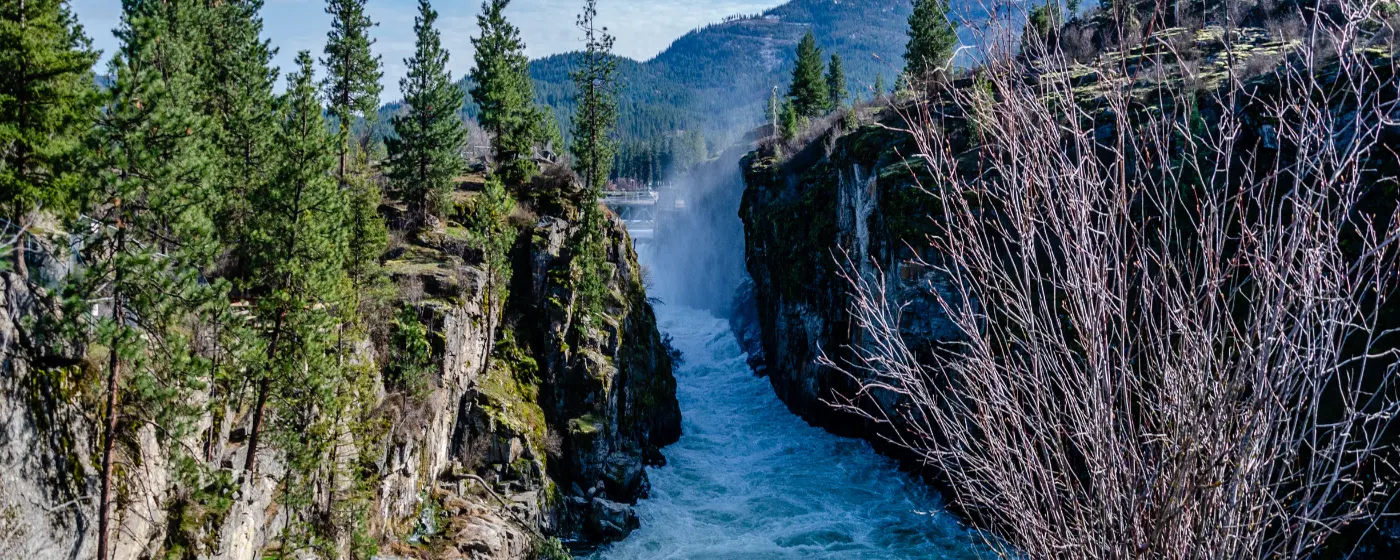
Falls Park sits just downstream and offers a more contemplative experience — the Post Falls Dam and the river views from the park have a genuinely dramatic quality that locals take for granted until someone from out of town points it out. Treaty Rock Park is a short drive west and combines river access with the area's most tangible connection to its pre-statehood history.
Trails and the Community Forest
The Post Falls Community Forest spans over 500 acres entered through Q'emiln Park, with roughly 10 miles of trails that connect to 20 miles of loop routes. Mountain bikers, hikers, and rock climbers use it year-round; the Spokane River access points within the forest are popular with kayakers in warmer months. This is not a maintained city park — it's working forest with real elevation change — and it draws people who want something more challenging than a paved loop.
The North Idaho Centennial Trail through Post Falls is the easier, paved alternative and sees heavy foot and cycling traffic from spring through fall. Connecting east toward Coeur d'Alene and west toward Spokane Valley, it's the kind of trail that makes "I'll go for a quick ride after work" actually happen.
Eating and Drinking
Post Falls Brewing Company on N Spokane St is the obvious first stop for craft beer — a true neighborhood brewery where you'll run into your contractor, your kid's soccer coach, and the couple who moved here from Portland last spring, all in the same evening. Republic Kitchen+Taphouse on E 4th Ave runs a more polished food program and draws a wider crowd. Beyond those two anchors, the dining scene is a mix of national chains along Seltice Way and a handful of independent spots that open, establish a local following, and occasionally close without much warning.
For a broader restaurant scene — more international options, a waterfront dining row, more independent retail — Coeur d'Alene is a 10-minute drive and genuinely worth the trip. Most Post Falls residents make that drive regularly and don't resent it. The ones who do resent it are usually the ones who expected Post Falls to feel more urban than it is.
What Regulars Know
The summer festival calendar fills quickly, with the Q'emiln Park event lawn hosting events that close parking lots well before you'd expect. Arriving early — or biking in on the Centennial Trail — is the habit locals develop after getting stuck in the first summer. The Spokane River kayak and paddleboard season runs roughly May through September, with the stretch through Post Falls being calmer and more accessible than the whitewater sections further upstream.
Top Things Locals Say About Post Falls
The best intel about a city comes from the people who actually live there. Here’s what Post Falls residents say when newcomers ask the questions everyone’s thinking.
“I drove the commute to Spokane on a Tuesday morning before we made an offer — took 28 minutes. What I didn't test was a January morning after two inches of overnight ice, which added about 20 minutes and a lot of white knuckles. That's the part nobody puts in the listing.”
— Recent Post Falls home buyer
“What's the most surprising thing about living in Post Falls?”
How much is right here without having to drive to Coeur d'Alene. The Community Forest behind Q'emiln Park has legitimate mountain biking — not a flat loop, actual climbing and singletrack. People assume Post Falls is just the strip along Seltice Way and don't realize the river corridor and the forest exist until someone takes them there.
“What do locals love most about Post Falls?”
The access without the price premium. You can be on the North Idaho Centennial Trail in five minutes from most neighborhoods south of I-90, and you're not paying Coeur d'Alene prices for the privilege. Q'emiln Park on a summer weekend has the energy of a city park three times the size — pickleball, dogs, kids in the splash pad, live music on the event lawn. It punches above its weight.
“What should newcomers to Post Falls know?”
The Seltice Way corridor is convenient but noisy — if you're looking at homes along that stretch, drive it at 7am on a weekday before you decide. The I-90 interchange at Spokane Street backs up more than the drive-time apps show during peak hours. And check your school attendance boundary with the district directly — the city is growing fast enough that boundaries have shifted before.
“Can you live in Post Falls without a car?”
Realistically, no. The North Idaho Centennial Trail is excellent for recreation and can get you to a few destinations on the east side of the city, but grocery stores, medical appointments, and employment are all car-dependent. Bus service exists but operates on limited routes and frequency. People who come from walkable cities and don't account for this are the ones who leave inside two years.
Cities Near Post Falls
Other communities near Post Falls worth a look — each with its own character and price point.
| City | Distance | Best For | Vibe | Median Rent | Median Buy |
|---|---|---|---|---|---|
| Coeur d'Alene | 7 mi | Lakefront lifestyle, walkable downtown | Polished, resort-adjacent, higher priced | $1,540 | $580,000 |
| Hayden | 10 mi | Families, quiet established neighborhoods | Suburban, calm, low-traffic | $1,450 | $520,000 |
| Rathdrum | 8 mi | Privacy, rural lots, lower entry price | Rural, spacious, small-town feel | $1,400 | $480,000 |
More Helpful Guides for Post Falls
Going deeper on Post Falls? Our blog series covers everything from first-time buying to retiring here — explore the guides below.
Local Expert Takeaway: Post Falls is the right move if you want Spokane-metro employment access, genuine outdoor infrastructure — Q'emiln Park, the Community Forest, the Centennial Trail — and home values noticeably below Coeur d'Alene, in exchange for a car-dependent daily routine and a city that is actively mid-construction on its own identity. Come with eyes open on the growth trajectory and check school attendance boundaries before you close on a neighborhood.
Quick Takeaways & FAQs
✅ The North Idaho Centennial Trail runs 10 miles through Post Falls and connects to both Coeur d'Alene and Spokane Valley — genuinely rare trail infrastructure for a city this size.
⚠️ Post Falls is one of the 100 fastest-growing U.S. cities, which means new subdivisions, traffic infrastructure catching up to demand, and school attendance boundaries that shift as new schools open.
📍 Treaty Rock Park on the city's west side preserves pictographs from the 1871 land agreement that founded Post Falls — a piece of history most newcomers discover only after living here a year.
What is the typical home price in Post Falls, Idaho?
How far is Post Falls from Spokane?
Is Post Falls a good place to raise a family?
Why are so many people moving to Post Falls from Washington state?
What are the best outdoor activities in Post Falls?
Helpful Links for Moving to Post Falls
Moving to Idaho?
Tell us what you need help with and we'll connect you with local resources.
