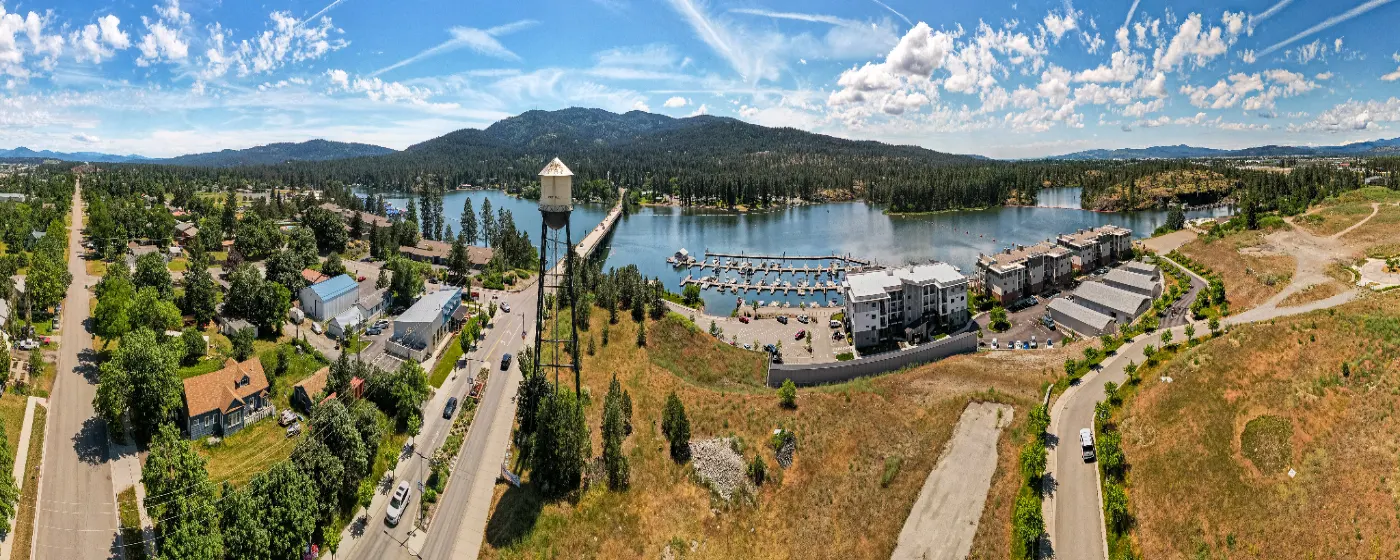
You've probably run the comparison already: Post Falls versus Coeur d'Alene, or Post Falls versus whatever city you're leaving. The numbers look appealing on a spreadsheet, but the real story is more layered than a single median figure. Post Falls sits at the western edge of Kootenai County, straddling Idaho Highway 41 and Interstate 90, about 20 minutes from downtown Spokane and five minutes from Coeur d'Alene's city limits. That geography matters enormously for daily costs — Spokane's wages, Coeur d'Alene's prices, and Idaho's tax structure all converge here at once.
The economic backbone of Post Falls is genuinely blue-collar by North Idaho standards. Buck Knives, Ground Force Manufacturing, and Sysco's regional distribution hub keep manufacturing and logistics wages in the conversation. Workers who commute into Washington State for higher wages and spend on the Idaho side — where there's no state income tax on wages earned there, and a notably low property-tax rate — have quietly made this one of the sharper budget plays in the region.
On non-housing costs, Post Falls tracks close to or below national averages. Idaho's grocery food cost index sits at approximately 94 (U.S. average = 100), meaning supermarket spending runs meaningfully below what most transplants are used to. Utilities are slightly above the Idaho city average, driven by sewer rates rather than electricity, but remain manageable. The catch — and it's a real one — is housing. The Zillow Home Value Index pegged the typical Post Falls home at $518,467 as of February 2026, which is above the national median and above what most people moving from the Midwest expect. That figure has risen fast, and first-time buyers often need to reset expectations after their first tour.
Whether you're weighing a move from the Pacific Northwest, considering Post Falls against Coeur d'Alene or Hayden, or just trying to build an honest household budget, the sections below cover housing costs, everyday expenses, a side-by-side city comparison, and the full tax picture so you can make a grounded call.
What It Really Costs to Live in Post Falls
Post Falls is not a budget market — but it is a relative value within its own competitive set. The Zillow Home Value Index put the typical home price at $518,467 as of February 2026, which is noticeably below Coeur d'Alene and well below anything comparable in the western suburbs of Seattle or Portland. For buyers priced out of those coastal markets, that figure reads as a bargain. For buyers coming from Spokane Valley or Rathdrum, it reads as a premium.
What drives the number is simple: Post Falls absorbs demand from two directions simultaneously. Buyers who want North Idaho's lifestyle but need Spokane's job market find Post Falls's westernmost position on I-90 to be the practical compromise. That dual demand has compressed inventory and pushed prices well past what the local wage base alone would support. The median household income in Post Falls is $82,183 — a reasonable income in most Idaho markets, but one that makes the current home-price-to-income ratio genuinely tight for local earners buying without out-of-state equity behind them.
On the categories that don't make headlines — groceries, gas, utilities, everyday services — Post Falls performs well. Idaho's overall cost of living index sits at approximately 97–98 against a national baseline of 100, meaning most non-housing spending runs modestly below average. The housing component alone, indexed at approximately 105 nationally, is what pulls the overall budget upward. For households who already own, or who can bring significant equity from a higher-cost market, the math still works in Post Falls's favor. For renters trying to transition to ownership purely on local wages, it's a harder climb.
Housing: Rent vs Buy in Post Falls
The entry point for buying in Post Falls starts around the low-to-mid $300,000s for older, smaller construction on the city's less-central edges — but that tier has thinned considerably as appreciation has accelerated. The more realistic purchase price for a move-in-ready three-bedroom home in most parts of the city now lands in the $420,000–$550,000 range, with the city-wide typical value anchored at $518,467 (Zillow Home Value Index, February 2026). Newer construction, particularly in planned subdivisions, regularly pushes past $575,000. For specifics on which areas of Post Falls hold the most entry-level inventory, the Best Neighborhoods guide breaks that down in detail.
The effective property tax rate in Post Falls is approximately 0.60% — one of the lower rates in Idaho and well below what buyers relocating from Oregon, Washington, or California typically pay. Kootenai County's rates are 31% below the statewide Idaho average, which is a structural advantage that compounds over time as values rise. The engine's mortgage calculator below will give you a monthly payment estimate based on your actual down payment and rate — use it rather than a back-of-the-envelope figure, because the interest-rate environment changes fast.
Renting in Post Falls typically runs $1,400–$1,700 per month for a two-bedroom apartment, depending on age of construction and included amenities. That range is noticeably below Coeur d'Alene's comparable inventory, which is the primary reason renters who work in the Coeur d'Alene corridor often choose to live in Post Falls. The rent-versus-buy calculation here hinges heavily on how long you plan to stay. If you're in Post Falls for two years or fewer, renting almost certainly makes more financial sense given transaction costs. At three to five years and beyond — with a reasonable down payment and the low effective property-tax rate — ownership starts to pencil out meaningfully, especially for buyers bringing equity from a higher-cost market.
One honest note for local-wage buyers: the gap between what you can rent and what you can comfortably buy has widened as appreciation has outpaced income growth. That's not unique to Post Falls, but it's sharper here than in Rathdrum or Hayden, where prices start a step lower.

Everyday Costs Beyond Housing in Post Falls
Avista Utilities serves Post Falls for electricity, and combined monthly utility costs — electric, water, sewer, and trash at standard usage benchmarks — average approximately $232 per month. That's about 5% above the Idaho city average, driven by sewer rates rather than electricity. Municipal trash collection runs approximately $13.85 per month as a flat city fee, which is among the more transparent line items in the local budget. Groceries index roughly 6% below the national average, so a household that spent $800 per month on food in Denver or Seattle will likely spend closer to $750 here doing the same shopping. Gas prices in Idaho have tracked in the low-to-mid $3.30s statewide, and the 20-mile commute to Spokane is manageable by almost any fuel-cost standard.
Phone and internet costs mirror national carrier rates; competition is reasonable enough that bundling deals are available. Out-of-pocket medical spending varies considerably by plan and employer coverage, so budget that line item based on your own situation rather than a city-level estimate.
| Category | Typical Monthly Cost | Notes |
|---|---|---|
| Housing (rent) | $1,400–$1,700 | Typical 2BR apartment range; owners: use the mortgage calculator above for a purchase estimate |
| Utilities | ~$232 | Electric (Avista), water, sewer, trash at standard benchmarks; slightly above Idaho city average |
| Groceries | $600–$850 | Idaho grocery index ~94 vs. U.S. average of 100; realistic for a 2-person household |
| Transportation & Gas | $200–$350 | Car-dependent city; gas averaging low-to-mid $3.30s statewide; budget higher for Spokane commuters |
| Phone & Internet | $100–$180 | Standard carrier rates; bundling available |
| Misc / Discretionary | $200–$400 | Dining along N Spokane St, independent breweries, weekend recreation along the Spokane River |
The sample above is a renter-oriented snapshot at median usage. Owners should substitute the mortgage calculator's output for the housing row and add the approximately 0.60% effective property tax rate to their annual planning.
Looking to buy in Post Falls? Estimate your payment.
Enter your numbers to see an estimated monthly mortgage payment.
Estimate only. Excludes HOA fees and mortgage insurance. The interest rate above is a starting point, not a quoted rate — replace it with your own to see real numbers. Insurance is a flat placeholder, not a Post Falls quote.
Post Falls vs Nearby Cities: Cost Comparison
| City | Median Home Price | Typical 2BR Rent | Cost vs Post Falls |
|---|---|---|---|
| Post Falls, ID | $518,467 (ZHVI, Feb 2026) | $1,400–$1,700/mo | — baseline — |
| Coeur d'Alene, ID | ~$575,000–$620,000 | $1,600–$1,950/mo | Noticeably higher across the board |
| Hayden, ID | ~$480,000–$520,000 | $1,350–$1,600/mo | Roughly comparable, slightly lower |
| Rathdrum, ID | ~$400,000–$450,000 | $1,200–$1,450/mo | Meaningfully cheaper to buy and rent |
| Spokane Valley, WA | ~$380,000–$430,000 | $1,250–$1,500/mo | Lower purchase prices, but Washington tax structure applies |
| Liberty Lake, WA | ~$500,000–$570,000 | $1,500–$1,850/mo | About the same to slightly higher; Washington tax structure applies |
* ZHVI = Zillow Home Value Index.
The Washington state cities in this comparison carry a different tax calculation — Washington has no state income tax but does levy a capital-gains tax and higher property taxes in many jurisdictions, so the true cost comparison shifts depending on your income profile and how long you plan to hold a home.
Among Idaho options, Rathdrum offers the clearest savings on purchase price, while Hayden competes closely with Post Falls. Coeur d'Alene commands a premium that has remained persistent even as Post Falls has appreciated.
Taxes & the Bottom Line for Post Falls
Idaho levies a flat state income tax of 5.3% on all taxable income — this rate took effect January 1, 2025, reduced from the previous 5.695% rate by HB 40 signed in March 2025. There is no city income tax layer in Post Falls, so 5.3% is what you pay at the state level and nothing more on that front. For households earning around the local median of $82,183, that's a straightforward and relatively modest income-tax burden compared to Oregon (up to 9.9%) or California (up to 13.3%).
Sales tax in Post Falls is Idaho's state rate of 6% — no additional city layer on top of it. Idaho does apply that 6% to groceries, which is an unusual policy among states, but the Idaho Food Tax Credit of $155 per person (2025 figure) partially offsets it when you file your state return. A household of four gets $620 back annually, which meaningfully reduces the real grocery-tax burden over the course of a year.
The effective property tax rate of approximately 0.60% is the number that most surprises buyers coming from higher-rate states. Kootenai County's rates run 31% below the Idaho statewide average and are lower than 68% of all Idaho counties — a structural advantage that doesn't show up in the home-price headline but absolutely shows up in annual carrying costs. Idaho also exempts Social Security benefits from state income tax entirely and levies no estate or inheritance tax, which has made Post Falls an increasingly deliberate choice for early retirees relocating from higher-tax West Coast states.
The honest bottom line: Post Falls fits households who are buying with equity behind them, earning wages at or above the local median, and planning to stay long enough for the low property-tax rate and below-average non-housing costs to compound. It's a tighter fit for first-time buyers relying entirely on local wages to carry a mortgage at current home-price levels, and the home-price figure referenced in the first section of this guide makes that tension real. Renters considering a transition to ownership here should run the full calculation — the calculator above, the 0.60% tax rate, and an honest look at how long they plan to stay — before assuming the Idaho tax advantages automatically make the math work.

Local Expert Takeaway: Post Falls is cheaper than Coeur d'Alene, more expensive than Rathdrum, and genuinely competitive on taxes and everyday costs compared to anywhere in western Washington or Oregon. The place where budgets get surprised is housing — not utilities, not groceries, not gas. If you're moving from a higher-cost market with equity to deploy, the 0.60% effective property tax rate and Idaho's 5.3% flat income tax make the ongoing carrying costs look very different from the purchase-price sticker. If you're a local-wage buyer without a down-payment head start, plan for a longer runway than the headline numbers suggest.
Quick Takeaways & FAQs
✅ Idaho's flat 5.3% income tax, no local city tax, and an effective property tax rate of just 0.60% give Post Falls homeowners a durable structural cost advantage over comparable Washington State addresses.
⚠️ The typical Post Falls home price of $518,467 (Zillow Home Value Index, February 2026) is well above the national median and has outpaced local wage growth, making ownership a real stretch for buyers without outside equity.
📍 Post Falls municipal trash collection runs approximately $13.85/month as a flat city fee, and Avista Utilities serves electricity — two line items that are easy to budget precisely, unlike the variable sewer rates that push overall utilities slightly above the Idaho city average.
What is the typical home price in Post Falls, Idaho?
How much does it cost to rent a two-bedroom apartment in Post Falls?
What is the property tax rate in Post Falls?
Does Idaho tax groceries, and how does that affect Post Falls residents?
How does the cost of living in Post Falls compare to Coeur d'Alene?
Moving to Idaho?
Tell us what you need help with and we'll connect you with local resources.
