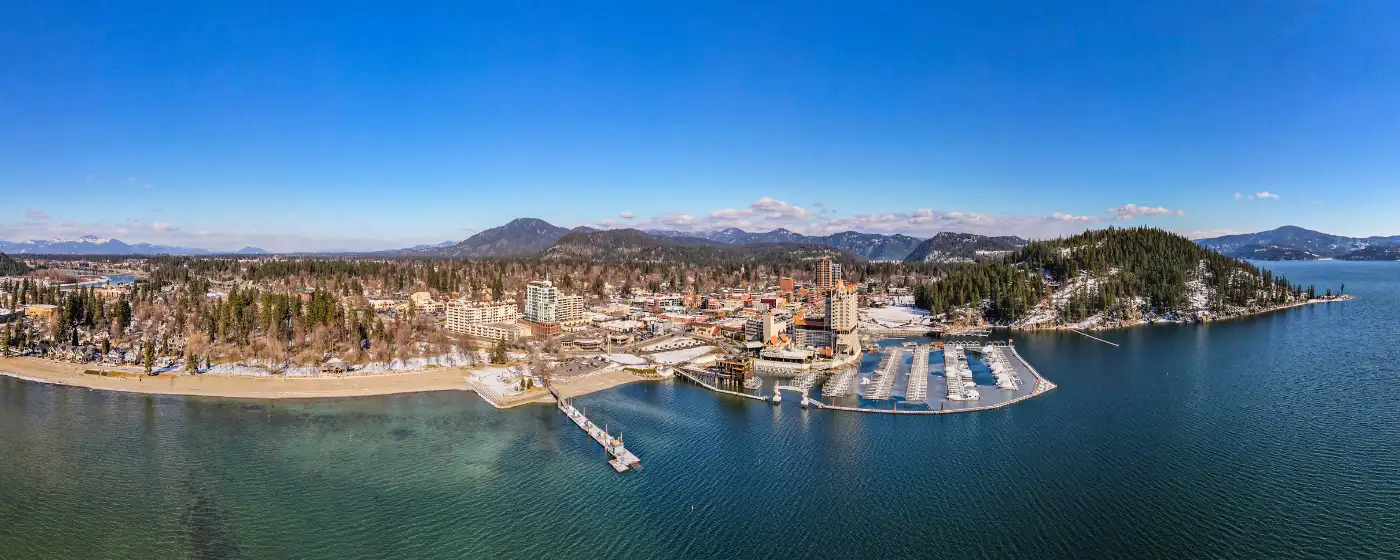
What Is Living in Coeur d'Alene, Idaho Like?
Maybe you've been priced out of Seattle or Portland and a coworker mentioned Coeur d'Alene. Maybe you drove through on I-90, caught a glimpse of the lake, and couldn't stop thinking about it. The surprise most newcomers share in month three isn't the scenery — it's that this is a real, working city, not a resort town you happen to live in. Coeur d'Alene sits in the Idaho panhandle along the northern shore of its namesake lake, roughly 30 miles east of Spokane on I-90, and that highway connection defines almost everything about how daily life here operates: who commutes where, where people shop, and which employers anchor the local economy.
The city's economic backbone runs deeper than tourism. Kootenai Health anchors healthcare employment across the region, the Coeur d'Alene School District 271 is one of North Idaho's largest public employers, Hagadone Hospitality runs the resort and much of the downtown hospitality industry, Hecla Mining has maintained a presence in the region for generations, and Idaho Forest Group drives manufacturing employment. The school district holds a B+ rating, according to Niche, which is a meaningful draw for families with school-age children relocating from larger metros. Kootenai County grew 1.7% between 2023 and 2024 alone, and Redfin's Q1 2026 migration data shows Seattle as the single largest source of inbound buyers — followed by Los Angeles and Portland.
Cost of living runs roughly 12% above the national average, driven almost entirely by housing. The typical home value stood at $545,000 in May 2026 (Zillow Home Value Index), which sounds steep against the national median but registers as a significant discount to the West Coast markets most newcomers are leaving — see the full breakdown on the cost of living page. Day-to-day life leans heavily outdoor: the 23-mile North Idaho Centennial Trail runs right through town along the Spokane River and Lake Coeur d'Alene, City Park and Tubbs Hill are accessible on foot from downtown, and McEuen Park draws families most summer evenings. The lake itself isn't backdrop — it's infrastructure for how people spend their free time here.
Whether you're seriously considering a move or just starting to research the area, the sections below break down Coeur d'Alene's housing market, daily rhythms, commute patterns, major employers, local weekend favorites, and what living here genuinely feels like once the novelty wears off.

Coeur d'Alene at a Glance
Looking to buy in Coeur d'Alene? Estimate your payment.
Enter your numbers to see an estimated monthly mortgage payment.
Estimate only. Excludes HOA fees and mortgage insurance. The interest rate above is a starting point, not a quoted rate — replace it with your own to see real numbers. Insurance is a flat placeholder, not a Coeur d'Alene quote.
Why Are People Moving to Coeur d'Alene?
The short answer is cost — relative cost, specifically. Buyers leaving Seattle, Los Angeles, and Portland arrive here and find they can afford a house with a yard, sometimes near the lake, for a fraction of what the same square footage would cost back home. But price arbitrage alone doesn't explain why people stay. The combination of outdoor access, a genuine downtown, and a shorter commute to Spokane's job market creates a lifestyle equation that's hard to replicate in cheaper Idaho markets further from an urban center.
Who Actually Moves Here
Remote workers arrived in force during 2020 and 2021 and never fully reversed. Many found the I-90 corridor gave them enough airport access via Spokane International (about 30 minutes west) to remain connected without living in a city. Families with kids tend to settle in areas near the district's stronger elementary schools, drawn by Coeur d'Alene School District 271's B+ rating according to Niche. Retirees from the Pacific Northwest gravitate here for the scenery and Idaho's relatively low property tax burden — the effective rate sits at approximately 0.37%, among the lowest in the region.
The Economic Draw
Coeur d'Alene isn't a one-employer town. A major regional health system anchors healthcare hiring. The school district, Hagadone Hospitality's resort and food-and-beverage operations, Hecla Mining, and Idaho Forest Group together create a diversified local job base that has kept unemployment lower than many comparable mountain-West cities during economic downturns.
The Riverstone district continues to attract new commercial development, with mixed-use projects and a planned 173-room Hilton Dual Brand Hotel along the Appleway Avenue corridor signaling continued private investment in the city's growth. That kind of development momentum matters to buyers trying to gauge whether a market has legs.
The Honest Downside
Growth has outpaced infrastructure in places. The city has grown nearly 7% since the 2020 census, and the roads — particularly US-95 through downtown — haven't kept pace. Some longtime residents who bought before 2019 will tell you the Coeur d'Alene they chose no longer quite exists: summer traffic, rising prices, and the influx of out-of-state buyers have changed the character of certain neighborhoods in ways that feel abrupt. That's worth weighing honestly before you move here expecting a quiet mountain town.
| Buyer Type | What Draws Them | Best Fit |
|---|---|---|
| Remote workers from Seattle/LA | Price gap, outdoor access, I-90 corridor | Views Walkable |
| Families with school-age children | B+ rated district, parks, community feel | Families School |
| Retirees from Pacific Northwest | Low property tax, scenery, medical access | Quiet Nature |
| Commuters to Spokane | Idaho tax climate, lower housing costs, 30-min drive | Commuter Value |
| First-time buyers priced out of Boise | Relatively lower entry point vs. Treasure Valley | First-Time Value |
| Luxury / lake-access buyers | Resort amenities, waterfront, Resort Golf Course | Luxury Views |
What Daily Life Feels Like in Coeur d'Alene
Living here has a rhythm that most out-of-state newcomers don't fully anticipate: summers are genuinely crowded and glorious, winters are grey and quiet, and the shoulder seasons — particularly late September and early October — are when many locals say they love the city most. Summer weekends bring tourist traffic to Sherman Avenue and the lakefront that can feel overwhelming if you live downtown. By mid-November, the tourists are gone and the bald eagles arrive at Wolf Lodge Bay and Higgins Point for their annual migration, lasting through January.
The Outdoor Reality
The North Idaho Centennial Trail is 23 paved miles running from the Idaho-Washington border to Higgins Point along the Spokane River and Lake Coeur d'Alene — and it passes through the middle of the city. Most residents who live within a mile of the trail use it for their daily bike commute or run rather than treating it as a weekend destination. Tubbs Hill's two-mile loop launches from the edge of downtown and delivers lake views that take most newcomers completely by surprise for something so close to a city center.
Where Locals Actually Gather
McEuen Park is the Friday-evening spot for families — a large, flat, well-maintained green space adjacent to downtown with a water feature that kids gravitate toward all summer. For breakfast, the N. 4th Street corridor has become a genuine morning destination: People's Waffle opened in May 2026 at 400 N. Fourth St., and Copow Café at 312 N. 4th Street offers a health-forward café option a few doors down. The Garnet Cafe on N. Government Way has been a neighborhood staple for the Canfield Mountain-adjacent crowd on the city's north side.
The Seasonal Quirk Newcomers Miss
Coeur d'Alene gets real winter. The city averages over 40 inches of snow annually, and while I-90 is well-maintained, the neighborhood streets — particularly on the hillsides above downtown — can become genuinely difficult from December through February. People who moved here imagining a mild Pacific Northwest climate (reasonable, given the Seattle comparison) discover in January that they need studded tires and a different relationship with their driveway. The lake doesn't freeze most years, which is beautiful, but the hills absolutely do.
Walkability is real in downtown and Midtown; it drops off sharply once you move north of Kathleen Avenue or east of 15th Street. If daily errands on foot matter to you, proximity to Sherman Avenue or the 4th Street corridor is worth paying for — the difference in day-to-day convenience is substantial. See the neighborhoods guide for how each area feels at street level.
The Coeur d'Alene Housing Market Right Now
The Zillow Home Value Index for Coeur d'Alene stood at $545,000 in May 2026 — that's the city's typical home value, not a luxury tier. By July 2026, the same index had climbed to $607,023, up 3.0% year-over-year, with homes moving to pending in roughly 21 days. This is not a slow market.
The speed reflects who's buying. Buyers from Seattle, Los Angeles, and Portland continue to arrive with equity from higher-priced markets, and many are comfortable moving decisively. Homes closer to the lake, downtown, or with mountain views tend to price at a meaningful premium above the city-wide figure; areas further north or east of the core price noticeably below it — though specific neighborhood figures live on the best neighborhoods page.
What This Market Rewards
The market here is lifestyle-driven in a way that's different from a pure commuter suburb. Two houses with identical square footage and school proximity can sit at very different price points depending on whether one has lake glimpses or sits on a flat lot with no view. That subjectivity makes local knowledge — understanding what's actually worth paying for versus what's just proximity to the resort — genuinely valuable before making an offer.
Inventory remains tight relative to demand. The 21-day average time to pending means that well-priced homes in desirable areas don't linger. For a fuller look at how the city's median interacts with rent levels and property taxes, see the cost of living page.
Coeur d'Alene Neighborhoods
Coeur d'Alene has several distinct areas — each with its own character and appeal. Here’s a breakdown to help you narrow down where to focus your home search.
🏡 Downtown
The most walkable part of Coeur d'Alene, centered on Sherman Avenue's restaurants and shops with McEuen Park and City Park Beach within easy reach. It suits buyers who want to leave the car home on weekends — though summer tourist crowds along Sherman are part of the bargain.
🏠 Sanders Beach
A quiet, established residential area just west of downtown with mature trees and lake proximity that attracts buyers who want the lakeside lifestyle without the resort-row pricing. Housing stock here trends toward mid-century homes on larger lots.
🌳 Garden District
One of Coeur d'Alene's most established neighborhoods, known for tree-lined streets and a mix of bungalows and craftsman-era homes south of downtown. It appeals to buyers who want neighborhood character and walkable access to the city's core.
🏘 Fort Grounds
The historic Fort Sherman site anchors this neighborhood near the museum and City Park, giving it one of the oldest residential footprints in the city. It suits buyers who value history and proximity to the lakefront over newer construction.
🏔 Silver Beach
A lakeside residential corridor east of downtown where properties backing the water command a significant premium, drawing buyers focused on direct lake access and views. The neighborhood has a quieter, less commercial feel than the resort area.
🌆 Fernan Lake Village
Tucked along the eastern edge of Coeur d'Alene near Fernan Lake, this smaller enclave offers a more secluded feel with wooded lots and proximity to trailheads. It suits buyers who want nature access and a quieter pace without leaving city limits.
Pros & Cons of Living in Coeur d'Alene
The Pros
- Stunning lakefront location with 25 miles of shoreline and world-class resort amenities
- Strong job market with proximity to Spokane employment hub
- Year-round recreation from skiing and hiking to boating and golf
- Vibrant downtown with restaurants
- breweries
- and walkable waterfront parks
The Cons
- Higher home prices than surrounding North Idaho communities
- Summer tourism brings crowds and traffic to downtown and lakefront areas
- Property taxes rising with appreciation
- though still below national average
Getting Around & Commuting in Coeur d'Alene
Coeur d'Alene is a car-dependent city. Full stop. If you're coming from a place where you occasionally went weeks without driving, that changes here. The city has a transit system, but it's limited in frequency and coverage, and almost everyone drives for daily errands, work, and school runs.
The I-90 Corridor
The single most important commute fact: Spokane is about 30 minutes west on I-90 under normal conditions, making it genuinely feasible to live in Coeur d'Alene and work in Washington's second-largest city. Many residents do exactly that, taking advantage of Idaho's lower income tax rate while drawing Spokane-level salaries. The catch is that I-90 through the Fourth of July Pass — east of the city — can close or slow dramatically during winter storms, and the stretch of I-90 between Post Falls and the Spokane Valley sees significant congestion during peak hours.
US-95: The Local Chokepoint
Within the city, US-95 is where daily frustration lives. The highway bisects the city north-to-south, and the intersection at US-95 and I-90 near the Prairie Avenue area is among the most congested points in North Idaho during morning and afternoon rush periods. If your daily route requires crossing US-95 between about 7:30 and 8:30 a.m. or 4:30 and 5:30 p.m., budget 10–15 extra minutes that the map won't show you.
The Downtown Grid and Sherman Avenue
Downtown Coeur d'Alene itself is surprisingly manageable for a city its size. Sherman Avenue runs east-west as the main commercial spine, and the numbered street grid north of it is logical and relatively low-traffic outside of summer tourist season. Parking downtown is easier than many comparable resort towns — there are structured lots near McEuen Park — but summer weekends along Sherman and the lakefront require patience.
The Commuter Hack Locals Learn
Residents who commute to Spokane regularly tend to time their departures early — leaving by 7 a.m. rather than 7:45 makes a material difference on the I-90 stretch through Post Falls. Coming home, the 4th Street exit into downtown is often faster than the US-95 interchange when traffic backs up. These aren't secrets, but they're the kind of thing you learn by living here rather than reading a map.
| Destination | Typical Drive Time | Key Route | Watch For |
|---|---|---|---|
| Spokane, WA (downtown) | ~30 min | I-90 West | Peak-hour congestion near Post Falls |
| Spokane Valley | ~20 min | I-90 West | State Line interchange backup |
| Post Falls | ~10–15 min | I-90 West | Seltice Way interchange |
| Hayden | ~10 min | US-95 North | US-95/Honeysuckle Ave signal timing |
| Rathdrum | ~20 min | US-95 North to ID-41 | US-95 northbound backups at 95/90 |
| Spokane International Airport | ~35–40 min | I-90 West to Airport Dr | Add 10 min for winter road conditions |
Schools in Coeur d'Alene
Families relocating to Coeur d'Alene have public, private, and higher-education options nearby. Here’s a quick overview.
🎓 School District
Coeur d'Alene School District 271 serves K–12 students across Coeur d'Alene and the surrounding area. Rated B+ (source: Niche.com).
🏆 Graduation Rate
The 4-year high-school graduation rate here is approximately 88.3%.
📚 Higher Education
Idaho’s public universities — Boise State, the University of Idaho, and Idaho State — offer four-year degrees statewide, with community colleges (CWI, CSI, NIC) providing two-year and workforce programs.
🌐 Online Learning
Boise State Online and University of Idaho Online offer fully accredited online degrees for remote learners across the state.
Safety in Coeur d'Alene
A quick look at how Coeur d'Alene compares on the numbers that matter most when weighing a neighborhood or a move.
🛡 Violent Crime
Approximately 2.4 per 1,000 residents.
🔒 Property Crime
Approximately 9.6 per 1,000 residents.
Compared to the FBI’s most recent national data (2024), Coeur d'Alene’s violent crime is below the national average (about 3.6 per 1,000), and property crime is below the national average (about 17.6 per 1,000).
Against Idaho as a whole, Coeur d'Alene’s violent crime is about the same as the state average, and property crime is somewhat above the state average (Bureau of Justice Statistics, Crime Known to Law Enforcement, 2024 (tables 2 and 3)).
Crime rates can vary a lot within a single city, so the citywide numbers above are only a starting point. Some neighborhoods in Coeur d'Alene run well below these averages, while others run higher — the kind of block-by-block detail that matters most when you’re actually choosing where to live. The full guide below breaks it down neighborhood by neighborhood.
Working in Coeur d'Alene
Coeur d'Alene’s largest employers span several industries — here are some of the anchors of the local job market.
🏥 Kootenai Health
Healthcare
🎓 Coeur d'Alene School District
Education
💼 Hagadone Hospitality
Resort/tourism
💼 Hecla Mining
Mining
🏭 Idaho Forest Group
Lumber/manufacturing
Parks & Recreation in Coeur d'Alene
Some of the outdoor spaces that shape everyday life in Coeur d'Alene.
🌱 Lake Coeur d'Alene
🌱 City Park and Beach
🌱 McEuen Park
🌱 North Idaho Centennial Trail
Coeur d'Alene residents don’t have to go far for green space — spots like Lake Coeur d'Alene and City Park and Beach are part of everyday life here, whether that’s a morning walk, a weekend hike, or just somewhere to unwind outside. The full guide below covers more of what Coeur d'Alene has to offer for parks and outdoor recreation.
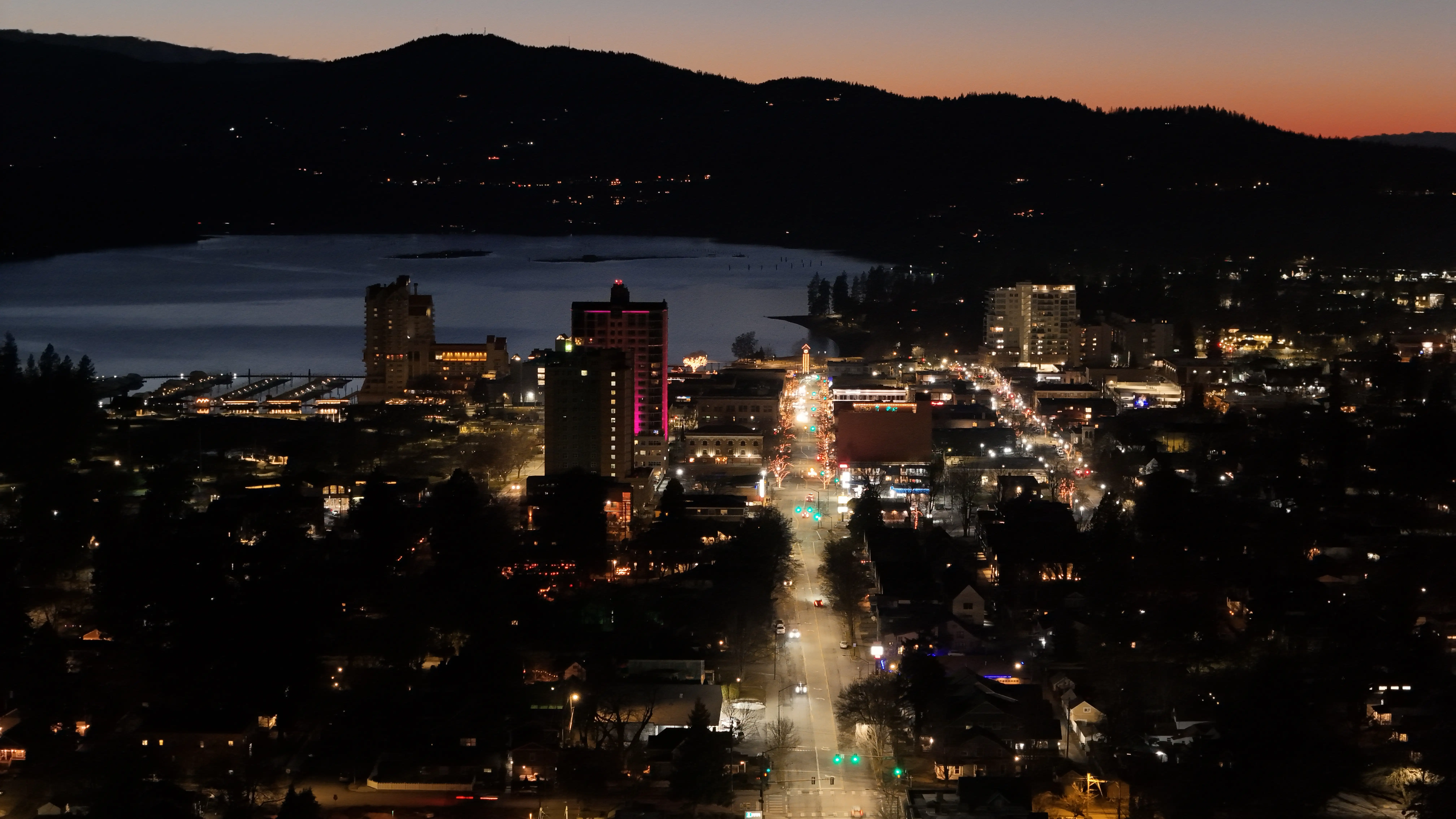
Retiring in Coeur d'Alene
Coeur d'Alene draws retirees for its balance of amenities, outdoor access, and cost. Here’s what to weigh.
🌤 Climate
Coeur d'Alene has four distinct seasons. Summers are warm and dry, with long days and low humidity that most retirees from the Pacific Northwest find ideal. Winters are genuine — expect snow from December through February, grey skies from November through March, and road conditions on hillside streets that require preparation. Spring and fall are the locals' favorite seasons: mild, uncrowded, and beautiful along the lake.
🍴 Lifestyle
The Centennial Trail, McEuen Park, City Park and Beach, and Tubbs Hill provide outdoor access that active retirees use year-round. Downtown offers independent cafés, the Museum of North Idaho, the Resort's Floating Boardwalk, and a restaurant scene that has deepened significantly over the last decade. The pace is slower than Spokane but far more active than most small Idaho cities.
🏚 55+ Communities
The Coeur d'Alene area has a growing inventory of active-adult communities and senior-living facilities, particularly in the Hayden and Post Falls corridors north and west of the city. Within the city limits, options range from independent 55-plus developments to assisted-living communities closer to the medical corridor. The retiring page has a current overview of available communities and what to expect from each.
✈ Getting Around
A car is essential for most retirees — the city's layout assumes you're driving. Spokane International Airport is about 35–40 minutes west on I-90, providing nonstop service to major West Coast hubs and beyond. Within the downtown core, many errands are walkable, and the flat terrain along the lakefront is accessible for most mobility levels. The hillside neighborhoods require more from drivers year-round.
🏛 Idaho Taxes for Retirees — What to Know
- Social Security is not taxed — Idaho does not tax Social Security benefits at the state level, regardless of income.
- Flat state income tax — Idaho has a flat income tax (5.3% for 2026). Other retirement income — pension distributions and 401(k)/IRA withdrawals — is taxed as ordinary income at that rate.
- Narrow retirement deduction — Idaho’s Retirement Benefits Deduction is limited: it reaches only certain government pensions (federal CSRS, Idaho firefighter/police, and military retirement) for those 65+ (or 62+ if disabled), and is reduced by Social Security received.
- Sales tax is the tradeoff — The state sales tax is 6.0%, and Coeur d'Alene adds no local sales tax on general retail, so the combined rate is 6.0% (Idaho State Tax Commission, 2026). Groceries are taxed, but a grocery tax credit offsets part of it; prescription drugs are exempt. A small number of resort cities add a local option tax, usually on lodging, alcohol, and prepared food rather than general retail.
- Low property taxes, with senior relief — Idaho property taxes are relatively low. Homeowners 65+ who own and occupy their home may qualify for the “circuit breaker” Property Tax Reduction based on income.
- No estate or inheritance tax — Idaho has no estate, inheritance, or gift tax.
- Capital gains — Capital gains are taxed as ordinary income, though Idaho allows a deduction of up to 60% of the net gain on qualifying Idaho property.
Tax laws change frequently and individual situations vary. This is general information, not tax advice — always consult a qualified Idaho tax professional or CPA for personalized retirement tax planning.
Weekends & Local Favorites in Coeur d'Alene
Weekends here tend to organize themselves around the lake in summer and the mountains in winter — and the transition between those two modes is sharper than most newcomers expect. By the time the eagle migration begins at Wolf Lodge Bay in November, the city has fully pivoted from kayaks and paddleboards to snowshoes and ski passes.
The Lake as Living Room
City Park and Beach at the foot of Sherman Avenue is the obvious starting point, but locals know that the City Park beach gets tourist-dense on summer Saturdays by 10 a.m. The North Idaho Centennial Trail, which skirts the lakeshore east of downtown, offers a way to find quieter water access on foot or bike. The Coeur d'Alene Resort's Floating Boardwalk — the longest floating boardwalk in the world — is worth a slow evening walk regardless of whether you're staying at the resort. The Resort Golf Course's floating green on the 14th hole is a genuinely singular piece of North Idaho infrastructure.
Downtown Mornings
The N. 4th Street corridor has quietly become the best block for a weekend morning. People's Waffle at 400 N. Fourth St. draws a line by 9 a.m. on Saturdays; Copow Café at 312 N. 4th offers a lighter, health-focused alternative if you'd rather skip the waffle queue. The Garnet Cafe on N. Government Way runs a quieter, neighborhood-scale breakfast that locals on the city's north end prefer when they want to avoid the downtown foot traffic entirely.
History and Culture
The Museum of North Idaho sits inside City Park and covers the region's railroad, logging, mining, and Coeur d'Alene Tribal history through multimedia displays — it's small but genuinely well-curated and often overlooked by newcomers who assume it's a tourist artifact. The Fort Sherman area near the museum provides historical context for the city's military origins that most people who live here for years never quite get around to learning.
The Winter Reality
Schweitzer Mountain Resort near Sandpoint is about an hour north and draws the serious ski crowd. Closer in, Silver Mountain Resort in Kellogg is about 45 minutes east on I-90 and more accessible for a spontaneous weekday run. The Centennial Trail is plowed in sections through winter, and a surprising number of residents use it year-round. What people who move from warmer climates consistently underestimate: the social life genuinely does contract in January and February, and building a winter routine — a sport, a regular restaurant, a standing gathering — is the single most effective thing you can do to feel at home here year-round.
Top Things Locals Say About Coeur d'Alene
The best intel about a city comes from the people who actually live there. Here’s what Coeur d'Alene residents say when newcomers ask the questions everyone’s thinking.
“I knew about the lake, but nobody told me about the US-95 situation. I was renting downtown and assumed I could avoid the worst of it, but if your day involves a single north-south crossing during rush hour, you just plan around it — it becomes as automatic as checking the weather.”
— Recent Coeur d'Alene home buyer
“What's the most surprising thing about living in Coeur d'Alene?”
How completely the city transforms between seasons. Downtown on a Saturday in July and downtown on a Tuesday in February are almost unrecognizable as the same place. A lot of people move here for the summer energy and then spend their first winter figuring out how to feel connected. The locals who genuinely love it year-round have usually found a winter routine — skiing east on I-90 toward Silver Mountain, or even just a standing Sunday morning spot on 4th Street.
“What do locals love most about Coeur d'Alene?”
The lake, without question, but more specifically how accessible it is. You can walk to City Park from most of downtown in under 15 minutes. The Centennial Trail runs through the city, not around it. Tubbs Hill is two miles of actual trail that starts from the edge of the downtown grid. The outdoor access isn't something you have to drive an hour to reach — it's woven into the layout of the city in a way that people from landlocked places find genuinely surprising.
“What should newcomers to Coeur d'Alene know?”
Plan your US-95 crossings intentionally, especially the stretch near the I-90 interchange during weekday rush hours. Summer weekends on Sherman Avenue require patience — tourists are part of life here, and the locals who resent them haven't made peace with what the city actually is. And get on the Centennial Trail in late September before winter arrives. That stretch of the trail along the lake at peak fall color is the thing most newcomers say made them certain they'd made the right call.
“Can you live in Coeur d'Alene without a car?”
Technically, but practically very difficult outside of a tight downtown radius. The city has bus service, but frequency and coverage are limited. If you live on or near Sherman Avenue or the 4th Street corridor and work downtown, you can manage many daily errands on foot or by bike using the Centennial Trail. Anywhere north of Kathleen Avenue or in the hillside neighborhoods, a car is simply necessary. This is not a city where car-free living is realistic for most people.
Cities Near Coeur d'Alene
Other communities near Coeur d'Alene worth a look — each with its own character and price point.
| City | Distance | Best For | Vibe | Median Rent | Median Buy |
|---|---|---|---|---|---|
| Post Falls | 10 mi | Commuters, value-driven families | Practical, growing, river-adjacent | $1,850 | $513,000 |
| Hayden | 8 mi | Families seeking newer construction | Suburban, quiet, school-focused | $1,700 | $600,000 |
| Rathdrum | 15 mi | Space-seekers, lower price points | Rural feel, acreage lots, low-key | $2,100 | $555,000 |
More Helpful Guides for Coeur d'Alene
Going deeper on Coeur d'Alene? Our blog series covers everything from first-time buying to retiring here — explore the guides below.
Local Expert Takeaway: The I-90 connection to Spokane is Coeur d'Alene's defining practical feature — it's what makes Idaho's tax climate accessible to people who need a real job market. But the city earns its own gravity: McEuen Park, the Centennial Trail, the 4th Street breakfast corridor, and a lake you can be swimming in 15 minutes after leaving work. The downside is real: summer crowds on Sherman Avenue, US-95 congestion, and winters that demand genuine preparation. Buy close to the trail or the lake if lifestyle access matters to you; buy north of Kathleen if you want space and quiet and don't mind driving for everything.
Quick Takeaways & FAQs
✅ The 30-minute I-90 commute to Spokane lets residents capture Idaho's income tax advantage while working in Washington's largest job market.
⚠️ Summer tourist traffic on Sherman Avenue and the US-95 corridor can feel relentless from June through Labor Day — locals learn to time their errands around it.
📍 The bald eagle migration to Wolf Lodge Bay each November is one of the most unexpected and genuinely spectacular seasonal events in North Idaho, and most people moving here from out of state have never heard of it.
Is Coeur d'Alene expensive to live in?
What is the job market like in Coeur d'Alene?
How are the schools in Coeur d'Alene?
What are the winters like in Coeur d'Alene?
Is Coeur d'Alene a good place to retire?
Helpful Links for Moving to Coeur d'Alene
Moving to Idaho?
Tell us what you need help with and we'll connect you with local resources.
