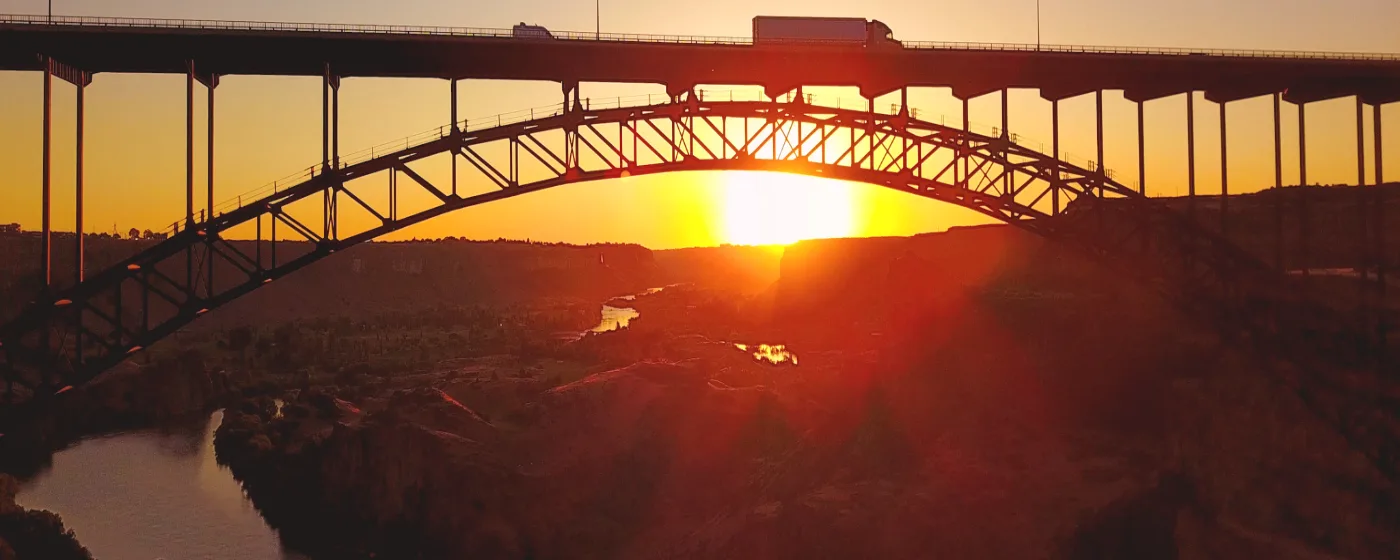
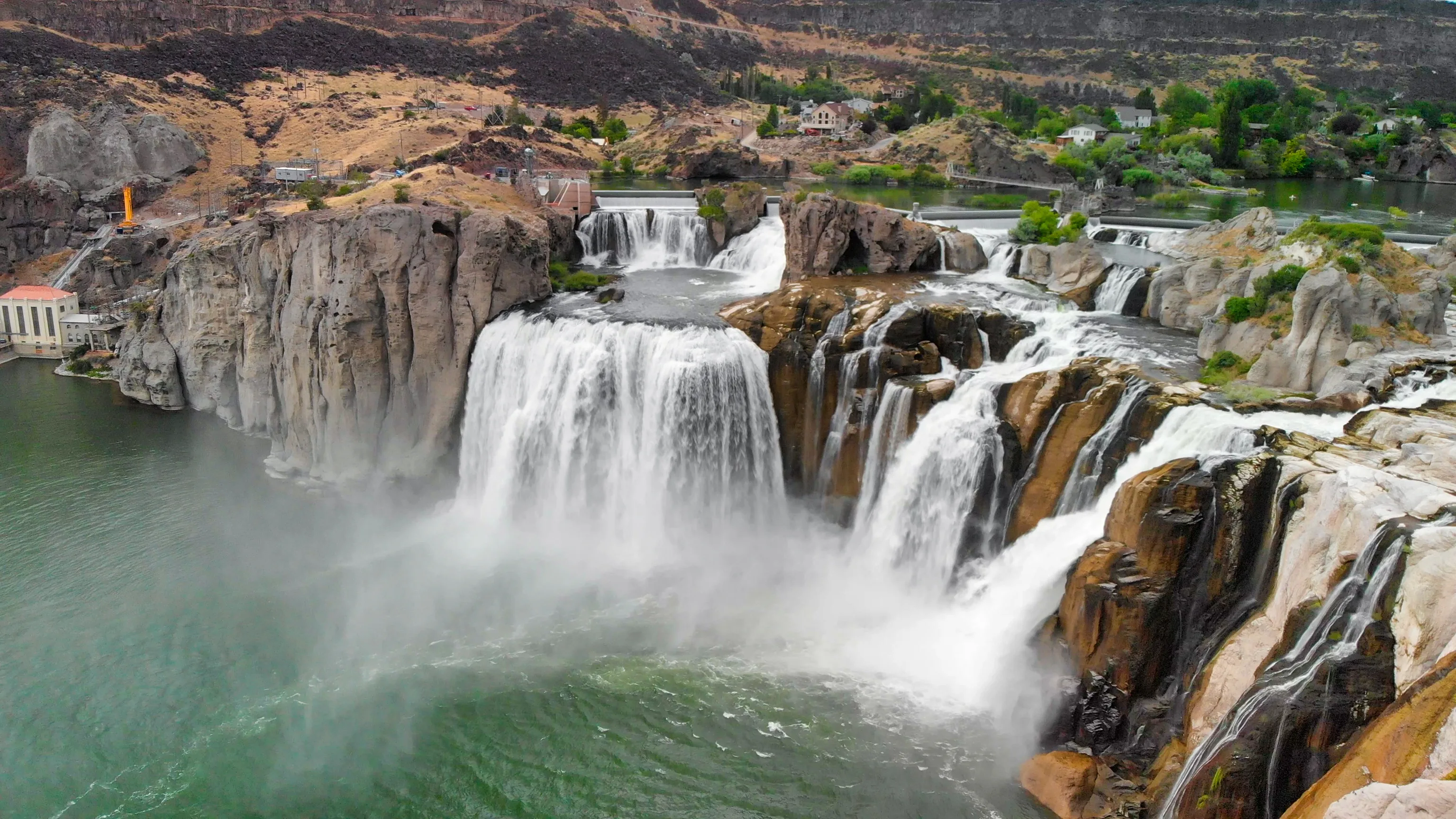
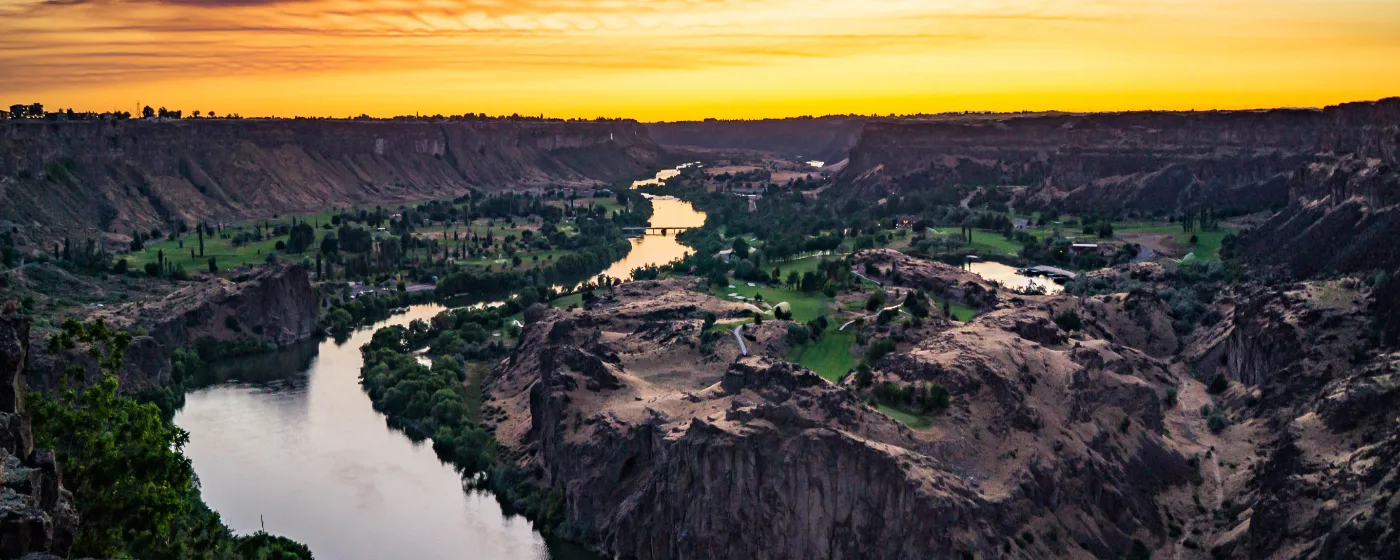
Most people who retire to Twin Falls didn't plan to. They were visiting Shoshone Falls, or passing through on I-84, or following a grown child who'd relocated for work at Chobani or St. Luke's — and something clicked. The Snake River Canyon cuts a 500-foot gash through the center of this city of roughly 55,000, and that dramatic geography hints at something the spreadsheets don't: Twin Falls is genuinely different from the generic mid-size Idaho towns retirees often default to. The Perrine Bridge is the only bridge in North America where BASE jumping is legal year-round. You'll hear that fact repeated at every dinner party. It tells you something about the place's tolerance for unconventional choices — including the unconventional choice of retiring somewhere most of your friends have never heard of.
Twin Falls is the largest city within about 100 miles in any direction in the Magic Valley region, which means retirees here get small-city prices with a surprisingly complete set of services: a full regional medical center, multiple grocery chains, a community college, and a downtown that's actively growing rather than quietly fading. The city's cost of living runs approximately 7–8% below the U.S. national average, and the $380,000 median sale price (Redfin, May 2026) is a fraction of what the same square footage costs in the Boise suburbs — let alone in the California or Pacific Northwest markets many newcomers are leaving behind. For retirees carrying equity from a higher-cost market, that gap can fund a decade of living expenses.
Daily life here runs on a car. The winters are real — cold, occasionally icy, and sometimes windy across the canyon rim — and the nearest major urban hub, Boise, is roughly two hours northwest on I-84. Those are honest constraints. But for retirees who want outdoor access without the price tag of a resort town, an established healthcare system without driving to a metro, and a community that's growing without feeling chaotic, Twin Falls makes a serious case. Centennial Waterfront Park, Dierkes Lake, and dozens of miles of canyon-rim trails are minutes from almost any address in the city. For more on parks and outdoor recreation, see the parks and recreation page.
Whether you're weighing Twin Falls against Boise, Sun Valley, or staying put, the sections below cover healthcare access, the retiree tax picture, what a fixed-income budget actually looks like here, walkability and community, downsizing options, and how Twin Falls stacks up against the nearby alternatives most retirees consider.
Why Retirees Are Choosing Twin Falls
The retirees who thrive here tend to share a few traits: they want to own a home outright or close to it, they're comfortable driving for most errands, and they'd rather spend their leisure time outdoors than in a shopping mall. Twin Falls delivers on all three. With a median sale price of $380,000 (Redfin, May 2026) — see the full cost-of-living breakdown — a retiree arriving with equity from a pricier market can often buy without a mortgage, or carry a very manageable one.
The city also rewards retirees who want to feel rooted rather than transient. Rock Creek Restaurant has anchored the local dining scene since 1978, flying in fresh fish twice weekly and cutting steaks in-house — the kind of place where regulars know the staff by name after six months. The downtown along Main Avenue North and Shoshone Street has been adding independent restaurants and brewpubs at a steady pace, and two new hotels are under construction as of 2026. This isn't a city holding its breath; it's growing.
Who should look elsewhere? Retirees who need urban walkability, frequent specialist care beyond what a strong regional hospital provides, or a cultural calendar comparable to Boise or Salt Lake City will find Twin Falls limiting. The arts scene is modest. Winters along the canyon rim can be harsh and windy in ways that surprise newcomers from milder climates. And the roughly two-hour drive to Boise — the nearest large-city airport and tertiary medical hub — is a real consideration for anyone managing a complex health condition. Twin Falls fits the active, independent retiree better than it fits someone who prioritizes proximity to family in a major metro or needs dense senior services within walking distance.
Healthcare & Medical Access in Twin Falls
St. Luke's Magic Valley Medical Center: The Regional Anchor
St. Luke's Magic Valley Medical Center, at 801 Pole Line Rd W, is the cornerstone of healthcare for retirees in the region. Opened in 2011 and purpose-built for a regional service area spanning southern Idaho and northern Nevada, it operates a 24-hour emergency department, an advanced cancer center, inpatient rehabilitation, behavioral health services, and women's and children's healthcare. For most day-to-day and moderate-complexity medical needs, you won't need to leave Twin Falls.
Primary care, cardiology, orthopedics, and outpatient oncology are all available locally through St. Luke's and associated clinic networks. The hospital's cancer center is particularly relevant for the 65-and-older demographic — having chemotherapy infusion and radiation available in-city rather than a two-hour round trip makes a meaningful difference in treatment quality of life.
The Honest Gap: Tertiary and Highly Specialized Care
Where Twin Falls falls short is at the edges of the specialty spectrum. Complex neurosurgery, transplant programs, and leading-edge clinical trials all require Boise — specifically St. Luke's Boise or St. Alphonsus Regional Medical Center. That drive is roughly two hours each way on I-84, manageable for periodic appointments but a real logistical burden during active treatment or recovery. Retirees with pre-existing conditions that require frequent specialist visits should map those appointments against the drive before committing.
The city also has a functioning network of independent clinics, urgent care facilities, and physical therapy providers that cluster along Blue Lakes Blvd N and the Pole Line corridor — the concentration of medical offices near the main hospital is one of the practical advantages of Twin Falls's layout. Ride TFT, the city's on-demand transit service accessible by app or phone, can connect you to medical appointments within city limits if driving becomes a concern, though it is not a substitute for reliable personal transportation.
What Locals Know
Establish your primary care relationship early, ideally before you move. St. Luke's clinic panels fill quickly as the city grows, and waiting months for a new-patient appointment is a real friction point that catches newcomers off guard. Telehealth options through the St. Luke's system partially offset this, but not entirely.
The Retiree Budget in Twin Falls
Idaho's Tax Posture for Retirees
Idaho's biggest gift to Social Security-dependent retirees: the state does not tax Social Security benefits at all, regardless of income level. If your retirement income is primarily Social Security, you are effectively in a zero-state-income-tax environment for that income stream.
Other retirement income — pensions, IRA withdrawals, 401(k) distributions — is taxed at Idaho's flat rate of 4.4% for tax year 2025 (per TaxShark Inc., June 2026; confirm the current rate at tax.idaho.gov before filing). That's a competitive rate relative to most western states, and Idaho imposes no estate or inheritance tax, which matters for retirees doing estate planning. The catch is that Idaho does not exempt retirement-account withdrawals the way some states do, so a retiree drawing heavily from a traditional IRA will feel that 4.4% on every dollar above their standard deductions.
Property Tax: Low Rate, Non-Automatic Relief
Twin Falls's effective property tax rate is approximately 0.72% — among the lower rates in the region and well below the national average. On a typical home in this market, that's a modest annual obligation relative to what most retirees paid in higher-cost states. The rate itself is the good news. The catch: Idaho's property-tax relief programs for seniors are not automatic. You must apply through the Twin Falls County Assessor's office. The circuit breaker credit, which can reduce property taxes for lower-income homeowners, and the homeowner's exemption both require active enrollment. Missing the application window means missing the benefit for that year — a mistake that's easy to make in your first year of residency.
Day-to-Day Costs on a Fixed Income
Twin Falls's overall cost of living runs approximately 7–8% below the U.S. national average, with groceries, utilities, and services all tracking below national norms. The city's retail base — anchored around Blue Lakes Blvd N and the Magic Valley Mall corridor — gives retirees competitive grocery options without driving to a neighboring city. The downtown restaurant scene, including long-standing spots like Rock Creek, offers a range of price points, and new independent restaurants have been opening steadily through 2025 and 2026. For a retiree on a fixed income, the combination of low housing costs, no Social Security tax, and a sub-national cost baseline makes monthly cash flow considerably more comfortable here than in most western cities.
Looking to buy in Twin Falls? Estimate your payment.
Enter your numbers to see an estimated monthly mortgage payment.
Estimate only. Excludes HOA fees and mortgage insurance. The interest rate above is a starting point, not a quoted rate — replace it with your own to see real numbers. Insurance is a flat placeholder, not a Twin Falls quote.
Walkability, Community & Staying Active in Twin Falls
The Walkability Reality
Twin Falls is a car-dependent city. Saying otherwise would be doing you a disservice. The commercial spine along Blue Lakes Blvd N and Addison Ave W is built for drivers, and most residential neighborhoods require a car to reach groceries, medical appointments, or retail. If giving up driving entirely is a near-term possibility for you, Twin Falls demands a very specific neighborhood strategy.
Downtown is the exception. The blocks around Main Ave N and Shoshone St are genuinely walkable — independent cafés, brewpubs including Koto Brewing Company and Milner's Gate Idaho Craft Brewery, galleries, and the city library are within a short walk of each other. Retirees who buy or rent in the downtown core can handle a meaningful portion of daily life on foot, and the canyon rim trail system begins close by. If car-light living matters to you, downtown is the only neighborhood in Twin Falls where it's realistic.
Community Anchors for Retirees
The College of Southern Idaho operates a robust community education program that draws retirees into continuing-ed classes, lecture series, and fitness programs — it's one of the more underrated assets for newcomers looking to build a social network quickly. The campus also hosts cultural performances and speakers that represent most of what Twin Falls offers in terms of a formal arts calendar.
The canyon rim trail network — running along the north and south rims of the Snake River Canyon — is where active retirees actually congregate on weekday mornings. Centennial Waterfront Park draws walkers and cyclists from across the city, and Dierkes Lake is a short drive for swimming and picnicking in summer. Volunteering opportunities at St. Luke's, the local food bank, and the numerous agricultural and civic organizations in the Magic Valley give structure to retirement schedules in a way that matters more than most people expect in their first year here.
What Surprises People After Six Months
The wind. The Snake River Canyon acts as a natural wind tunnel, and the canyon rim neighborhoods can be genuinely gusty in fall and winter in a way that isn't obvious when you visit in July. It doesn't stop people from walking the rim trail, but it is a real factor in daily outdoor life that newcomers consistently underestimate.
Right-Sizing: Downsizing in Twin Falls
The Inventory Landscape
Twin Falls is not a market overflowing with purpose-built 55+ communities. The dominant downsizing inventory here is single-level ranch homes — a practical artifact of the region's agricultural economy and the building patterns of the 1970s through 2000s. Many of the neighborhoods on the north side of the city and along the Grandview Drive corridor have solid concentrations of single-story homes that transition well for retirees who want to eliminate stairs without moving into a formal senior community.
Patio homes and smaller detached properties with low-maintenance landscaping exist but compete for limited inventory. The market for these moves quickly — a well-priced single-level home in a quiet area tends to attract multiple offers because both downsizing retirees and younger buyers are chasing the same product type. If this is your target, budget time to search actively rather than casually.
Condo and Attached Options
The condo and townhome segment in Twin Falls is thin compared to what retirees find in Boise or Sun Valley. A handful of attached-home developments exist closer to the downtown core and along the Blue Lakes corridor, but options are limited and HOA-governed communities with full exterior maintenance included are rare. This is one area where Twin Falls genuinely lags behind larger Idaho markets for downsizers who want a lock-and-leave lifestyle.
Formal 55+ and Active-Adult Communities
Dedicated active-adult communities — the kind with clubhouses, organized activities, and age-restricted covenants — are sparse in Twin Falls proper. There are age-qualified manufactured-home parks and a small number of independent-living developments in and near the city, but nothing on the scale of the large master-planned communities found in the Treasure Valley. Retirees who prioritize that amenity package specifically should weigh nearby Boise-area options seriously. Twin Falls's downsizing proposition is strongest for the self-directed retiree who wants to own a simple, manageable home and build community organically rather than through a planned community's infrastructure.
Jerome, just 10 miles east on US-93, offers a slightly smaller but quieter market where single-level inventory occasionally surfaces at prices noticeably below Twin Falls, worth monitoring if your timeline is flexible.
Twin Falls vs Nearby Retirement Destinations
| City | Cost vs Twin Falls | Primary Hospital | Walkability | Senior Living Depth | Overall Retirement Fit |
|---|---|---|---|---|---|
| Twin Falls | Anchor | St. Luke's Magic Valley — full regional hospital | Car-dependent; downtown walkable core | Thin; mostly single-level homes and small IL facilities | Strong for active, independent retirees |
| Jerome | Noticeably cheaper | St. Luke's Jerome — small critical access hospital; Twin Falls for serious needs | Very limited; small-town grid | Very thin | Good for ultra-low-cost rural living; limited amenities |
| Buhl | Cheaper | No hospital in city; Twin Falls for all hospital needs | Minimal | Very limited | Rural retreat; works for deeply budget-focused retirees near farming community roots |
| Kimberly | About the same | Relies on Twin Falls entirely | Minimal; bedroom community layout | Very thin | Quiet residential option for those working or visiting Twin Falls regularly |
| Boise | Noticeably pricier | St. Luke's Boise + St. Alphonsus — full tertiary care | Much more walkable; multiple neighborhoods viable | Extensive; large master-planned 55+ communities | Best for retirees prioritizing healthcare depth, walkability, or arts |
| Sun Valley / Hailey area | Significantly pricier | St. Luke's Wood River — limited; Boise for complex care | Hailey walkable; Ketchum very walkable | Growing but expensive | Lifestyle-premium pick; stunning setting, high cost |
For retirees whose priority is keeping costs down while staying close to real medical infrastructure, Twin Falls is the clear winner over Jerome, Buhl, or Kimberly — all of which depend on Twin Falls for anything beyond basic urgent care. The calculus flips when healthcare complexity becomes the primary concern: Boise's tertiary hospital network is a genuine advantage that Twin Falls cannot replicate, and retirees managing serious chronic conditions may find the two-hour buffer to advanced specialty care too significant a compromise. Sun Valley's corridor around Hailey and Ketchum offers an unmatched outdoor lifestyle and is increasingly attracting affluent retirees, but the cost premium is substantial and the hospital depth is even thinner than Twin Falls. For the self-directed, active retiree arriving with home equity from a pricier market and a preference for owning outright in a city that's growing without becoming chaotic, Twin Falls sits in a genuinely favorable position among its regional peers.
Local Expert Takeaway: The retirees who regret moving to Twin Falls almost always cite the same two things: they underestimated how much they'd drive, and they didn't establish a primary care doctor before arriving. The ones who thrive made a different set of moves — they bought a single-level home on the north side or near downtown, enrolled early in the CSI community education program to build a social network, applied for the property-tax homeowner's exemption in their first month at the county assessor's office, and planned their twice-yearly Boise trips around specialist appointments rather than treating each one as an emergency scramble. Rock Creek on Addison Ave W becomes a monthly ritual for many retirees within a year of arrival. That's not an accident — it's a city that rewards showing up consistently.
Quick Takeaways & FAQs
✅ Idaho exempts Social Security benefits from state income tax entirely, giving Twin Falls retirees a meaningful advantage if Social Security is their primary income source.
⚠️ Twin Falls is car-dependent outside its downtown core — retirees who can no longer drive safely will find the city's on-demand Ride TFT transit service a limited substitute for personal transportation.
📍 Idaho's property-tax relief programs for seniors are not automatic: you must apply through the Twin Falls County Assessor's office, and missing the window means losing the benefit for the entire year.
Does Idaho tax Social Security benefits for retirees?
What hospital serves retirees in Twin Falls?
Are there 55+ or active-adult communities in Twin Falls?
How walkable is Twin Falls for retirees who want to reduce driving?
What is the property tax rate in Twin Falls and are there senior exemptions?
Moving to Idaho?
Tell us what you need help with and we'll connect you with local resources.
