
Most people researching Twin Falls expect a small, sleepy Idaho farm town with almost no crime. The reality is more textured than that. Twin Falls is the commercial hub of Magic Valley — drawing workers and shoppers from Jerome, Filer, Kimberly, Buhl, and Hansen every single day — and that regional role inflates its per-capita crime numbers in ways the raw figures don't immediately explain. A city of roughly 55,000 residents that hosts a daytime population closer to 100,000 is going to look different on a crime-per-resident spreadsheet than it feels on a Tuesday evening in a residential neighborhood.
The headline numbers from 2024 FBI data are a violent crime rate of 4 per 1,000 residents and a property crime rate of 11 per 1,000 — figures that sit above Idaho's statewide norms but land close to the national average for cities of comparable size. More usefully: total reported crime in Twin Falls dropped 9.5% in 2024 compared to 2023, according to Twin Falls Police Lt. Steven Gassert citing the Idaho State Police Crime in Idaho report. That downward trend matters more for a relocating family than any single snapshot number.
Idaho itself provides a favorable backdrop. The state's property crime rate is among the lowest in the nation per FBI Uniform Crime Report data, and the statewide violent crime rate — approximately 2.54 per 1,000 — sits well below the national figure of roughly 3.59 per 1,000. Twin Falls is higher than Idaho's norm, but landing above a very low bar is not the same as being dangerous. The city's ongoing construction boom, with new hotels rising along the canyon rim and near the Magic Valley Mall, signals the kind of economic investment that correlates with long-term neighborhood stability.
Whether you're considering a specific block near Canyon Rim Trail or trying to understand how Downtown Twin Falls compares to quieter areas like Settlers Ridge or Morning Sun, the sections below break down Twin Falls's crime picture by type, geography, and practical risk — so you can make an informed decision about where in this city to plant roots.

Twin Falls Crime by the Numbers: Context First
The two figures you'll encounter most often are 4 violent crimes per 1,000 residents and 11 property crimes per 1,000, both drawn from 2024 FBI data released in October 2025. Taken alone, they can look alarming. Placed in context, they tell a different story.
| Geography | Violent Crime (per 1,000) | Property Crime (per 1,000) | Notes |
|---|---|---|---|
| Twin Falls, ID | 4.0 | 11.0 | 2024 FBI data; daytime pop. roughly doubles |
| Idaho statewide | ~2.54 | Nation's lowest range | SafeWise 2026; FBI UCR |
| U.S. national average | ~3.59–4.0 | Moderate-high | USAFacts 2024 |
| Similar-size U.S. cities | Noticeably higher avg. | Noticeably higher avg. | NeighborhoodScout city-size comparison |
| Twin Falls 2023 (prior year) | Higher | Higher | Overall rate down 9.5% YOY per ISP report |
| Idaho overall 2023→2024 | Declining | Declining | State crime rate fell 8.7% — favorable backdrop |
The daytime population caveat is the most important number most crime maps never show you. When workers from surrounding Magic Valley communities drive into Twin Falls for the day — and when shoppers from six surrounding counties run errands at the retail corridors along Blue Lakes Boulevard — those people aren't counted as residents, but any crime that happens around them gets counted against Twin Falls's 55,589-person denominator.
The practical result: Twin Falls's real residential risk is measurably lower than the per-capita rate suggests. NeighborhoodScout's own city-size analysis places Twin Falls's crime rate noticeably below the average for comparably sized American cities, even before the daytime-population adjustment.
What Kind of Crime Actually Happens Here
Not all crime is the same, and the composition of Twin Falls's crime mix matters enormously for a relocating family or individual deciding how to live here.
Of 2,852 offenses reported in 2024, more than 1,500 fell into just three categories: simple assault, larceny, and drug offenses. That concentration tells you something important — the city's crime profile skews toward interpersonal disputes and opportunistic theft, not the organized or predatory violence that tends to drive people out of cities.
Your Statistical Risk, Broken Down
NeighborhoodScout's analysis of the 2024 FBI data puts the property crime victimization chance at approximately 1 in 88. Your chance of becoming a violent-crime victim is roughly 1 in 239. To put that second figure in perspective: it means the overwhelming majority of Twin Falls residents will go years — often their entire time living here — without experiencing a violent incident directed at them.
What Property Crime Looks Like on the Ground
Larceny is the dominant category, which in practice means unlocked car doors, packages left on porches, and opportunistic theft from retail parking lots. Motor vehicle theft exists but is not epidemic. Burglary rates are modest relative to other Idaho cities of similar size.
The practical upshot: locking your car, not leaving valuables visible, and taking the same common-sense steps you'd take in any mid-size city covers most of your exposure here. Twin Falls is not a city where residents walk around anxious — it's a city where residents learn quickly which parking lots deserve a second thought.
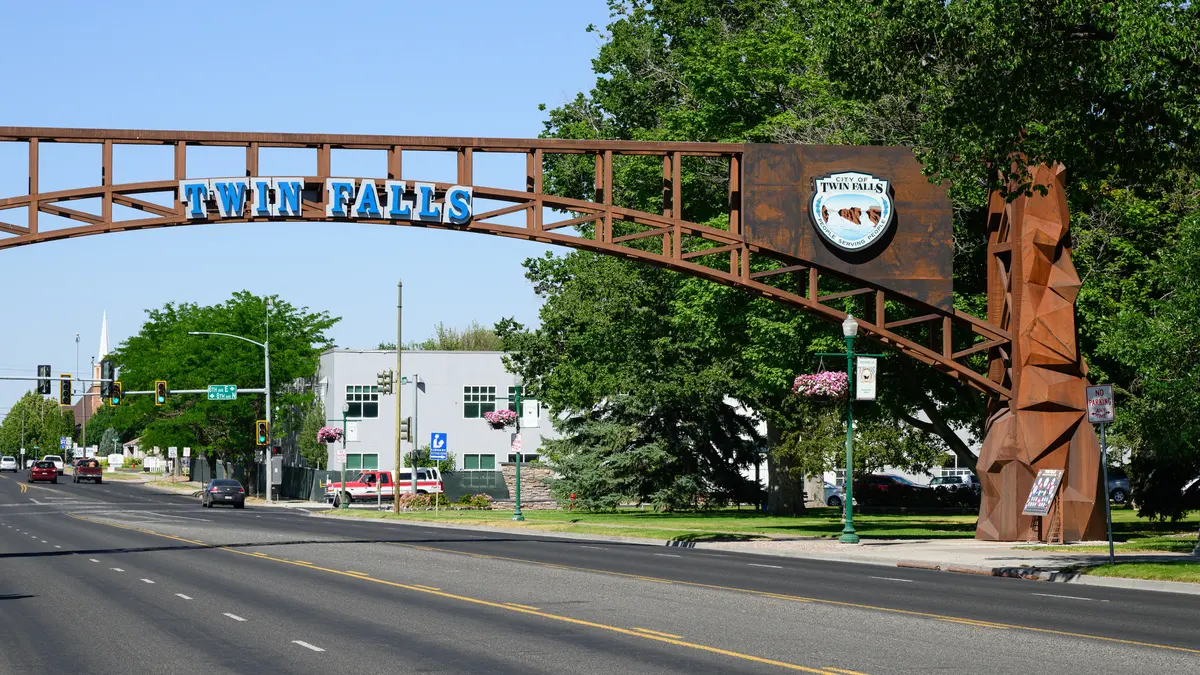
Where Crime Concentrates: East Side vs. West Side
The single most useful thing to understand about safety in Twin Falls is the east-west divide. It's not dramatic — this isn't a city with a genuinely dangerous quarter — but it's real and it shapes where savvy residents choose to live.
The East Side: Retail Corridors and Higher Incident Counts
The east side of Twin Falls, anchored by the retail corridors along the numbered streets and the area locals call the "president's streets," logs the highest raw crime counts in the city — roughly 304 cases per year in the highest-concentration zones, according to CrimeGrade.org's February 2025 breakdown. This tracks directly with the retail density: more foot traffic, more parking lots, more transient activity around big-box stores and fast food. If you're looking at a home in the eastern corridors, you're not walking into a danger zone — but you are accepting a neighborhood with more ambient commercial activity and the petty crime that follows it.
The West Side: The Quieter Half
The west side logs approximately 63 incidents per year in its lowest-crime zones — less than a quarter of the east side's total. Residential areas to the northwest of the city center, including the direction toward Settlers Ridge and the canyon, consistently appear among the lower-crime geographies in NeighborhoodScout's analysis. The rural south of the Twin Falls metro reports the least theft and overall crime of any part of the broader area.
Downtown: A Neighborhood in Transition
Downtown Twin Falls sits in the middle of this spectrum. The Historic Warehouse District, where 2nd South Market operates as a food hall with multiple independent local vendors, has seen meaningful reinvestment — and reinvestment tends to push crime rates down over time. The 2026 construction boom, with new hotels rising near the Magic Valley Mall and along the canyon, is another signal that the Downtown corridor is moving in a positive direction. It's still an urban core with the incidents that come with that, but it's not a place residents avoid.
| Area | Relative Crime Level | Primary Crime Type | Best For |
|---|---|---|---|
| East side / retail corridors | Highest in city | Larceny, vehicle break-ins | Commuter |
| Downtown / Warehouse District | Moderate, improving | Petty theft, assaults | Walkable |
| Near College of Southern Idaho | Below city average | Low overall | First-Time Value |
| Canyon Rim area | Below city average | Low residential; trailhead risk | Families Views |
| Settlers Ridge / northwest | Among city's lowest | Minimal | Families Quiet |
| Rural south of metro | Lowest in metro | Minimal | Privacy Nature |
For a fuller look at what distinguishes these neighborhoods beyond the safety lens, see the best neighborhoods in Twin Falls breakdown.
Looking to buy in Twin Falls? Estimate your payment.
Enter your numbers to see an estimated monthly mortgage payment.
Estimate only. Excludes HOA fees and mortgage insurance. The interest rate above is a starting point, not a quoted rate — replace it with your own to see real numbers. Insurance is a flat placeholder, not a Twin Falls quote.
The One Crime You Actually Need to Worry About: Vehicle Break-Ins
If there's a single pattern that surprises people after six months in Twin Falls, it's this: your house is probably fine, your person is probably fine, but your car at a trailhead parking lot is a genuine target.
The Canyon Rim Trail parking lot at Pole Line Road and Eastland Drive North has been a documented, recurring vehicle break-in location — flagged specifically in a January 2025 KEZJ investigation into Twin Falls vehicle crime hotspots. Recreational trailhead parking is a citywide vulnerability, not just one lot. The Snake River Canyon draws visitors from across the region, and where there are tourists with valuables in cars, there are opportunists.
What This Means Practically
Never leave anything visible in your car at trailhead lots near the Perrine Bridge, Dierkes Lake, or the Canyon Rim Trail access points. This isn't paranoia — it's the specific, localized advice that separates someone who knows Twin Falls from someone reading a generic safety ranking. The broader residential neighborhood of Canyon Rim itself has a much better crime profile than its trailhead parking would suggest; the break-in risk is concentrated at the recreational access points, not in the surrounding homes.
Vehicle break-ins also cluster around the numbered streets and president's streets areas on the east side — particularly near high-foot-traffic retail. The habit of locking your car and clearing the interior every time is worth building in those zones.
After Dark Downtown
The stretch of Main Avenue North that includes the downtown brewery district sees the usual weekend foot traffic of any mid-size city's core. It's lively, not threatening — but it's worth knowing that simple assaults (the most common violent offense in Twin Falls) tend to cluster around late-night commercial corridors rather than residential streets. If you're walking back to a car parked several blocks off Main on a Friday night, you're doing the same calculation you'd do in any mid-size American downtown.
How to Research Safety Before Settling on a Neighborhood
Raw city-level crime rates are the least useful tool for actually choosing where to live. Twin Falls is small enough that a few blocks in the right direction can move you from a moderate-crime zone into one of the quieter pockets in the entire Magic Valley region.
Use Block-Level Crime Maps, Not City Averages
CrimeGrade.org and NeighborhoodScout both publish maps that let you zoom to a specific street or ZIP code rather than reading the whole-city average. When you're evaluating a home near the College of Southern Idaho versus one in the retail-heavy east side, those tools will show you the difference immediately — the same difference that the city-wide 11-per-1,000 property crime figure completely obscures.
Check the Trend, Not Just the Snapshot
A single year's number is a snapshot; a direction is a story. Twin Falls's 9.5% overall crime drop from 2023 to 2024 — and Idaho's broader 8.7% state decline — suggests the trajectory here is favorable. A neighborhood that was slightly elevated two years ago and is now improving is a different proposition than one that's been static or worsening.
Talk to People at the Right Times and Places
The families who gather on weekend mornings along the Canyon Rim Trail corridor or at Centennial Waterfront Park will give you a more granular read on a specific block than any data source. Six months after moving in, most Twin Falls residents either confirm that their corner of the city is exactly as calm as it looked, or they identify the one specific parking lot or strip they'd avoid — rarely anything more alarming than that.
Drive the Streets at Different Hours
The east side retail corridors look completely different at 10 a.m. on a Saturday than at 10 p.m. on a Friday. If you're considering a home within a mile of Blue Lakes Boulevard, drive past it in the evening before you decide. That thirty-minute exercise will tell you more about ambient activity than a month of reading crime reports.
The honest summary: Twin Falls rewards a little homework. The city's geographic and commercial layout creates pockets of genuinely low crime within a few minutes of the areas that pull the city's averages upward. Finding those pockets is the real research task — not deciding whether Twin Falls as a whole is safe or unsafe.

Local Expert Takeaway: Twin Falls reads higher on paper than it feels on the ground, largely because the city's crime figures are calculated against its resident population while its daytime commercial draw from Jerome, Buhl, and the rest of Magic Valley quietly inflates that denominator's risk pool. The practical reality: most residents in areas like Settlers Ridge, Canyon Rim, and the neighborhoods near the College of Southern Idaho go years without a meaningful incident. Lock your car at the Canyon Rim Trail parking lot at Pole Line and Eastland Drive North — that's the one specific, documented vulnerability that catches newcomers off guard. Downtown has real momentum in 2026, with construction along the canyon and the 2nd South Market food hall anchoring the Warehouse District's reinvestment. The directional trend is clearly improving, and the city's crime mix — dominated by simple assault, larceny, and drug offenses rather than serious predatory crime — is consistent with a regional commercial hub, not a high-risk city.
Quick Takeaways & FAQs
✅ Total reported crime in Twin Falls dropped 9.5% in 2024 compared to 2023, a trend that mirrors Idaho's statewide 8.7% decline — both pointing in the right direction.
⚠️ Twin Falls's violent crime rate of 4 per 1,000 sits above Idaho's low statewide norm, and the east-side retail corridors do pull the city's property crime average upward in ways that don't reflect quieter residential areas.
📍 The Canyon Rim Trail parking lot at Pole Line Road and Eastland Drive North is a documented, recurring vehicle break-in hotspot — a specific detail worth knowing before you start hiking with valuables in your car.
Is Twin Falls, Idaho a safe place to live?
What is the crime rate in Twin Falls, ID?
Which parts of Twin Falls have the most crime?
Is property crime a big problem in Twin Falls?
How does Twin Falls crime compare to the rest of Idaho?
Moving to Idaho?
Tell us what you need help with and we'll connect you with local resources.
