
Plenty of people picture retirement on Mercer Island and then hesitate when they see the price tag. The hesitation is reasonable — the median sale price was $2,596,500 in April 2026. But for retirees who can absorb that entry point, the island delivers something genuinely rare inside a major metro: physical separation from the city's noise and density, a six-mile loop of trails and lakefront parks, and a direct light-rail connection to Seattle that opened in March 2026. You are not giving up access. You are buying distance from the chaos while keeping access to everything the city offers.
The retirees who land here and stay tend to share a profile. They have equity from a long-held home — often in California, the Eastside, or Seattle proper — and they are trading square footage for security and setting. Washington's tax posture helps: no state income tax means Social Security, pension income, IRA draws, and 401(k) distributions arrive untouched by the state. The island's crime rates sit well below regional norms, and the community investment here tends to keep property values stable over the long arc of a retirement.
Day-to-day costs away from housing are more moderate than the home prices imply. The Town Center has independent cafés, Mioposto Pizzeria, the Crawlspace Gastropub, and Las Bugambilias within walking distance of each other. For a fuller picture of what daily spending looks like, the cost-of-living page has the detail. What matters here is the structural question: can a fixed income sustain the property tax, the HOA if you choose a condo, and the lifestyle without requiring car trips for every errand? The honest answer depends heavily on where you choose to live on the island.
Whether you are narrowing down from a short list of Eastside cities or deciding between Mercer Island and somewhere cheaper like Issaquah or Renton, the sections below cover healthcare access, the retiree tax picture, walkability and senior community life, downsizing options, and a side-by-side look at the realistic alternatives.
Why Retirees Are Choosing Mercer Island
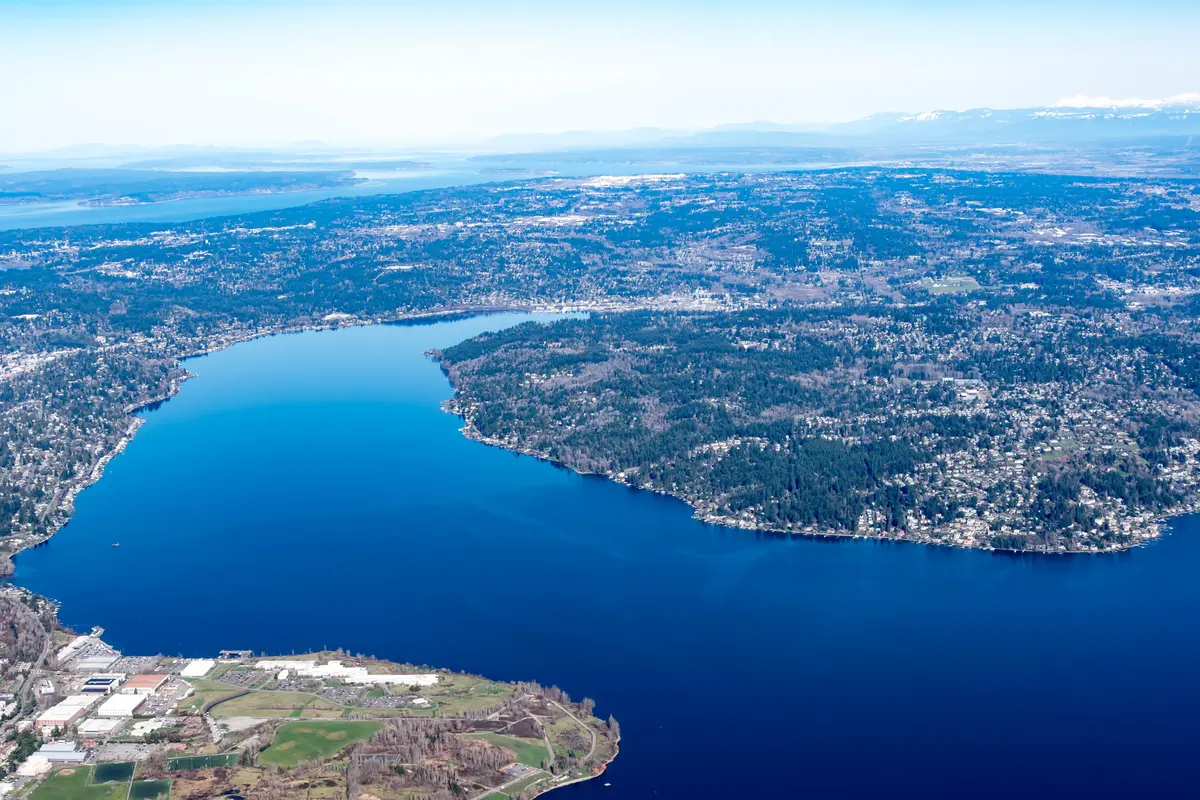
The argument for Mercer Island in retirement is not subtle. You get an island — literally separated from the surrounding metro by Lake Washington — with roughly 20 parks, a perimeter trail, and a Town Center that functions as a genuine village. Most retirees who move here come from one of three places: they already lived on the Eastside and are downsizing in place, they are arriving from California or another high-cost state and find even Mercer Island prices easier to absorb after selling there, or they are Seattle residents who want more quiet without surrendering proximity to the city.
The median sale price of $2,596,500 (April 2026) sets the floor honestly: this is not a place to stretch a modest retirement budget. Retirees on fixed incomes who cannot deploy significant home-sale equity should look first at Renton or Issaquah, where entry points are substantially lower. But for those whose equity and portfolio can carry it, Mercer Island offers something that neither Bellevue nor Seattle itself reliably provides — low crime, low density, and a community small enough that you recognize faces at Luther Burbank Park on a Tuesday morning.
The friction moment many newcomers underestimate: the island is hilly outside of Town Center, and driving remains necessary for most of the residential areas. Retirees who want to age in place without a car should concentrate their search within a short walk of the light-rail station and the Town Center retail cluster. Those who assume the island's compact size means universal walkability tend to be surprised at month three when they realize the house they bought on the south end requires a car for every errand.
Healthcare & Medical Access in Mercer Island
Mercer Island has no full-service hospital of its own — that is the single most important healthcare fact for any retiree evaluating the island. What it does have is a location precisely between two robust healthcare markets, which means specialists, primary care, and emergency services are close in both directions.
Overlake Medical Center — Bellevue
Overlake Medical Center in Bellevue is the closest major hospital to Mercer Island, reachable in roughly 10 minutes by car. It offers comprehensive emergency care, surgical services, and specialized geriatric programs — the kind of depth that matters when you are managing chronic conditions rather than just seeking routine care. For retirees whose primary concern is speed to an emergency room, Overlake's proximity across the I-90 bridge is the strongest card the island holds.
Swedish Medical Center — Seattle
Swedish Medical Center operates two relevant campuses in Seattle — First Hill and Cherry Hill — both approximately 15 to 20 minutes from Mercer Island by car. Swedish is particularly well regarded for advanced rehabilitation services, which becomes relevant after joint replacement or a cardiac event. With the 2 Line light rail now running, the First Hill campus is also reachable by train and a short connecting bus ride, which matters if you eventually stop driving.
The Honest Distance Reality
For routine cardiology, oncology, or neurology appointments, most Mercer Island retirees split their care between Bellevue and Seattle depending on which health system their physician belongs to. The island itself has primary care clinics and specialist offices, but major tertiary care — transplant programs, Level I trauma, complex cancer treatment — requires going to Seattle's larger medical campuses. That trip runs 20 to 30 minutes by car in normal traffic and about 21 minutes to the university district area by light rail. For most retirees, that is a workable distance. For those managing a condition that requires frequent high-acuity appointments, proximity to a larger urban medical center in Seattle may tip the scales toward living closer in.
The practical upside: being sandwiched between Bellevue and Seattle means Mercer Island residents genuinely have access to two complete healthcare markets. Primary care availability is better than in many suburban communities this size, and telehealth has closed many of the remaining gaps for routine follow-up care.

The Retiree Budget in Mercer Island
Washington is one of the most retirement-friendly states in the country for income taxation, and that advantage is real rather than marginal. The state levies no personal income tax, which means Social Security benefits, pension payments, IRA withdrawals, and 401(k) distributions arrive without state tax withheld. For a household drawing $80,000 to $120,000 annually in retirement income, the savings compared to California, Oregon, or Minnesota can run into thousands of dollars per year.
Washington does impose a 7% capital-gains tax on large taxable gains, but it specifically exempts retirement account transactions and the sale of real estate. A retiree living on Social Security, a pension, and retirement account draws will almost certainly never owe this tax. The exception worth noting: retirees with substantial taxable brokerage accounts — not IRAs, but standard investment accounts — who realize large gains in a single year should consult a tax advisor, because gains above the exemption threshold in those accounts are subject to the 7% rate.
Property Taxes at This Price Point
Mercer Island's effective property tax rate is approximately 0.83%. On a home at or near the city's median, that is a meaningful annual figure — though still well below the effective rates common in Texas, Illinois, or New Jersey. Washington also offers a property tax exemption program for qualifying senior homeowners based on income and age, which can reduce the assessed value subject to tax. If your household income falls within the program's eligibility range, the savings are worth exploring through King County.
Daily Cost of Living on a Fixed Income
Grocery and dining costs on the island run close to Seattle-area norms — higher than the national average but not dramatically beyond what residents of any major Pacific Northwest metro would expect. The Town Center has a full-service grocery store, a handful of independent cafés, and restaurants ranging from casual (Mioposto Pizzeria) to gastropub (the Crawlspace Gastropub). Roanoke Inn, the island's longtime neighborhood tavern, offers a lower-key weeknight option. For a complete breakdown of daily costs, see the cost-of-living page.
The structural budget question most retirees underestimate: if you buy a condo rather than a single-family home to simplify maintenance, HOA fees on the island can run several hundred to over a thousand dollars per month depending on the building and amenities. Factor that into your fixed-income math before the offer, not after.
Looking to buy in Mercer Island? Estimate your payment.
Enter your numbers to see an estimated monthly mortgage payment.
Estimate only. Excludes HOA fees and mortgage insurance. The interest rate above is a starting point, not a quoted rate — replace it with your own to see real numbers. Insurance is a flat placeholder, not a Mercer Island quote.
Walkability, Community & Staying Active in Mercer Island
The island's citywide Walk Score of 33 reads as car-dependent, and for most residential streets, it is accurate. But that number obscures the meaningful exception: the Downtown/Town Center pocket, where daily errands, dining, and the light-rail station are genuinely accessible on foot. Retirees who prioritize walkability should concentrate their search within a quarter mile of Town Center — and should visit on foot, not just by car, before committing.
Outside of Town Center, the terrain compounds the walkability challenge. Mercer Island is hilly in most directions from the center, and residential streets were not designed with pedestrians as the primary user. Driving remains the default for most island residents. That is worth saying plainly: if your retirement plan depends on giving up a car in five years, the south end or east side of the island is not the right fit.
Parks, Trails, and the Outdoor Life
The outdoor picture is genuinely strong. Luther Burbank Park on the northeast shore combines a swimming beach, off-leash dog area, sports fields, and lakefront trails in a single destination that functions as the island's social commons on warm afternoons. Aubrey Davis Park and Clarke Beach Park round out the lakefront access. The island perimeter trail gives walkers and cyclists a mostly flat route with water views — one of the better walking environments in the Seattle metro for retirees who want low-traffic, scenic exercise without driving to a trailhead.
Senior Community and Social Life
The Mercer Island Community and Event Center serves as the organizational anchor for senior programs on the island, hosting fitness classes, arts programs, and community events throughout the year. The senior population is engaged and tends to be well-networked — the island's small size (roughly 25,000 residents) means that community organizations, arts groups, and volunteer opportunities are accessible without navigating a large bureaucracy. Rotary, garden clubs, and arts organizations all operate here with active membership.
What retirees who move from larger cities sometimes find surprising after six months: the social scene on Mercer Island is quieter and more self-generated than in urban neighborhoods. There is no equivalent of Bellevue's downtown restaurant row or Seattle's density of venues. The upside is exactly that — a slower pace, recognizable faces, and a community where showing up at Luther Burbank Park on a Tuesday morning means running into neighbors. The downside is that retirees who need a city's ambient social energy can feel isolated, particularly in winter when outdoor life contracts.
Right-Sizing: Downsizing in Mercer Island
Mercer Island's housing stock skews heavily toward single-family homes, and many of them were built on sloped lots in the 1960s through 1980s — which means split-levels and stairs, not the single-level living that makes aging in place practical. If your downsizing priority is eliminating stairs, you need to search specifically and deliberately, because the default inventory will not hand it to you.
Condo and Townhome Options
The Town Center area has the island's best concentration of condo and attached-housing options. Buildings here tend to be low- to mid-rise, with elevator access in newer construction, and proximity to the light-rail station is a meaningful long-term asset for residents who will eventually stop driving. Inventory is limited relative to demand — the island is six square miles and almost entirely built out — so buyers in this segment should expect competition and limited selection at any given time.
Purpose-built 55-plus communities are not a dominant feature of Mercer Island's housing supply. The island is not the right market if you are specifically seeking a managed active-adult campus with a clubhouse and organized amenities included in the price. That product exists more robustly in communities like Issaquah or on the edges of Bellevue, where land allowed larger planned developments.
What the Downsizing Math Actually Looks Like
Retirees downsizing from a larger single-family home on the island often find that even a two-bedroom condo near Town Center sells in a price range that surprises people accustomed to condo pricing in other markets. The entry point for attached housing on Mercer Island is substantially higher than in comparable suburban communities — a direct function of the overall market. The upside: if you are selling a larger island home to fund the move, the equity captured is also substantial, and the math often works in favor of staying on the island rather than cashing out to a less expensive market and losing proximity to healthcare, family, and the social network you have built.
One practical note on inventory: Mercer Island runs roughly 7 to 9 days to pending for competitive properties, meaning desirable single-level or elevator-served units move quickly. If single-level living is non-negotiable, connect with a local buyer's agent before you are ready to close — these units sell before most search portals surface them.
Mercer Island vs Nearby Retirement Destinations
| City | Cost vs Mercer Island | Primary Hospital | Walkability | Senior Living Depth | Overall Retirement Fit |
|---|---|---|---|---|---|
| Mercer Island | Anchor | Overlake Medical Center (Bellevue, ~10 min) | Car-dependent island-wide; Town Center walkable | Limited 55+ inventory; condo options near Town Center | Luxury Quiet Strong fit for equity-rich retirees |
| Bellevue | About the same to slightly pricier | Overlake Medical Center (on-site) | Downtown Bellevue highly walkable; suburbs car-dependent | Strong condo and senior-community inventory downtown | Walkable Best if healthcare proximity is the top priority |
| Issaquah | Noticeably cheaper | Swedish Issaquah Campus (~15 min) | Car-dependent; some walkable pockets near Gilman Blvd | Strong 55-plus campus inventory; largest selection nearby | Value Nature Best for active adults who want managed communities |
| Renton | Substantially cheaper | Valley Medical Center (on-site) | Partially walkable downtown core; suburban elsewhere | Moderate; growing condo supply near downtown | Budget-Friendly Best for retirees prioritizing fixed-income sustainability |
| Newcastle | Noticeably cheaper | Overlake Medical Center (Bellevue, ~15 min) | Largely car-dependent; few walkable retail nodes | Limited; primarily single-family residential | Privacy Quiet setting; limited senior-specific amenities |
| Seattle (First Hill / South Lake Union) | Comparable to slightly cheaper per sq ft | Swedish First Hill / major medical campuses (on-site or blocks away) | Highly walkable; transit-rich | Deep inventory of urban senior housing and assisted living | Transit Best for retirees who want to stop driving entirely |
Issaquah is the clearest alternative for retirees who want a quieter Pacific Northwest setting and access to purpose-built active-adult communities at a substantially lower entry price. Bellevue wins on healthcare proximity — Overlake Medical Center is there, not a bridge away — and on walkability if you land in the downtown core. Renton offers the most affordable path among these options and has its own hospital in Valley Medical Center, making it worth a serious look for retirees managing a tighter fixed income.
Seattle proper flips the equation entirely: urban senior housing near major medical campuses puts you closer to more hospitals than anywhere else on this list, and the light rail now connects Mercer Island to that same corridor in about 10 minutes. For retirees who are certain they will eventually stop driving, a city address near a major medical campus may prove more practical over a 20-year retirement horizon than an island setting that still assumes car ownership. Mercer Island sits between those worlds — quieter than the city, more connected than the distant suburbs, and genuinely competitive on safety and community quality, if the price point is sustainable for your situation.

Local Expert Takeaway: Mercer Island is a strong retirement choice for one specific profile: equity-rich, car-owning retirees who want a quiet island community with fast access to Seattle and Bellevue healthcare without giving up the Pacific Northwest outdoors. The light-rail connection to Seattle's International District opened in March 2026 and changes the calculus for aging in place — retirees who eventually stop driving now have a real transit option rather than total car dependence. The catch is inventory: single-level homes and elevator-served condos near Town Center are scarce and move fast. If walkability and stair-free living are non-negotiable, your search needs to start in the Town Center corridor, not the island's wooded south end, and you should expect to move quickly when the right unit appears.
Quick Takeaways & FAQs
✅ Washington levies no state income tax on Social Security, pensions, or retirement account withdrawals — one of the strongest tax postures for retirees in the country.
⚠️ Mercer Island has no hospital of its own, and the island's hilly terrain makes car-free aging-in-place impractical outside the Town Center corridor.
📍 Sound Transit's 2 Line, which opened March 28, 2026, gives Mercer Island retirees a direct train to Seattle's First Hill medical district in roughly 10–15 minutes — a meaningful long-term asset for residents who plan to eventually stop driving.
Is Mercer Island a good place to retire on a fixed income?
What is the closest hospital to Mercer Island for retirees?
Does Washington State tax Social Security or retirement income?
Are there 55-plus or active-adult communities on Mercer Island?
Can you realistically get around Mercer Island without a car in retirement?
Moving to Washington?
Tell us what you need help with and we'll connect you with local resources.
