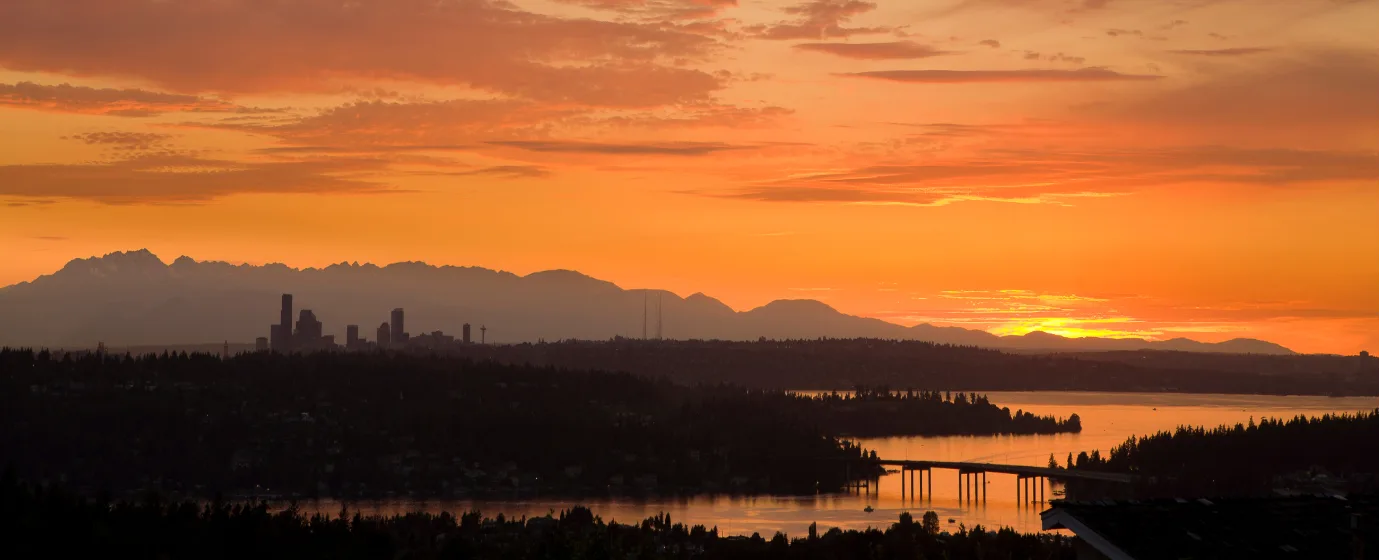
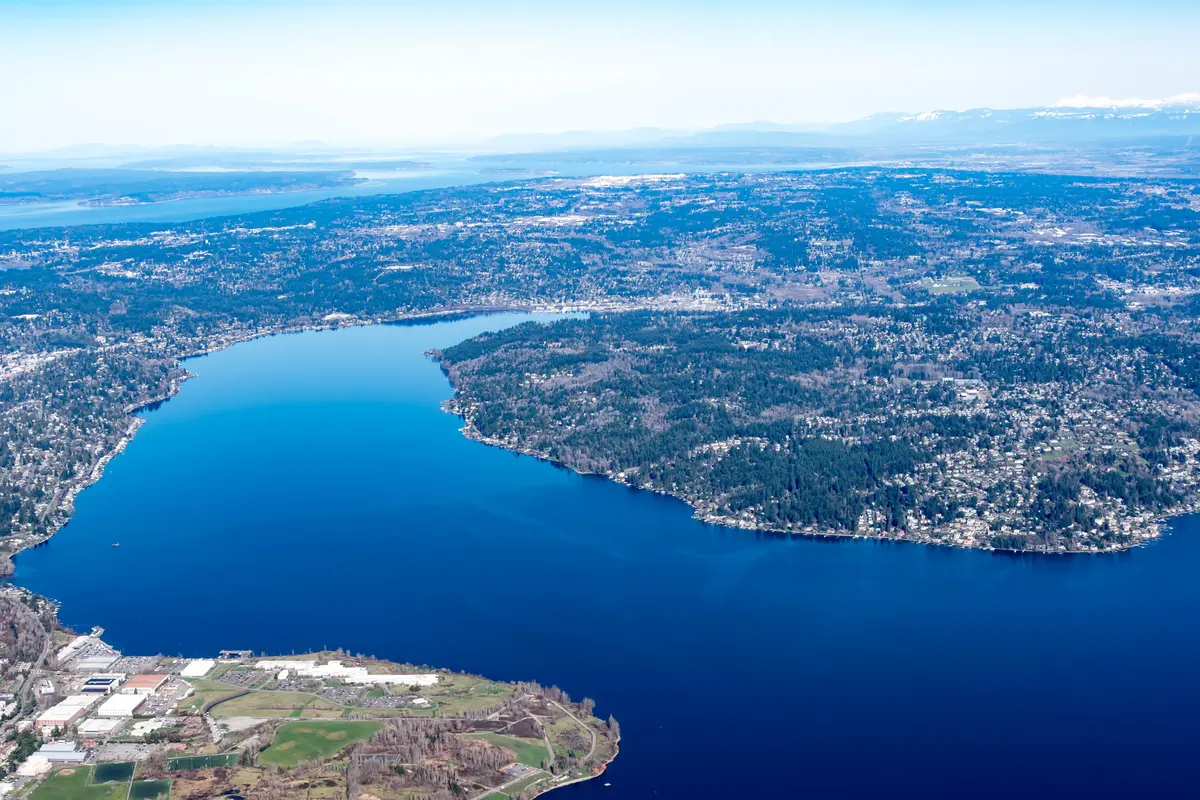
Most Californians who land on Mercer Island arrive the same way: priced into it. They priced out of the Bay Area or a coastal California suburb, or got a remote offer from Amazon or Microsoft that made Washington's tax structure suddenly relevant, and someone said, "Have you looked at the island?" What they didn't expect was a place that feels genuinely small — 25,307 residents, one main commercial street along SE 27th St, a single high school — sitting four miles from downtown Seattle with the Cascades visible from the shoreline on a clear morning. The island sits mid-span on I-90 between Seattle and Bellevue, connected by the Lacey V. Murrow Memorial Bridge, one of the largest floating bridges in the world. That geography is everything here. You are not choosing between city and suburb. You are choosing a specific, bounded island community that happens to have two major metros within a ten-minute drive.
The people who move here from California tend to share a profile: dual-income households, often one tech earner commuting to Amazon's South Lake Union campus or Microsoft's Redmond campus, children either school-age or close to it. The Mercer Island School District is ranked among the top two in Washington State by Niche (2026), with West Mercer Elementary ranked the single best public elementary in the state and Mercer Island High School in the top ten statewide — that ranking alone drives a meaningful share of inbound demand from California buyers whose kids thrived in competitive Bay Area districts and want to land somewhere equally rigorous. The median household income here is $219,069, which tells you something about who your neighbors will be.
The cost-of-living reality is layered. Mercer Island runs roughly 43% above the U.S. national average as of 2025, driven almost entirely by housing. But measured against San Francisco, it comes in noticeably less expensive on an overall basis — a gap that grows significantly once you account for what Washington does not have: a state personal income tax. For a household earning $300,000 in California, eliminating that tax bill is not a small detail. The trade-off is a 10.3% combined sales tax rate, with the state base at 6.5%; groceries are exempt. Day-to-day life otherwise has the texture you'd expect from a well-resourced small city: Luther Burbank Park and Clarke Beach Park give you Lake Washington access year-round, the Sound Transit 2 Line station opened in March 2026, and Shawn's Cafe & Bakery on SE 27th St is the kind of morning anchor that makes a town feel like a town rather than a subdivision.
Whether you are already under contract or still running the numbers from a California kitchen table, the sections below break down the California-to-Washington comparison on price and taxes, what the buying environment actually looks like for out-of-state buyers, what daily life delivers that California mostly doesn't, where the honest downsides are, and what Californians consistently say after six months here that nobody told them to expect.
The Tax Math: What Leaving California Actually Means
The headline is real: Washington has no personal income tax. For a California household earning $400,000 — a reasonable figure for a dual-income tech couple relocating to work near Bellevue or Seattle — the California marginal rate at that income level sits around 12.3%, with the effective rate often landing between 8% and 10% depending on deductions. The savings on moving across that state line are not marginal. They restructure what a monthly budget looks like from the first paycheck.
One important nuance: Washington taxes 7% on long-term capital gains above a $278,000 standard deduction for 2025, rising to 9.9% on gains above $1,000,000. If you are liquidating a California brokerage account or selling a rental property as part of the move, that figure matters and is worth a conversation with a tax professional before you close either transaction.
| Tax Category | California | Washington (Mercer Island) | The Difference |
|---|---|---|---|
| State personal income tax | Up to 13.3% (top marginal); effective rate 8–10% for high earners | None | Significant annual savings for six-figure earners |
| Sales tax (general) | Varies by county; typically 9–10.75% | 10.3% combined (Mercer Island, 2026) | Roughly comparable; groceries exempt in WA |
| Property tax (effective rate) | Typically ~1.0–1.2% (Prop 13 limits on existing owners) | ~0.83% effective rate | Lower effective rate on Mercer Island |
| Capital gains (state) | Taxed as ordinary income at state rate | 7% on long-term gains above $278,000 standard deduction (2025); 9.9% above $1,000,000 | CA higher for most earners; WA relevant for large liquidation events |
| Grocery tax | Generally exempt (with exceptions) | Exempt from state and Mercer Island sales tax | Comparable |
| Estate / inheritance tax | None at state level | Washington estate tax applies above $2.193M threshold | Relevant for high-net-worth estates |
The property tax rate is where Mercer Island surprises California buyers most favorably — the effective rate of approximately 0.83% is lower than what most California counties charge new buyers on a newly assessed purchase price. On a $2,596,500 median sale, the California new-owner rate would typically produce a meaningfully higher annual bill than the Mercer Island effective rate on that same number. The cost of living page has a full breakdown of how individual line items stack up.
Health coverage costs also shift in ways Californians notice. Insurance premiums on the individual and employer-sponsored market in Washington tend to run noticeably lower than what high earners were paying in California, though the island's small size means you will drive farther for certain specialist appointments — advanced care is concentrated in Seattle and Bellevue rather than available locally.
Home Prices: California Context for a $2.5M Median
The number that stops California buyers mid-scroll: Mercer Island's median sale price was $2,596,500 in April 2026. That figure sits above much of the South Bay, roughly in line with parts of the Peninsula, and above most East Bay markets that feed this relocation corridor. If you are arriving from an inland California suburb expecting a discount, Mercer Island is not that story.
What it is: a different calculus. In San Francisco proper, a similar price point often produces a 1,400-square-foot condo in a dense neighborhood with street parking. On Mercer Island, that same budget typically reaches a single-family home with a yard, Lake Washington views in many cases, and a school district ranked in the state's top two. The square footage and land coverage at a given price point are materially better.
| California Market | Approx. Median (2025–2026) | vs. Mercer Island | What the Gap Buys |
|---|---|---|---|
| San Francisco (city) | ~$1.3M (condos dominant) | Mercer Island notably higher | Single-family home, yard, top-rated schools |
| Marin County | ~$1.8M | Mercer Island higher | Island setting, no state income tax |
| Peninsula (mid-Peninsula) | ~$3.0–3.5M | Mercer Island lower | Comparable school quality, lower property tax rate |
| South Bay tech corridor | ~$2.8–3.2M | Mercer Island slightly lower | No income tax, larger lots on average |
| Orange County | ~$1.4M | Mercer Island substantially higher | Tighter inventory, different climate |
| East Bay (established suburbs) | ~$1.5–2.2M | Mercer Island at or above | Stronger school district ranking |
Entry-level on Mercer Island — older construction, smaller footprints, interior locations without water views — typically starts well above $1.5M. The median reflects a market where move-in-ready homes with views and recent renovations transact above $3M with regularity. For a deeper look at what different neighborhoods command, the neighborhoods page covers the geographic distinctions.
One honest friction point: California buyers who sold under Proposition 13's long-time-owner assessment caps often experience sticker shock at what their Washington property tax bill reflects — because unlike California, Washington taxes based on current assessed value without the same long-term cap structure. The effective rate of 0.83% is favorable, but it applies to a large number.

The Buying Environment: What Out-of-State Buyers Get Wrong
Mercer Island operates on a compressed timeline that California buyers from slower markets underestimate badly. Inventory on the island is structurally limited — you cannot build more land — and well-positioned listings in the $2M–$3.5M range regularly receive offers within the first week. The buyers you are competing against are often already pre-approved locals or tech employees who have been watching the island for months.
Washington is an escrow state, not a pure attorney-close state. The process will feel familiar if you bought in California — title and escrow companies handle closings, and the sequence of offer, mutual acceptance, inspection, and closing runs roughly 30 days for a standard transaction. What differs is the disclosure framework: Washington sellers complete a seller disclosure form (Form 17), but the emphasis on buyer due diligence during inspection periods is high. Waiving inspection contingencies happens in this market; know what you are agreeing to before you do it.
The Floating Bridge Variable
Every Mercer Island buyer eventually confronts this: there is no alternative route off the island. I-90 is the only road. If the bridges close for weather or emergency maintenance, the island is effectively inaccessible by car. This happens rarely, but the psychological reality of it — one exit, period — is something Californians who came from grid-street suburbs find genuinely unfamiliar.
The Sound Transit 2 Line opened at Mercer Island Station in March 2026, running every eight minutes during peak periods toward both downtown Seattle and Bellevue. That new rail connection has changed the commute calculus for households where one person works transit-accessible jobs — Bellevue Downtown is approximately ten minutes by light rail, Seattle is reachable westbound on the same line. For the commute and transit picture in full, see the living in Mercer Island page.
What to Do Differently
Get a Washington-licensed lender lined up before you start making offers, not after. California lenders are often unfamiliar with local title companies and escrow timelines, and a listing agent on a competitive Mercer Island property will notice. The first-time homebuyer page covers the buying-process mechanics in detail, including Washington-specific programs.
Tour in person before making an offer — a standard piece of advice that this market makes non-negotiable. Mercer Island's topography means that two streets half a mile apart can have radically different feel: dense tree cover, lake exposure, slope grade, and morning vs. afternoon light all vary more than photos reveal.
Looking to buy in Mercer Island? Estimate your payment.
Enter your numbers to see an estimated monthly mortgage payment.
Estimate only. Excludes HOA fees and mortgage insurance. The interest rate above is a starting point, not a quoted rate — replace it with your own to see real numbers. Insurance is a flat placeholder, not a Mercer Island quote.
What Daily Life Delivers — and What California Had That This Doesn't
Six months after moving, nearly every California transplant says a version of the same thing: "I didn't realize how quiet it would be." Not quiet in a sleepy-suburb way — quiet in the sense that the island genuinely feels insulated. The noise floor drops. There is no through traffic; you cannot drive through Mercer Island on your way to somewhere else. Every car here is either a resident, a visitor, or a delivery.
The Town Center along SE 27th St is the social infrastructure. Allister on SE 27th St serves New American food at a level that would not feel out of place in San Francisco. The Roanoke Inn on 72nd Ave SE, built in 1914 and the oldest business on the island, is where local families end up on Friday evenings, reliably and unpretentiously. Mioposto Pizzeria on SE 27th St handles the weeknight-dinner anchor role with wood-fired pies that draw regulars from across the island. Shawn's Cafe & Bakery on SE 27th St is the morning place — the croissants are the real thing, and the tables fill early with people who have nowhere more important to be on a Saturday.
The Outdoor Shift
Luther Burbank Park on the island's northeast tip is the equivalent of a community living room — 77 acres of Lake Washington frontage, a swim beach, a dog off-leash area, and a summer concert series that draws the entire island. Clarke Beach Park on the south end adds more waterfront access. For Californians arriving from inland California suburbs, the ratio of public green space to population here is startlingly generous. For the full outdoor picture, the parks and recreation page covers trails, beaches, and seasonal programming.
What California Had That Is Simply Missing Here
Diversity of restaurant options is the honest gap. The Town Center has a handful of solid spots, but if you want the density of choices available in any mid-size California city — multiple cuisines within walking distance on a given night — you are driving to Seattle or Bellevue. That ten-minute drive on a clear evening is easy. On a Friday at 5:30 p.m. with I-90 backed up past Renton, it is not.
Year-round farmers markets are thinner than what Bay Area residents are accustomed to. The island runs a seasonal market, but the weekly-abundance culture that California coastal cities have built does not have a direct Mercer Island equivalent. Seattle's Pike Place Market fills some of that need — it is not far — but it requires crossing the bridge.
The Honest Trade-Off: Why Some Californians Leave Within Three Years
The people who leave Mercer Island after two or three years tend to leave for one of three reasons, and all three are predictable in retrospect. The first is the island constraint itself: some buyers discover that the physical boundary — one road, one bridge, water on all sides — produces a claustrophobia they did not anticipate from satellite photos. If you are someone who reflexively explores by car on weekends, the lack of spontaneous direction-choices off the island is a real psychological adjustment.
The second reason is school-completion timing. A meaningful share of Californians move specifically for the Mercer Island School District — district-reported proficiency rates run approximately 81% in math and 85% in reading, with an 18:1 student-teacher ratio — and once their youngest finishes high school, the rationale for the premium weakens. Families who started with that driver sometimes discover that their roots in the community are shallower than they expected, and they return to California for retirement or downsize to Bellevue. For a full look at the schools, see the schools page.
The Weather Reality
California transplants universally underestimate the grey. Not the rain — the Pacific Northwest's rain reputation is somewhat exaggerated in terms of volume — but the overcast duration. From November through February, Mercer Island can go two or three weeks without meaningful direct sunlight. Lake Washington reflects back a flat grey sky. Seasonal affective disorder is a documented clinical reality in this latitude, and people who struggled with grey winters in Portland or San Francisco tend to hit the same wall here. The people who stay long-term are either native to the Pacific Northwest or have deliberately built outdoor habits — running, paddleboarding on the lake, skiing at Snoqualmie Pass — that get them outside regardless of sky conditions.
The third reason is social friction. Mercer Island is a small, tight community where many social networks are already established. Californians who moved for the island's reputation sometimes find the social integration slower than expected. The Roanoke Inn and Luther Burbank Park events are genuine connection points, but building real community on the island typically takes longer than it did in a California neighborhood with higher residential turnover. That is not a flaw — it is a feature of a stable, long-term-resident island — but it surprises people who expected easy entry.
For a read on who the island genuinely suits and who tends to find it a poor fit, the living in Mercer Island overview covers buyer types in more depth. On crime and safety, which are among the strongest metrics on the island, the safety page has the full picture.

Local Expert Takeaway: Mercer Island is the right move from California if the school district is your anchor, your income is high enough that eliminating California's state income tax meaningfully changes your monthly picture, and you genuinely want a small, bounded island community rather than a conventional suburb. If you are expecting a California coastal city's density of restaurants and retail within walking distance, or you need the psychological comfort of being able to drive in any direction on a whim, the island's constraints will feel real within six months. Do the math on the income tax savings, walk SE 27th St on a Tuesday morning, and sit with the fact that I-90 is your only road out — if all three feel right, the case for making an offer is strong.
Quick Takeaways & FAQs
✅ Washington's zero state income tax can save a high-earning California household tens of thousands of dollars annually from the first paycheck — the single largest financial shift in the move.
⚠️ Mercer Island's median sale price of $2,596,500 (April 2026) is not a discount over most premium California markets; buyers arriving expecting relief will need to reframe what they are buying — school access, island quiet, and a lower effective property tax rate — rather than a price break.
📍 Mercer Island Station opened on the Sound Transit 2 Line in March 2026, giving island residents a light-rail connection to both downtown Seattle and Bellevue that runs every eight minutes at peak — a commute option that simply did not exist before this year.
Do I really save money moving from California to Mercer Island if home prices are just as high?
How competitive is the Mercer Island real estate market for out-of-state buyers?
Does Washington's no-income-tax advantage apply to capital gains from selling my California home?
How do Mercer Island schools compare to competitive California districts?
What do California transplants wish they had known before moving to Mercer Island?
Moving to Washington?
Tell us what you need help with and we'll connect you with local resources.
