The question most people Google before committing to San Marcos is the same one they're almost embarrassed to ask out loud: is it actually safe? The honest answer is that San Marcos is a mid-sized college city of 77,830 people sitting between Austin and San Antonio along I-35, and it reads like one. The presence of Texas State University shapes everything here — the energy, the economy, the housing market, and yes, the crime picture. A city with tens of thousands of students moving in and out every year is going to register differently on a crime index than a quiet suburban bedroom community, and understanding that context is essential before you read a single heat-map color.
San Marcos carries a violent crime rate of 3.59 per 1,000 residents and a property crime rate of 22.58 per 1,000 residents. Those numbers sit meaningfully below the Texas state benchmarks of 4 per 1,000 for violent crime and 20.7 per 1,000 for property crime — and below the national violent crime figure of 3.7 per 1,000. The property crime rate does run above the national figure of 18.4 per 1,000, which is worth acknowledging plainly. For families and professionals researching a move, the key insight is that the city's crime is heavily concentrated in specific zones and crime types, and the residential neighborhoods where most of those families actually live tell a noticeably different story than the city-wide average.
The trend line is also working in San Marcos's favor. Violent crime declined sharply from a 2022 peak, and both violent and property crime have been on a downward trajectory over the past five years. The San Marcos Police Department has expanded its workforce and earned formal accreditation from the Texas Police Chiefs Association in April 2025 — a meaningful institutional marker that most small-to-mid-sized Texas departments don't hold. For those also weighing typical home prices or cost of living context, those details live on the cost-of-living page.
This guide breaks down San Marcos's crime data by type and geography, explains what the college-city effect means for your specific neighborhood research, profiles the areas most and least associated with incidents, and covers what the police department has actually been doing to address it — so you can make a grounded decision about where in San Marcos you'd actually want to live.

San Marcos Crime Rates vs. Texas and the Nation
The city-wide numbers are the starting point, not the conclusion. San Marcos carries a violent crime rate of 3.59 per 1,000 residents — below both the Texas state rate of 4 per 1,000 and the national rate of 3.7 per 1,000. That's a meaningful gap, and it holds up even accounting for the transient student population that inflates San Marcos's denominator in ways that make the city look larger than its permanent-resident base.
The property crime rate of 22.58 per 1,000 residents is the more complicated number. It runs above the Texas state rate of 20.7 per 1,000 and noticeably above the national figure of 18.4 per 1,000. That spread is real and worth taking seriously — but it also has a structural explanation that any honest reading of the data has to account for.
What's Driving Property Crime
Larceny-theft dominates the property crime picture, accounting for roughly 61% of all reported offenses in 2024. This is typical of college cities with high-traffic retail corridors: San Marcos Premium Outlets draws millions of visitors annually, and the commercial zones around it generate the kind of theft volume that inflates a city-wide rate without reflecting conditions in residential neighborhoods. Motor vehicle theft is an area of genuine vigilance — it ran elevated in 2024 relative to comparable Texas cities, and parking habits and garage access matter more here than in quieter markets.
Burglary, by contrast, was far lower as a share of property crime, which is actually the category most relevant to residential safety. A city where most property crime is retail larceny and parking-lot vehicle theft reads very differently for a homeowner than one where residential break-ins are the dominant pattern.
The Trend Is Favorable
Both violent and property crime have declined over the past five years. Violent offenses fell sharply — down from a peak in 2022 — and the overall crime rate continued falling into 2025. For a city growing as fast as San Marcos, a declining crime rate alongside population growth is not a given; it reflects real investment in policing and community infrastructure.
Where Crime Concentrates: The Geography You Need to Understand
San Marcos is not uniformly risky or uniformly safe — it has distinct zones, and where you live within the city determines your actual exposure far more than the city-wide average does. Understanding that geography is the most actionable thing this guide can give you.
The College and Commercial Core
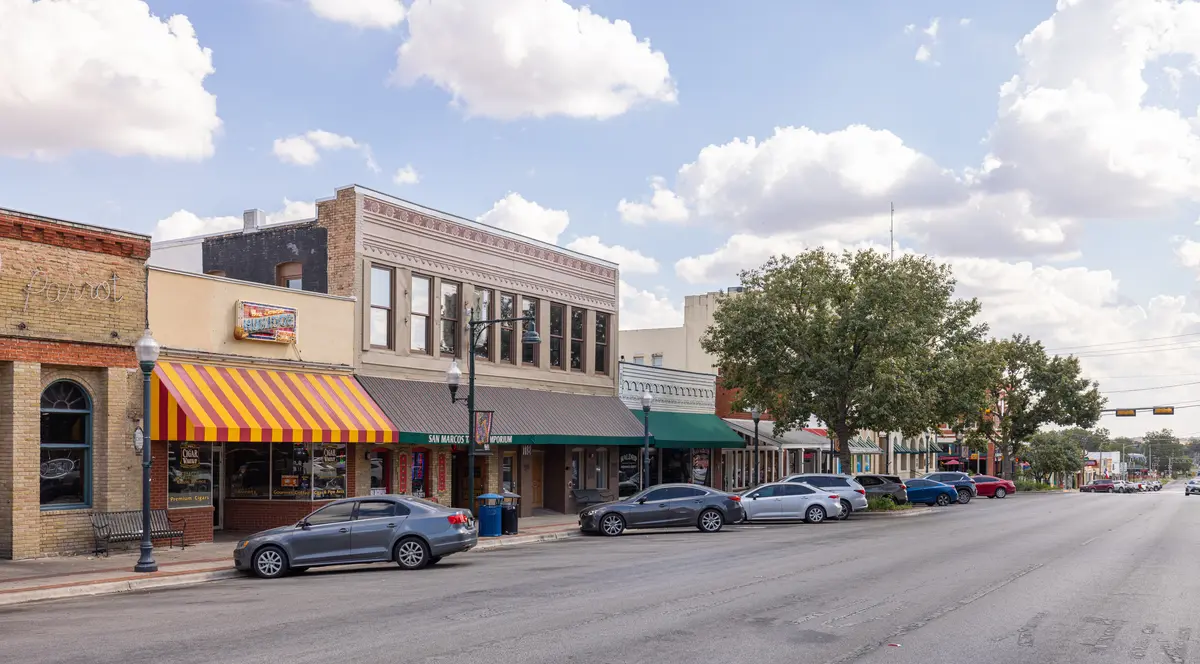
Downtown San Marcos and the blocks immediately surrounding Texas State University's campus register higher on crime heat maps than any residential neighborhood in the city. This is the college-city effect in its most direct form: crime follows crowds, and areas with tens of thousands of students, bars, late-night foot traffic, and concentrated retail will always accumulate more reported incidents than quiet subdivisions. That does not mean those areas are dangerous for residents in the way the raw numbers suggest — much of what gets reported is theft, noise, and minor disorder in high-density, high-activity zones. Families considering neighborhood options farther from campus will find the picture improves considerably.
Southwest San Marcos: Retail Concentration, Not Residential Risk
The area anchored by the Premium Outlets and surrounding commercial development along I-35 records among the highest total incident counts in any part of San Marcos. Nearly all of it is retail-adjacent: larceny from vehicles in parking lots, shoplifting, and theft from the commercial properties that serve a regional customer base.
Aggregator tools like CrimeGrade.org explicitly note this distinction: a red zone on a retail-heavy heat map does not necessarily mean the area is unsafe for people who live there. The southwest's crime count is a function of commercial density, not neighborhood character. That said, motor vehicle theft is worth taking seriously citywide, and parking in well-lit, secured areas is a practical habit worth building.
Northern San Marcos: The Safest Residential Zone
The northern parts of the city consistently show the lowest crime exposure for residents. The risk of being a victim of violent crime in the north runs roughly half what it does in central neighborhoods — a meaningful difference that experienced local real estate agents and longtime residents will confirm. Established residential communities with more homeowner stability and less transient traffic tend to accumulate fewer incidents of every type.
Willow Creek and Hunter's Hill are among the neighborhoods cited as safer areas within the city. Both sit above the city-wide typical home price — which you can explore further on the neighborhoods page — and both carry the settled residential character that tends to correlate with lower crime exposure. Cottonwood Creek, which sits below the city-wide median in price, offers a more affordable entry point and has a different demographic profile, though it does not carry the same geographic distance from the city's higher-activity zones.
What the College-City Effect Really Means for Residents
Every mid-sized college city in Texas deals with this, and San Marcos is candid enough about it that the police department's own public-safety briefings address it directly. Texas State University brings a massive student population into a city of 77,830 — a ratio that fundamentally reshapes what crime statistics mean and who they describe.
The Population Denominator Problem
Crime rates are calculated per 1,000 residents using the permanent population figure. In San Marcos, the daytime and weekend population swells dramatically with students, visitors to the River and Rio Vista Park, and shoppers at the outlets. When crime is measured against a base that undercounts the people actually present, the per-resident rate looks worse than the per-person-actually-here rate would. This is a well-documented methodological issue with college cities, not a defense of the numbers — it just means the comparison to a suburban bedroom community is inherently imperfect.
Mental Health Response as a Policing Reality
The San Marcos Police Department handled a substantial volume of mental-health calls in both 2023 and 2024. That volume reflects a college environment where crises, substance incidents, and psychiatric emergencies are a routine part of the patrol workload — not a sign of unusual danger, but a sign of what a city built around a large university actually looks like from the inside. The department has responded by certifying its entire eligible frontline workforce as state-credentialed crisis responders under a Texas Commission on Law Enforcement program. Officers in public-facing roles including patrol and crisis response logged thousands of hours of training in the years leading up to 2025.
For a family moving from a quieter suburban market, this is worth understanding. San Marcos is not a suburb with a university in it — it's a college city that also has excellent residential neighborhoods. The texture of daily life is different, and so is the texture of what the police department spends its time on.
What Doesn't Change Based on the University
Property crime in established residential neighborhoods — the burglary and home-invasion categories that most homebuyers care about most — is not primarily a university-driven phenomenon. The student population affects retail theft, vehicle incidents near campus, and noise and disorder calls. It does not meaningfully elevate risk inside a quiet street in Hunter's Hill or a cul-de-sac in Willow Creek. Those neighborhoods operate on a rhythm that's largely independent of what's happening closer to campus or along the retail corridor.
Looking to buy in San Marcos? Estimate your payment.
Enter your numbers to see an estimated monthly mortgage payment.
Estimate only. Excludes HOA fees and mortgage insurance. The interest rate above is a starting point, not a quoted rate — replace it with your own to see real numbers. Insurance is a flat placeholder, not a San Marcos quote.
The San Marcos Police Department: What's Changed Recently
A police department's institutional quality matters as much as its raw numbers, and San Marcos has made verifiable, concrete investments in both over the past few years. These aren't marketing claims — they're documented actions with external validation.
TPCA Accreditation
In April 2025, the San Marcos Police Department earned formal accreditation from the Texas Police Chiefs Association. The program evaluates agencies against 173 best practices covering use of force, citizen rights, vehicle pursuits, property and evidence management, and internal investigations. Most Texas police departments of this size have not completed this process. Accreditation doesn't guarantee outcomes, but it signals that the department operates under documented, externally reviewed policies — and that matters for a city with the kind of enforcement complexity that comes with a large university population and a high-traffic commercial corridor.
Department Growth and Staffing
The department has grown its sworn officer ranks alongside the city's population, keeping patrol presence meaningful in a city that has added residents steadily over the past decade. Five School Resource Officers now cover San Marcos Consolidated Independent School District campuses under a 2024 memorandum of understanding with the district, a structure that keeps trained officers embedded in schools rather than relying on ad-hoc response.
Community Engagement Programs
The department runs a Citizen's Police Academy — a multi-week program that walks community members through department operations — as well as a Crime Prevention and Community Outreach unit that works with residential neighborhoods on specific safety concerns. For anyone doing thorough research on a specific block or subdivision before deciding where to settle, connecting with that unit is one of the most direct ways to get a ground-level read that no heat map can provide.
The combination of declining crime rates, growing staffing, formal accreditation, and targeted training makes San Marcos's police department a meaningful factor in the city's safety picture — not just a line item to note and move past.
Practical Safety Guidance for People Considering San Marcos
Reading data is different from living with it. Here's what the numbers actually translate to in terms of decisions you'd make when researching where to land.
The Neighborhoods Worth Prioritizing for Families
If minimizing crime exposure is a top priority, the northern residential areas — particularly Willow Creek and Hunter's Hill — consistently show up as the lower-risk end of the city's geographic spectrum. Both have the established community character that correlates with residential stability and lower incident rates. Blanco Vista and La Cima, newer master-planned communities on the city's edges, also benefit from distance from the commercial and campus zones that generate most of the city's reported incidents. Trace and Kissing Tree similarly sit in areas of the city with a quieter residential profile. For a fuller look at what each neighborhood is actually like to live in, the neighborhoods guide goes deeper on character and fit.
What Surprises People After Six Months
The thing newcomers don't expect: how much of the crime heat map is tied to the Premium Outlets and the retail corridor, not to where they actually live. People who move to a neighborhood in the north or a newer subdivision on the city's edge often report feeling notably removed from the activity they worried about when they first looked at the crime maps. The map looked alarming; the daily reality of their street didn't match it. That gap between the city-wide picture and the neighborhood-level experience is the most important thing this guide can communicate.
Motor Vehicle Theft: The One Consistent Caution
Across all parts of the city, motor vehicle theft runs elevated. This is not a neighborhood-specific problem — it's a citywide pattern worth building habits around. Enclosed garages, steering wheel locks, and avoiding leaving valuables visible in parked vehicles are practical steps that every San Marcos resident, not just those in higher-activity zones, would do well to take seriously.
Using Crime Data the Right Way
No crime index or heat map replaces a direct conversation with neighbors on a specific street. Before settling on a neighborhood, it's worth spending time there at different hours, checking in with the San Marcos Police Department's community outreach unit, and asking the people who already live there what they've actually experienced. The data gives you the framework; the ground-level research fills in what the data can't. For a city like San Marcos — growing fast, demographically layered, shaped by a large university — that local texture matters more than the aggregate numbers suggest.
Local Expert Takeaway: San Marcos is safer than its college-city reputation suggests, but it's not uniformly safe across the map. The violent crime rate sits below the Texas state average, and the property crime picture is heavily distorted by retail larceny concentrated near San Marcos Premium Outlets and student-traffic zones around Texas State. Families who choose established residential neighborhoods in the city's northern areas — Willow Creek, Hunter's Hill, and the newer master-planned communities on the edges — typically find a daily reality that looks nothing like the city-wide heat map. The San Marcos Police Department's 2025 Texas Police Chiefs Association accreditation and its full frontline crisis-response certification are genuine institutional markers of a department that has been investing in professionalism alongside the city's growth. The one citywide caution that applies everywhere: motor vehicle theft is elevated, and parking habits matter.
Quick Takeaways & FAQs
✅ San Marcos carries a violent crime rate of 3.59 per 1,000 residents — below both the Texas state rate and the national average, a meaningful benchmark for a fast-growing college city.
⚠️ Property crime runs above the national figure, but the dominant driver is retail larceny near the Premium Outlets corridor — not residential break-ins in the neighborhoods where most families actually live.
📍 The San Marcos Police Department earned Texas Police Chiefs Association accreditation in April 2025 and certified its entire eligible frontline workforce as state-credentialed crisis responders — concrete institutional steps that most comparable Texas departments haven't matched.
Is San Marcos, TX a safe place to live?
Which neighborhoods in San Marcos are considered the safest?
Why does San Marcos have a high property crime rate?
How does the Texas State University campus affect San Marcos crime statistics?
What has the San Marcos Police Department done recently to improve public safety?
Moving to Texas?
Tell us what you need help with and we'll connect you with local resources.
