North Houston · Cost of Living · 2026
Cost of Living in North Houston, Texas: Every City Ranked
Cities ranked by what it actually costs to live there — home prices, household income needed, and the trade-offs that drive each city's number.
Cities ranked by what it actually costs to live there — home prices, household income needed, and the trade-offs that drive each city's number.
If you're comparing cities across North Houston, you already know the region stretches from Harris County's older suburban grid up into the pine-country sprawl of Montgomery County — and that corridor produces a wide range of price points, lifestyles, and daily trade-offs. What ties these cities together is their dependence on a few north-south freeways for access to Houston's job core, and a shared reality: property taxes in Texas hit hard everywhere, so the sticker price of a home is only the beginning of the cost conversation.
Communities built on working-class and rural-edge economies tend to carry lower home prices and longer commutes; master-planned and lake-adjacent communities command premiums that reflect the services and environment they've spent decades building. The cities in between each have their own reason for landing where they do — rural character, freeway proximity, a historic small-town core, or simply being inside a particularly sought-after school district. The sections below break down what drives each city's cost, what kind of buyer it genuinely suits, and the honest trade-offs that don't show up in a listing price.
All prices reflect 2026 market data sourced from Zillow and cross-referenced with our individual city guides. County tax rates are verified effective rates.
Ranked by overall affordability. Click any city to jump to the full breakdown.
| # | City | Home Price | Monthly PITI | Income to Buy | Est. Rent |
|---|---|---|---|---|---|
| 1 | New Caney Montgomery County | $263,075 | $1,792/mo | $80,016/yr | $1,650/mo |
| 2 | Magnolia Montgomery County | $364,817 | $2,418/mo | $84,877/yr | $1,850/mo |
| 3 | Conroe Montgomery County | $315,986 | $2,136/mo | $93,829/yr | $1,450/mo |
| 4 | Spring Harris County | $369,011 | $2,651/mo | $100,165/yr | $1,400/mo |
| 5 | Jersey Village Harris County | $387,116 | $2,578/mo | $100,588/yr | $1,379/mo |
| 6 | Tomball Harris County | $361,053 | $2,423/mo | $104,209/yr | $1,600/mo |
| 7 | Klein Harris County | $368,676 | $2,474/mo | $107,637/yr | $1,490/mo |
| 8 | Montgomery Montgomery County | $393,324 | $2,606/mo | $110,802/yr | $1,475/mo |
| 9 | The Woodlands Montgomery County | $630,000 | $4,185/mo | $177,576/yr | $1,830/mo |

#1 Most Affordable · Montgomery County
Best for buyers who want maximum space at a lower price point
New Caney sits where Montgomery County's suburban edge meets its rural stretch, and its $263,075 typical home price reflects that honestly. Most of the housing stock is newer construction — subdivisions built for buyers who need space and value more than urban proximity. The I-69 and US-59 corridor carries the bulk of commuter traffic, and SH-99 and Loop 494 have made the area more accessible than it once was. The trade-off is real: services are thin, the area still feels incomplete in stretches, and the drive to Houston's employment centers takes commitment.
New Caney suits buyers who prioritize square footage and a lower entry price over walkability or a short commute. It's a particularly strong fit for remote workers or trades workers who don't need to be downtown daily — and for families willing to build equity in a growing pocket of Montgomery County while the infrastructure catches up around them.
#2 Rural Small Town · Montgomery County
Best for buyers seeking land and a quieter, semi-rural pace
Magnolia occupies a distinctive slice of western Montgomery County — a genuine small town feel with FM-1488 and FM-1774 as its main connectors to the broader region, and SH-249 opening up the northwest Houston corridor for commuters. Its $364,817 typical home price reflects a community where acreage is still attainable and the rural-suburban balance tips toward quiet. That highway access has changed the calculus for buyers who once found this corner of the county too remote.
Magnolia tends to suit buyers who want land, elbow room, and a community that hasn't fully suburbanized yet. It's a different kind of town than Conroe or Spring — less infrastructure, fewer retail anchors, more of a settle-in-and-stay quality that appeals to buyers who find the denser suburbs to the east too close together.
#3 County Seat & Lake Town · Montgomery County
Best for buyers who want services, character, and lake access
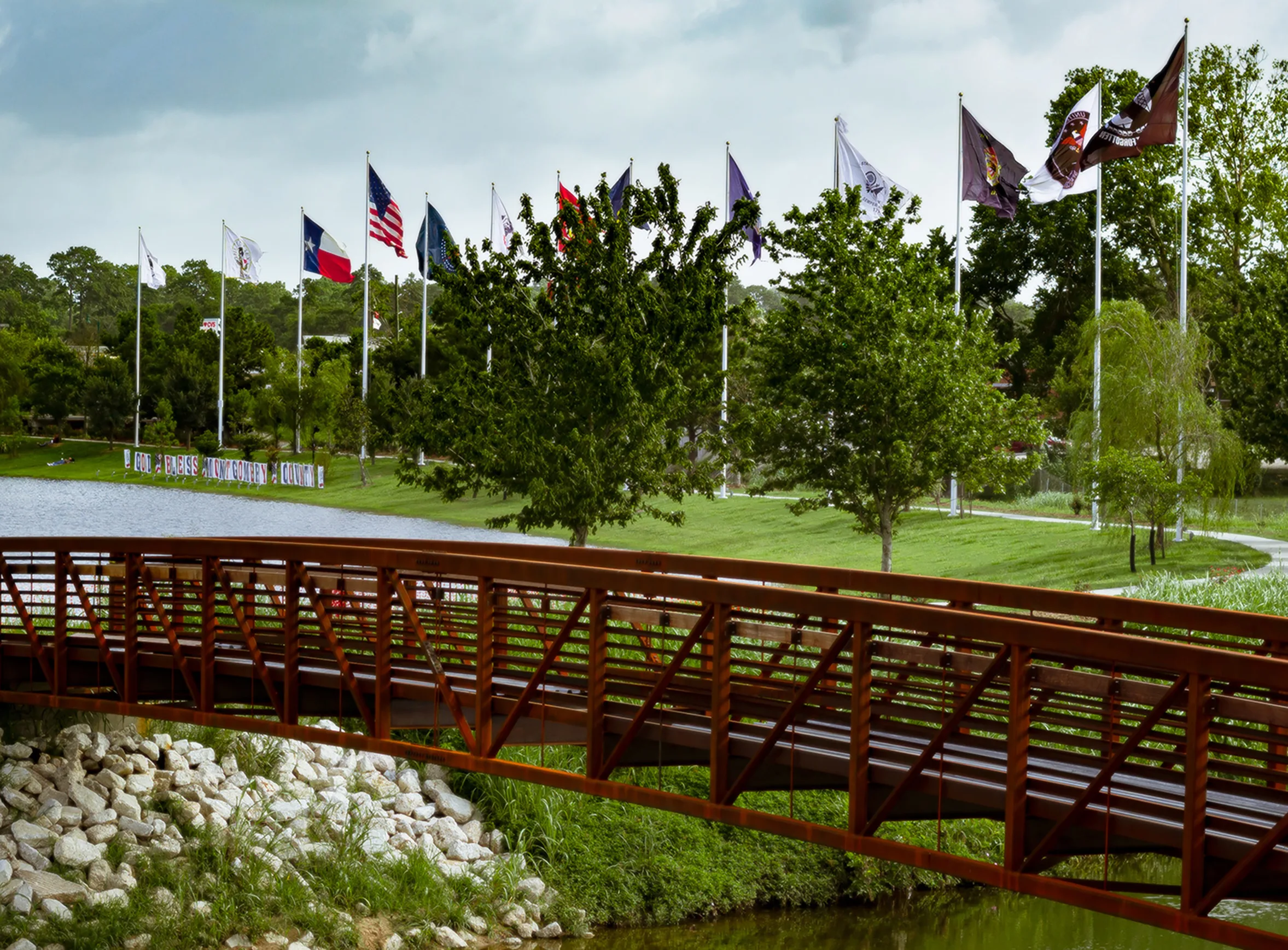
Conroe is the county seat of Montgomery County and the commercial and civic spine of the entire North Houston region — and its $315,986 typical home price reflects a city with real bones: a downtown square, a performing arts scene, Lake Conroe just to the west, and I-45 running straight to Houston. It is the 35th-largest incorporated city in Texas, which means infrastructure, services, and housing variety that smaller neighbors can't match. The 55+ communities Villas at White Oak Ranch and Water Crest on Lake Conroe both operate here, making it a serious option for retirees who want amenity-rich living without a master-planned price point.
Conroe is the city where the widest range of buyers actually lands — families, retirees, remote workers, and commuters all find something that works. It doesn't carry the master-planned polish of The Woodlands, but it offers more services and character than the newer-growth communities to the north and east, and its price point sits in a range that feels achievable without sacrificing much.
#4 Freeway-Access Suburb · Harris County
Best for commuters who need Harris County freeway access
Spring occupies the Harris County side of North Houston's suburban corridor, straddling I-45 and TX-99 in a way that gives commuters genuine options. Its $369,011 typical home price reflects a community with solid access to Houston's job centers, established neighborhoods alongside newer subdivisions, and enough retail density that daily errands don't require a long drive. The Hardy Toll Road via Spur 548 gives commuters a real alternative to I-45 during peak hours.
Spring suits buyers who want to stay in Harris County, need reasonable freeway access to Houston proper, and don't want to pay The Woodlands premium for that proximity. The community has grown into a layered mix of established and newer residential neighborhoods — for a buyer whose priority is access and value, that variety is a genuine advantage.
#5 Lowest Rent · Harris County
Best for buyers who want a defined community close to Houston
Jersey Village is a small, fully incorporated city surrounded by Houston on virtually every side — and that encirclement is the defining fact of its real estate market. At a $387,116 typical home price, buyers are paying for established neighborhoods with mature trees, a genuine local government, and direct access to the US-290 and TX-8 corridors that feed into Houston's northwest employment base. The city is the 304th-largest incorporated city in Texas, meaning it is compact and intentional — residents chose a defined community rather than a sprawling suburb.
Jersey Village suits buyers who want to be close to Houston's west side without actually living in the city, and who value the stability of an established, well-maintained neighborhood. It is a quiet, orderly place — not a destination for buyers chasing amenities or nightlife, but a strong fit for buyers who want predictability and location above everything else.
#6 Historic Small City · Harris County
Best for buyers who want a real small-town feel with room to grow
Tomball has done something most small cities in this corridor haven't: it kept a functional, walkable historic district while absorbing significant residential growth along SH-249 and SH-99. Its $361,053 typical home price reflects that balance — there's genuine character in the old downtown, newer subdivisions on the edges, and a community identity that feels earned rather than engineered. Winfrey Estates is the named 55+ community operating in the city.
Tomball tends to attract buyers who want a real town feel — a place where the old-town restaurants are locally owned and the community has a genuine civic identity — without paying the premium that a master-planned community commands. It's a particularly good fit for buyers coming from smaller Texas towns who want something similar at a North Houston price point.
#7 School-District Community · Harris County
Best for families making a school-district-first decision
Klein is a large unincorporated community in Harris County whose identity is defined less by city government and more by the Klein Independent School District, which draws families from a wide footprint across the SH-99, SH-249, and I-45 corridors. Its $368,676 typical home price reflects a mature suburban community with established neighborhoods, strong household incomes, and consistent demand from families who specifically want to land inside the district boundaries. There are no 55+ communities in Klein, and the community skews decisively toward family buyers.
Klein suits buyers who are making a school-district-first decision and want established suburban infrastructure to go with it. It's a neighborhood community more than a city — if you need a strong civic downtown or walkable retail, Klein won't deliver that, but for buyers whose priority is school access and a stable neighborhood, the calculus is clear.
#8 Quiet Historic Town · Montgomery County
Best for remote workers or retirees who want genuine small-town quiet
Montgomery is a genuine small town — the 489th-largest incorporated city in Texas — with a historic square, a slower pace, and a home price that reflects rural Montgomery County character rather than suburban density. At $393,324, buyers are paying for the identity of a place that has resisted the sprawl engulfing the county to its east and south. TX-105 and FM-149 are the main corridors, and the town sits far enough from the freeway grid that daily commuting to Houston is a serious undertaking rather than a reasonable routine.
Montgomery suits buyers who are done commuting — remote workers, retirees, or anyone whose daily life is self-contained enough that proximity to Houston's job core is irrelevant. The trade-off is real: you're buying into a quiet, rural-feeling community that asks you to drive for most services. For the right buyer, that's exactly the point.
#9 Master-Planned Community · Montgomery County
Best for buyers who want a fully self-contained master-planned community
The Woodlands is a master-planned community built around a deliberate idea — walkable village centers, a forested canopy, corporate campuses, and a self-contained ecosystem of retail, healthcare, dining, and recreation — and its $630,000 typical home price reflects the sustained demand that idea has produced for decades. I-45 and SH-99 carry commuter traffic toward Houston, and the internal road network is designed to minimize how often you actually need a freeway. Windsor Hills is the named 55+ community operating within the community.
The Woodlands suits buyers who are looking for a place that functions as a complete environment, not just a neighborhood. Retirees, corporate relocatees, and families who want every amenity close by all find a home here — but buyers who bridle at HOA culture, highly managed environments, or the financial commitment the price point demands often find it a poor fit. It's the most complete community in North Houston, and the price reflects every layer of that completeness.
North Houston's price spread is driven by services, commute access, and master planning — not just square footage. A buyer stretching for The Woodlands is paying for an ecosystem; a buyer choosing New Caney is betting on growth and accepting a longer haul to Houston's core. Neither is wrong, but they are genuinely different bets.
Tell us what you need help with and we'll connect you with local resources.
