
You've probably run the numbers on Texas retirement and liked what you saw. No state income tax, home prices well below coastal markets, and a city large enough to have genuine medical depth — Lubbock checks real boxes on paper. What the spreadsheet doesn't show is that Lubbock is a flat, car-dependent West Texas city where driving to everything is simply the reality of daily life. If that trade-off works for you — and for a lot of retirees, it genuinely does — you land in a city with surprisingly serious medical infrastructure and a cost of living that stretches a fixed income further than most Sun Belt alternatives.
Lubbock is the 10th-largest incorporated city in Texas, home to 273,071 people, anchored by Texas Tech University and a medical corridor built around Texas Tech University Health Sciences Center, University Medical Center, and Covenant Health. That medical ecosystem is the single biggest reason retiring physicians, nurses, and health-conscious retirees from smaller West Texas towns deliberately choose Lubbock as their base. The university also keeps the cultural calendar fuller than you might expect for a Plains city — museums, performing arts, and a consistent stream of lectures and events that give retirees somewhere to be.
The cost of living is the honest draw. The typical home price sits at $212,191 (July 2026), which means a retiree downsizing from a paid-off home in a pricier market can often buy outright or carry a very modest mortgage. The South Plains climate delivers 264 sunny days a year, winters that are cold but not prolonged, and a dry air that many transplants from humid climates find genuinely preferable — though the spring winds and the occasional dust storm take some adjusting to.
Whether you're weighing Lubbock against staying in a larger Texas metro, relocating from out of state, or deciding between Lubbock and a smaller nearby town, the sections below break down the healthcare access, retiree tax picture, walkability, downsizing options, and how the city stacks up against its neighbors as a place to actually retire.
Why Retirees Are Choosing Lubbock
The retirees who land in Lubbock and stay tend to share a few things: they want serious medical access without paying Austin or Dallas prices for it, they're comfortable driving everywhere, and they either grew up in the region or have family here. That last point is more common than outsiders expect — Lubbock draws a lot of returning West Texans who left for work decades ago and are now coming back to be near grandchildren or aging parents.
The typical home price of $212,191 (July 2026) makes Lubbock one of the more affordable entry points in Texas for a retiree on a fixed income. A couple downsizing from a larger home can often buy a solid single-level brick house outright, which eliminates a mortgage payment from the retirement budget entirely. The city also has genuine cultural infrastructure — the Buddy Holly Center, the National Ranching Heritage Center, Texas Tech athletics, and a performing arts scene anchored by the university — so the fear of being bored in a Plains city doesn't hold up as well as you might think.
Who should look elsewhere? If walkability matters to you day-to-day — if you want to walk to a coffee shop, a pharmacy, or a restaurant without getting in a car — Lubbock will frustrate you. It is a genuinely car-dependent city. Retirees who thrive here tend to be people for whom driving is no hardship, at least in their early retirement years. It's also worth being honest about the weather: spring windstorms and occasional dust events are part of life on the South Plains. If you're coming from the Pacific Northwest or the Southeast, that takes real adjustment.
Healthcare & Medical Access in Lubbock
A Medical Hub for 400 Miles in Every Direction
The healthcare picture in Lubbock is, frankly, the strongest argument for retiring here over any surrounding small town. University Medical Center — inside city limits — is both a Level I Trauma Center and a Level II Pediatric Trauma Center, and it is the only hospital system within 400 miles to hold both designations simultaneously. For a retiree, that distinction matters most when something serious happens suddenly: a cardiac event, a stroke, a major surgery. UMC is not a community hospital doing its best — it is a genuine regional trauma center.
Covenant Health operates as the region's largest health system, with specialty coverage that spans the gap between Dallas and Albuquerque. Covenant Medical Center has recognition from U.S. News & World Report across eight specialty areas and procedures, which gives retirees access to specialty care — cardiology, orthopedics, oncology — without driving to a major metro. In most comparably sized cities without a medical school, you'd be making that drive routinely.
The Academic Medicine Advantage
Texas Tech University Health Sciences Center anchors the medical-academic ecosystem in a way that matters practically for patients. TTUHSC runs a School of Medicine, School of Nursing, and School of Allied Health in the same corridor — a concentration of training programs that draws specialists and clinical faculty who then practice locally. Academic medical environments tend to have more specialists, more clinical trials, and more aggressive protocols for complex conditions than community-only systems, and that's a meaningful difference for retirees managing chronic or complicated health situations.
StarCare Specialty Health System runs Silver Star, a Program of All-Inclusive Care for the Elderly (PACE) in Lubbock. PACE programs provide integrated medical and social services specifically for seniors who want to remain living independently but need support to do so — coordinated care, transportation to appointments, caregiver support, and family services, all under one umbrella. Most small and mid-sized Texas cities don't have a PACE program at all.
The Honest Limitation
For the most advanced subspecialty care — certain complex cancer treatments, organ transplants, highly specialized neurological procedures — Lubbock's system will sometimes refer patients to Dallas, which is roughly five hours by car. This is the honest reality of any city outside the largest metros, and it applies here. For the vast majority of what retirees need day-to-day and in genuine emergencies, Lubbock's medical depth is exceptional for a city its size. The gap only appears at the far edge of subspecialty medicine.

The Retiree Budget in Lubbock
Texas's Tax Treatment of Retirement Income
Texas has no state income tax. That means Social Security benefits, pension income, 401(k) and IRA withdrawals — all of it — are completely exempt from state-level taxation. Federal taxes still apply depending on your total income, but the state takes nothing from your retirement distributions. For a retiree moving from a state that taxes retirement income, the difference shows up immediately in cash flow.
Texas also levies no estate or inheritance tax, and voters approved Proposition 8 in November 2025, constitutionally barring the Legislature from ever imposing one. What you build here, you pass on without a state-level haircut.
The Over-65 Property Tax Break Is Substantial
Texas voters approved Proposition 11 in November 2025, raising the mandatory over-65 school district exemption from $10,000 to $60,000. Combined with the standard $140,000 homestead exemption, homeowners 65 and older now exempt $200,000 from school district taxes — eliminating school property taxes entirely for many seniors whose homes are appraised at or below that threshold. In a city where the typical home price is $212,191 (July 2026), that exemption covers most of the taxable value for many retirees.
Once you qualify for the over-65 exemption, your school district tax bill is also permanently frozen at that year's level. Home values can rise; your school tax bill cannot. The freeze covers school district taxes only — city, county, and special district taxes are not frozen — but school taxes are typically the largest single component of the Texas property tax bill. The effective property tax rate is approximately 1.49%, which is worth comparing against what you're currently paying; see the full breakdown on the cost of living page.
Day-to-Day Spending on a Fixed Income
Texas sales tax tops out at 8.25% — 6.25% state plus up to 2% local — and it applies broadly to goods and services. The important offset: most groceries are exempt from Texas sales tax, which matters on a fixed income where food spending is a real budget line. Gas, utilities, and dining out do carry the full rate.
The West Texas cost of living is genuinely lower than the Texas Triangle metros. Utilities are the honest counterpoint — summers on the South Plains are hot, and air conditioning bills from June through September are real. That's an expense category worth factoring into any retirement budget comparison, even if the housing and overall costs remain favorable.
Looking to buy in Lubbock? Estimate your payment.
Enter your numbers to see an estimated monthly mortgage payment.
Estimate only. Excludes HOA fees and mortgage insurance. The interest rate above is a starting point, not a quoted rate — replace it with your own to see real numbers. Insurance is a flat placeholder, not a Lubbock quote.
Walkability, Community & Staying Active in Lubbock
The Walkability Reality
Lubbock is a car-dependent city. Car ownership isn't a lifestyle preference here — it's a practical necessity for most retirees. The city has bus service but minimal bike infrastructure, and most daily errands — groceries, medical appointments, restaurants — require driving. If you reach a point in retirement where driving is no longer comfortable or possible, Lubbock's transit options are limited, and that's an honest planning consideration for anyone thinking about the later stages of retirement.
The one genuine on-foot plus: Lubbock is flat. Almost entirely flat. There are no hills to navigate, no terrain barriers, and the wide streets and grid layout mean that in certain neighborhoods — Tech Terrace in particular — you can walk to coffee shops and a few retail options without much difficulty. But that is the exception, not the rule for the city as a whole.
Parks and Outdoor Life
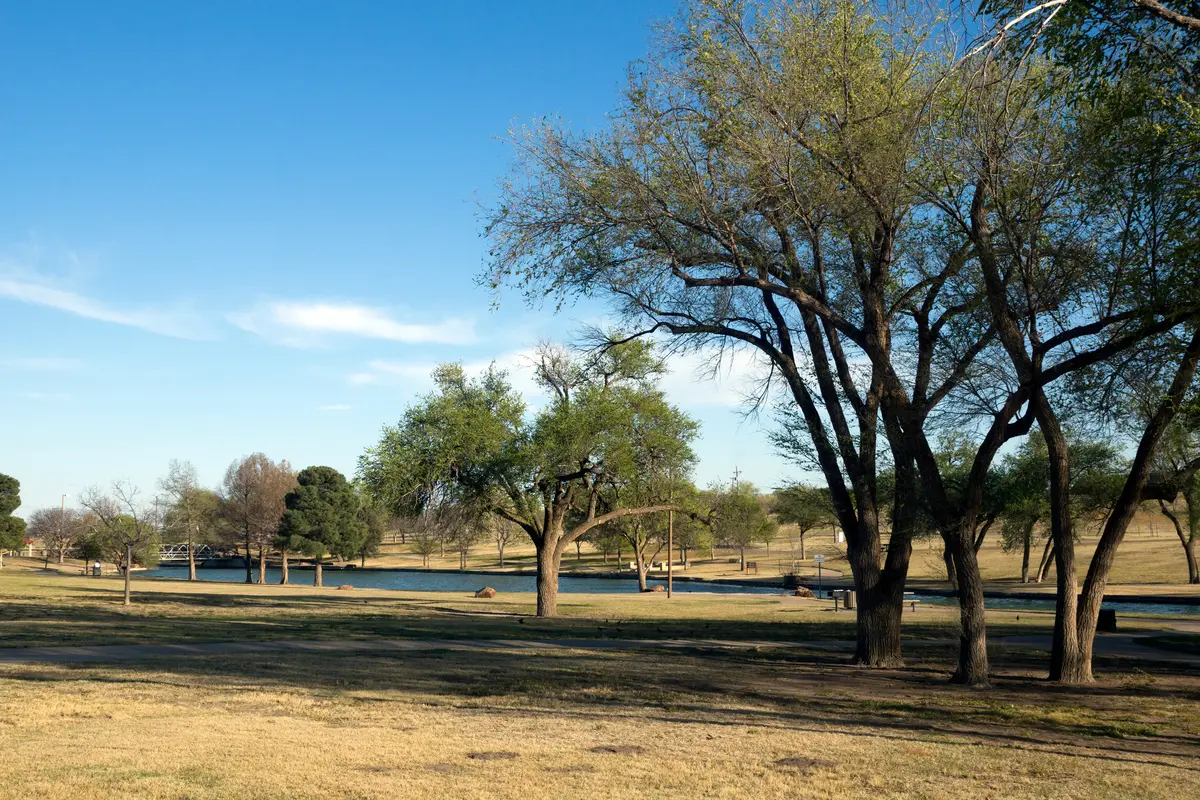
About 51% of Lubbock residents live within a half-mile of a park, which is below the national average but still means the park system is reasonably distributed across the city. Mackenzie Park, which sits along the Yellow House Canyon, gives retirees a green space with genuine character — shaded paths, the historic Prairie Dog Town, and easy walking loops that suit most fitness levels. Lubbock Lake Landmark offers something rarer: a genuine prehistoric archaeological site that doubles as a peaceful walking destination, with educational programming that draws curious retirees regularly.
Buffalo Springs Lake and Ransom Canyon, both a short drive from the city, expand the outdoor picture significantly. For retirees who want to fish, kayak, or simply sit by water without living in a lakefront community, both are accessible enough to factor into the weekly routine. The parks and recreation page covers the full system in detail.
Community, Volunteering & Social Life
The university presence drives more community programming than you'd find in a typical Plains city of comparable size. Texas Tech's Osher Lifelong Learning Institute runs continuing education courses specifically for adults 50 and older — lectures, travel programs, study groups — and it tends to attract the kind of retirees who want intellectual engagement, not just leisure. That's a meaningful quality-of-life differentiator.
The Lubbock Downtown Farmers Market and the Texas Country Farmers Market give retirees a regular weekly gathering point — the kind of place where you run into the same people and build the incidental social connections that matter in retirement. The arts calendar built around the Buddy Holly Center and the American Windmill Museum adds cultural texture that retirees who care about local history and the performing arts find genuinely satisfying. Volunteerism is a strong thread in the civic culture here, and organizations connected to the university, the healthcare system, and local nonprofits all run robust volunteer programs.
Right-Sizing: Downsizing in Lubbock
What the Housing Stock Actually Looks Like
Lubbock has a meaningful inventory of single-story brick ranch homes — the South Plains building tradition for decades — and that housing type lines up well with what most retirees are looking for when they downsize. You're not hunting for a needle in a haystack the way you might be in a city where multi-story construction dominated. The challenge is finding them in the right neighborhoods at the right price, which takes more searching in some areas than others.
Patio homes and smaller single-level attached homes do exist in Lubbock, concentrated in the more established residential areas, but this is not a city with the kind of active-adult patio-home community inventory you'd find in a larger Sun Belt metro. Condos are available but the market is thin compared to a city like Austin or San Antonio. The typical home price of $212,191 (July 2026) gives downsizers real flexibility — a retiree selling a paid-off home in a higher-cost market can often land in Lubbock without a mortgage at all. See the neighborhoods page for a breakdown of areas that tend to suit different buyer profiles.
55+ Communities
No 55+ communities were found in Lubbock. This is an honest gap in the local inventory, and it matters for retirees who specifically want the age-restricted community experience — shared amenities, organized social programming, and neighbors in the same life stage.
What Lubbock does have is a range of senior living facilities for retirees who want or need more support. Carillon Senior Living offers independent living, assisted living, memory care, and skilled nursing under one roof — a continuum-of-care model that lets residents age in place without relocating as needs change. Primrose Retirement Community of Lubbock is another established option in the independent-to-assisted living range. These are not 55+ lifestyle communities in the sense of a golf-cart-friendly neighborhood — they're senior living facilities, which serve a different and often later-stage need.
Retirees who specifically want the 55+ community lifestyle — age-restricted, amenity-rich, active-adult-focused — will need to look at larger Texas markets or consider whether Lubbock's conventional single-family neighborhoods, with their lower price points and abundant single-story inventory, provide a reasonable substitute through a different path.
Lubbock vs Nearby Retirement Destinations
| City | Cost vs Lubbock | Primary Hospital | Walkability | Senior Living Depth | Overall Retirement Fit |
|---|---|---|---|---|---|
| Lubbock | Anchor city | University Medical Center (Level I Trauma); Covenant Health | Car-dependent; flat terrain; limited transit | Assisted living, independent living, memory care; no 55+ communities found | Strong medical access, low costs, limited walkability |
| Wolfforth | Noticeably higher | Relies on Lubbock systems for hospital care | Car-dependent small town | Very limited; relies on Lubbock facilities | Quieter suburban feel; you pay more and commute to all care |
| Shallowater | Noticeably higher | Relies on Lubbock systems for hospital care | Car-dependent; rural setting | Minimal; Lubbock facilities required for meaningful care | Small-town living at a price premium; works if family is nearby |
| Idalou | About the same | Relies on Lubbock systems for hospital care | Car-dependent; very small town | Minimal local options | Rural quiet at Lubbock prices; trade-off is convenience for everything |
| Slaton | Noticeably cheaper | Small community hospital; Lubbock for specialist care | Walkable in the historic downtown core; car needed for most else | Limited; residents travel to Lubbock for most senior services | Lowest cost entry point; significant trade-off in medical access and amenities |
| Amarillo | About the same | BSA Health System and Northwest Texas Healthcare System | Car-dependent; slightly more commercial density | Broader 55+ community inventory than Lubbock | Similar cost and car dependence; stronger 55+ community options |
The comparison comes down to one honest question: how much do you value medical depth versus other factors? Lubbock wins that category clearly over every surrounding option — Wolfforth, Shallowater, Idalou, and Slaton all rely on Lubbock's hospital systems for anything serious, so moving to those towns means accepting Lubbock's medical infrastructure while paying a suburban premium (in Wolfforth and Shallowater) or living with true rural isolation (in Idalou and Slaton).
Amarillo is the one nearby city worth a genuine side-by-side comparison. It sits at roughly the same cost level, has its own regional hospital system, and offers a somewhat stronger inventory of 55+ communities — if that specific lifestyle is a priority, Amarillo deserves a serious look. Lubbock's edge is the academic medicine layer: TTUHSC and UMC's combined depth is simply not replicated in Amarillo, and for retirees with complex or ongoing medical needs, that gap is real.
Slaton offers the lowest-cost entry point in the region and has a genuine historic downtown, but the compromise in medical access and amenity depth is significant. Most retirees who consider it ultimately conclude that the savings don't offset the reliance on a 30-minute drive to Lubbock for anything beyond routine care.
Local Expert Takeaway: Lubbock makes the most sense for retirees who prioritize medical access and low housing costs over walkability and a curated 55+ lifestyle. The combination of University Medical Center's Level I trauma status, Covenant Health's specialty depth, and TTUHSC's academic medicine presence puts Lubbock in a different category than any surrounding small town for retirees managing ongoing health needs. The Texas tax structure — no income tax, a now-generous over-65 school tax exemption with a freeze — is genuinely favorable, and a typical home price of $212,191 (July 2026) gives downsizers real budget room. The honest gap is 55+ community lifestyle options: none were found here, and the city's car dependence is real. Retirees who drove everywhere during their working years and plan to do the same in retirement tend to adapt without much friction; those expecting to age out of driving within a decade should plan for that reality now.
Quick Takeaways & FAQs
✅ University Medical Center is a Level I Trauma Center — the only hospital system within 400 miles with both Level I and Level II Pediatric Trauma designations — making Lubbock a genuine regional medical hub for retirees.
⚠️ Lubbock is car-dependent with no 55+ communities found in the city, meaning retirees who want an age-restricted active-adult community or walkable daily errands will need to look elsewhere.
📍 Texas voters approved Proposition 11 in November 2025, raising the over-65 school district exemption to $60,000 and freezing school taxes at the qualifying year's level — a significant budget stabilizer for Lubbock homeowners 65 and older.
Is Lubbock a good place to retire?
Are Social Security benefits taxed in Lubbock, Texas?
What property tax breaks are available to seniors in Lubbock?
Are there 55+ communities in Lubbock?
How does Lubbock's healthcare compare to surrounding small towns for retirees?
Moving to Texas?
Tell us what you need help with and we'll connect you with local resources.
