
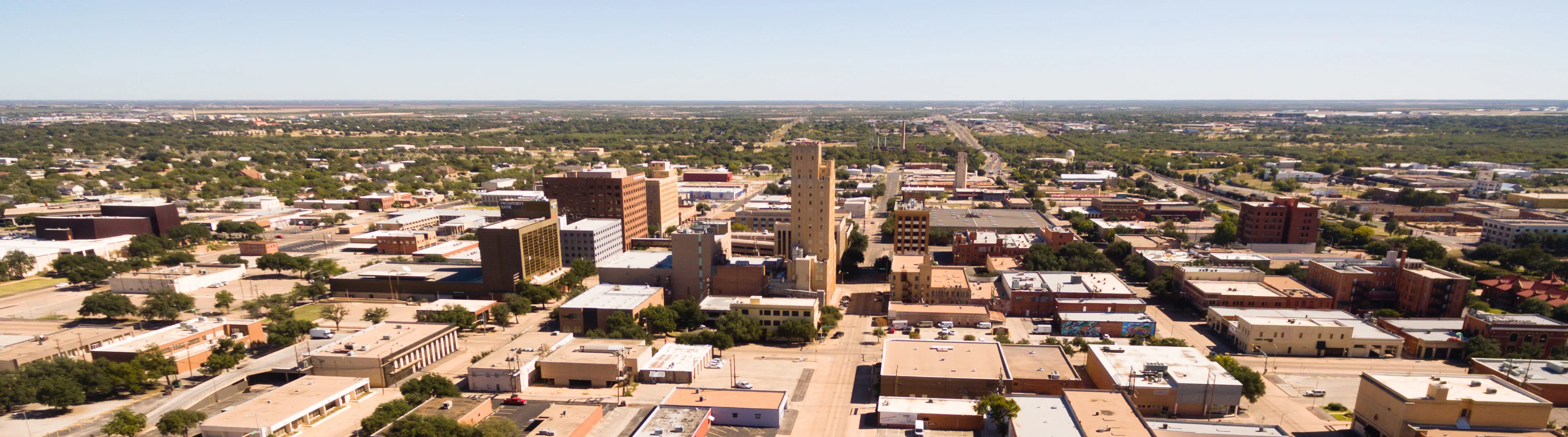
You've run the numbers and they keep coming back in Lubbock's favor. The home prices look almost suspiciously low compared to what you left behind in California, the commutes are short, and Texas has no state income tax. All of that is real. But the numbers also come with a few things the spreadsheet doesn't tell you — flat plains that stretch to every horizon, tornado watches that have no California equivalent, and a cultural cadence that runs slower and louder on Friday nights when Texas Tech or a high school team is playing. Lubbock sits in the middle of the South Plains at roughly 3,200 feet of elevation, a city of 273,071 that functions as the commercial, medical, and educational hub for a vast stretch of West Texas.
Texas Tech University is the city's dominant economic engine, contributing an estimated $19.2 billion in annual economic output to the state. The Texas Tech University Health Sciences Center, Covenant Health, UMC Health System, the Lubbock Independent School District, and the City of Lubbock round out the major employer base. The Lubbock ISD holds a B rating, according to the Texas Education Agency, and serves a large district across the city. A large share of people who move here are following an academic appointment, a university-adjacent job, or a healthcare career — and many Californians find that the combination of a lower cost basis and a strong institutional anchor makes the trade-off worthwhile.
Lubbock's overall cost of living runs 9% below the U.S. national average — and that gap widens considerably when you're arriving from anywhere in California. The typical home price here stood at $212,191 as of July 2026, a figure that reads as entry-level in most of coastal California. Rent, groceries, utilities, and routine care costs all trend noticeably below what California residents are used to paying. The catch: two-car households are the norm, public transit is limited, and a serious shopping run or a specialist appointment may mean driving. You gain purchasing power; you trade away the convenience infrastructure that California metros take for granted. For more on the full cost picture, see the cost of living breakdown.
Whether you're being relocated by an employer, following a university offer, or simply looking for a place where your income can finally stretch, the sections below break down what Lubbock looks like through California eyes — the real numbers on home prices and taxes, the climate adjustment, the neighborhoods worth knowing, the local economy, and what daily life here is genuinely like.

The Home Price Reality: What Your California Equity Can Do Here
The single most disorienting thing about buying in Lubbock after California is that the numbers feel wrong in a good way. California's statewide typical home value of $773,735 (Zillow Home Value Index) means that in most of the state, you're starting your search well above what a median household income can support. In Lubbock, the typical home price stood at $212,191 as of July 2026 — a gap that is not a rounding error or a reflection of a distressed market. It reflects a fundamentally different land and labor cost structure on the South Plains.
If you're arriving with California equity — the proceeds from selling a home you bought years ago — that capital goes a long way here. What was a down payment in a high-cost California metro can be a cash purchase in Lubbock, or can buy a substantially larger home than you left behind. That psychological shift takes some getting used to: buyers from California often find themselves over-researching entry-level properties here that would be considered exceptional value by any West Coast measure.
The honest caveat: Lubbock's median household income of $60,895 sits just below the income needed to comfortably carry the typical home at current rates, which tells you something about the local wage structure. If you're working remotely on a California salary, you are in a genuinely advantaged position. If you're taking a local job at local wages, run the full budget — the home price is lower, but so is the income floor. For neighborhood-by-neighborhood character and what different parts of the city look like, see the best neighborhoods guide.
How Nearby Cities Compare
Not every community in the region prices at Lubbock's level. If a suburban feel matters to you, know that home prices in Wolfforth and Shallowater run noticeably higher than Lubbock's city-wide typical, while Idalou comes in at about the same level. The suburbs offer newer construction and quieter streets; Lubbock proper offers proximity to Texas Tech, the Depot Entertainment District, and the city's institutional core.
| City | vs. Lubbock Typical Price | Character | Best For |
|---|---|---|---|
| Lubbock | Baseline | Full urban core, university, medical district | First-Time Commuter |
| Wolfforth | Noticeably higher | Fast-growing suburb, newer builds | Families Quiet |
| Shallowater | Noticeably higher | Small-town feel, tight community | Families School |
| Idalou | About the same | Rural edge, larger lots | Nature Privacy |
Within Lubbock itself, Tech Terrace runs above the city median — it's the closest thing to a premium walkable neighborhood the city has, anchored by the university's western edge. Bowie and Heart of Lubbock both sit below the city-wide figure, offering the most accessible entry points into homeownership in Lubbock proper.
Taxes: The Real Trade-Off Between California and Texas
The income tax comparison is where California-to-Lubbock math gets the most dramatic. Texas has no state income tax. California's top state income tax rate of 13.3% applies only to the highest earners, but the brackets climb steeply — and most working professionals in California feel them well before they reach the top. The practical effect at a household income of $100,000 is a savings of roughly $5,208 per year by crossing the state line into Texas.
That figure is real. But the full picture requires the property tax offset, and it is significant. Lubbock's effective property tax rate is 1.49%. California's effective property tax rate of 0.71% (California Franchise Tax Board) is less than half that. On a $212,191 home in Lubbock, the difference adds real cost annually compared to a similarly-valued home in California. The income tax savings generally outpace the property tax increase for most households — but buyers who are purchasing at the lower end of the market should model both, not just the headline.
Sales Tax: Closer Than You Might Expect
California's statewide base sales tax rate of 7.25% (California Dept. of Tax and Fee Administration) is the floor — and in many California counties and cities, combined local rates reach 9–10%. Lubbock's combined rate is 8.25%, composed of the 6.25% Texas state base, a 0.5% county layer, and a 1.5% city add-on. For most everyday purchases, you will pay a comparable or marginally lower sales tax rate in Lubbock than you did in a higher-rate California jurisdiction.
The Overall Cost-of-Living Context
Texas as a state costs meaningfully less to live in than California across nearly every major category — housing, groceries, utilities, and routine care all run noticeably lower. Lubbock specifically comes in 9% below the U.S. national average — which means it's one of the more affordable cities even within an already-affordable state. The broad picture: lower income taxes, lower sales taxes, lower home prices, and lower costs for routine care all point in the same direction. The property tax rate is the genuine counterweight, and it matters most for buyers who purchased a high-value home in California and are comparing annual carrying costs against what they're used to. See the full tax breakdown on the cost of living page.
| Tax Category | California | Lubbock / Texas | Net Direction for Most Movers |
|---|---|---|---|
| State income tax | California's top state income tax rate of 13.3% | None | Favors Texas strongly |
| Effective property tax rate | California's effective property tax rate of 0.71% | 1.49% | Favors California |
| Statewide base sales tax | California's statewide base sales tax rate of 7.25% | 6.25% state base (8.25% combined local) | Roughly comparable |
| Groceries & everyday costs | Among highest in U.S. | Noticeably below national average | Favors Lubbock significantly |
| Routine care costs | Among highest in U.S. | ~7% below national average | Favors Lubbock |
Health insurance premiums run noticeably below what you were likely paying in California, though if you need advanced specialist care, you may find yourself driving to a larger metro. That is the honest trade-off, and it is worth factoring in before you decide.

Climate: The Adjustment Californians Don't See Coming
Californians who arrive in Lubbock expecting a variant of Texas heat are only half-right. Summers here are hot — average July highs near 93°F — but the elevation and low humidity make them more bearable than Houston or Dallas. Winters are a genuine surprise: average January highs near 55°F, with cold snaps and occasional ice storms that bear no resemblance to anything in coastal California.
What really catches people off guard is severe weather season. Lubbock sits in the heart of tornado country, and the South Plains takes that seriously. In June 2025, a single supercell produced 8 tornadoes across the region — a weather event that has no California equivalent. Knowing where your storm shelter is and having a plan is not anxiety; it's how people who live here approach spring and early summer. The learning curve is real, and it's worth taking seriously before your first season.
What 264 sunny days a year Actually Feels Like
Lubbock logs 264 sunny days a year — meaningfully above the U.S. average of 205. If you're coming from a fog-heavy Bay Area microclimate or a consistently overcast Northern California winter, the relentless sunlight on the South Plains is one of the genuinely pleasant surprises. The flip side: the landscape is flat, open, and wind-exposed in a way that takes adjustment. There are no mountains on the horizon, no visible water from most of the city. The sky is the feature here, and it is an enormous one.
Rainfall averages only 19–20 inches per year — far drier than even the drier parts of California's interior valleys when you account for seasonal distribution. Dust events, called haboobs locally, roll through from the west and can drop visibility to near zero within minutes. After six months here, most arrivals from California have learned to check the wind forecast before a weekend outdoor plan.
The Seasonal Rhythm
Spring is genuinely beautiful — wildflowers along the roadsides and mild temperatures before summer heat arrives. Fall is the social center of the year, driven almost entirely by Texas Tech football — the on-campus stadium seats over 60,000 and fills it. If you've never lived in a college football town, the intensity of game weekends in September and October is its own kind of culture shock — and most residents consider it a feature, not a bug.
Looking to buy in Lubbock? Estimate your payment.
Enter your numbers to see an estimated monthly mortgage payment.
Estimate only. Excludes HOA fees and mortgage insurance. The interest rate above is a starting point, not a quoted rate — replace it with your own to see real numbers. Insurance is a flat placeholder, not a Lubbock quote.
Jobs, Economy, and Working in Lubbock
Texas Tech University is not just a landmark — it is Lubbock's economic engine in a way that is unusual even by university-town standards. Together with the Texas Tech University Health Sciences Center, the university ecosystem dominates the local employment base, anchoring everything from research positions to food service. The two institutions together keep a large, educated workforce cycling through the city each year and consistently graduate a substantial class that either stays in the region or seeds the local professional network.
Healthcare and education each employ roughly 20,000 workers in Lubbock, making them the twin pillars of the local labor market. Covenant Health and UMC Health System are major employers in the care sector; the Lubbock Independent School District and the City of Lubbock anchor the public side. For Californians working in academia, healthcare administration, or research, those institutional employers are the primary draw — and they offer a level of stability that a more cyclical private economy doesn't.
What's Growing
The most significant recent addition to Lubbock's economy is manufacturing. Leprino Foods broke ground on an 850,000-square-foot dairy manufacturing facility — an $870 million project — that was under construction as of late 2025 and is expected to bring 600 jobs upon full completion. For a city whose economy has historically skewed toward services and education, that facility represents a meaningful shift toward a more diversified base.
Local wages rose 9% in the year ending June 2026, and year-to-date retail sales were up 7% in that same period — signs that the local economy was running warm. The unemployment rate stood at 4.5% as of June 2026, a level that reflects a functional labor market. Remote workers arriving from California with California-level salaries will find their purchasing power dramatically higher than anything they experienced there. See the full employment picture on the living in Lubbock hub.
The Car-Dependent Reality
One practical note that surprises a lot of California transplants: public transit here is limited in a way that is qualitatively different from even car-dependent California suburbs. Plan on two cars per household. The average commute runs just over 16 minutes — short enough that driving doesn't feel like a burden — but the assumption is that you own a car and use it for everything. If you relied on BART, Caltrain, or a Metro line in California, building that cost and routine into your new budget is worth doing before you arrive.
Neighborhoods, Local Life, and What Lubbock Is Actually Like Day to Day
Lubbock's neighborhoods carry distinct personalities that a quick drive-through won't reveal. Tech Terrace, the area closest to Texas Tech's campus, runs above the city-wide typical home price and is the neighborhood most likely to feel familiar to someone arriving from a walkable California college town. The streets are tree-lined by local standards, the housing stock skews toward mid-century brick homes, and the proximity to campus means there's genuine foot traffic and a real coffee shop culture. If you want the most urban version of Lubbock, this is it.
LakeRidge, Vintage Township, and Oakmont sit on the southwestern and southern edges of the city and draw families with school-age children looking for newer construction and quieter streets. Kelsey Park and Bacon Crest offer additional options in the mid-range, with the kind of subdivision feel that will read as familiar to most California suburban transplants. Bowie and Heart of Lubbock are the most accessible entry points by price, sitting below the city median — Bowie has a more established residential character, while Heart of Lubbock is more mixed in its housing stock and tenure. For the full neighborhood breakdown, see the best neighborhoods guide.
What Lubbock Looks Like on a Weekend
The city's social life orbits Texas Tech, the Depot Entertainment District near the historic railroad depot, and a network of parks and outdoor spaces that make more sense the longer you live here. Mackenzie Park anchors the northeast side and is one of the genuine gathering spots for the city. Buffalo Springs Lake draws residents on warm weekends with open water, while Ransom Canyon offers dramatic canyon scenery that will feel unlike anything else on the South Plains. Prairie Dog Town inside Mackenzie Park is exactly what it sounds like, and it is one of those only-in-Lubbock details that residents eventually come to love.
The Lubbock Downtown Farmers Market and Texas Country Farmers Market both run through the warmer months and give the city a community anchor that California transplants often find reassuring — a place where people actually show up and spend time. The Buddy Holly Center and the National Ranching Heritage Center are genuine cultural institutions, not tourist traps: the Ranching Heritage Center in particular is one of the most distinctive outdoor museum experiences in the state.
Weekends and Local Favorites
Lubbock's dining scene runs deeper than first-time visitors expect. Corralito Steak House Lubbock is the kind of Texas steakhouse that earns its reputation over decades. Triple J Chophouse & Brew Co. pairs local brewing with a serious kitchen. Spanky's has been a near-campus institution long enough to have served multiple generations of Texas Tech alumni. Cast Iron Grill draws a loyal following for comfort food, and Aspen Creek Grill rounds out a range of options that lean toward unpretentious and well-executed rather than trend-chasing.
For coffee, J&B Coffee, Sugar Browns Coffee Co., Monomyth Coffee, Ooo La Lattes, and He-Brews Coffee are all locally rooted and all worth knowing. The independent coffee culture here is stronger than most people expect from a West Texas city, and it's one of the small daily details that makes Lubbock feel more like a real city than a regional outpost. The Lubbock Preston Smith International Airport (LBB) sits about 7 miles from the city core and handles direct connections that make the city considerably more accessible than its geography might suggest.
The honest thing to say about daily life in Lubbock is this: the city asks you to adjust your expectations about density, greenery, and geographic drama, and in return it gives you affordability, short commutes, a university energy that keeps the place young, and a community that takes football, food, and West Texas weather with equal seriousness. Most people who leave do so for career reasons or because they miss proximity to mountains or the coast. Most people who stay stop noticing what isn't there and start paying attention to what is.
Local Expert Takeaway: Californians who move to Lubbock and struggle most are the ones who expected a scaled-down version of what they left. The ones who land well treat it as a different kind of city: one where $212,191 buys a real house, where 264 sunny days a year come with flat open skies instead of ocean views, and where Texas Tech's campus gives the city a rhythm and energy that most comparably priced metros simply don't have. The income tax savings are genuine. The property tax rate is the honest counterweight. Run both numbers, buy in Tech Terrace or one of the southwest neighborhoods if the university culture appeals to you, and get a storm shelter plan sorted before your first spring.
Quick Takeaways & FAQs
✅ Lubbock's typical home price of $212,191 (July 2026) sits dramatically below California's statewide typical home value of $773,735, giving California equity holders genuine purchasing power from day one.
⚠️ Texas has no state income tax, but Lubbock's effective property tax rate of 1.49% is more than double California's effective rate — model both before assuming the move is a clean financial win.
📍 Tornado season on the South Plains is real and requires a plan; in June 2025, a single supercell produced 8 tornadoes across the region — a weather reality that has no California equivalent.
How much cheaper is Lubbock than California for housing?
Does moving from California to Lubbock actually save money on taxes?
What is the job market like in Lubbock for someone moving from California?
What should Californians know about Lubbock's climate and weather?
Which Lubbock neighborhoods are best for California transplants?
Moving to Texas?
Tell us what you need help with and we'll connect you with local resources.
