
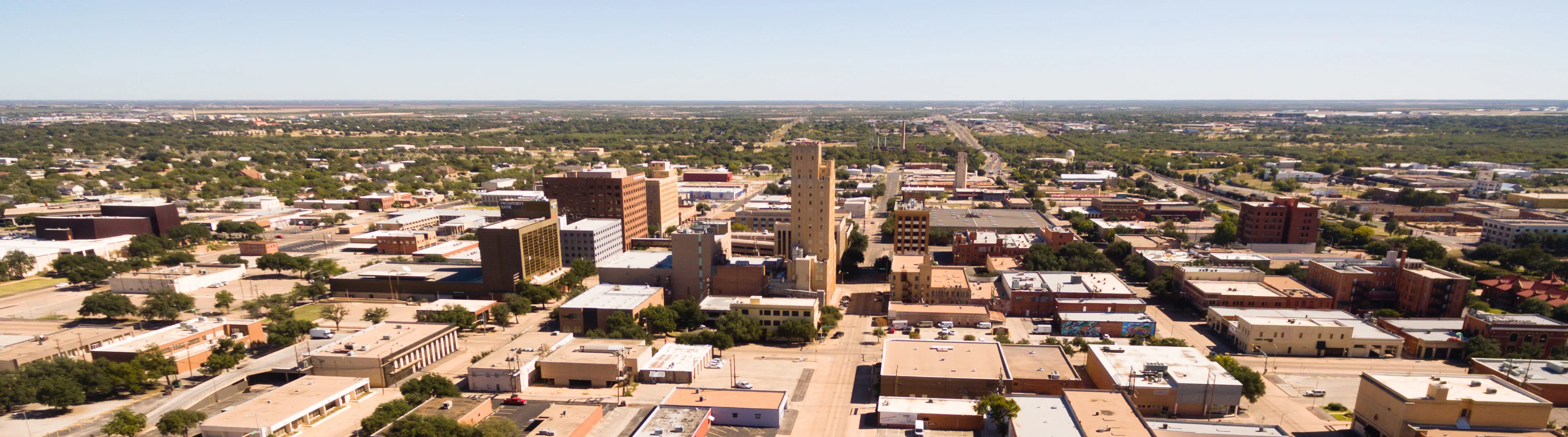
Lubbock sits in the middle of the Texas South Plains — a self-contained metro of 273,071 people with no larger city within easy driving distance. That geographic isolation shapes its cost of living more than anything else. There is no Bay Area overflow, no Austin commuter premium, no adjacent job market bidding up land values. What drives prices here is what has always driven them on the High Plains: local demand from Texas Tech University, a substantial healthcare economy, and families who have lived in Lubbock County for generations.
The result is a city that costs meaningfully less than most Texas metros people compare it to. Texas Tech University, the Texas Tech University Health Sciences Center, Covenant Health, and UMC Health System are the economic anchors, and the school system — Lubbock Independent School District, with 23,119 students enrolled in 2025-26 — is the daily-life institution most families ask about first. People who move here from Dallas, Houston, or out of state tend to arrive for a job offer and stay because the math keeps working.
Housing is the headline number. The typical home price in Lubbock stood at $212,191 as of July 2026 (Zillow Home Value Index), a figure that looks almost implausible to buyers arriving from the coasts or from Austin. City-wide rent runs $1,380 per month (Zillow ZORI, July 2026). Utilities, groceries, and transportation all come in below national averages. The one honest caveat: Texas has no state income tax, but property tax rates are real, and the South Plains climate — scorching summers, occasional ice storms — pushes utility bills in directions newcomers sometimes underestimate.
Whether you are deciding between renting and buying, trying to understand what the tax picture really looks like without a state income tax, or just want to know how Lubbock stacks up against Wolfforth or Shallowater, the sections below break down every major cost category with the specificity that a spreadsheet comparison never quite captures.

What It Really Costs to Live in Lubbock
Lubbock's affordability shows up across every major spending category, not just housing. Groceries, transportation, and utilities all run noticeably below national averages — a breadth that matters because it means the savings are structural, not dependent on a single favorable line item.
What drives the low baseline is a combination of land availability, a regional economy that isn't competing with coastal tech wages, and the absence of a luxury-market premium. Lubbock is the 10th-largest incorporated city in Texas, but it does not price like one. There is no zip code adjacent to an Apple or Google campus bidding up land in a five-mile radius. The dominant employers — Texas Tech, the health systems, the school district — pay well for the region but do not create the speculative pressure that inflates prices in Austin or Dallas suburbs.
The honest complication is property taxes. Texas funds local government and schools through real estate levies, and Lubbock is no exception. The effective combined property tax rate of approximately 1.49% is real enough to affect which price range actually fits your budget. For buyers comparing Lubbock to a state with income tax, the math usually still favors Texas. But for buyers expecting the property-tax bill to feel small, it rarely does. For the schools and neighborhood picture that shapes which parts of the city cost what, the best neighborhoods guide covers the geographic spread.
Housing: Rent vs Buy in Lubbock
The typical home in Lubbock sold for $212,191 as of July 2026 (Zillow Home Value Index). Entry-level homes — older construction, smaller footprints, often on the east side of the city — can be found noticeably below that figure. The upper end of the market, newer construction in established subdivisions, runs well above it. For a city of 273,071 people with a functioning hospital system, a major research university, and a functioning downtown entertainment district, that median is genuinely low.
The catch that surprises some buyers: the median household income in Lubbock is $60,895 — which falls just below the income needed to purchase the typical home here at current rates. That gap is not enormous, but it does mean the entry-level end of the market carries real weight. Buyers who want specifics on which neighborhoods tend to price at or below the city median — and which run above it — will find that breakdown in the best neighborhoods guide.
City-wide rent runs $1,380 per month (Zillow ZORI, July 2026). Renting makes the most sense for people on short assignments at Texas Tech or the health systems, for newcomers still learning which part of the city suits them, and for anyone who hasn't built enough equity from a prior home to use as a down payment. Buying pencils out faster here than in most Texas cities simply because the purchase price is lower — the gap between a mortgage payment and rent is narrower than in Austin or Dallas, which compresses the break-even timeline.
The effective property tax rate is approximately 1.49%, combining city, county, and school district levies. That figure is the single most important number for buyers to model, and the interactive calculator below will do the math at whatever purchase price and down payment you enter. Do not skip it — on a $212,000 purchase, the annual tax load is real enough to affect your comfortable price ceiling.

Everyday Costs Beyond Housing in Lubbock
| Category | Typical Monthly Cost | Notes |
|---|---|---|
| Housing (typical rent) | $1,380/mo | City-wide typical rent. Buying? Use the calculator above for a mortgage estimate. |
| Utilities | $200–$280/mo | Electricity, gas, water, sewer, trash |
| Groceries | $520–$700/mo | Food at home, household of 2–3 |
| Transportation & Gas | $200–$350/mo | Fuel, and transit where it is a real option |
| Phone & Internet | $110–$180/mo | Mobile plan plus home broadband |
| Misc / Discretionary | $220–$420/mo | Dining out, entertainment, subscriptions |
Non-housing figures are estimates for a household of two to three, not a sourced index; housing is the city-wide typical rent (Zillow ZORI, July 2026). Refreshed with the rest of the city data.
Lubbock's climate is the biggest hidden variable in a non-housing budget. The South Plains sits at roughly 3,200 feet of elevation with very little shade, which means summers push air conditioning hard from May through September. Lubbock joined Texas's deregulated electricity market in January 2024, so residents can now shop among competing retail electric providers rather than being locked into one — a meaningful lever for managing the city's above-average summer cooling bills. Electricity rates here run competitively for Texas, but the sheer volume of cooling hours means the summer bill still climbs.
All-in monthly utility costs — electricity, water, heating, cooling, and garbage — typically run in the $300 to $350 range for a standard household, with water service alone averaging roughly $35 to $50 per month. That is below the national average in absolute terms, but the summer cooling load means the bill has more seasonal swing than buyers arriving from mild climates expect. Newcomers from the Pacific Northwest or the Mid-Atlantic consistently underestimate August.
Transportation is one of Lubbock's clearest budget wins. Local transportation costs run well below the national average, driven mostly by short intra-city distances and competitive fuel prices. Lubbock Preston Smith International Airport (LBB) is seven miles from downtown — no long airport-run drives. Citibus operates fixed-route bus service, on-demand microtransit, and campus shuttles; Texas Tech students ride free. The system overhauled its routes in 2025 and expanded coverage to South Lubbock, but for most residents outside the Texas Tech corridor, a car is still the practical choice for daily errands.
Groceries run below the national average — there is real retail competition in the market — and the city's sales tax exemption on groceries and prescription medicines provides a further buffer on essential purchases. Phone and internet costs are roughly in line with what you would pay in any mid-sized Texas city; the fiber build-out in Lubbock has increased competition enough that residents are not paying a rural premium for connectivity.
Looking to buy in Lubbock? Estimate your payment.
Enter your numbers to see an estimated monthly mortgage payment.
Estimate only. Excludes HOA fees and mortgage insurance. The interest rate above is a starting point, not a quoted rate — replace it with your own to see real numbers. Insurance is a flat placeholder, not a Lubbock quote.
Lubbock vs Nearby Cities: Cost at a Glance
| City | Typical Home Price | Typical Rent | Cost vs Lubbock |
|---|---|---|---|
| Lubbock (this city) | $212,191 | $1,380/mo | — |
| Wolfforth | $301,990 | $1,400/mo | 42% higher |
| Shallowater | $268,685 | $1,462/mo | 27% higher |
| Idalou | $222,487 | $1,100/mo | 5% higher |
Source — home prices: Zillow ZHVI, July 2026; rent: Zillow ZORI, July 2026. Nearby-city figures are the same series, refreshed together.
Wolfforth and Shallowater both carry noticeably higher typical home prices than Lubbock proper — buyers pay for newer subdivisions, smaller-town feel, and strong school ratings without giving up quick access to the city. The premium is real and should be factored into any suburban-vs-city comparison.
Idalou is the option that often surprises people: it sits close enough for an easy commute and prices at roughly the same level as Lubbock, making it worth including in any serious search. Slaton and Plainview both price below Lubbock, offering lower entry points for buyers willing to accept longer commutes and smaller local amenity bases. If you want a full side-by-side with current figures, the comparison the engine builds from live data appears in the section below.
The pattern across all these options is consistent: the closer the suburb to Lubbock's best-rated school districts and newest development corridors, the higher the premium over the city-wide baseline. Lubbock proper remains the most affordable of the main options in its immediate orbit for buyers who don't need a specific suburban school district.
Taxes & the Bottom Line for Lubbock
Texas levies no personal state income tax — wages, self-employment income, retirement distributions, and capital gains all face zero state obligation. For a household earning the Lubbock median of $60,895, that is a meaningful annual difference compared to states where income is taxed at 5% or more. The trade-off is property taxes, and in Texas that trade-off is explicit and real.
The combined sales tax rate in Lubbock is 8.25%, built from the 6.25% Texas state rate, a 0.5% Lubbock County rate, and a 1.5% city rate. Groceries and prescription medicines are exempt, which matters more to a family budget than the headline rate suggests — routine grocery shopping carries no sales tax burden at all.
The effective property tax rate is approximately 1.49% across all taxing entities. That combined rate — city, county, and school district together — is what buyers should model against their purchase price, not any single-entity figure. The calculator attached to the housing section does this automatically.
The honest budget read: Lubbock fits people who want a low cost of entry into homeownership, no state income tax drag, and a city large enough to have real healthcare, higher education, and cultural amenities without paying a big-metro premium. The home price shown above is not a floor for a particular pocket of the city — it is the city-wide typical, and entry-level options exist noticeably below it. People who tend to find Lubbock a stretch are those who need coastal-level cultural density, frequent direct flights to major metros, or proximity to natural amenities that the flat South Plains simply does not offer. Budget-wise, this is one of the more accessible mid-sized cities in Texas; lifestyle-fit is the more relevant filter for most people who do the math and still hesitate.
Local Expert Takeaway: Lubbock's cost of living advantage is real and broad — not a housing-only story. The typical home price sits well below comparable Texas cities, groceries and transportation both run below national averages, and the January 2024 electricity deregulation means residents can actively shop for lower rates rather than accepting whatever a utility assigns. The honest pressure points are property taxes (approximately 1.49% combined effective rate) and summer utility bills that run higher than the annual average suggests. For a household earning close to the local median, the math is tight but workable — and for anyone arriving with equity from a higher-cost market, Lubbock's price level tends to feel like a significant reset.
Quick Takeaways & FAQs
✅ The typical Lubbock home price of $212,191 (July 2026) sits well below the Texas state average and below every nearby comparable city except Idalou and Slaton.
⚠️ Property taxes run approximately 1.49% effective rate — the no-income-tax advantage is real, but the property tax line is not small and should be modeled carefully before closing.
📍 Lubbock joined Texas's deregulated electricity market in January 2024, meaning residents can now shop competing retail electric providers — a meaningful lever for managing the city's above-average summer cooling bills.
Is Lubbock, TX an affordable place to live?
What is the property tax rate in Lubbock?
How much does rent cost in Lubbock?
How do Lubbock utility costs work, especially electricity?
How does Lubbock's cost of living compare to nearby cities like Wolfforth and Shallowater?
Moving to Texas?
Tell us what you need help with and we'll connect you with local resources.
