Central Texas · Cost of Living · 2026
Cost of Living in Central Texas: Every City Ranked
Cities ranked by hard financial data — home prices, estimated rent, and income needed to buy — across the Central Texas corridor.
Cities ranked by hard financial data — home prices, estimated rent, and income needed to buy — across the Central Texas corridor.
If you're choosing between Central Texas cities, the decision usually comes down to a question most relocation guides skip: how much of your paycheck do you want your housing to take? This corridor stretches from the rolling hills of Coryell County through the Brazos Valley, loosely tied together by military installations, a major interstate, and the gravitational pull of Texas A&M and Baylor universities. Each city has a different answer to what everyday life costs — and the gaps between them are larger than most buyers expect before they start shopping.
Cities whose economies are built around Fort Hood, Coryell County agriculture, and working-class wages tend to sit at the more accessible end of the housing spectrum, while university towns and bedroom communities where demand from students, faculty, and commuters is strongest push prices upward. The sections below break down each city's housing costs, what drives them, and which kind of buyer each place genuinely suits.
All prices reflect 2026 market data sourced from Zillow and cross-referenced with our individual city guides. County tax rates are verified effective rates.
Ranked by overall affordability. Click any city to jump to the full breakdown.
| # | City | Home Price | Monthly PITI | Income to Buy | Est. Rent |
|---|---|---|---|---|---|
| 1 | Copperas Cove Coryell County | $227,504 | $1,479/mo | $65,248/yr | $900/mo |
| 2 | Waco McLennan County | $197,359 | $1,336/mo | $66,910/yr | $1,290/mo |
| 3 | Killeen Bell County | $220,448 | $1,479/mo | $67,027/yr | $1,182/mo |
| 4 | Gatesville Coryell County | $242,969 | $1,580/mo | $71,082/yr | $800/mo |
| 5 | Temple Bell County | $248,213 | $1,666/mo | $74,998/yr | $1,200/mo |
| 6 | Navasota Grimes County | $275,180 | $1,849/mo | $82,062/yr | $1,200/mo |
| 7 | Bryan Brazos County | $276,528 | $1,865/mo | $82,217/yr | $1,164/mo |
| 8 | Harker Heights Bell County | $300,567 | $2,017/mo | $88,940/yr | $1,100/mo |
| 9 | Brenham Washington County | $329,916 | $2,159/mo | $92,093/yr | $1,250/mo |
| 10 | College Station Brazos County | $349,346 | $2,376/mo | $101,536/yr | $1,300/mo |

#1 Most Affordable · Coryell County
Best for Fort Hood workers who want a quieter address
Copperas Cove sits in Coryell County and draws directly from the Fort Hood labor pool, which keeps its $227,504 typical home price firmly in working-family territory. The 96th-largest incorporated city in Texas, it's a genuine mid-size community — not a rural outpost — with its own school district and a quieter pace than neighboring Killeen. I-14 and US-190 connect it to the broader region without requiring the full commercial density of larger cities.
The city suits buyers who want the financial benefits of the Fort Hood belt without living directly adjacent to the installation — a meaningful distinction for families who want a slightly more settled neighborhood character. The compromise is that services, dining, and entertainment are thinner than in Killeen or Temple, so most residents drive for anything beyond everyday errands.
#2 Lowest Home Price · McLennan County
Best for buyers who want a real city at an accessible price
Waco's $197,359 typical home price reflects an economy anchored by Baylor University and a housing stock that is still mid-transition — the renovation wave along the Brazos has not yet repriced the whole inventory. Texas's 24th-largest incorporated city by U.S. Census count, it offers a functioning downtown, I-35 access to the Austin and Dallas corridors, and enough urban infrastructure that daily life doesn't require constant driving.
Buyers who do best here tend to be first-timers, investors eyeing the student rental market, or remote workers who want an urban address without urban pricing. The trade-off is a city still working through its revitalization unevenly — some blocks have arrived, others haven't, and knowing the difference matters when you're picking a neighborhood.
#3 Military Installation Town · Bell County
Best for military families and VA loan buyers
Killeen's $220,448 typical home price reflects an economy built around Fort Hood — one of the largest military installations in the country — which creates consistent demand but also consistent churn, since many buyers are on PCS cycles rather than putting down permanent roots. I-14 (Central Texas Expressway) and US-190 are the main corridors into and out of town, and the housing stock runs heavily toward single-family homes built in the last few decades.
Active-duty families, veterans, and civilian contractors are the core buyer pool here, and the city is well-suited to them. Buyers without a military connection sometimes find the transient character of the market affects neighborhood cohesion in ways that take a few months to notice.
#4 Lowest Rent · Coryell County
Best for buyers who want genuine small-town life
Gatesville's $242,969 typical home price reflects its character as a small county seat — the 183rd-largest incorporated city in Texas — that functions more as a working agricultural and government town than a bedroom community. The Coryell County economy here includes corrections and county employment alongside farming, and that working-town base keeps prices grounded without the military-market dynamics of the Fort Hood cities to the east. US-84 and TX-36 are the main routes connecting it to the broader corridor.
Buyers who suit Gatesville best tend to be those who specifically want small-town life and are willing to drive for larger services — this is not a city where you stumble on amenities, it's one where you choose the pace deliberately. It can be a strong fit for buyers relocating from genuinely rural areas who want to step slightly up in services while keeping costs controlled.
#5 Regional Hub City · Bell County
Best for families who want city services and I-35 access
Temple's $248,213 typical home price sits at a point where the city's genuine advantages become visible: a regional medical presence, I-35 access, and a mid-size city feel that has been attracting families priced out of the Austin corridor for years. The 45th-largest incorporated city in Texas, it has enough commercial infrastructure — retail, dining, healthcare — that daily life doesn't require long drives, which is a real quality-of-life factor buyers sometimes underweight when comparing raw home prices.
Temple tends to suit families with school-age children, healthcare workers, and buyers who want a city with its own economic identity rather than one that exists purely to serve a nearby installation or university. The trade-off relative to lower-cost neighbors is real but modest — what you're buying is service density and I-35 connectivity.
#6 Historic Small Town · Grimes County
Best for small-town buyers near a college metro
Navasota's $275,180 typical home price runs well above what its small-town scale — the 260th-largest incorporated city in Texas — might suggest, and the reason is location: it sits along SH-6 within reasonable reach of the Bryan-College Station metro, which pulls demand and prices upward even for buyers who aren't working there. The town itself has a distinct character, built around its historic downtown and Grimes County agricultural roots, that appeals to buyers looking for something other than a subdivision feel.
It tends to suit buyers who want a genuine small town with some proximity to a larger college market — people who want to work in Bryan-College Station but prefer a quieter address, or retirees drawn to the character of a historic Grimes County community. The catch is that services are thin locally, and the drive to anything beyond basics is part of the daily equation.
#7 Working College Metro City · Brazos County
Best for buyers who want college-town proximity without full pricing
Bryan's $276,528 typical home price reflects its dual identity as both a working city in its own right and the older, less campus-centric half of the Bryan-College Station metro. The 46th-largest incorporated city in Texas, it has real urban infrastructure — the Earl Rudder Freeway (SH-6 and US-190) runs through it, connecting to College Station and the broader state highway network — along with a more established residential character than its university-town neighbor. For buyers interested in 55+ communities, Briarcrest Northwest, Briar Meadows Creek, and The Cloisters are the options found here.
Bryan suits buyers who want proximity to the Texas A&M economy and amenities without paying full college-town prices, and particularly those who prefer an older housing stock and a downtown that predates the university boom. The trade-off is that some buyers find College Station's newer infrastructure more appealing, and the two cities' identities are distinct enough that it's worth spending time in both before deciding.
#8 Established Military Suburb · Bell County
Best for military buyers who want a settled suburban feel
Harker Heights carries a $300,567 typical home price — notably above its Fort Hood-belt neighbors Killeen and Copperas Cove — because it functions as the more established, family-oriented residential layer of the metro. The 108th-largest incorporated city in Texas, it has a reputation for quieter streets, newer housing stock, and a suburban feel that appeals to military families and civilian buyers alike. I-14 and US-190 keep Fort Hood access straightforward, and FM-2410 runs through the city's main commercial corridor.
The city genuinely suits buyers who want the economic advantages of the Fort Hood market — including VA loan eligibility and a resilient buyer pool — but prefer a community that feels more settled and less transient than Killeen proper. The premium over Killeen and Copperas Cove is real, and buyers need to decide whether that neighborhood character is worth it for their situation.
#9 Small City With Character · Washington County
Best for remote workers choosing a lifestyle small city
Brenham's $329,916 typical home price reflects something that doesn't show up in raw income figures: demand driven by proximity to Houston and Austin, rural amenity value, and the kind of small-city character — the 159th-largest incorporated city in Texas — that attracts buyers specifically seeking it. US-290 is the main artery connecting it to both metro areas, and that highway access is a large part of what sustains prices in a town of Brenham's size. Washington County's rolling landscape and the agriculture around it are a draw in themselves.
Brenham suits buyers who want a genuine small city with real town-square character and are willing to commute to one of Texas's major metros for work — or who are remote workers choosing a lifestyle address deliberately. It's a poor fit for buyers who need robust local services or everyday walkability, since the trade-off for the character is real thinness in retail and healthcare compared with Temple or Waco.
#10 University Research Town · Brazos County
Best for university-connected buyers and long-term investors
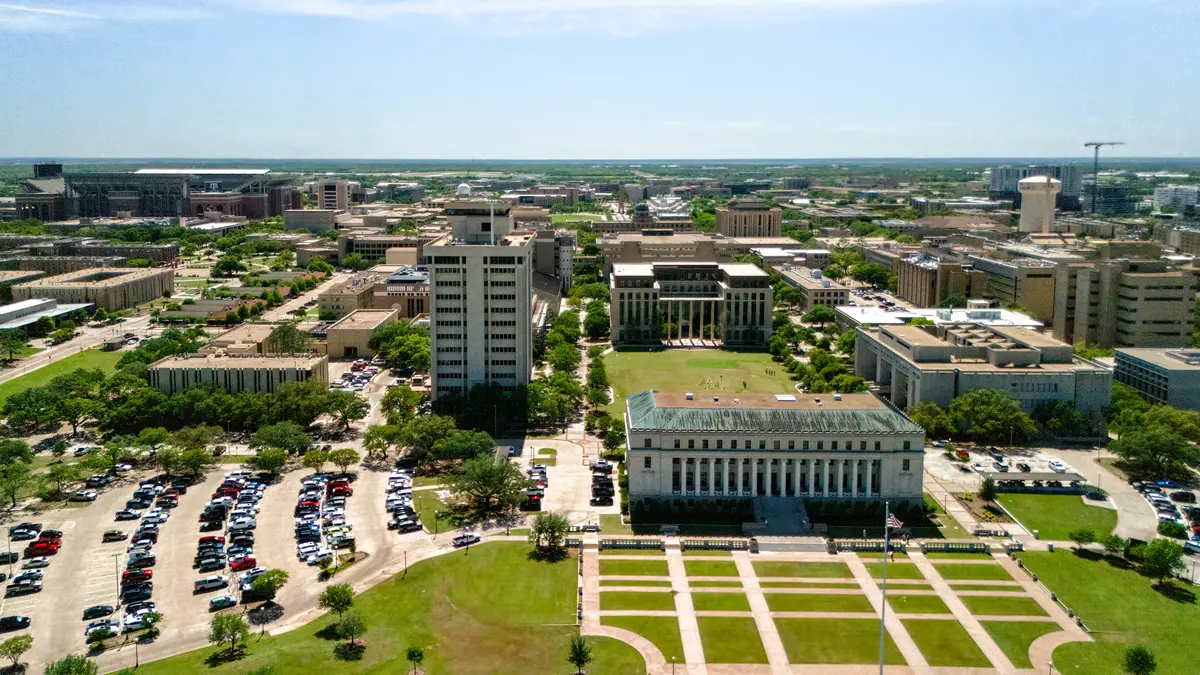
College Station's $349,346 typical home price is shaped almost entirely by Texas A&M University — the demand it creates for faculty housing, the investor market around student rentals, and the broader economic engine of one of the country's largest university campuses. The 31st-largest incorporated city in Texas, it has infrastructure to match: SH-6 (Earl Rudder Freeway), SH-30, and SH-40 give the city genuine connectivity, and the commercial base along Texas Avenue (Bus. SH-6) serves a population that skews young and educated.
Buyers who get the most from College Station are those with a direct connection to the university — faculty, staff, or families who value the cultural and recreational offerings of a major research campus — or investors with a long time horizon in the student rental market. Buyers purely chasing value will find the cost premium hard to justify unless the university environment itself is part of the decision.
The real divide in Central Texas is between the Fort Hood belt — Killeen, Copperas Cove, Harker Heights — and the university corridor anchored by Waco, Bryan, and College Station. Military buyers and value-focused families tend to gravitate toward the former; remote workers and retirees drawn to college-town energy often find the latter worth the premium.
Tell us what you need help with and we'll connect you with local resources.
