
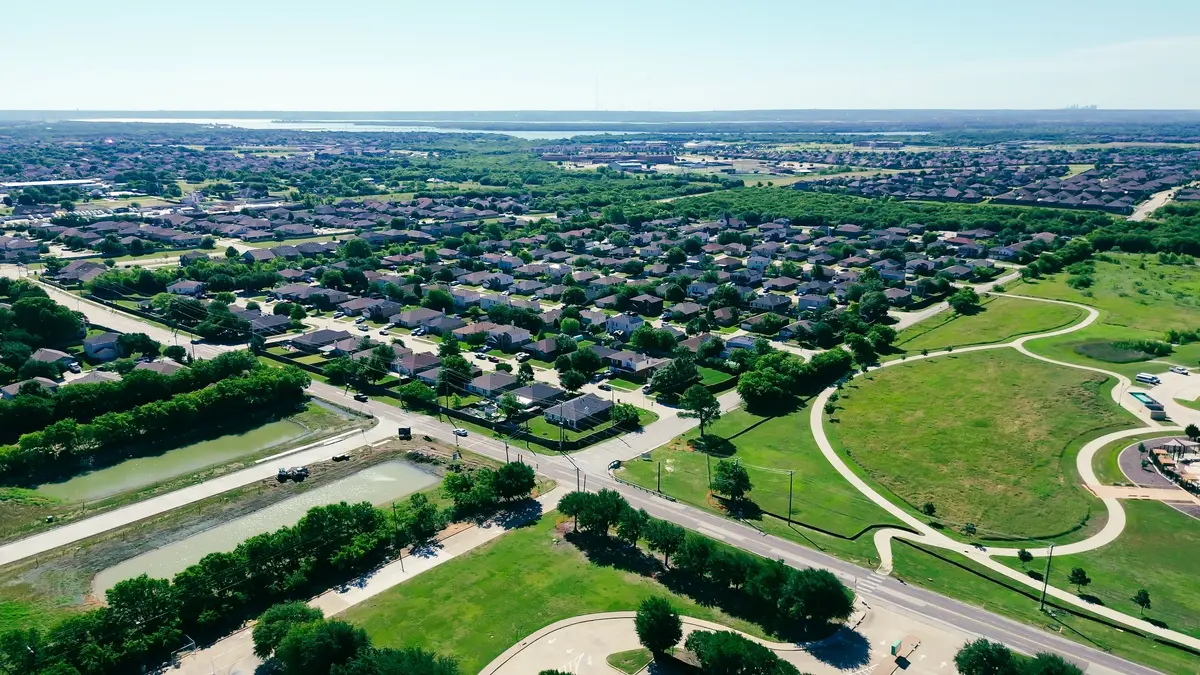
You've run the numbers on California versus Texas and the spreadsheet looks almost too good. Then someone asks you to describe Arlington, and you realize you can't — it isn't a charming small town or a sleek tech corridor. It is the 7th-largest incorporated city in Texas, with 402,134 residents, two pro-sports stadiums, a major automotive plant, and a University of Texas campus. It sits squarely between Dallas and Fort Worth in Tarrant County, connected to both by I-20 and I-30, and it functions less like a suburb than a full-sized city that happens to share a metro with two larger ones. That geographic middle position is both the asset and the thing Californians most underestimate.
The employer base here is concrete and varied. The Arlington Independent School District and the City of Arlington are the two largest institutions. General Motors' Arlington Assembly plant — an active, full-scale operation producing full-size SUVs — anchors the industrial side. The University of Texas at Arlington brings a research and academic layer. A regional health system rounds out the picture. The school district, with 51,139 students enrolled in 2025-26, holds a C rating, according to the Texas Education Agency — something families arriving from California's higher-rated districts will want to weigh carefully before assuming school quality travels with them. See the full breakdown on the schools page.
Cost of living sits close to the national average — well below the 38–50% above-national mark that most major California metros carry. The typical home value here, at $312,255 as of July 2026, is the figure that stops most Californians mid-sentence. The income tax disappears entirely when you cross into Texas. The property tax rises, which matters, and we will work through exactly how those two forces interact. Routine care insurance premiums run noticeably below what most Californians paid, though you will drive farther when you need specialist or advanced care. The full cost-of-living picture, including utilities, groceries, and transportation, lives on the cost of living page.
Whether you are choosing between staying in California or finally making the move, the sections below break down the real financial shift, the tax picture state by state, what daily life in Arlington actually looks like, what surprises people in the first six months, and what you should understand about neighborhoods and the local economy before you sign anything.
The Home Price Reality: California vs. Arlington
California's statewide typical home value of $773,735 is the number most Californians have internalized as normal. Arlington's typical home value of $312,255 as of July 2026 is not a typo and not a distressed market — it is a functioning, large American city where homes are simply priced closer to what wages support.
That gap is wide enough to change almost every financial decision you make. A down payment that barely gets you into a California condo covers a four-bedroom house in North Arlington, which runs above the city median. Southwest Arlington and West Arlington track at roughly the city median, while East Arlington comes in below it — useful context for buyers who want to stretch their dollars further without leaving the city. For neighborhood character beyond those price tiers, see the neighborhoods page.
One honest caution: the median household income in Arlington is $75,171, which sits below what it takes to carry the typical home here comfortably. That is not a crisis, but it does mean the market is not universally easy — buyers at the local median income are stretching, and that price pressure is real even at $312,255. Californians arriving with equity from a prior sale are often in the strongest position in the room.
What the Price Gap Actually Buys You
In practical terms, what $312,255 gets you in Arlington would cost two to two-and-a-half times as much in most California coastal markets. That translates to more square footage, a yard, a garage, and a neighborhood that isn't the city's cheapest option.
For buyers coming with California equity, the math shifts further. Arriving with $300,000–$400,000 in proceeds is not unusual for Californians selling a modest home. That kind of down payment in Arlington can mean buying without a large ongoing principal balance — a structural financial change, not just a lifestyle upgrade.
The catch that every honest broker in Arlington will tell you: Texas property taxes are among the highest in the country, and they will appear on that otherwise-attractive monthly payment. We cover that directly in the tax section below.
The Tax Shift: Income, Property, and Sales
The headline number everyone knows is correct. California's top state income tax rate of 13.3% applies only to the highest earners, but the brackets below it are still steep — and Texas levies no state income tax at all. Zero, at every income level. That is not a marginal difference; it restructures your annual cash flow from the first paycheck.
As an illustrative example, a single filer earning $100,000 pays roughly $5,055 in California state income tax. In Texas, that same income generates $0 in state tax — about $421 per month that goes directly to take-home pay rather than Sacramento. Your actual result depends on your income, filing status, and deductions, but the directional shift is that consistent regardless of where you land in the brackets.
The Property Tax Trade-Off
Here is where the calculation gets more honest. California's effective property tax rate of 0.71% is low — a legacy of Proposition 13's 1978 assessment limits. Arlington's effective property tax rate is 1.47%, more than double that figure. On a home at the Arlington typical price of $312,255 (July 2026), that rate produces a meaningfully higher annual tax bill than the same home would carry under California's system.
The income-tax savings are real and recurring. The property-tax bill is also real and recurring. For most Californians moving at a working-age income level, the income-tax elimination outpaces the property-tax increase over time — but the gap is smaller than the headline numbers suggest, and buyers who assume they are simply pocketing the entire income-tax savings will be surprised by the first property-tax statement. Run the math on your specific income and home price before you commit.
Sales Tax: A Narrower Gap Than You Think
California's statewide base sales tax rate of 7.25% sounds lower than you might expect it to, but local additions push the combined rate above 10% in many California counties. Texas's state base rate is 6.25%, with a combined state-and-local cap of 8.25%. On a blended state-plus-local basis, Texas lands around 8.2% and California around 8.8–9.0% — a consistent but modest everyday advantage, not a transformative one.
One specific relief for grocery shoppers: both California and Texas exempt most groceries from sales tax, so your weekly grocery bill does not inflate when you cross state lines. The sales tax advantage shows up more in big-ticket purchases — furniture, appliances, vehicles — than in routine household spending.
| Category | California | Arlington / Texas | Practical Impact |
|---|---|---|---|
| State income tax | California's top state income tax rate of 13.3% (Tax Foundation) | 0% | Largest recurring gain for working Californians |
| Effective property tax rate | California's effective property tax rate of 0.71% | 1.47% | Partially offsets income-tax gain; run your specific numbers |
| Statewide base sales tax | California's statewide base sales tax rate of 7.25% | 6.25% (max combined 8.25%) | Modest everyday advantage in Texas |
| Groceries taxed? | No (most items exempt) | No (most items exempt) | No change at checkout |
| Typical home price | California's statewide typical home value of $773,735 (Zillow ZHVI) | $312,255, July 2026 (Zillow ZHVI) | Structural affordability shift for buyers |
| Overall cost of living | Typically 38–50% above national average in major metros | Near national average | Broad daily cost reduction across most categories |
* ZHVI = Zillow Home Value Index.
The full property tax rate, sales tax rate, and income breakdown are on the cost of living page.

Why Californians Are Choosing Arlington Specifically
Texas has been a consistent destination for Californians leaving the state, and that flow has been large and durable enough to reshape neighborhoods in cities across the DFW metro. Within that broader pattern, Californians are the single largest source of new Texas residents — and Arlington draws a specific slice of that group for reasons that go beyond low home prices.
Dallas/Fort Worth International Airport is 13 miles away, which matters enormously for Californians who still have family, clients, or a remote employer on the West Coast. The ability to stay connected — to fly back without a regional airport or a long drive — is not a minor lifestyle detail for people making a cross-country move. It is often the deciding factor between Arlington and a smaller Texas city at a similar price point.
The Employment Anchor
The job market here is broader than many Californians expect from a city that isn't Dallas or Fort Worth proper. The General Motors Arlington Assembly plant is an active, full-scale manufacturing operation. The University of Texas at Arlington adds research and academic employment. The school district, city government, and a regional health system collectively employ a significant share of the local workforce.
For Californians working remotely, the calculus is simpler: the income-tax elimination and the lower housing cost are the whole argument, and Arlington's position roughly at the geographic center of the DFW metroplex means access to the entire metro's amenities without paying downtown Dallas prices. About 30 minutes to Dallas is the working commute reference if your employer eventually calls you back on-site.
Who Thrives Here and Who Doesn't
Families with school-age children tend to arrive expecting California-level school performance and need to recalibrate: the Arlington Independent School District holds a C rating, according to the Texas Education Agency, which is a real signal worth taking seriously. See the schools page for the full picture, including individual campus options.
Californians who leave within two years almost universally cite the same two things: the summer heat and the car dependence. Arlington is not a walkable city by design. Most errands need a car, and the road network is built around it. If you are coming from a neighborhood in California where you walked to coffee or took transit to work, that part of your life does not transfer.
Looking to buy in Arlington? Estimate your payment.
Enter your numbers to see an estimated monthly mortgage payment.
Estimate only. Excludes HOA fees and mortgage insurance. The interest rate above is a starting point, not a quoted rate — replace it with your own to see real numbers. Insurance is a flat placeholder, not a Arlington quote.
Daily Life: What Changes and What Doesn't
The adjustment most Californians describe after six months is not the taxes or the home price — it is the summer. Arlington averages 235 sunny days a year, but June through September is not California sunshine; it is sustained triple-digit heat with humidity that doesn't break the way a California dry heat does. The outdoor lifestyle you had in California migrates indoors from roughly mid-June through late September, and that shift is larger than people anticipate when they are planning the move in January.
What doesn't change is the scale of what the city offers. AT&T Stadium and Globe Life Field are both within the city — not a drive to another city, not a metro amenity you share abstractly. Six Flags Over Texas and Six Flags Hurricane Harbor Arlington sit here too. For families arriving from California with kids who grew up going to theme parks, that is a direct translation of lifestyle, not a downgrade. Levitt Pavilion Arlington brings an outdoor concert series through the warmer months that functions as one of the city's genuine community gathering points.
Weekends and Local Favorites
River Legacy Park and Big Bear Creek Greenbelt are the city's best answers to outdoor recreation — extensive trail systems that give you a real run or ride without leaving Arlington. Veterans Park and Richard Simpson Park fill out the city's green space. For coffee, Savor Coffee Bar, Nehemiah Coffee Company, Inclusion Coffee, Grounds and Gold Co., and Chill Coffee and Wine Bar are the names locals actually use — independently owned, each with a distinct feel. For food, Hurtado Barbecue draws serious attention, Razzoo's Cajun Cafe handles the casual end of things, Mariano's Hacienda Ranch has been part of the local dining landscape for decades, and The Tipsy Oak and The Social House round out the options for evenings out. The Farmers Market — Arlington TX and the Downtown Arlington Farmers Market both run through the warm months. The Downtown Arlington Farmers Market sits within walking distance of the University of Texas at Arlington campus.
The Neighborhood Texture
North Arlington is where families with school-age children most often land when price isn't the primary constraint — the housing stock skews newer and the feel is more suburban than the older parts of the city. Downtown Arlington is legitimately walkable by Arlington standards, anchored by the university and an evolving dining and entertainment core. East Arlington, which includes the Entertainment District surrounding the stadiums, has an energy on game nights that the rest of the city doesn't. For a deeper read on each neighborhood's character, see the neighborhoods page.
What Californians Get Wrong Before They Move
The most common miscalculation is treating the income-tax elimination as pure gain without running the property-tax offset. California's effective property tax rate of 0.71% is historically low because of assessment limits that keep longtime homeowners' taxable values frozen well below market. In Arlington, there is no equivalent cap at that level — the effective rate of 1.47% applies to current assessed value. Californians who owned California real estate for years and paid almost nothing in property tax per dollar of value are genuinely surprised by the first annual statement in Texas.
The second miscalculation is school expectations. California has districts with genuinely strong performance metrics, and the familiarity with a particular school quality creates an assumption that transfers. The Arlington Independent School District, on 2024-25 state assessments, saw 36% of students reach math proficiency and 43% reach reading proficiency. Families for whom school performance is the deciding factor should work the schools page carefully — individual campuses vary, and private school options exist in the metro.
The Honest Safety Picture
Arlington's crime rates run above both Texas state benchmarks and national figures — a meaningful data point that varies significantly by area within the city. This is not a city-wide emergency, but it is worth understanding before you choose a neighborhood. The safety page goes into neighborhood-level context.
The Things That Genuinely Surprise People
After six months, Californians most often say they underestimated three things: how much they would miss the Pacific Ocean, how much they would save without state income tax, and how quickly the local community absorbed them. Arlington is a city of 402,134 people with enough population mass that you don't stick out as a transplant — there are enough Californians here now that the move has a community of peers who made it before you. That social landing is easier than most people expect.
What they overestimated is how much the entertainment infrastructure would feel like a replacement for California culture. The stadiums and theme parks are real assets, but they are event-driven. The daily texture of life — the casual outdoor energy of a California beach city or a Northern California college town, the walkable streets, the coffee culture — does not translate directly. Arlington is its own thing, and arriving expecting a California experience at Texas prices will disappoint you. Arriving expecting a large, functional, affordable Texas city is accurate.

Local Expert Takeaway: The financial case for moving to Arlington from California is real — the income tax alone restructures your take-home pay, and $312,255 buys a house that $773,735 barely approaches in California. But the move works best for people who have run the full math: income-tax savings minus higher property-tax rate, summer heat as a lifestyle constraint not a marketing line, and school performance that requires investigation rather than assumption. Californians who arrive with California equity, an accurate picture of Arlington's school district, and a willingness to embrace a car-dependent, Texas-scaled city consistently say they would make the same call again. Those who arrive expecting California amenities at Texas prices leave faster.
Quick Takeaways & FAQs
✅ Arlington's typical home value of $312,255 (July 2026) is well below California's statewide typical home value of $773,735 — Californians arriving with equity from a prior sale are often in the strongest buyer position in the room.
⚠️ Texas's 1.47% effective property tax rate is more than double California's effective property tax rate of 0.71%, which meaningfully offsets the income-tax elimination for buyers who don't run the full calculation before closing.
📍 Dallas/Fort Worth International Airport is 13 miles from Arlington — a concrete advantage for Californians who need to stay connected to West Coast family, remote employers, or clients after the move.
How much do I actually save on taxes moving from California to Arlington?
Is Arlington a good place for families moving from California?
How does the home-buying process differ in Texas compared to California?
What is the commute like from Arlington to Dallas or Fort Worth?
Will I notice a difference in the cost of everyday groceries and shopping after moving from California?
Moving to Texas?
Tell us what you need help with and we'll connect you with local resources.
