
Maybe you're weighing Scappoose because someone told you it's a quieter alternative to the Portland suburbs, or because US-30 puts you closer to the coast than most Portland-area zip codes. The safety question comes up early, and the honest answer is that Scappoose compares well — not just against the Portland metro, but against Oregon and the country as a whole. A city of 8,179 people doesn't generate the crime volume that makes headlines, and the data backs that up in concrete terms.
Scappoose carries a violent crime rate of 1.48 per 1,000 residents and a property crime rate of 13.45 per 1,000 residents, both drawn from FBI 2024 calendar-year data. Those numbers sit well below Oregon's state violent rate of 3.3 per 1,000 and the national violent rate of 3.7 per 1,000. On the property side, the state rate runs at 24.5 per 1,000 and the national rate at 18.4 per 1,000 — Scappoose is noticeably lower than both. The engine-rendered comparison table directly below the first section heading shows you exactly where Scappoose lands against each benchmark.
The community texture matters as much as the statistics. Local residents consistently describe Scappoose as peaceful and family-friendly, and the city runs a Community Enhancement Program (CEP) with documented 2024 allocations, which signals an ongoing municipal commitment to neighborhood conditions. For a detailed look at daily life, the Living in Scappoose guide covers commute, employers, and the broader quality-of-life picture. This page focuses specifically on what the crime data shows, how safety varies by part of town, what local policing looks like, and what you should pay attention to before choosing a neighborhood.
How Scappoose Crime Rates Compare to Oregon and the Nation
Scappoose recorded a violent crime rate of 1.48 per 1,000 residents in 2024 — a genuinely low figure for a city of this size. No murders were reported. Assault and robbery rates came in well below national norms, and rape incidents were a fraction of the national figure.
Niche's per-100,000 breakdown makes the category-level picture concrete. Scappoose's assault rate (123.4) runs less than half the national figure (282.7). Robbery (12.3) is nearly eleven times lower than the national rate (135.5). Burglary (172.8) is roughly a third of the national average (500.1). Theft (864) is less than half the national figure (2,042.8). The one outlier is motor vehicle theft, which at 308.6 per 100,000 runs close to the national average of 284 — the one category where Scappoose doesn't have a clear edge.
That motor vehicle figure is worth sitting with. It doesn't mean Scappoose has a serious auto-theft problem in absolute terms, but it does mean car security habits that serve you well in a low-crime small town — leaving a garage door opener visible, parking an unlocked vehicle in a driveway — carry a little more risk here than the overall crime picture might suggest. Lock your car, and Scappoose's statistical profile remains genuinely reassuring across the board.
Niche assigns Scappoose a B− Crime & Safety grade, which places it among the safer towns in the Portland metro on that measure. The comparison table rendered below this section shows the full breakdown against Oregon and national benchmarks.
West Side vs. East Side: Where Scappoose Feels Safest
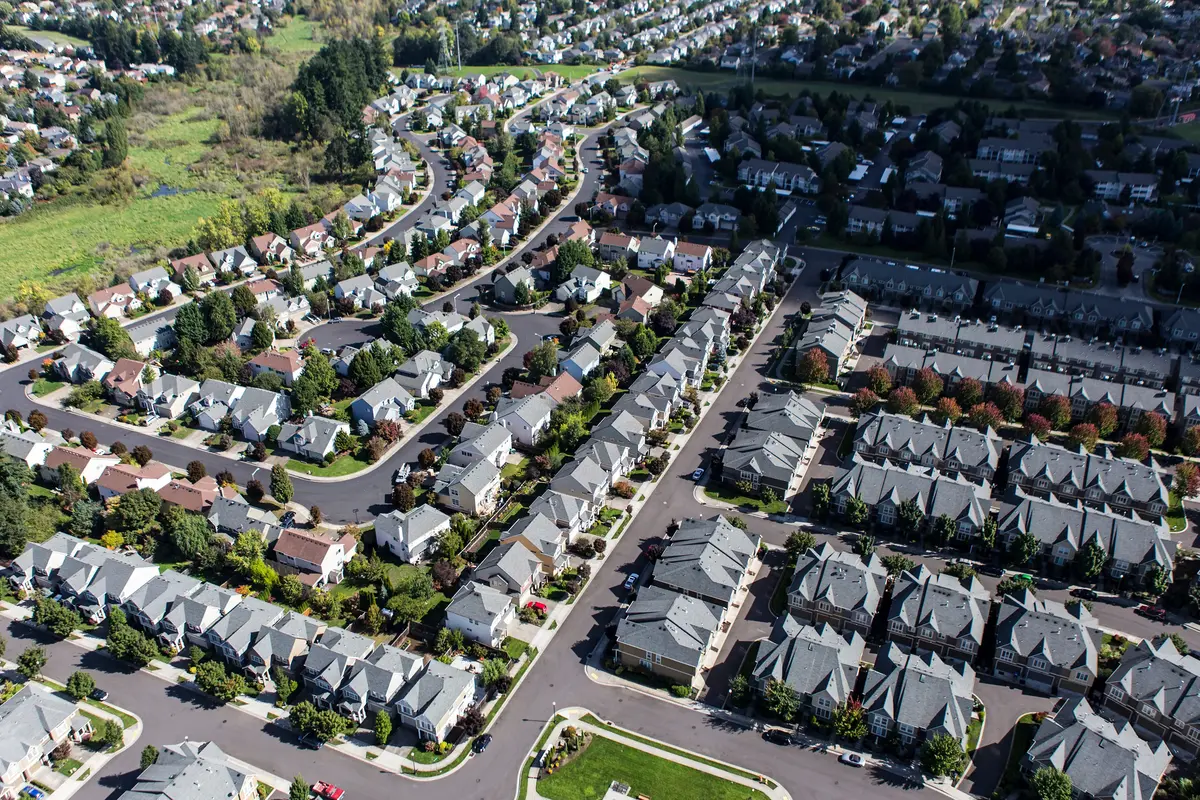
Not every part of Scappoose carries the same risk profile, and understanding the geographic pattern helps if you're choosing between neighborhoods. CrimeGrade.org's analysis of incident geography finds that residents generally regard the west side of Scappoose as the city's safest area. The east side, by contrast, sees the highest total incident counts — and that pattern lines up with where commercial activity and through-traffic concentrate.
That east-west divide lines up with what the property-crime pattern shows more broadly. Where incidents do occur, they tend to cluster around commercial corridors and higher-traffic zones rather than quiet residential streets. The implication for neighborhood research: areas closer to retail activity and through-traffic on US-30 carry a modestly higher property-crime exposure than the quieter, more residential parts of town.
Neighborhood Safety Texture
Dutch Canyon Estates and Huser Estates sit on the hillside and western edges of the city, removed from the main commercial spine — the kind of residential pockets that tend to show lower incident counts. South Scappoose and the Heritage Park Area are established residential neighborhoods that local residents consistently describe as calm. The Airpark and Honeyman Road Area, further out from the commercial core, has the geographic separation that typically correlates with lower property-crime exposure.
Downtown Scappoose and the Columbia River / Dike Road Area sit closer to the higher-traffic corridors where the property incident clustering shows up. That doesn't make them unsafe in any absolute sense — property crime rates are below state and national averages citywide — but if you're comparing two neighborhoods and one is closer to the commercial strip, that distinction is worth factoring in. For a fuller look at what each neighborhood is like to live in, the neighborhoods guide goes deeper on character and fit.
One thing residents learn after a few months: Scappoose is small enough that unusual activity gets noticed. The local community communication channels are active and neighbors communicate quickly when something feels off — that informal network is a real part of why the community texture feels as safe as the statistics suggest.

Local Policing: What You're Getting in a City This Size
Scappoose has its own dedicated municipal police department — not something every city of this size can say. The Scappoose Police Department handles patrol, investigation, traffic management, and public safety education. Residents can submit crime tips directly through the City of Scappoose's official mobile app, which is a practical tool for a community where most people know when something looks out of place.
The honest note: the department is a small municipal agency, and the department has publicly acknowledged that staffing falls short of what the city needs, with pay competition from larger nearby agencies cited as the core recruitment challenge. A small department for a city of 8,179 residents is a real constraint — response times in a pinch depend partly on how stretched coverage is at any given moment.
The Columbia County Sheriff's Office supplements local policing across unincorporated county lands, with patrol deputies available to assist municipal agencies and respond to emergencies throughout the region. That regional backup matters for a small department, and the two agencies' coordination is part of why the coverage picture isn't as thin as the department's size might suggest.
The city also runs its Community Enhancement Program (CEP) with documented 2024 allocations — a signal that local government is investing in the conditions that prevent crime, not just responding to it after the fact. That kind of municipal attention to community conditions is part of what keeps a small city's numbers where Scappoose's are.
Looking to buy in Scappoose? Estimate your payment.
Enter your numbers to see an estimated monthly mortgage payment.
Estimate only. Excludes HOA fees and mortgage insurance. The interest rate above is a starting point, not a quoted rate — replace it with your own to see real numbers. Insurance is a flat placeholder, not a Scappoose quote.
What the Property Crime Picture Really Means for Homeowners
Scappoose carries a property crime rate of 13.45 per 1,000 residents — well below state and national benchmarks — but the distribution of incidents across the city isn't even. Most residents go years without a direct experience, and your exposure depends meaningfully on where in Scappoose you land.
Theft is the dominant category, not burglary. Scappoose's burglary rate (172.8 per 100,000) is about a third of the national figure (500.1), which is a meaningful gap — it suggests that the property incidents that do occur here lean toward opportunistic theft rather than targeted home break-ins. That distinction matters for how you think about daily security habits versus serious home-hardening measures.
Motor vehicle theft running near the national average is the one place where standard precautions genuinely apply. Don't leave valuables visible in a parked car, and if you're parking regularly in a higher-traffic commercial area, that habit matters more than it might in a city where the rate was lower. This is Scappoose's one category where complacency is the actual risk.
For renters and homeowners alike, the City of Scappoose publishes crime statistics on its official website. Checking the geographic breakdown before choosing between two neighborhoods — particularly if you're weighing a quieter residential street against something closer to the US-30 corridor — is exactly the kind of research that turns a statistical picture into a practical one. The cost of living page covers the typical home price and typical rent ranges if you're still weighing your housing options.
The Honest Picture: Scappoose's Safety Strengths and the Real Trade-offs
Scappoose is genuinely safer than most places you could land in the Portland metro, and the numbers are not close. With a violent crime rate of 1.48 per 1,000 residents and no murders reported in 2024, Scappoose sits in company that most mid-size cities can't match. A property crime rate of 13.45 per 1,000 residents is well below both state and national figures. For families with kids and people moving from areas where safety is a daily concern, the overall picture is as reassuring as small-town Oregon gets.
The trade-offs are real but narrow. A small police department means you're dependent on coverage that a larger city agency wouldn't have to think about. Motor vehicle theft tracks closer to the national average than the city's other crime categories do. And the east side of Scappoose, particularly near commercial corridors, carries a modestly higher property incident concentration than the quieter residential pockets on the west side.
None of those trade-offs change the fundamental picture. Scappoose is not the safest place in Oregon — it's a small river-valley city with the gaps in policing coverage and the commercial-traffic exposure that come with that scale. But it is comfortably safer than state and national baselines on every major crime category except auto theft, and it has the kind of tight community awareness that statistics don't fully capture.
People who move out of Scappoose more often cite the limited local job base or the rainy stretch from October through April — with only 139 sunny days a year, that's a real seasonal adjustment — rather than anything to do with safety. The Living in Scappoose guide covers those quality-of-life trade-offs in full. Safety, by contrast, is one of Scappoose's genuine strengths and one of the clearer reasons families keep choosing it over noisier alternatives along the river corridor.

Local Expert Takeaway: Scappoose carries a violent crime rate of 1.48 per 1,000 residents — roughly 60% below the national average — and a property crime rate of 13.45 per 1,000 residents, well below both Oregon and U.S. benchmarks, with one exception: motor vehicle theft tracks close to the national average, so basic car security habits matter here more than the overall statistics might suggest. The west side of the city, including neighborhoods like Dutch Canyon Estates and Huser Estates, is where residents most consistently report feeling safe; areas closer to the US-30 commercial corridor carry a modestly higher property-incident exposure. The Scappoose Police Department is a real municipal agency with active coverage, and the Columbia County Sheriff's Office provides regional backup — though the department's size relative to the city's population is honest context worth knowing. Scappoose isn't a city where safety drives people away; it's one of the clearer reasons families who discover it tend to stay.
Quick Takeaways & FAQs
✅ Scappoose carries a violent crime rate of 1.48 per 1,000 residents, well below both the Oregon state average and the national average, with no murders reported in 2024.
⚠️ The Scappoose Police Department is a small municipal agency that has publicly acknowledged staffing challenges — regional backup from the Columbia County Sheriff is a meaningful part of local coverage.
📍 Motor vehicle theft is the one crime category where Scappoose tracks near the national average, so locking your car — especially near commercial corridors — matters more than the city's otherwise low crime profile might suggest.
What is Scappoose's crime rate compared to Oregon and the U.S.?
Which part of Scappoose is the safest?
Is property crime a concern in Scappoose?
Does Scappoose have its own police department?
How does Scappoose compare to nearby cities like St. Helens for safety?
Moving to Oregon?
Tell us what you need help with and we'll connect you with local resources.
