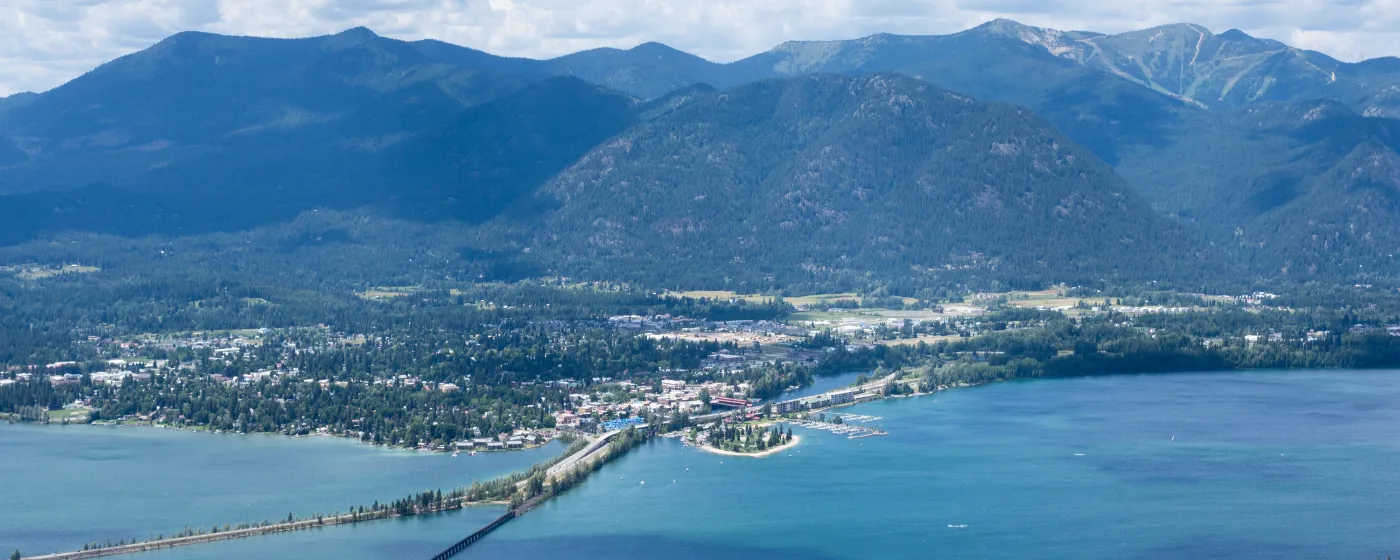
Maybe you've been priced out of a larger Northwest city and someone mentioned Sandpoint as an affordable alternative. That framing is only half right. Sandpoint sits on the north shore of Lake Pend Oreille in Bonner County, roughly 75 minutes from Spokane, and it carries a cost structure that surprises a lot of people who picture rural Idaho as cheap. The Zillow Home Value Index puts the typical home at $588,781 (2026) — a figure that lands Sandpoint among the pricier small cities in the entire state, driven by lake access, mountain proximity, and a constrained land supply that doesn't behave like most of Idaho.
The economic engine here is a mix of healthcare, manufacturing, tourism, and a growing tech presence. Bonner General Health, Litehouse Foods, Schweitzer Mountain Resort, and mobile analytics firm Kochava are among the key pillars. That employer mix means incomes are more varied than in a single-industry town — the median household income sits at $72,289 — and it means the buyer pool includes everyone from resort-economy workers to remote-tech professionals who relocated specifically for the lifestyle, which keeps upward pressure on prices year-round.
Outside housing, the picture softens. Utilities run slightly below the national average, anchored by hydroelectric power that covers more than half the city's electricity supply. Natural gas costs are well below U.S. norms. Groceries run about 10% above the national average — a real number for a small-market town with limited retail competition. Idaho's tax structure, including a flat 5.3% income tax, a 6% sales tax, and a property-tax effective rate of approximately 0.43%, provides meaningful relief compared to West Coast states many newcomers are leaving.
Whether you're deciding between renting and buying, comparing Sandpoint to Ponderay or Priest River, or just trying to build a realistic monthly budget, the sections below break down housing, everyday costs, nearby-city comparisons, and the full tax picture so you can run the real numbers before you commit.

What It Really Costs to Live in Sandpoint
Sandpoint's overall cost-of-living index comes in at 116 against a national baseline of 100 — roughly 16% above the U.S. average, and 4th most expensive among 33 Idaho cities measured. That gap isn't spread evenly across categories. Housing carries a sub-index of 136, which means it's doing nearly all the heavy lifting. Strip out housing and Sandpoint is closer to average than most newcomers expect.
The honest comparison to the rest of Idaho: Boise metro prices have climbed sharply, but Sandpoint's median still sits noticeably above most of the state's smaller cities. Compared to Spokane across the border in Washington, Sandpoint runs materially higher on housing but similar or lower on most other line items. The driving force isn't a booming job market — it's geography. You cannot manufacture more lakefront, and Schweitzer Mountain Resort's draw brings buyers with equity from larger markets who aren't particularly price-sensitive.
The practical consequence: a household earning near the $72,289 median income will spend a disproportionate share of its budget on housing here, whether renting or buying. The lifestyle math only works cleanly if you're bringing equity from elsewhere, earning above the local median, or have a specific reason — work-from-home flexibility, a paid-off property — that lets you absorb the premium.
Housing: Rent vs Buy in Sandpoint
The Ownership Picture
The typical home in Sandpoint is valued at $588,781 (Zillow Home Value Index, 2026). Entry-level inventory — older construction, smaller footprints, locations farther from the waterfront — can be found starting in the low $400,000s, but that range is thin and moves fast. Anything updated, on acreage, or with lake or mountain views tends to push well past the median.
Idaho's effective property-tax rate of approximately 0.43% is one of the lowest in the country — less than half the national median. That rate meaningfully reduces the annual carrying cost on a Sandpoint home compared to similarly priced properties in California, Oregon, or Washington. Use the mortgage calculator below to model your specific purchase price and down-payment scenario.
The Rental Reality
Renting doesn't offer the relief you might hope for. A two-bedroom apartment in Sandpoint typically runs $1,300–$1,800 per month as of early 2026. The rental market is thin — inventory is limited, turnover is low, and landlords have little competitive pressure to discount. If you're relocating and planning to rent while you look for a home to buy, budget at the higher end of that range and secure something before you arrive if at all possible.
Rent vs Buy: The Honest Read
Buying makes more financial sense here than in many comparable resort markets, primarily because Idaho's property-tax rate keeps annual carrying costs low. Renting is the smarter short-term move if you're uncertain about staying — the transaction costs of buying and selling within two years are hard to recover in a market this size. For longer-term residents, ownership builds equity in a market where supply constraints have historically supported prices.

Everyday Costs Beyond Housing in Sandpoint
The utility picture in Sandpoint is genuinely one of the budget bright spots. The average monthly electricity bill runs approximately $159, kept in check by the region's hydroelectric grid — 57% of the city's power comes from hydro sources. Natural gas averaged $14.18 per thousand cubic feet in August 2025, well below the national average of roughly $24.56 for the same period. The city updated its municipal water and wastewater rates in September 2025 under a multi-year plan, so expect modest annual adjustments through 2028, but the baseline remains reasonable.
Groceries are the other friction point beyond housing. Sandpoint's grocery sub-index of 110 (national = 100) reflects the reality of a small North Idaho market: limited retail competition and higher logistics costs for fresh goods. You won't find the variety or warehouse-club pricing of a major metro. Transportation costs index slightly above average at 116, largely because car dependency is total — there is no meaningful public transit, and most errands require driving. The nearest large-format shopping options are in Coeur d'Alene or Spokane, so factor in occasional longer supply runs if you're used to urban retail.
| Category | Typical Monthly Cost | Notes |
|---|---|---|
| Housing (2BR rent) | $1,300–$1,800 | Typical 2-bedroom apartment, early 2026. Owners: use the mortgage calculator above for a purchase estimate. |
| Electricity | ~$159 | Average monthly bill; hydro-heavy grid keeps rates relatively low. |
| Natural Gas | $60–$90 | Estimated monthly average; well below U.S. norms. Higher in winter heating months. |
| Groceries | $400–$600 | Single person to couple estimate; runs ~10% above national average. |
| Transportation & Gas | $200–$350 | Car-dependent city; no public transit. Gas prices track regional Northwest averages. |
| Healthcare | $150–$400 | Wide range depending on employer coverage vs. individual market plan. |
| Phone & Internet | $100–$180 | Standard smartphone plan plus home broadband; fiber availability varies by address. |
| Misc / Discretionary | $200–$500 | Dining out, recreation, skiing at Schweitzer, personal care. Resort-town pricing applies. |
These are estimates for budgeting purposes; your actual costs will vary based on household size, habits, and exact location.
Looking to buy in Sandpoint? Estimate your payment.
Enter your numbers to see an estimated monthly mortgage payment.
Estimate only. Excludes HOA fees and mortgage insurance. The interest rate above is a starting point, not a quoted rate — replace it with your own to see real numbers. Insurance is a flat placeholder, not a Sandpoint quote.
Sandpoint vs Nearby Cities: Cost Comparison
| City | Median Home Price | Typical 2BR Rent | Cost vs Sandpoint |
|---|---|---|---|
| Sandpoint, ID | $588,781 | $1,300–$1,800/mo | — (baseline) |
| Ponderay, ID | ~$420,000–$480,000 | $1,100–$1,500/mo | Noticeably cheaper; adjacent to Sandpoint, similar services |
| Dover, ID | ~$500,000–$560,000 | Limited rental stock | Slightly cheaper; small waterfront community |
| Sagle, ID | ~$480,000–$550,000 | Limited rental stock | Somewhat cheaper; more rural, acreage common |
| Kootenai, ID | ~$380,000–$450,000 | Very limited inventory | Cheaper; small town with longer commute trade-offs |
| Priest River, ID | ~$300,000–$380,000 | $900–$1,300/mo | Significantly cheaper; 30 min southwest, fewer amenities |
* Nearby-city figures are approximate ranges based on available market data; Sandpoint's figure is the Zillow Home Value Index (2026).
Ponderay is the most practical comparison — it shares services, sits directly adjacent, and offers meaningfully lower prices for buyers willing to give up a Sandpoint mailing address. Priest River is the value floor of the corridor, but the distance from Sandpoint's restaurants, Cedar Street Bridge Public Market, and Schweitzer access is a real daily consideration.
Taxes & the Bottom Line for Sandpoint
Idaho's Tax Structure
Idaho moved to a flat 5.3% individual income tax rate effective January 1, 2025 — reduced from 5.695% under HB 40, signed in March 2025. That's a competitive rate relative to Oregon (up to 9.9%) or California (up to 13.3%), though higher than Washington's zero income tax, which draws some comparison shoppers. Idaho does not tax Social Security benefits, which matters significantly for retirees running the numbers.
The statewide sales tax is 6%, with a combined state-and-local average of 6.03%. There is no local sales tax surcharge in Sandpoint itself. Idaho does apply sales tax to groceries — but the state partially offsets this through a food tax credit of $155 per person for the 2025 tax year, which provides the most meaningful relief to lower-income households.
Property Taxes: The Real Advantage
The effective property-tax rate of approximately 0.43% is the number that changes the math most dramatically for buyers coming from the Pacific Northwest or California. At less than half the national median rate of 0.89%, it substantially reduces annual carrying costs on the home values described earlier in this guide. For buyers comparing Sandpoint's prices to those in Washington or Oregon, factoring in the property-tax difference brings the true annual cost of ownership closer together than the sticker prices suggest.
Who the Budget Works For
Sandpoint's cost structure rewards two types of households: those bringing outside equity — typically from a California, Washington, or Oregon sale — and remote workers earning above the local median whose income isn't anchored to local wages. For households earning near or below $72,289 and relying on local employment, the housing cost-to-income ratio is genuinely stretched. Renting eats most of a modest paycheck; buying at the typical price requires either a substantial down payment or a dual income. The tax environment helps at the margin, but it doesn't fix a fundamental mismatch between local wages and local home prices. If your income is locally sourced and near the median, Ponderay or Priest River may make the budget work in a way that Sandpoint proper cannot.
Local Expert Takeaway: After six months here, most people are pleasantly surprised by their utility bills — the hydroelectric grid is real, and natural gas costs are genuinely low. What catches them off guard is the grocery bill and the reality that every errand requires a car. The fun spending — a ski day at Schweitzer, dinner along the waterfront, weekend browsing at Cedar Street Bridge Public Market — adds up fast in a resort-town economy where prices reflect the seasonal tourist trade. Build more discretionary cushion into your budget than you think you need, especially in winter.
Quick Takeaways & FAQs
✅ Idaho's effective property-tax rate of approximately 0.43% — less than half the national median — meaningfully reduces the annual ownership cost on Sandpoint homes despite high sticker prices.
⚠️ Sandpoint ranks 4th most expensive among 33 measured Idaho cities, and the rental market offers little relief: a two-bedroom apartment typically runs $1,300–$1,800 per month as of early 2026.
📍 There is no public transit in Sandpoint — a car is required for every errand, and occasional supply runs to Coeur d'Alene or Spokane are part of normal life for residents who want big-box retail or specialty grocery options.
What is the typical home price in Sandpoint, Idaho?
How much does it cost to rent an apartment in Sandpoint?
Is Sandpoint, Idaho cheaper than Coeur d'Alene or Spokane?
What is Idaho's property tax rate, and how does it affect Sandpoint homeowners?
Does Sandpoint have a local sales tax or income tax on top of Idaho's state rates?
Moving to Idaho?
Tell us what you need help with and we'll connect you with local resources.
