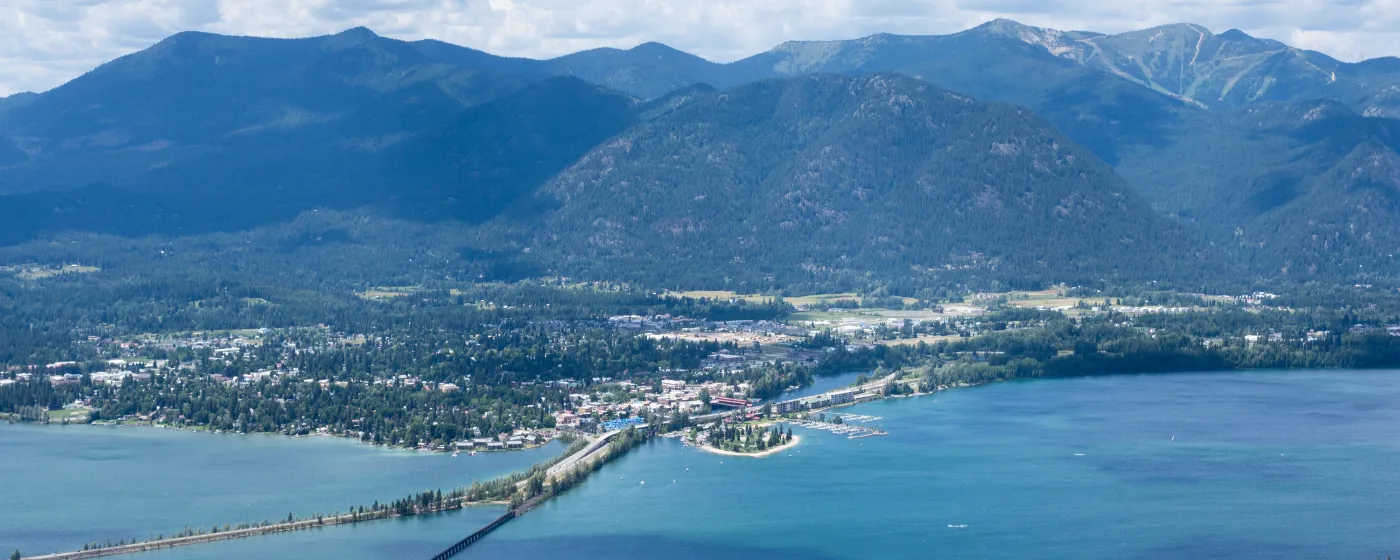
People ask whether Sandpoint is safe almost as a formality — they're expecting the usual small-town reassurances. What they don't expect is hard FBI data that puts this city of roughly 10,000 people among the four safest cities its size in the entire state. Sandpoint sits at the north end of Lake Pend Oreille, surrounded by the Cabinet and Selkirk ranges, accessed by US-2 and US-95, and shaped daily by a seasonal tourism economy anchored to Schweitzer Mountain Resort. That economic mix — outdoor recreation, a regional hospital, a food manufacturer, a tech company — draws a working population with deep community stakes, and it shows in the crime numbers.
The city's violent crime rate is 0.86 per 1,000 residents, measured against Idaho's own statewide rate of 2.4 per 1,000 and a national figure of 3.59 per 1,000 (FBI, 2024). Those aren't close comparisons. Sandpoint runs at roughly a third of the state average for violent crime and less than a quarter of the national rate. Property crime — larceny, vehicle break-ins, package theft — is where the picture gets more nuanced, at 10 per 1,000 residents. That figure sits marginally above Idaho's statewide property crime rate of 9.67 per 1,000, which itself is the lowest of any state in the nation. In context, Sandpoint's property crime rate is unremarkable for a small city with a busy downtown, a lakefront park, and a resort economy that brings tens of thousands of visitors through every year.
The overall crime index tells a sharper story: Sandpoint's City-Data crime index of 71 is 3.3 times lower than the U.S. average, and total crime dropped 25% from 2023 to 2024 alone. Idaho's statewide crime rate fell 6.3% over the same period, hitting a 20-year low. Sandpoint is moving in the same direction as the state, but from an already-low starting point. For people relocating from larger metros — or even from mid-size cities in Washington or Montana — the adjustment is noticeable within weeks.
This guide breaks down exactly what the crime data means at the neighborhood level, where the safety picture varies across Sandpoint's eight distinct areas, how the police department is staffed relative to the population, what to watch for as a practical matter, and what six months of living here actually reveals that the statistics don't.

How Sandpoint's Crime Rates Compare to State and National Benchmarks
Sandpoint ranked 4th safest among Idaho cities with populations of 10,000 or more in 2024, using violent crime rate as the primary metric (FBI UCR submissions). That ranking matters because Idaho is already among the least-crime-affected states in the country — its violent crime rate ranks 13th lowest nationally, and its property crime rate is the lowest of any state.
Putting the numbers in a single table makes the comparison concrete:
| Geography | Violent Crime (per 1,000) | Property Crime (per 1,000) |
|---|---|---|
| Sandpoint, ID | 0.86 | 10.00 |
| Idaho (statewide) | 2.40 | 9.67 |
| United States | 3.59 | ~19.00 (est.) |
| Idaho rank — property crime | — | Lowest in nation |
| Idaho rank — violent crime | 13th lowest | — |
| Sandpoint rank among ID cities 10k+ | 4th safest | — |
The violent crime gap between Sandpoint and the national average is the headline finding. Less obvious but equally relevant: the 4.5% national drop in violent crime in 2024, combined with Idaho's 6.3% drop in total crime, means Sandpoint's already-low rates are moving in a favorable direction rather than holding steady against a worsening national backdrop.
Property crime is the more honest concern. At 10 per 1,000, it sits just above Idaho's already-exceptional statewide figure — roughly 9 property incidents for every 10 total incidents reported in the city. Larceny-theft drives the bulk of it, consistent with a tourist-active downtown where unlocked vehicles and unattended gear at boat launches create routine opportunity. This is not a pattern unique to Sandpoint; it's a feature of any small city anchored to a high-traffic outdoor-recreation economy.
Neighborhood-Level Safety: Where the Picture Varies
The city-wide figures are useful, but the within-city variation is what actually affects your daily experience. CrimeGrade.org's 2025 analysis of Sandpoint found that violent crime victimization risk ranges from roughly 1-in-242 in the northern parts of the city to 1-in-516 on the west side — meaning the west side carries about half the violent crime risk of the north end. That's a meaningful spread for a city this size.
The neighborhoods themselves reflect that gradient. For a full character breakdown of each area, see the best neighborhoods in Sandpoint guide — the summary below focuses on what the safety picture looks like across those areas.
| Neighborhood | General Safety Profile | Primary Concern (if any) | Best For |
|---|---|---|---|
| West Sandpoint (Pine St / Baldy Mountain) | Among the safest in the city | Minimal — quiet residential streets | Families Quiet |
| Syringa Heights | Low incident rate, elevated position above city | Wildlife encounters, not crime | Privacy Nature |
| Pristine Heights | Low — semi-rural feel, low traffic | Road access in winter | Views Quiet |
| Moonridge Estates | Low — established subdivision | None notable | Families |
| Northview Estates | Moderate — north-end variation applies | Slightly higher north-end risk vs. west side | Commuter |
| Timber Creek | Low — newer residential | None notable | Families Value |
| Dover Bay | Low — gated/planned waterfront community | Marina area — occasional vehicle break-ins | Luxury Views |
| Downtown Historic District | Moderate — highest foot traffic zone | Property crime; larceny near City Beach / Sand Creek | Walkable Renter |
The west side of Sandpoint — including Pine Street / Baldy Mountain and the higher-elevation neighborhoods like Syringa Heights and Pristine Heights — consistently draws the lowest crime exposure. The Downtown Historic District, which runs from the Panida Theater toward Cedar Street Bridge Public Market and the City Beach corridor along Sand Creek, sees the highest concentration of property incidents. That's where the tourist foot traffic is, and it's where opportunistic larceny concentrates.
Dover Bay, as a planned waterfront community across the Long Bridge in Dover, sits outside Sandpoint's city limits. Its safety profile benefits from controlled access and lower density — but marina parking lots at the water's edge are not immune to the vehicle break-in pattern common to lakefront recreation areas throughout North Idaho.

Police Coverage and Department Capacity
The Sandpoint Police Department Patrol Division runs 24/7 coverage with 2 sergeants, 3 corporals, and 10 patrol officers. For a city of roughly 10,200 people, that staffing level translates to approximately 3.5 officers per 1,000 residents — 44% above the Idaho state average and 8% above the national average.
That ratio matters in practical terms. A department that is staffed above both state and national averages has more capacity for proactive patrol rather than purely reactive response. The department's Community Resource Officer unit specifically handles code enforcement and public-nuisance patrol in residential and business districts — the kind of visible presence that tends to suppress the opportunistic property crime that dominates Sandpoint's incident profile.
What this means for new residents: response times in Sandpoint are generally faster than you'd expect from a small city, and the department operates with a community-facing orientation rather than a purely enforcement posture. Long-timers note that the CRO unit is a regular presence in the downtown corridor on summer weekends, which correlates with the relatively contained property crime footprint given the volume of visitors cycling through City Beach and the Cedar Street Bridge Public Market area.
Bonner County Sheriff's Office provides coverage for the unincorporated areas surrounding Sandpoint — relevant if you're considering Sagle, rural Ponderay, or areas along the highway corridors that fall outside city limits. Sheriff coverage in rural North Idaho means longer response times than in-city, a trade-off worth weighing if you're drawn to the more remote elevation neighborhoods near Schweitzer or the county roads south of the lake.
Looking to buy in Sandpoint? Estimate your payment.
Enter your numbers to see an estimated monthly mortgage payment.
Estimate only. Excludes HOA fees and mortgage insurance. The interest rate above is a starting point, not a quoted rate — replace it with your own to see real numbers. Insurance is a flat placeholder, not a Sandpoint quote.
What Property Crime Actually Looks Like Day-to-Day
The Seasonal Pattern
Sandpoint's property crime is not distributed evenly across the year. Summer — when City Beach fills up, Long Bridge becomes a pedestrian landmark, and Schweitzer Mountain Resort transitions to mountain biking — brings the city's highest visitor density and its highest property-incident counts. This is the window when unlocked cars in trailhead lots and unattended gear near the boat launch on Lake Pend Oreille generate the most reports.
Winter compresses the pattern toward the Schweitzer access roads and the downtown bar and restaurant corridor near N 2nd Ave and Oak Street, where MickDuff's Brewing Company and Matchwood Brewing draw a late-evening crowd. Vehicle break-ins in poorly lit side-street parking are the dominant concern during ski season, not assault or robbery.
What Locals Actually Do
After six months here, most newcomers stop locking valuables in their cars as an afterthought and start doing it as a reflex. Not because Sandpoint is dangerous — the numbers confirm it isn't — but because the city's recreation economy means parking lots at trailheads, the boat ramp near Sand Creek, and the Long Bridge pullouts see enough foot traffic to make a smash-and-grab an occasional reality during peak season.
The adjustment most people don't anticipate: leaving Portland or Seattle with the mental model of a big-city crime environment, and then having to recalibrate downward significantly. Several residents describe the first winter as the moment they genuinely stopped thinking about crime as a daily variable. The downtown corridor after midnight on a Friday is quieter than most mid-size city suburbs at 9 p.m.
What to Watch Near Downtown
The blocks immediately surrounding City Beach and the Sand Creek corridor see the highest concentration of property incidents in the city. If you're evaluating a rental or residence in the Downtown Historic District — particularly east of First Avenue toward the water — walk the area after 10 p.m. on a summer weekend before you decide. It's not alarming, but it's the most active zone in Sandpoint's otherwise calm crime landscape.
The Honest Safety Assessment: Strengths, Caveats, and What Six Months Reveals
The Genuine Strengths
Sandpoint's violent crime rate of 0.86 per 1,000 isn't a favorable outlier that requires careful interpretation — it's straightforwardly low by any meaningful comparison. The 25% single-year drop in total crime from 2023 to 2024 suggests the trajectory is moving in the right direction, not holding a baseline. And the above-average police staffing ratio means the department has room to work proactively, not just reactively.
For families with school-age children, the practical upshot is that Sandpoint functions like a small town in terms of felt safety — kids ride bikes on Baldy Mountain Road, families gather at City Beach without meaningful concern, and the community events around the Panida Theater and Cedar Street Bridge Public Market draw mixed-age crowds without incident. That's not a romanticized version of small-town life; it's what the data supports.
The Honest Caveats
Property crime at 10 per 1,000 is real, and in a city this size, 10 per 1,000 means roughly 100 property incidents per year city-wide. Most of those are larceny rather than burglary, and most target cars and recreational gear rather than residences. But dismissing property crime entirely because the violent crime rate is impressive would be a mistake.
The north end of the city carries a higher victimization risk relative to the west side — not dramatically higher, but consistently measurable. Northview Estates and the areas approaching the US-95 corridor don't have the quiet residential insulation of the Pine Street neighborhoods or the elevation-driven separation of Syringa and Pristine Heights.
Why People Move Out — and What It Has to Do With Safety
The people who leave Sandpoint rarely cite crime as a reason. They cite housing costs, limited career options, or winter isolation. The city's safety profile is one of the least-contested aspects of living here — which is itself a kind of data point. When the primary reasons for leaving a place don't include feeling unsafe, the safety picture is doing its job.
What surprises most newcomers by month six isn't that Sandpoint is safer than they expected — they generally arrive with that expectation. It's that the downtown area, which looks like it should carry the risk factors of any tourist-active corridor, actually stays calm enough that Spuds Waterfront Grill on N 1st Ave and the brewpubs along N 2nd Ave and Oak Street close without the kind of late-night disturbance activity that marks similar-sized tourist towns in other states. That's the detail the crime index can't fully capture.
Local Expert Takeaway: Sandpoint's violent crime rate sits at less than a quarter of the national average, and the city ranked 4th safest among Idaho's larger cities in 2024. Property crime is the realistic concern — larceny near City Beach, the Sand Creek boat launch, and trailhead parking lots during summer and ski season. The west side of the city, particularly the Pine Street and Baldy Mountain area and the higher-elevation neighborhoods like Syringa Heights, consistently shows the lowest crime exposure. The downtown corridor is fine — just don't leave valuables visible in your car on a summer weekend. The Sandpoint Police Department is staffed well above state and national averages, which keeps response times tight for a city this size.
Quick Takeaways & FAQs
✅ Sandpoint's violent crime rate of 0.86 per 1,000 residents is less than a quarter of the national average and roughly one-third of Idaho's own statewide rate — among the most favorable comparisons of any city its size in the region.
⚠️ Property crime at 10 per 1,000 is real and concentrated in the downtown corridor near City Beach and Sand Creek, particularly during summer and Schweitzer ski season when visitor density peaks.
📍 The west side of Sandpoint — Pine Street, Baldy Mountain Road, and the elevation neighborhoods like Syringa Heights — carries roughly half the violent crime victimization risk of the north end, a meaningful within-city difference worth factoring into any neighborhood decision.
What is Sandpoint's violent crime rate compared to Idaho and the U.S.?
Is property crime a real concern in Sandpoint?
Which parts of Sandpoint are safest?
How is the Sandpoint Police Department staffed?
Has crime in Sandpoint been getting better or worse recently?
Moving to Idaho?
Tell us what you need help with and we'll connect you with local resources.
