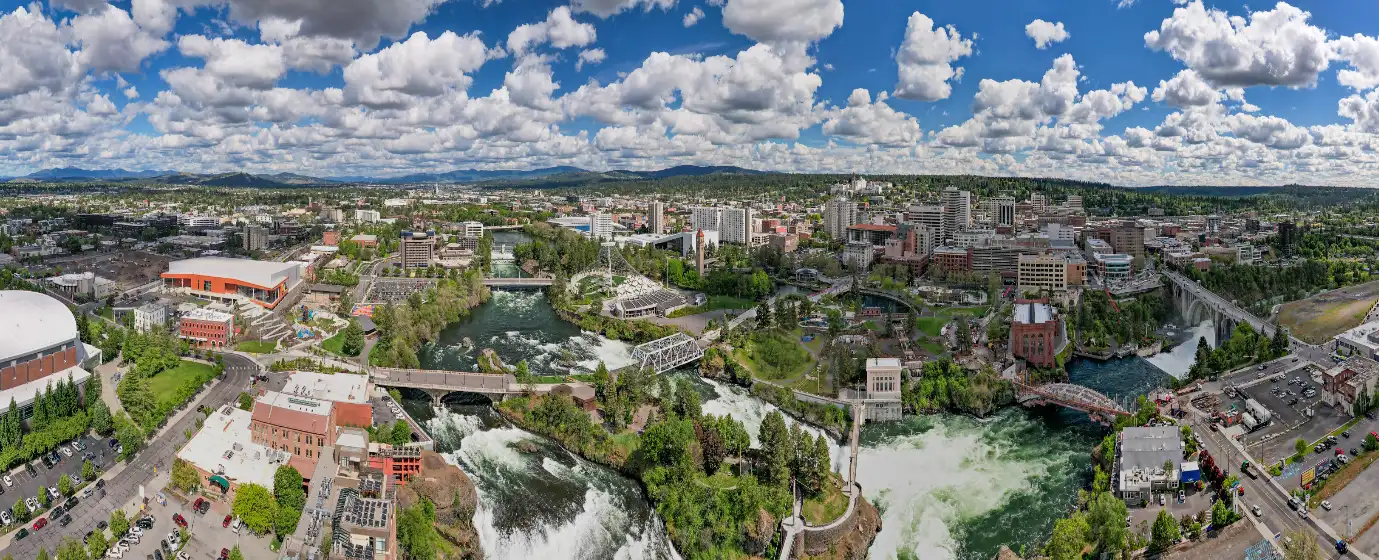
Maybe your Bay Area rent just crossed another threshold you can't justify. Maybe you've been watching Spokane Valley home prices from a Zillow tab you've had open for six months, doing the math and re-doing the math. The surprise most Californians hit isn't sticker shock — it's the opposite. The typical home value in Spokane Valley is $399,691 (Zillow Home Value Index, mid-2026), less than half the statewide California median. For buyers leaving Los Angeles, San Jose, or San Diego, that gap is wide enough to change not just your housing budget but your entire financial picture. Spokane Valley sits in the Inland Northwest, connected to downtown Spokane via Sprague Avenue and I-90, with the Selkirks visible to the north and the Spokane River running along its northern edge.
Washington has no state income tax on wages or salaries — a fact that lands differently depending on what bracket you were in when you left California, where the top marginal rate reaches 13.3%. For a household at the Spokane Valley median income of $74,042, the move eliminates the state income-tax line entirely. The city's economic backbone includes Kaiser Aluminum's Trentwood rolling mill, Numerica Credit Union, Wagstaff Inc., and the Central Valley School District, which holds a B+ rating, according to Niche, and serves as the district most families here rely on. The population of roughly 108,000 tilts toward working families, tradespeople, and remote workers who've done the same California math you're doing now.
Day-to-day costs run noticeably lower than most California metros. Numbeo's June 2026 data puts the Spokane metro — which Spokane Valley anchors — at roughly 14.7% less expensive than Los Angeles on everyday goods and services outside of housing. Groceries are not subject to Washington's 9.0% combined sales tax, which is one of the quieter wins of the move. The Centennial Trail runs through town, Dishman Hills Natural Area offers quick access to trails without a two-hour drive, and Mirabeau Point Park anchors the city's east side. For parks and outdoor access, see the full breakdown on the parks and recreation page.
Whether you're seriously considering the move or still stress-testing the numbers, this guide covers the California-to-Spokane Valley comparison on home prices, taxes, and cost of living; the cultural shift that comes with the move; the tax picture in detail; what surprises people after six months; and the honest case for — and against — making the jump.
The Home Price Reality: What Your California Budget Actually Buys Here
The first thing to understand is that Spokane Valley doesn't just offer lower prices — it offers a fundamentally different relationship between income and homeownership. California's price-to-income ratio for homebuying sits at roughly 11.3× in Los Angeles. In the Spokane metro, that figure is 5.2×. That's not a rounding difference; it's the difference between a home being theoretically possible and actually achievable.
The typical Spokane Valley home value is $399,691 (Zillow Home Value Index, mid-2026). California's statewide median routinely exceeds $800,000 — and in coastal metros, it climbs well past that. The practical result: a California buyer who sells a modestly appreciated home often arrives in Spokane Valley with enough equity to purchase outright or put down a substantial amount and carry a manageable payment.
| Market | Typical Home Value | Price-to-Income Ratio | Best For |
|---|---|---|---|
| Spokane Valley, WA | $399,691 (mid-2026 ZHVI) | ~5.2× | First-Time Families |
| California statewide | Routinely above $800,000 | Varies by metro | Luxury |
| Los Angeles metro | Well above state median | ~11.3× | Luxury |
| Liberty Lake, WA (nearby) | Noticeably above Spokane Valley | Higher than SV | Families Commuter |
| Spokane, WA (city proper) | Below Spokane Valley median | Moderate | First-Time Value |
| Millwood, WA (adjacent) | Comparable to SV entry-level | Moderate | Value |
* ZHVI = Zillow Home Value Index.
Spokane Valley's neighborhoods range from the older ranch-style homes near Chief Garry Park and Trentwood to the newer construction in Veradale and Greenacres — and none of them carry the California price premium you're used to. For a neighborhood-by-neighborhood breakdown, see the best neighborhoods page.
One thing California buyers consistently underestimate: the speed of the Spokane Valley market. Well-priced homes in Veradale and Opportunity move quickly, sometimes within days. Coming from a market where you've been repeatedly outbid, the reflex is to hesitate — but hesitation here can cost you just as much as it did there.
The Tax Picture: What You Gain, What You Give Up, and the Fine Print
Washington's most advertised advantage is the absence of a state income tax on wages and salaries — and for the typical Spokane Valley household, that advantage is real. California's top marginal rate of 13.3% means a professional earning $150,000 in California was sending a significant slice to Sacramento. In Washington, that line disappears entirely for 2025 and 2026.
What High-Asset Movers Need to Know
The income-tax win is not universal. Washington taxes 7% on long-term capital gains above a $278,000 standard deduction for 2025, rising to 9.9% on gains above $1,000,000. If you're selling a California home with substantial appreciation, liquidating an investment portfolio, or closing out a business, that gain may be taxable in Washington in the year you establish residency. California also taxes capital gains as ordinary income — so you're trading one tax structure for another, not escaping taxation. Model this with a CPA before you list your California home.
There's also a new development worth knowing: the 2026 Washington legislature passed Senate Bill 6346, establishing a 9.9% tax on adjusted gross income exceeding $1 million, effective January 1, 2028. It won't affect the vast majority of Spokane Valley households, but high-earning remote workers and executives relocating here should factor it into long-range planning.
| Tax Category | California | Washington / Spokane Valley | Net Impact for Most Movers |
|---|---|---|---|
| State income tax (wages) | Up to 13.3% marginal rate | None (2025–2026) | Significant annual savings |
| Capital gains (long-term) | Taxed as ordinary income | 7% on gains above $278K standard deduction (2025); 9.9% above $1M | Varies — model carefully |
| Property tax rate | 1% on purchase price (Prop 13) | ~0.83% effective rate | Lower rate; much lower base price |
| Sales tax (general) | Up to 10.25% in high-rate areas | 9.0% combined (effective Jan 2026) | Roughly comparable; groceries exempt in WA |
| Groceries | Exempt in California | Exempt in Washington | No change |
| Retirement income | Fully taxed at ordinary rates | Not taxed at state level | Major advantage for retirees |
| Social Security benefits | Partially taxed | Not taxed at state level | Meaningful for fixed-income households |
| Millionaires' income tax | Already in effect | 9.9% on AGI above $1M, starts 2028 | Minimal impact on most households |
The property tax math deserves a close look. Spokane Valley's effective rate is approximately 0.83%. California caps its rate at 1% under Proposition 13, but that cap applies to the purchase price — and a new buyer in Los Angeles is starting from a much higher base than $399,691. For most California transplants, the property tax bill in Spokane Valley will be noticeably lower in absolute dollars, not just in rate.
For the full picture on utilities, groceries, and everyday costs in Spokane Valley, that page has the complete breakdown.
Everyday Cost of Living: The Gaps That Compound Over Time
The home price and income tax comparisons get the headlines, but the everyday gaps are what actually change how a paycheck feels month to month. A CalcFi analysis reviewed in July 2026 found that a Los Angeles household needs roughly $8,366 per month to match the purchasing power of $6,600 per month in Spokane. That's not a one-time windfall — it recurs every month you live here.
Where the Savings Show Up
Groceries run noticeably lower than in coastal California. Washington's 9.0% combined sales tax does not apply to food or prescription medications, which matters for families doing a real monthly budget. Restaurants, services, and home maintenance tend to cost less than their counterparts in the Bay Area or Los Angeles — though less so compared to California's Inland Empire or Central Valley, where you may have been living if you were already priced out of the coast.
Health insurance premiums run noticeably below what most Californians were paying through individual or small-business plans. The honest trade-off: you will drive farther for specialist care, and advanced treatment for complex conditions means a trip to a larger regional center rather than something down the street.
What Doesn't Get Cheaper
Utilities in Spokane Valley — particularly heating costs — are a genuine adjustment. Winters here are cold and dry, and natural gas bills in January look nothing like a San Diego or Los Angeles utility bill. First-year residents consistently underestimate this. Budget for it before you move, not after your first February statement.
Car dependency is higher than in many California cities with transit infrastructure. Spokane Valley was built around the car and I-90, and while the Centennial Trail is excellent for recreation, running a two-car household is closer to the norm than the exception. That cost is real and ongoing.
The sales tax at 9.0% is not dramatically lower than the highest California jurisdictions, which cap at 10.25%. The difference is meaningful at the margins but won't transform a budget on its own. What transforms the budget is the mortgage payment on a $399,691 home versus an $800,000-plus California equivalent — and that difference compounds every month for the life of the loan.
Looking to buy in Spokane Valley? Estimate your payment.
Enter your numbers to see an estimated monthly mortgage payment.
Estimate only. Excludes HOA fees and mortgage insurance. The interest rate above is a starting point, not a quoted rate — replace it with your own to see real numbers. Insurance is a flat placeholder, not a Spokane Valley quote.
The Cultural Shift: What Californians Actually Find When They Arrive
Spokane Valley is not a scaled-down version of where you came from. That's obvious from the numbers, but it goes deeper than square footage and commute times. This is a mid-sized Inland Northwest city built around manufacturing, agriculture, and trades — Kaiser Aluminum's Trentwood rolling mill has operated here for generations, and Wagstaff Inc. and Numerica Credit Union anchor a different kind of local economy than a California tech corridor.
What Locals Know
The pace is slower and the social radius is smaller. Neighbors tend to know each other. The Plantes Ferry Sports Complex and Mirabeau Point Park are where families actually gather on weekends — not a farmer's market with a $7 coffee, but a ball field or a trail. YaYa Brewing Company on E. Montgomery Drive, which recently expanded to a 5,500-square-foot taproom with Detroit-style pizza and an arcade, is becoming one of those Friday-night spots where you'll run into the same people you saw at the kids' game that afternoon. Bardic Brewing and Cider on E. Sprague Ave is another locally owned option with a different character — cidery-forward, quieter, easier to hold a conversation in.
The political and cultural landscape in Spokane Valley runs conservative, which is a real change from most California metros. This isn't a warning — it's information. Newcomers who expect the social dynamic of a coastal city sometimes find the adjustment harder than they expected. Those who move here specifically for a different community culture tend to feel at home quickly.
What Surprises People After Six Months
Smoke season. People who moved from California have some experience with wildfire smoke, but the Inland Northwest's geography concentrates it differently. Late summer — August in particular — can bring several weeks of air quality that keeps people inside more than they planned. It doesn't happen every year to the same degree, but in a bad smoke year it's genuinely disruptive, and it catches California transplants off guard because the rest of the summer is beautiful.
The other surprise is how quickly people stop missing certain California amenities and start missing others. The specific food options — the density of diverse restaurants in a city like Los Angeles or the Bay Area — don't replicate here, at least not at the same scale. Spokane Valley has solid options, but you will drive to downtown Spokane for dining variety, and some cuisines you relied on weekly simply won't be within ten minutes anymore.
For a full picture on commuting and what it takes to get around the region, the living in Spokane Valley hub covers daily life and employer context.
Who This Move Works For — and Who Should Think Twice
The case for Spokane Valley is unusually strong for a specific type of California mover: someone with California home equity to deploy, a remote job or a transferable career, and a genuine preference for space, lower density, and a slower pace. That combination makes Spokane Valley genuinely transformative, not just marginally cheaper.
| Buyer or Mover Type | How Spokane Valley Fits | Best For |
|---|---|---|
| Remote worker leaving coastal CA | Equity from CA home sale covers most or all of a Spokane Valley purchase; paycheck goes further immediately | Value Commuter |
| Families with school-age children | Central Valley School District is solid at a fraction of California school-district home premium; outdoor access without a drive | Families School |
| California retirees | No state tax on Social Security, pensions, or retirement distributions; property tax rate below 1% | Quiet Value |
| First-time buyers priced out of CA | Price-to-income ratio roughly half of Los Angeles; entry-level homes actually exist here | First-Time |
| High-asset movers / investors | Capital gains tax at 7% above $278K standard deduction (2025), rising to 9.9% above $1M, and a future millionaires' income tax (2028) reduce the advantage; model carefully | Luxury |
| Urban amenity seekers | Downtown Spokane is 15 minutes away; Spokane Valley itself is suburban and car-dependent — manage expectations | Walkable |
The Honest Case Against
If your income depends on a California labor market — entertainment, biotech, specialized finance — and you can't work remotely, the income-tax savings don't offset the salary differential that often exists between Spokane Valley employers and California equivalents in the same field. The local median household income of $74,042 reflects that reality.
People move out of Spokane Valley for a few consistent reasons: the winters are harder than anticipated (not extreme by Midwest standards, but a genuine adjustment from Southern California), the smoke season is worse in bad years than any California experience prepared them for, and the limited walkability and density start to feel constraining after a few years for people who genuinely loved urban life. None of these are dealbreakers for the right buyer — but they're real, and they're specific.
The Central Valley School District is solid and consistently performs well, but the district serves a large, varied area and the experience varies by school — boundary research matters. See the schools page for that detail. For a safety overview relevant to Californians comparing against high-density metros, the safety page has the current numbers.

Local Expert Takeaway: The California-to-Spokane Valley move works best when you're bringing equity with you, not just relocating a paycheck. A buyer who sells a California home — even one bought at the bottom of a cycle — often arrives here with enough to purchase outright or put down enough to change their monthly math entirely. The tax picture is genuinely favorable for wage earners: no Washington state income tax on salaries means the savings are immediate and recurring. The honest friction points are smoke season in August, winter utility bills that surprise people who moved from Southern California, and a dining and cultural scene that is good but not at Los Angeles or Bay Area scale. If you're expecting a California lifestyle at half the price, you'll be partly right — but Spokane Valley is its own city with its own pace, and the transplants who thrive here are the ones who moved toward it, not just away from something else.
Quick Takeaways & FAQs
✅ Washington's zero state income tax on wages and salaries delivers an immediate, recurring financial advantage over California's rate structure — one that compounds across every year you live here.
⚠️ Washington's capital gains tax — 7% on long-term gains above a $278,000 standard deduction for 2025, rising to 9.9% above $1,000,000 — means Californians selling appreciated assets should run the numbers with a CPA before establishing residency.
📍 YaYa Brewing Company on E. Montgomery Drive recently expanded to over 5,500 square feet with Detroit-style pizza and an arcade — the kind of neighborhood anchor that signals a city investing in its own identity, not just waiting for Spokane to define it.
Is Spokane Valley actually cheaper than California, or does the sales tax and cost of living close the gap?
Does Washington state really have no income tax, and does that apply to Californians who move there?
What happens to my California home equity when I move to Spokane Valley — does Washington tax it?
How different is Spokane Valley from coastal California in terms of day-to-day lifestyle?
Is Spokane Valley a good fit for California retirees specifically?
Moving to Washington?
Tell us what you need help with and we'll connect you with local resources.
