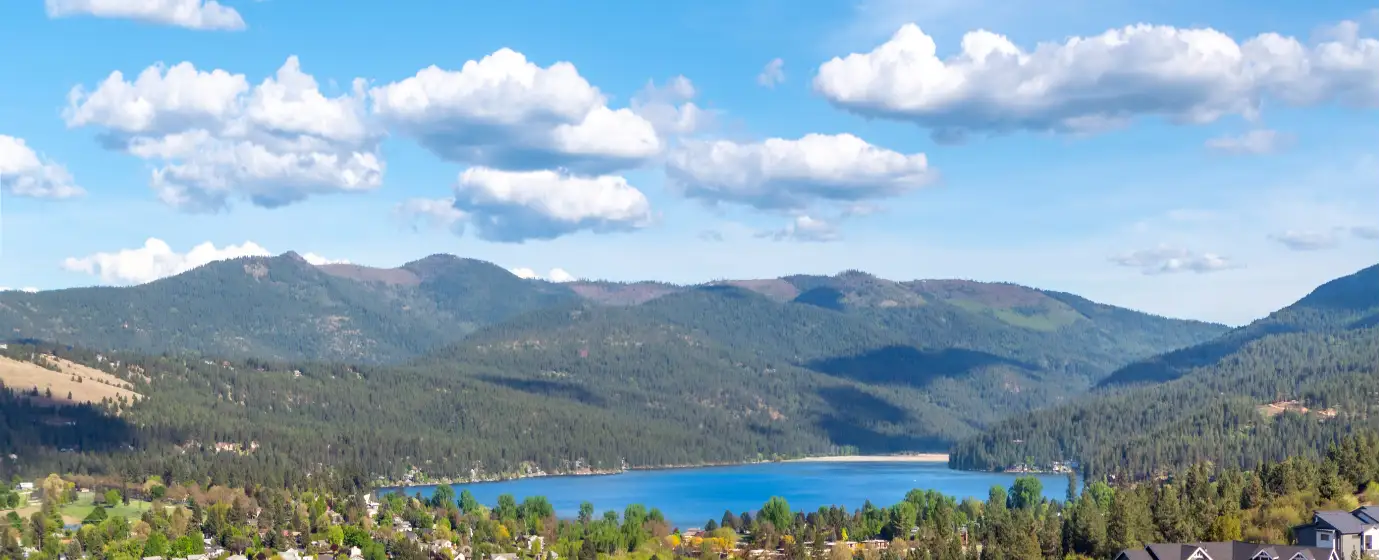
If you've been comparing Liberty Lake to Spokane Valley or eyeing Coeur d'Alene across the Idaho state line, you've probably noticed that Liberty Lake sits at its own price point — higher than Spokane proper, competitive with Coeur d'Alene, and noticeably below what you'd pay for equivalent square footage in the Seattle suburbs. What drives that premium is straightforward: Liberty Lake is a planned community that grew intentionally around the lake itself, with newer construction, a walkable town center along N Harvest Parkway, and employers like Itron and STCU bringing six-figure salaries into a relatively small city of about 13,000 people. The result is a housing market that prices in the lifestyle, not just the square footage.
The median household income here — $118,723 — tells you something important about the buyer pool. Liberty Lake consistently attracts dual-income professional households, many of them tied to the Inland Northwest tech, financial services, and manufacturing sectors. That income level means the city's housing costs are broadly affordable for residents who already live and work here. For someone relocating from a lower-wage market, or a single-income household, the math requires a harder look. Washington's complete absence of a state income tax is a real offset — a family earning $120,000 keeps several thousand dollars annually that they'd lose in Oregon or California — but the 9.0% combined sales tax in Liberty Lake quietly reclaims some of that advantage on everyday purchases.
Day-to-day life beyond housing runs close to regional averages, with a few wrinkles worth knowing. Electricity rates have climbed roughly 13% year-over-year through early 2026, driven by Avista Utilities rate adjustments, and water and sewer costs have risen steadily under the Liberty Lake Sewer and Water District's multi-year adjustment schedule. Groceries, however, carry zero sales tax under Washington state law — a genuine offset that matters more than people initially expect. The nearest big-box grocery options sit along the Sprague Avenue corridor in Spokane Valley, a short drive west, and the River District near N Harvest Parkway has added independent dining options including Crêpe Café Sisters, which opened its second location here in late 2025.
Whether you're weighing a purchase, comparing rents, or stress-testing your monthly budget before signing anything, the sections below break down Liberty Lake's housing costs, everyday expenses, a side-by-side comparison with nearby cities, and how the tax picture actually shakes out.
What It Really Costs to Live in Liberty Lake
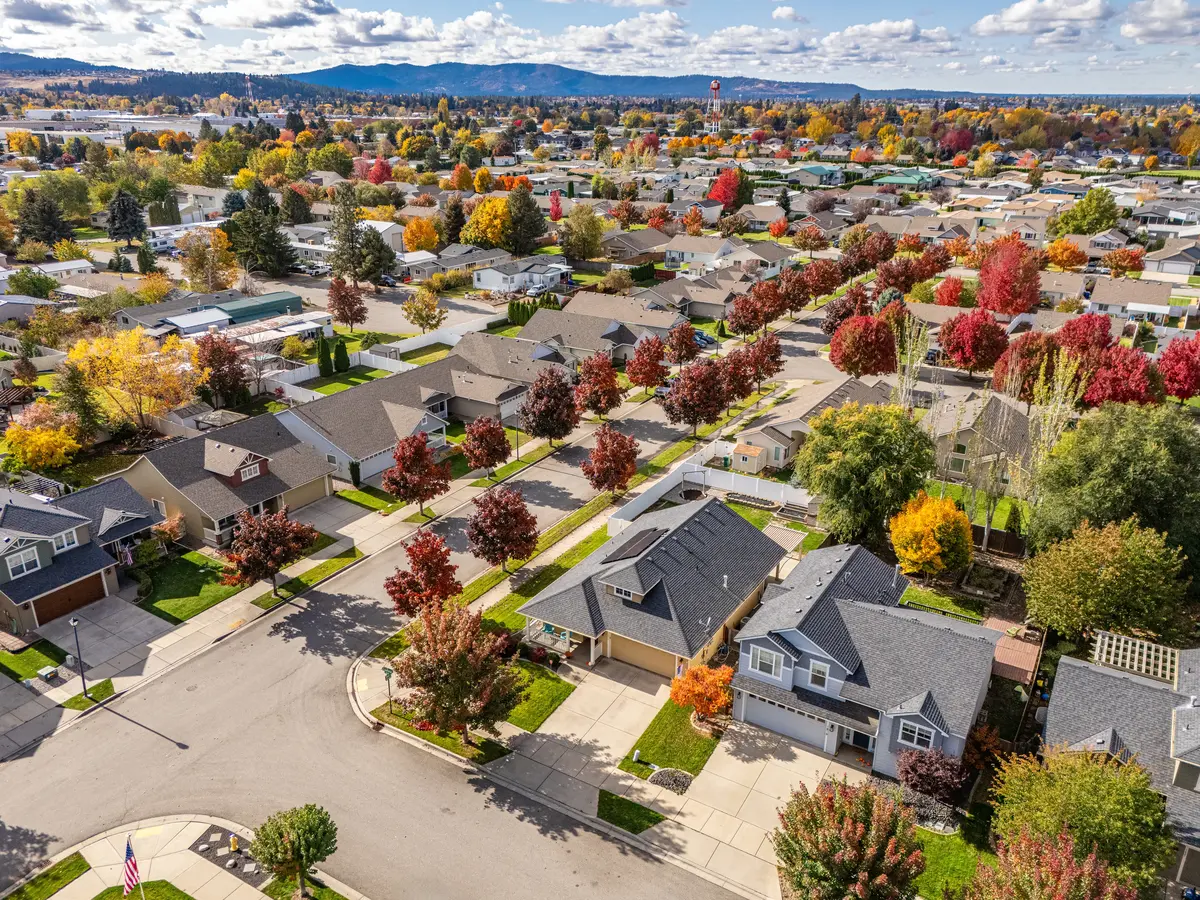
Liberty Lake is not the most affordable city in the Spokane metro — and it's not trying to be. The Zillow Home Value Index pegs the average home value at $580,200 (mid-2026), a figure that places it noticeably above Spokane and Spokane Valley, roughly in line with Post Falls just across the Idaho border, and competitive with the lower end of the Coeur d'Alene market. What you're paying for is newer stock: most of the housing here was built after 2000, which means fewer deferred-maintenance surprises but also fewer of the deep-value opportunities you can still find in Spokane's older neighborhoods.
Two forces sustain that price level. First, Liberty Lake's employment base draws households with above-average incomes, which supports asking prices even when the broader regional market softens. Second, supply is genuinely constrained — the city is ringed by natural features and existing development, so new inventory tends to absorb quickly. That combination makes significant price corrections here historically less severe than in more speculative markets.
Compared to the Washington state median, Liberty Lake sits meaningfully higher. Against Idaho's Coeur d'Alene, the gap has narrowed considerably over the past few years as that market appreciated. The practical takeaway: if your budget is calibrated to Spokane prices, Liberty Lake will feel like a step up. If you're arriving from the west side of the Cascades or from a major California metro, it will feel like a relief.
Housing: Rent vs Buy in Liberty Lake
Entry-level ownership in Liberty Lake typically starts in the low-to-mid $400,000s for older townhomes and condos — the relative handful of attached product in the city. Detached single-family homes generally enter the market above $500,000, with the average home value at $580,200 and move-up homes on larger lots pushing well past $700,000. Entry-level homes in the city tend to cluster in the older sections toward the city's perimeter; for neighborhood-by-neighborhood breakdowns, the Best Neighborhoods guide covers the specifics.
The effective property tax rate in Liberty Lake is approximately 0.83% — below the national average and one of the lower rates in the Spokane County area. Spokane County commissioners voted unanimously in late 2025 to hold the levy rate flat for 2026, forgoing the 1% annual increase Washington law permits, which provides a degree of near-term cost stability for owners. Use the mortgage calculator below this section to model your actual monthly payment — it accounts for taxes and insurance in a way any general estimate can't.
Renting makes financial sense in Liberty Lake for people who expect to stay fewer than three to four years, who are waiting to understand the local micro-markets before committing, or whose down payment isn't yet built up. Typical two-bedroom rents in the city run roughly $1,700–$2,100 per month depending on age of the unit and whether it includes a garage. That range is not dramatically cheaper than carrying a mortgage on an entry-level purchase, which is part of why renters who plan to stay long-term generally find owning the stronger position here — but run the calculator with current rates before treating that as settled advice.
What Surprises Renters After Six Months
Renters who arrive expecting Seattle-style apartment density tend to be caught off guard: Liberty Lake's rental inventory is genuinely thin, dominated by single-family rentals and a limited number of smaller complexes. When a well-priced unit opens, it moves within days. If you're relocating here and need a rental bridge while you shop for a home, start your search earlier than you think necessary.
Everyday Costs Beyond Housing in Liberty Lake
Utilities run at the higher end of what you'd expect for a smaller Pacific Northwest city. Avista Utilities provides electricity at approximately 14.11 cents per kWh as of February 2026 — a roughly 13% jump from the prior year. At Washington's average residential consumption of about 955 kWh per month, a typical household electric bill lands around $135. Natural gas runs approximately $17.32 per thousand cubic feet (as of February 2026), and the Liberty Lake Sewer and Water District raised water rates 4.8% in 2025 as part of an ongoing multi-year adjustment. Budget for utilities climbing modestly each year; flat-rate assumptions will leave you short.
Groceries cost roughly what you'd pay in any mid-sized Northwest city — and Washington's full exemption of unprepared food from sales tax means a family spending $800 a month on groceries saves around $70 compared to a state that taxes them. Gas prices near Liberty Lake tend to track slightly above the Idaho side of the border (Post Falls and Coeur d'Alene), though the gap rarely exceeds 15–20 cents per gallon. Most residents commute by car; the drive to central Spokane runs about 20 minutes on I-90, and most errands within the city are drivable in under 10 minutes.
| Category | Typical Monthly Cost | Notes |
|---|---|---|
| Housing (2BR rent) | $1,700–$2,100 | Rental range; owners: use the mortgage calculator above for a purchase estimate |
| Electricity | ~$135 | Based on ~955 kWh/month at 14.11¢/kWh (Feb 2026, Avista Utilities) |
| Natural Gas | $60–$100 | Seasonal range; higher Nov–Feb for heating; ~$17.32/Mcf as of Feb 2026 |
| Water, Sewer & Trash | $80–$120 | Liberty Lake Sewer and Water District; rates rose 4.8% in 2025 |
| Groceries | $600–$900 | No sales tax on unprepared food in Washington — a meaningful offset |
| Transportation & Gas | $200–$350 | Most residents drive; gas typically slightly above Idaho border prices |
| Phone & Internet | $150–$220 | Competitive providers available; fiber options in newer developments |
| Misc / Discretionary | $300–$600 | Dining, entertainment, recreation; 9.0% sales tax applies to non-grocery purchases |
These are estimates for planning purposes — individual spending varies significantly. The 9.0% combined sales tax (6.5% state + 2.5% city) is the line item that catches people off guard most often on non-grocery discretionary spending.
Looking to buy in Liberty Lake? Estimate your payment.
Enter your numbers to see an estimated monthly mortgage payment.
Estimate only. Excludes HOA fees and mortgage insurance. The interest rate above is a starting point, not a quoted rate — replace it with your own to see real numbers. Insurance is a flat placeholder, not a Liberty Lake quote.
Liberty Lake vs Nearby Cities: Cost Comparison
| City | Median Home Price | Typical 2BR Rent | Cost vs Liberty Lake |
|---|---|---|---|
| Liberty Lake, WA | $580,200 | $1,700–$2,100/mo | — baseline — |
| Spokane, WA | ~$325,000–$350,000 | $1,200–$1,600/mo | Noticeably cheaper to buy; rent also lower |
| Spokane Valley, WA | ~$400,000–$440,000 | $1,400–$1,800/mo | Meaningfully cheaper; closer in rent |
| Post Falls, ID | ~$430,000–$470,000 | $1,500–$1,900/mo | Somewhat cheaper; lower Idaho income tax applies |
| Coeur d'Alene, ID | ~$550,000–$620,000 | $1,700–$2,200/mo | About the same; rent nearly identical |
| Otis Orchards–East Farms, WA | ~$380,000–$420,000 | $1,300–$1,700/mo | Noticeably cheaper; more rural trade-off |
The clearest takeaway from this table: Spokane proper offers the sharpest price discount relative to Liberty Lake, while Coeur d'Alene has converged to near-parity. Keep in mind that Idaho cities like Post Falls and Coeur d'Alene come with a state income tax — Washington's zero income tax meaningfully shifts the true cost comparison for higher earners.
Taxes & the Bottom Line for Liberty Lake
No State Income Tax — The Headline Advantage
Washington has no personal income tax, full stop. For a household earning the city's median of $118,723, that's a significant line item that simply doesn't exist compared to neighbors in Idaho (who pay a flat 5.8% state income tax), Oregon, or California. Over a decade of homeownership, the cumulative savings are substantial — and it's one of the primary reasons higher-earning households in the Inland Northwest choose the Washington side of the state line.
Sales Tax: Real, But Not Uniform
The 9.0% combined sales tax (6.5% Washington state base plus 2.5% Liberty Lake city rate) is the visible trade-off for that income tax freedom. On a $50,000 car purchase, you pay $4,500 in sales tax. On a $3,000 furniture order, another $270. The offset that matters most day-to-day: unprepared groceries are fully exempt from Washington sales tax, so your weekly grocery bill doesn't carry the 9% burden. Dining out, clothing, electronics, and home goods do.
Property Tax: Below Average, Currently Stable
The effective property tax rate of approximately 0.83% is below the national average and notably lower than rates in many comparable Washington cities. Spokane County held the levy flat for 2026, which provides near-term predictability for buyers closing this year. That rate is applied to assessed value, which in Spokane County tracks closely to market value — so as home values rise, your tax bill rises proportionally even if the rate holds steady.
Who This Budget Reality Fits
Liberty Lake's cost profile suits dual-income households earning $100,000 or more who prioritize newer construction, low property taxes, and the income-tax advantage — and who are willing to accept a 9% sales tax on non-grocery spending. Single-income buyers or households coming from significantly lower-cost markets may find the home price referenced above leaves thin margin for savings, particularly as utilities continue their upward drift. The city tends to disappoint buyers who approach it expecting Spokane pricing with Liberty Lake amenities — those two things don't coexist at this address.
Local Expert Takeaway: Liberty Lake's cost of living is best understood as a premium on intentionality: newer homes, a planned town center, and employers who pay above regional averages all support prices that stay noticeably above Spokane and Spokane Valley. Washington's zero income tax is a genuine financial advantage — especially if you're comparing against Post Falls or Coeur d'Alene, where Idaho's income tax applies. The 9.0% sales tax stings on big purchases but leaves groceries untouched. Watch the utility trend closely: Avista electricity rates rose 13% year-over-year into early 2026, and the water district has been adjusting rates annually. For a household earning close to the city's $118,723 median, the numbers work comfortably. For households below that range, budget the utilities and non-grocery spending carefully before signing.
Quick Takeaways & FAQs
✅ Washington's zero state income tax saves Liberty Lake households thousands of dollars annually compared to equivalent earners living across the border in Idaho or Oregon.
⚠️ The 9.0% combined sales tax (state + city) is one of the higher local rates in the Inland Northwest and applies to everything except unprepared groceries — a real cost on big-ticket purchases.
📍 Electricity rates in Liberty Lake rose roughly 13% year-over-year into early 2026; factor in annual utility increases when stress-testing your monthly budget.
What is the average home price in Liberty Lake, WA?
Does Washington state have an income tax, and how does that affect living in Liberty Lake?
What is the property tax rate in Liberty Lake?
How does the cost of living in Liberty Lake compare to Spokane?
What is the sales tax rate in Liberty Lake, and do groceries get taxed?
Moving to Washington?
Tell us what you need help with and we'll connect you with local resources.
