
What Is Living in Huntsville, Texas Like?
Most people driving through Huntsville on I-45 see two things: a 67-foot statue of Sam Houston rising out of the pines, and the signs for the Texas Department of Criminal Justice. What they miss is everything in between — a genuine East Texas college town with 49,088 residents, a forested setting inside the Piney Woods, and a cost of living that looks almost impossible compared to the Houston metro an hour and change to the south. Huntsville sits roughly midway between Dallas and Houston along I-45, with US-190, SH-75, SH-30, and SH-19 radiating outward from the city core, and that central location shapes everything from who commutes here to why remote workers keep landing here when they get priced out of the city.
Two institutions define the economic backbone of this city in a way that's rare even in Texas. Sam Houston State University — founded in 1879 on a 368-acre campus — brings thousands of undergraduates into town each fall, along with faculty, staff, and graduate students. The Texas Department of Criminal Justice, headquartered here and operating the largest prison system in the United States, anchors the other half of the local economy as a major statewide employer. The result is a job market that skews toward government, education, and healthcare — with a major regional health system and the Huntsville Independent School District rounding out the top employers. Huntsville ISD holds a D rating, according to the Texas Education Agency, which is a real consideration for families making the move. For the full picture on schools, the Huntsville schools page goes deeper.
The typical home price in Huntsville sits at $262,042 (Zillow Home Value Index, July 2026) — noticeably below what buyers face in Willis or the Lake Conroe corridor, and dramatically below Houston's inner suburbs. The typical rent runs $1,351 per month (Zillow ZORI, July 2026). Worth knowing: the median household income of $47,529 runs below what most lenders would consider comfortable for the typical home here, so many buyers are working with two incomes, a down payment assist, or financing help — the first-time buyer page covers the mechanics. Day-to-day, this is a town where 203 sunny days a year meet genuine piney-woods outdoors culture: Huntsville State Park draws crowds from across the Houston region, and the Sam Houston National Forest wraps the city on multiple sides. There's real nature here, not just proximity to it.
Whether you're considering a move or just researching the area, the sections below break down Huntsville's neighborhoods, housing market, commute patterns, local employers, and what daily life here is really like.

Huntsville at a Glance
Looking to buy in Huntsville? Estimate your payment.
Enter your numbers to see an estimated monthly mortgage payment.
Estimate only. Excludes HOA fees and mortgage insurance. The interest rate above is a starting point, not a quoted rate — replace it with your own to see real numbers. Insurance is a flat placeholder, not a Huntsville quote.
Why Are People Moving to Huntsville?
The short version: Huntsville is one of the most affordable cities within striking distance of Houston, and people who've been priced out of Conroe, The Woodlands, and the northern suburbs are noticing. The typical home price of $262,042 (July 2026) is the headline number, but the deeper draw is the lifestyle math — a forested setting, a walkable university-town core, and a commute that's manageable if your schedule has any flexibility.
The Two Employers That Shape Everything
Sam Houston State University and the Texas Department of Criminal Justice aren't just the two largest employers in Walker County — they define the character of the city. SHSU brings a constant influx of students, faculty, and staff who want to live close to campus, which keeps demand for housing stable even when the broader market softens. TDCJ's headquarters here means a layer of state-government employees who tend to value proximity to work, job security, and the lower cost of living Huntsville offers.
Beyond those two anchors, a major regional health system, the Huntsville ISD, the City of Huntsville, and Walker County government collectively represent thousands of stable, local jobs. This is not a boom-and-bust economy — it's a steady, institutionally driven one, which suits buyers who prioritize predictability over speculation.
Who's Actually Moving Here
| Buyer Type | What Draws Them | Best Fit |
|---|---|---|
| SHSU faculty & staff | Campus proximity, affordable ownership vs. renting | Commuter Value |
| State & TDCJ employees | Job stability, low cost of living, established neighborhoods | Quiet Value |
| Houston-area remote workers | East Texas setting, home-price delta, slower pace | Nature Value |
| Families with school-age children | Space, low density, outdoor access — with eyes open on schools | Families Nature |
| First-time buyers | Entry-level price point rare in the Houston corridor | First-Time Value |
| Retirees (non-55+ community) | Cost, forested setting, slower pace — no dedicated 55+ communities found | Quiet Nature |
The honest caveat: Huntsville ISD holds a D rating, according to the Texas Education Agency, and on 2024-25 state assessments, 26% of students reached math proficiency and 44% reached reading proficiency. Families who move here without understanding that reality tend to be surprised within the first school year. Many parents supplement with private tutoring, or look at private school options in the area — see the full breakdown at Huntsville schools.
What People Don't Expect
The prison system is visible in a way newcomers from outside Texas don't always anticipate. TDCJ operates multiple facilities in and around Walker County, and the corrections workforce is a significant part of everyday Huntsville — at the gas station, the grocery store, the coffee shop. For most residents this is background noise; for some it's an adjustment. It's worth knowing before you show up.
What Daily Life Feels Like in Huntsville
A Town With Two Speeds
Huntsville runs at one speed during the academic year and a noticeably slower one in summer. When SHSU's student body is on campus, the downtown square has energy — coffee shops fill up, the local dining scene turns over quickly, and traffic on the routes through the university district gets real. In June and July, the city feels more like the East Texas small town it also is.
That rhythm is something longtime residents love and some newcomers find disorienting. If you're moving here from a suburb with a consistent, car-dependent suburban hum, Huntsville will feel different — more variable, more tied to an institutional calendar.
The Piney Woods Are Not a Marketing Line
The Sam Houston National Forest covers land in multiple directions from the city, and Huntsville State Park sits just to the southwest. On a weekday morning, the trails around Lake Raven genuinely feel remote — more than 21 miles of marked hiking and biking routes through East Texas pines, and a 210-acre lake where you can rent kayaks, canoes, and paddleboats. The park draws serious birdwatchers from across the region, including species as striking as bald eagles and painted buntings.
This is the piece of Huntsville that surprises remote workers who move here for the price point: they expected affordable, and got affordable-plus-genuinely-wild-outdoors. Kate Barr Ross Memorial Park anchors the in-town green space for families who want something closer than a state park drive.
The History You Can't Avoid
Sam Houston didn't just campaign through here — he retired and died in Huntsville, on July 26, 1863. The Sam Houston Memorial Museum on the SHSU campus is one of the city's primary heritage anchors, and the statue titled A Tribute to Courage — nicknamed "Big Sam" by locals — stands 67 feet tall on a 10-foot granite base along I-45. It is, by any measure, the first thing anyone notices driving into town, and it earns that attention. The Texas Prison Museum, which many visitors don't expect to find compelling, regularly surprises people who wander in.
Errands and Daily Logistics
Most errands are car-dependent. Huntsville has the major chains and grocery options a city of 49,088 generates, but a serious shopping run — specialty groceries, larger retail, certain medical specialists — means driving toward Conroe or further into the Houston metro. That's not a dealbreaker for most residents, but it's the practical friction of choosing a Piney Woods city over a full-service suburb. The full cost-of-living breakdown, including utilities and transportation costs, lives at the cost-of-living page.
The Huntsville Housing Market Right Now
The typical home price in Huntsville sits at $262,042 (Zillow Home Value Index, July 2026), which puts it at one of the more accessible entry points in the broader Houston region. The typical rent runs $1,351 per month citywide — both figures are noticeably below what buyers and renters face in Willis, the Lake Conroe area, or anywhere inside the Beltway.
What that number buys varies considerably across the city's neighborhoods. The established communities around Elkins Lake — with its golf course and lake — attract a different buyer than the newer construction in Texas Grand Ranch or the more modestly scaled streets of The Avenues and Normal Park closer to campus. The neighborhoods page maps those character differences in detail.
What to Understand About the Market
The effective property tax rate here is 1.31%, which is moderate for Texas but still a real line item on any monthly budget — especially given that the median household income of $47,529 runs below what's typically needed to carry the city's median home comfortably. Two-income households and buyers with meaningful down payments are better positioned than the income figure alone suggests; buyers relying on a single income near the median should model their numbers carefully before committing.
Texas has no state income tax, which is the partial offset — and for buyers relocating from California or other high-income-tax states, the math often still works out favorably. The cost-of-living page runs through the full tax picture, and the first-time buyer page covers financing programs available to Huntsville buyers.
New Construction vs. Established Inventory
Huntsville has a mix of older homes in the historic core and neighborhoods adjacent to campus, and newer subdivisions pushing out toward the edges of the city. Some areas — particularly around Texas Grand Ranch — skew toward larger lots and newer builds, while the blocks nearest to SHSU tend toward older, smaller homes with more character and more deferred maintenance. Neither is better across the board; it depends entirely on what you're optimizing for.
One thing well-priced homes in Huntsville don't tend to do is sit unnoticed. The price point draws real buyer attention, particularly from the Houston metro, and homes that are priced to market generate genuine competition.
Huntsville Neighborhoods
Huntsville has several distinct areas — each with its own character and appeal. Here’s a breakdown to help you narrow down where to focus your home search.
🏡 Elkins Lake
Elkins Lake is Huntsville's most established planned community, built around a golf course and a private lake that gives the neighborhood a resort-like feel unusual for this price point. It suits buyers who want amenity-rich surroundings and a more active neighborhood association culture.
🏠 Texas Grand Ranch
Texas Grand Ranch sits on the outer edge of the city and caters to buyers who want newer construction, larger lots, and a more rural feel while still being inside Huntsville's city limits. It's a strong fit for families who want space and newer builds over historic character.
🌳 Rockbridge
Rockbridge is a quieter, established residential area that attracts buyers looking for a stable, low-key neighborhood without the HOA intensity of Elkins Lake. The housing stock is a mix of ages and sizes, with a generally suburban feel.
🏘 Sterling Ridge
Sterling Ridge draws families and working professionals who want a tidy, relatively newer subdivision setting inside the city. The neighborhood has a consistent housing character and suits buyers who prioritize move-in-ready homes and neighborhood cohesion.
🏔 Hunters Creek
Hunters Creek offers a quieter residential pocket with a mix of housing styles and a community feel that appeals to buyers who want something between the full-subdivision experience and the older campus-adjacent neighborhoods. It's a practical, grounded choice.
🌆 Riverside Harbor
Riverside Harbor sits near the Trinity River corridor and appeals to buyers drawn to a more natural setting on the edges of the city. It suits buyers who prioritize outdoor access and a less dense residential feel over proximity to the city core.
Pros & Cons of Living in Huntsville
The Pros
- Significantly more affordable housing than nearby Houston metro
- Vibrant college-town amenities and culture from Sam Houston State University
- Historic, walkable downtown square
- Easy I-45 access to Houston for weekend trips or occasional commuting
The Cons
- Crime rates run higher than many similarly sized Texas cities, particularly violent crime
- Local public schools score below state averages on standardized tests
- Median household income is well below the state average, partly reflecting the large student population
Getting Around & Commuting in Huntsville
The I-45 Reality
I-45 is the spine of daily life in Huntsville. It connects the city to Houston to the south and to Dallas to the north, and it carries the majority of the commuter traffic that moves in and out of Walker County each workday. The drive to Houston is about 75 minutes under normal conditions — which means roughly 75 minutes is your floor, not your average, once Houston-side traffic is factored in. Anyone considering Huntsville as a Houston commuter city should make that drive during a weekday morning before they make an offer.
US-190, SH-75, SH-30, and SH-19 handle the regional connections: east and west across the Piney Woods, down toward the Lake Livingston area, and north toward the Dallas corridor. For residents whose jobs are in Huntsville itself — SHSU, TDCJ, the school district — the commute is short and genuinely low-stress by Texas standards.
Who This Commute Works For
| Commuter Profile | Commute Reality | Verdict |
|---|---|---|
| Works in Huntsville (SHSU, TDCJ, HISD) | Short drive, low traffic, 10-20 minutes most days | Ideal |
| Commutes to Houston 2-3 days/week | about 75 minutes to Houston; workable with schedule flexibility | Manageable |
| Daily Houston commuter | About 75 minutes each way; adds up quickly | Demanding |
| Remote worker, Houston trips occasional | Best of both worlds at this price point | Strong fit |
| Commutes toward Conroe / The Woodlands | Shorter run south on I-45; far more manageable than full Houston | Good fit |
| Commutes toward Madisonville or Trinity | US-190 and SH-19 are low-traffic rural highways | Easy |
The growth of The Woodlands as a major employment center has made the I-45 corridor more viable for Huntsville residents who work there — it's a significantly shorter run than a full Houston commute, and traffic thins out considerably once you're back above Conroe.
Getting Around Town
Inside Huntsville, a car is the practical tool for almost everything. The SHSU campus has its own internal walkability, and the blocks immediately surrounding the university can be navigated on foot for students who live close — but for residents across the city's broader footprint, most errands mean a drive. George Bush Intercontinental Airport (IAH) is the nearest major commercial airport, about 58 miles to the south, making it accessible when travel comes up. The airport connection is one of the legitimate lifestyle advantages of Huntsville's I-45 position.
Schools in Huntsville
Families relocating to Huntsville have public, private, and higher-education options nearby. Here’s a quick overview.
🎓 School District
Huntsville Independent School District serves K–12 students across Huntsville and the surrounding area. Rated D (source: Texas Education Agency, 2025 A-F accountability rating (2024-25 school year)).
🏆 Graduation Rate
The 4-year high-school graduation rate here is approximately 86.9%.
📚 Higher Education
Texas’s public universities — the University of Texas at Austin, Texas A&M University, and the University of Houston — offer four-year degrees statewide, with one of the largest community college systems in the country (50+ public community college districts) providing two-year and workforce programs.
🌐 Online Learning
UT Austin Online and Texas A&M University Online offer fully accredited online degrees for remote learners across the state.
Safety in Huntsville
A quick look at how Huntsville compares on the numbers that matter most when weighing a neighborhood or a move.
🛡 Violent Crime
Approximately 5.3 per 1,000 residents.
🔒 Property Crime
Approximately 17.2 per 1,000 residents.
Compared to the most recent national figures from the Bureau of Justice Statistics (2024), Huntsville’s violent crime is above the national average (about 3.7 per 1,000), and property crime is below the national average (about 18.4 per 1,000).
Against Texas as a whole, Huntsville’s violent crime is somewhat above the state average, and property crime is somewhat below the state average (Bureau of Justice Statistics, Crime Known to Law Enforcement, 2024 (tables 2 and 3)).
Crime rates can vary a lot within a single city, so the citywide numbers above are only a starting point. Some neighborhoods in Huntsville run well below these averages, while others run higher — the kind of block-by-block detail that matters most when you’re actually choosing where to live. The full guide below breaks it down neighborhood by neighborhood.
Working in Huntsville
Huntsville’s largest employers span several industries — here are some of the anchors of the local job market.
🏛 Texas Department of Criminal Justice
State government, corrections
🎓 Sam Houston State University
Higher education
🏥 Huntsville Memorial Hospital
Healthcare
🎓 Huntsville Independent School District
Education
🏛 City of Huntsville
Municipal government
🏛 Walker County
County government
Parks & Recreation in Huntsville
Some of the outdoor spaces that shape everyday life in Huntsville.
🌱 Huntsville State Park
Huntsville residents don’t have to go far for green space — spots like Huntsville State Park are part of everyday life here, whether that’s a morning walk, a weekend hike, or just somewhere to unwind outside. The full guide below covers more of what Huntsville has to offer for parks and outdoor recreation.
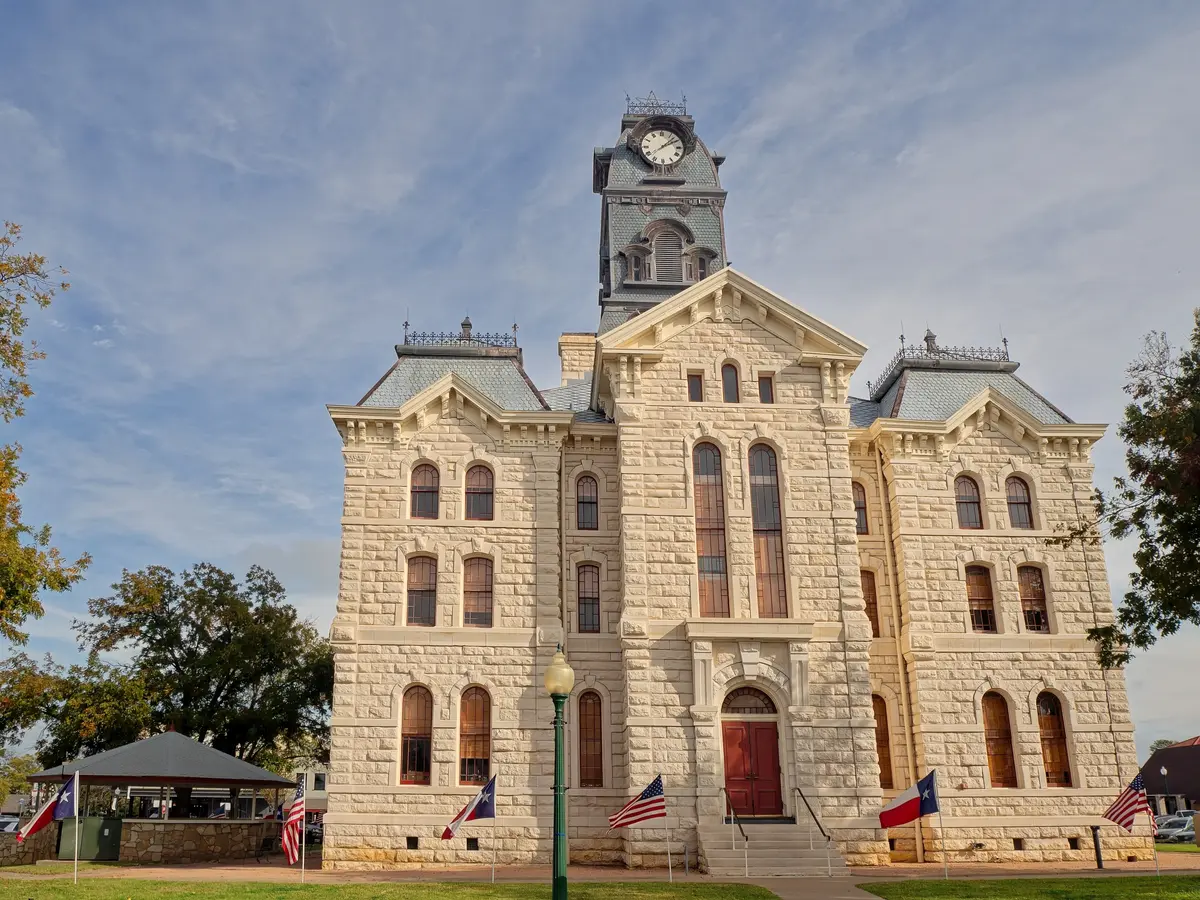
Retiring in Huntsville
Huntsville draws retirees for its balance of amenities, outdoor access, and cost. Here’s what to weigh.
🌤 Climate
Huntsville gets 203 sunny days a year, but those come packaged with East Texas humidity that makes summer feel more intense than the temperature alone suggests. Winters are mild — genuinely mild, with rare freezing temperatures — and the piney-woods setting keeps spring and fall feeling lush and green. The tradeoff is June through September, which runs hot and sticky.
🍴 Lifestyle
Daily life in Huntsville offers a mix of small-city convenience and genuine natural access. The downtown square has local dining, coffee shops, and warm-weather evening activity, and Huntsville State Park is a consistent anchor for outdoor recreation year-round. The Sam Houston Memorial Museum and Texas Prison Museum give the city a cultural depth that surprises most newcomers.
🏚 55+ Communities
No 55+ communities were found in Huntsville. Retirees who settle here typically buy in established neighborhoods — Elkins Lake, with its golf course and lake setting, is a common choice — rather than an age-restricted development. The retiring page covers lifestyle, healthcare access, and what the city offers retirees in more detail.
✈ Getting Around
A car is essential for daily life in Huntsville. Errands, medical appointments, and most services are car-dependent, and a serious shopping run means driving toward Conroe. George Bush Intercontinental Airport (IAH) is about 58 miles south via I-45, making it accessible for retirees who travel regularly.
🏛 Texas Taxes for Retirees — What to Know
- No state income tax — Texas has no personal income tax — constitutionally protected under Article VIII, Section 24. Social Security, pensions, 401(k)/IRA withdrawals, and annuity payments are all untaxed at the state level, with no state return to file.
- Sales tax is the tradeoff — The state sales tax is 6.25%, and local add-ons bring the combined rate in Huntsville to 8.25% (Texas Comptroller of Public Accounts, city sales and use tax rates, July 2026). Groceries and prescription drugs are exempt.
- Property taxes — the real tradeoff — Texas’s effective property tax rate averages about 1.40%, among the highest in the country, since property tax (not income tax) funds most local government and schools.
- Over-65 homestead exemption and school-tax freeze — Homeowners 65+ (or disabled) get an additional $60,000 exemption from their home’s value for school district taxes, on top of the general homestead exemption — $200,000 off school taxable value combined, following November 2025’s Proposition 11 (SB 23), which raised the over-65 exemption to $60,000, and Proposition 13 (SB 4), which raised the general homestead exemption to $140,000. Once claimed, your school district tax bill is frozen at that year’s amount and cannot increase as home values rise, and the ceiling can transfer if you move to a new home within Texas.
- Deferral option if cash is tight — Homeowners 65+ can defer property tax payment entirely for as long as they live in the home, rather than paying it currently — interest accrues, but no forced sale.
- No estate or inheritance tax — Texas has no estate tax, no inheritance tax, and no gift tax.
- No separate capital gains tax — Because Texas has no state income tax, capital gains — including on investments and home sales — are not taxed at the state level at all, unlike states such as Washington that tax capital gains separately from income.
Tax laws change frequently and individual situations vary. This is general information, not tax advice — always consult a qualified Texas tax professional or CPA for personalized retirement tax planning.
Weekends & Local Favorites in Huntsville
The Outdoors Are the Weekend
Most Huntsville residents with any interest in the outdoors end up at Huntsville State Park more weekends than they expected when they moved here. The 2,083-acre park, built around 210-acre Lake Raven, has enough variety — fishing for crappie and bass, kayaking, swimming at the sandy beach, more than 21 miles of hiking and biking trails — that it doesn't get old quickly. The Sam Houston National Forest wraps around it, extending the trail network and the sense of genuine wilderness within a short drive of the city.
Kate Barr Ross Memorial Park handles the closer-in green space needs — a spot where families gather on weekday afternoons and weekends without making a full state-park expedition of it.
The Downtown Square and Historic Core
The historic downtown square is where Huntsville's small-town character comes through most clearly — local shops, a concentration of dining options, and a summer concert series that draws residents out on warm evenings. It's not a densely packed urban grid; it's a genuine small-city square with room to wander, and it earns its place in the weekly routine for residents who live close enough to use it easily.
The Sam Houston Memorial Museum, the Texas Prison Museum, and the Big Sam statue are all genuinely worth the time — not in a checklist way, but because they're legitimately interesting and because they tell you something real about what Huntsville is and has always been.
Where Locals Eat and Drink Coffee
For breakfast and lunch, Farmhouse Cafe and City Hall Cafe & Pie Bar are the go-to spots — the pie bar in particular has a following that extends well beyond the city. Potato Shack and Grand Buffet fill out the casual end of the rotation, and 1836 Steakhouse handles the sit-down dinner occasion.
The coffee scene has genuine depth for a city this size. Sipsy's Coffee House and Bloomin' Brews Coffee - Huntsville are the daily-driver spots. Louise & Oleta's Tea House and Cafe draws a quieter crowd and has a loyal following for its atmosphere as much as its menu. Farmhouse Coffee & Cream and C.A.T. Cafe Bakery - Coffee Art Tea round out a local coffee scene that punches above what you'd expect for a city of this size.
Birdwatching, Camping, and the Longer Weekend
Huntsville State Park draws campers and birdwatchers from across the Houston region, with lakeside campsites, over 250 documented species including bald eagles and painted buntings, and a general decompression that comes from a few nights in the pines. For residents, having that right outside town is one of the legitimate quality-of-life advantages that doesn't show up in a cost-of-living spreadsheet.
Local favorites in Huntsville
Restaurants
- Farmhouse Cafe
- Grand Buffet
- City Hall Cafe & Pie Bar
- Potato Shack
- 1836 Steakhouse
Outdoors
- Huntsville State Park
- Lake Raven
- Sam Houston National Forest
- Kate Barr Ross Memorial Park
Coffee
- Sipsy's Coffee House
- Bloomin’ Brews Coffee - Huntsville
- Louise & Oleta's Tea House and Cafe
- Farmhouse Coffee & Cream
- C.A.T. Cafe Bakery - Coffee Art Tea
Top Things Locals Say About Huntsville
The best intel about a city comes from the people who actually live there. Here’s what Huntsville residents say when newcomers ask the questions everyone’s thinking.
“I knew the commute to Houston would be long, but I figured I'd get used to it. What I didn't expect was how quickly I stopped wanting to make it — there's enough going on here between the university, the state park, and just having a real yard that the city started feeling complete on its own.”
— Recent Huntsville home buyer
“What's the most surprising thing about living in Huntsville?”
How much the SHSU calendar runs your life even if you have nothing to do with the university. Move-in weekend in August, graduation weekend in December — traffic patterns, restaurant waits, everything shifts around those dates. Once you know the rhythm it's fine, but nobody warns you the first year.
“What do locals love most about Huntsville?”
Huntsville State Park, without hesitation. Having 2,083 acres of genuine East Texas forest and Lake Raven that close to the city — and being able to get there on a random Tuesday afternoon — is something people don't fully appreciate until they've lived somewhere without it. The pace of the city is also something people grow to value: it's not in a hurry, and that stops being a complaint pretty quickly.
“What should newcomers to Huntsville know?”
Summer in Walker County is genuinely hot and humid — not 'Texas summer' in the abstract, but the specific thick-air heat that comes with being inside a pine forest. Plan accordingly for the first June and July. Also, if your work takes you to Houston regularly, figure out your departure window fast: leaving Huntsville after 7:30 AM on a weekday and hitting I-45 northbound Houston traffic coming back after 4:30 PM can add 30 to 45 minutes in each direction on a bad day.
“How much do you need a car in Huntsville?”
For almost everything. Students living close to the SHSU campus can manage the campus core and the nearby commercial strip on foot, but for residents across the rest of the city — groceries, medical appointments, hardware, anything beyond the immediate downtown area — you're driving. A serious shopping run that goes beyond the local options means heading toward Conroe. That's the practical reality of a city this size in the Piney Woods, and most residents have made their peace with it.
Cities Near Huntsville
Other communities near Huntsville worth a look — each with its own character and price point.
| City | Distance | Best For | Vibe | Median Rent | Median Buy |
|---|---|---|---|---|---|
| New Waverly | 10 mi | buyers wanting rural quiet near I-45 | small town, forested, unhurried | $1,000 | $349,606 |
| Willis | 25 mi | families near Lake Conroe corridor | growing suburb, lake-adjacent, convenient | $1,250 | $277,393 |
| Madisonville | 30 mi | buyers prioritizing affordability and quiet | rural, slow-paced, deeply small-town | $950 | $239,564 |
More Helpful Guides for Huntsville
Going deeper on Huntsville? Our blog series covers everything from first-time buying to retiring here — explore the guides below.
Local Expert Takeaway: Huntsville makes the most sense for buyers who work in the city — at SHSU, TDCJ, or through the local school district — or who can work remotely and want East Texas forest at their doorstep for significantly less than the Houston corridor charges. The outdoor access at Huntsville State Park and Lake Raven is the real thing, the coffee and dining scene around the SHSU campus is livelier than the city's size suggests, and the price point at $262,042 typical is one of the few genuine values left within range of Houston. The school district rating is the honest asterisk: go in clear-eyed, and Huntsville rewards you. Go in expecting a suburb, and you'll be confused within a year.
Quick Takeaways & FAQs
✅ Huntsville State Park and Lake Raven put 2,083 acres of genuine East Texas wilderness within a short drive of most neighborhoods — an outdoor amenity most comparably priced cities can't match.
⚠️ The school district holds a D rating, according to the Texas Education Agency, with 26% of students reaching math proficiency on 2024-25 state assessments — a real consideration for families moving here with school-age children.
📍 Big Sam — the 67-foot 'A Tribute to Courage' statue along I-45 — is the world's tallest statue of an American hero, and it's exactly as striking in person as it sounds; locals stop noticing it, but visitors never do.
Is Huntsville, TX a good place to raise a family?
How far is Huntsville, TX from Houston?
What is the cost of living like in Huntsville, TX?
What are the best neighborhoods in Huntsville, TX?
Are there 55+ communities in Huntsville, TX?
Helpful Links for Moving to Huntsville
Moving to Texas?
Tell us what you need help with and we'll connect you with local resources.
