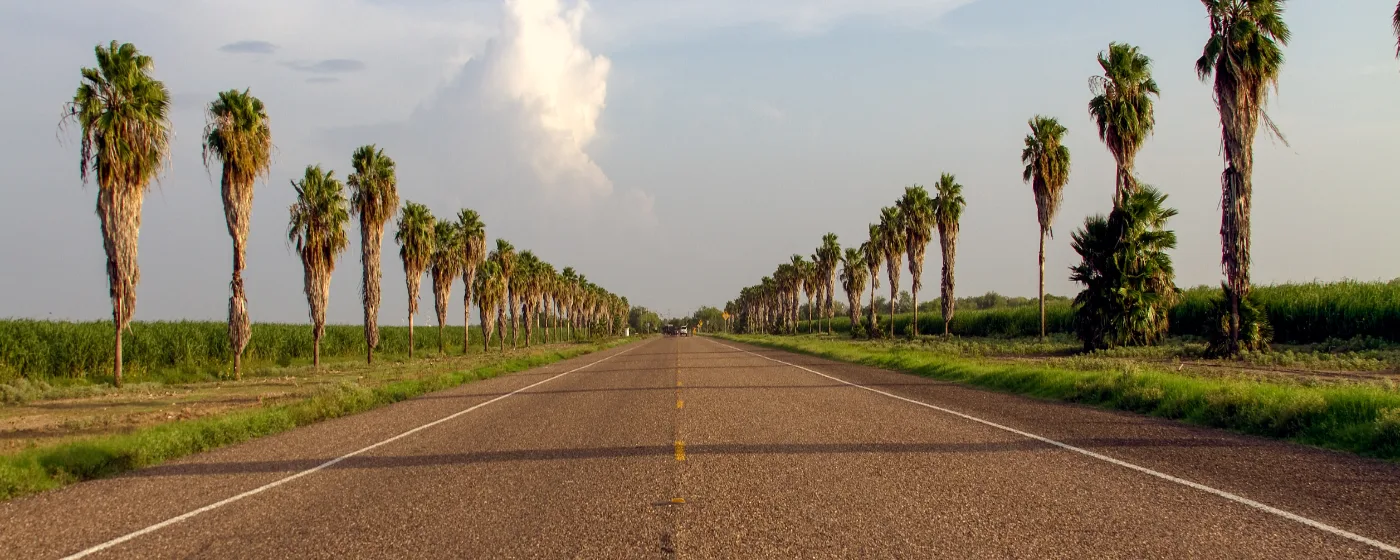
Maybe your company gave you the option to work remotely and you finally ran the numbers. Maybe you've been watching California home prices climb for a decade and realized the equity in your current place could buy something outright in South Texas. Whatever brought you to this search, Alamo surprises most California transplants the same way: the sticker shock runs in reverse. A city of 20,625 residents in the heart of the Rio Grande Valley, Alamo sits within the fast-growing McAllen-Edinburg-Mission metro, connected by US-83 and I-2, and positioned about 15 minutes from the commercial core of McAllen. The warm climate isn't marketing copy — the city goes by "Land of Two Summers" for a reason, and 225 sunny days a year back that up.
The economic picture here is shaped by a few anchor institutions. The Pharr-San Juan-Alamo Independent School District is both the dominant employer and the center of civic life, with 29,053 students enrolled in 2025-26. The city government, local healthcare, and retail serving the broader Rio Grande Valley round out the employment base. The demographic profile is strikingly young — a median age of 29.7 years and 32% of residents under 18 — which means this is a city built around families with kids and multigenerational households, not retirees and empty nesters. That culture shows up in how people spend weekends, how schools are regarded, and what the housing stock looks like.
The cost-of-living gap between California and Alamo is substantial enough to change what financial freedom looks like for most transplants. The typical home value here stood at $173,228 as of July 2026 — a figure that opens up options most California buyers haven't seriously considered in years. Texas collects no state income tax, the sales tax ceiling runs below California's, and even the higher property tax rate looks different once you see what it buys in terms of a purchase price. The full cost-of-living breakdown covers utilities, groceries, and rent for those who aren't buying immediately.
Whether you're seriously weighing a move or just trying to understand what life in a Rio Grande Valley city actually looks like, the sections below break down the California-to-Alamo financial comparison in detail — home prices, income taxes, property taxes, sales taxes, and the lifestyle trade-offs that spreadsheets don't capture.

The Home Price Gap Is Not a Rounding Error
Start with the number that usually ends the conversation for California buyers: the typical home value in Alamo stood at $173,228 as of July 2026 (Zillow Home Value Index). Put that next to California's statewide typical home value of $773,735, and the gap isn't a modest discount — it's a category difference.
For a buyer leaving a mid-tier California market, that difference means arriving with a significant down payment from equity, a drastically lower monthly obligation, or both. For a buyer who has been renting in California and never managed to break into ownership, Alamo represents a genuine first opportunity. The housing stock skews toward single-family construction on real lots rather than the attached and condo-heavy supply that dominates California's affordable tier.
The honest counterweight: Alamo's effective property tax rate sits at 1.83%, which is meaningfully higher than what you paid in California. California's effective property tax rate of 0.71% is held artificially low by Proposition 13, which caps assessed-value increases at 2% annually until a property sells. Texas has no such cap — Hidalgo County appraises at market value each year, and your tax bill moves with the assessment. On a $173,228 home, that 1.83% rate is still a modest annual figure in absolute terms. But if you're mentally budgeting based on your California tax rate applied to a California purchase price, recalibrate before you close.
Texas voters did pass a constitutional amendment in November 2025 raising the general homestead exemption for school property taxes from $100,000 to $140,000, with combined exemptions reaching $200,000 for qualifying seniors and disabled homeowners. That meaningfully reduces the taxable base for most owner-occupants and partially offsets the rate differential. For a full side-by-side on property tax mechanics, see the cost-of-living page.
What this means practically: the California buyer who has been sitting on $300,000 in equity arrives in Alamo with the leverage to purchase outright or carry a very small mortgage — a financial position that takes most Rio Grande Valley residents decades to reach. That's the real headline of this move, and it compounds quickly when you factor in what Texas does with income.
The Income Tax Difference Is Permanent and Substantial
Texas does not levy a state income tax. This is written into the state constitution, not subject to legislative whim, and it applies on day one of residency regardless of where your income originates.
California's top state income tax rate of 13.3% applies only to the highest earners, but the bracket structure starts at 1% and climbs steeply through the middle-income range. A single filer earning $100,000 pays approximately $5,055 in California state income tax annually. The same earner in Texas pays zero. That's roughly $421 per month redirected from the state back to your household — every month, indefinitely.
For dual-income households, remote workers with California-sourced income who are planning a clean break, or anyone in a profession where earnings grow over time, the cumulative effect is significant. California's progressive structure means the savings grow with income: the higher you earn, the more the no-income-tax advantage compounds.
One thing to sort carefully before the move: if you continue working for a California-based employer or have California-sourced business income after relocating, California's Franchise Tax Board is aggressive about residency audits. A clean severance of California tax ties requires more than a change of address — it requires documented steps. That's a conversation for a CPA who handles multi-state situations, not something to figure out after filing.
| Tax Category | California | Texas (Alamo) |
|---|---|---|
| State income tax | California's top state income tax rate of 13.3% (brackets start at 1%) | None — constitutionally prohibited |
| Statewide base sales tax | California's statewide base sales tax rate of 7.25% (highest state base rate in the U.S.) | 6.25% state base; combined max 8.25% |
| Effective property tax rate | California's effective property tax rate of 0.71% (Prop 13 protected) | 1.83% (market-value reassessment annually) |
| Homestead exemption | $7,000 assessed-value reduction | $140,000 school tax exemption (Nov 2025 amendment) |
| Capital gains tax | Taxed as ordinary income at state rate | No state capital gains tax |
| Estate / inheritance tax | No state estate tax currently | No state estate tax |
The sales tax picture is more nuanced. California's statewide base sales tax rate of 7.25% is the highest state base rate in the United States, and local additions push some California cities past 10%. Texas's state rate of 6.25% combined with local additions maxes out at 8.25% — lower ceiling, though not dramatically so on everyday purchases. Where you'll feel the difference most is on large discretionary purchases: vehicles, appliances, furniture. The savings on a car purchase alone can be meaningful.
What California Comfort Costs in the Rio Grande Valley
Californians moving to Alamo consistently underestimate two things: how much the summer heat compresses outdoor life, and how far McAllen's commercial corridor extends their practical geography. Let's be honest about both.
Summers here are long, humid, and relentless in a way that Southern California's dry heat is not. From June through September, midday temperatures routinely exceed 100°F with humidity that makes it feel worse. Outdoor activities shift to early morning or evening. The trade-off is winters that genuinely don't require a coat — the climate earns the "Land of Two Summers" nickname honestly. For a Californian who moved there partly to escape gray winters, that part translates well. The 225 sunny days a year figure holds, but the character of those days differs by season in ways worth experiencing before committing.
The commercial footprint of the city is modest — Alamo is a residential community that leans on McAllen, its parks, and the broader metro for shopping, dining, and services. A serious shopping run means driving out of town. McAllen Miller International Airport (MFE) is about 15 minutes away, serves the broader Rio Grande Valley, and connects to Dallas-Fort Worth, Houston, Austin, and Mexico City — which matters more than it sounds if your California family expects you to visit regularly.
Healthcare costs run noticeably below what most Californians were paying in insurance premiums and routine care, which is a genuine budget relief. The honest trade-off is that advanced specialist care requires a drive — the regional infrastructure here is not equivalent to a Bay Area or Los Angeles medical ecosystem, and complex procedures typically mean traveling to a larger center.
The cultural texture of Alamo is distinctly Rio Grande Valley: bilingual by default, family-centered, and oriented around the rhythms of a community where 32% of residents are under 18. Multigenerational households are the norm, not the exception. For a Californian moving from a diverse urban environment, much of this will feel familiar. What catches people off guard is the pace — smaller, quieter, less anonymous than most California cities, which is either exactly what you wanted or something to reckon with honestly.
Looking to buy in Alamo? Estimate your payment.
Enter your numbers to see an estimated monthly mortgage payment.
Estimate only. Excludes HOA fees and mortgage insurance. The interest rate above is a starting point, not a quoted rate — replace it with your own to see real numbers. Insurance is a flat placeholder, not a Alamo quote.
Schools, Neighborhoods, and the Community Your Kids Would Enter
The Pharr-San Juan-Alamo Independent School District serves the city and holds a B rating, according to the Texas Education Agency (2025 A–F accountability rating, 2024–25 school year). With 29,053 students enrolled in 2025-26, PSJA ISD is a large district with real resources. On 2024-25 state assessments, 46% of students reached math proficiency and 52% reached reading proficiency — figures that are below state averages and worth factoring into your decision if your kids are coming from a higher-performing California district.
The district's genuine distinction is its Dual Language Enrichment Program, which runs from pre-K through grade 12 and develops full bilingual proficiency in English and Spanish. For families who value bilingualism as an academic and professional asset — and in the Rio Grande Valley, that fluency opens real doors — this is a program that competes with anything California offers at the elementary level. The UIL athletics programs are active and well-attended, and Friday night football is a genuine community event here in a way that feels different from a suburban California high school.
For a deeper look at boundary quirks and individual campus ratings, the schools page goes through the district's campuses in detail. What to know before you get there: the district's demographics are predominantly Hispanic, bilingual households are the default, and the community culture around education is tight-knit and engaged in ways that don't always show up in test-score summaries.
The neighborhoods themselves span a range of residential character. The neighborhoods page covers the full breakdown, but the short version: areas like Tower Oaks and Tower Pointe offer newer construction with well-maintained streets, while North Alamo and South Alamo carry more modest single-family stock and a longer-established residential feel. The Alamo Country Club area anchors one end of the market in terms of lot size and housing style.
The city's demographic youth — median age of 29.7 years — means the neighborhoods feel active and family-forward. Parks, schools, and community events are the social infrastructure here, not nightlife or a dense restaurant corridor. Alamo Central Park anchors civic gathering in a way that becomes clearer once you've been here through a few community events.
Weekends and Local Favorites in Alamo
One of the first things California transplants notice is that Alamo's local scene is built around food, family, and the outdoors — and it delivers on all three in ways that don't require the metro's scale. The verified local anchors worth knowing:
For barbecue, The Original Willie's Bar-B-Q is an institution. El Dorado Restaurant handles the Tex-Mex side of things with the kind of depth you'd expect from a community where the cuisine is genuinely native rather than adapted. Tower Burger Co. is the casual neighborhood option that regulars return to. Muelle 37 and Railyard 83 Icehouse round out the dining scene with distinct personalities — the latter with an outdoor, gathering-friendly format that suits the climate well for most of the year.
Coffee and breakfast: El Manjar Bakery and La Familia Bakery handle the morning pastry-and-coffee circuit that locals have mapped out long before any transplant arrives. Coffee Time (CT83) and 707 Coffee House give you the independent café option for those who are used to working remotely from a coffee shop — a crowd that has grown substantially as more remote workers arrive from California and other high-cost states.
The outdoor draw that sets Alamo apart from every other Rio Grande Valley city is the Santa Ana National Wildlife Refuge, 2,088 acres along the Rio Grande sheltering over 400 bird species and 450 butterfly species, including rare mammals like the ocelot. It's described as the "Gem of the National Wildlife Refuge System" and draws serious birders from across the country — which means world-class wildlife observation is part of daily life here in a way that no California suburb can replicate. The Maria del Pilar Garza Museum connects the city's agricultural and cultural roots for those who want to understand what they've moved into, not just where they've landed.
Bentsen-Rio Grande Valley State Park in nearby Mission and Anzalduas Park nearby expand the outdoor footprint considerably. McAllen is about 15 minutes away and carries the metro-level dining, retail, and entertainment options that Alamo proper doesn't try to replicate. That division of labor — Alamo as a residential community, McAllen as the commercial center — is a feature of daily life you adapt to quickly, and most transplants find it a reasonable trade once the initial adjustment passes.

Local Expert Takeaway: The financial case for moving from California to Alamo is real and large — no state income tax, a typical home price of $173,228 as of July 2026, and a commercial corridor about 15 minutes away in McAllen that covers what the city itself doesn't. What catches most California transplants off guard isn't the numbers, it's the pace and the heat: summers here are genuinely intense, the city is smaller and quieter than most people picture, and the community is built around families and bilingual culture in ways that are immersive rather than ambient. Run the full tax comparison before you move, understand the PSJA ISD picture for your kids' specific grade levels, and spend a week here in July before you sign anything — because the climate is the one variable the spreadsheet doesn't capture.
Quick Takeaways & FAQs
✅ Texas collects no state income tax — a permanent, constitutionally protected advantage that saves a $100,000 earner roughly $5,055 a year compared to California.
⚠️ Alamo's effective property tax rate of 1.83% is meaningfully higher than California's Prop 13-protected rate, and Hidalgo County reassesses at market value annually — budget accordingly.
📍 Santa Ana National Wildlife Refuge, just south of the city, covers 2,088 acres and shelters over 400 bird species including rare ocelots — it's one of the top birding destinations in the world, and it's effectively in Alamo's backyard.
How much will I actually save on taxes by moving from California to Alamo, Texas?
Is Alamo's $173,228 typical home price accurate, and what does it actually buy?
How are the schools in Alamo for kids coming from California?
What surprises California transplants most after six months in Alamo?
Do I need to do anything special to stop paying California income tax when I move to Alamo?
Moving to Texas?
Tell us what you need help with and we'll connect you with local resources.
