
Most people who retire to Central Oregon are aiming for Bend. Prineville is the one they find when Bend's prices stop making sense. At a typical home price of $433,014 (July 2026) — noticeably below what you'd pay in Redmond or Bend — this small high-desert city of 11,917 makes a financial case that's hard to dismiss. What the spreadsheet doesn't capture is the trade-off: you're 204 sunny days a year, surrounded by rimrock and ponderosa pine, in a town that runs at a different pace than the resort corridor to the west.
The economy here is anchored by Meta's data center campus, Crook County School District, and county and city government — not the tourism and tech money that drives Bend. That distinction matters for retirement: Prineville has stayed genuinely affordable while Bend has not. US-26 is your main artery out of town, and most advanced medical care, big-box retail, and airport access sits about 35 minutes to Bend. That distance is the central fact of retirement life here, and it deserves honest weight before you make an offer.
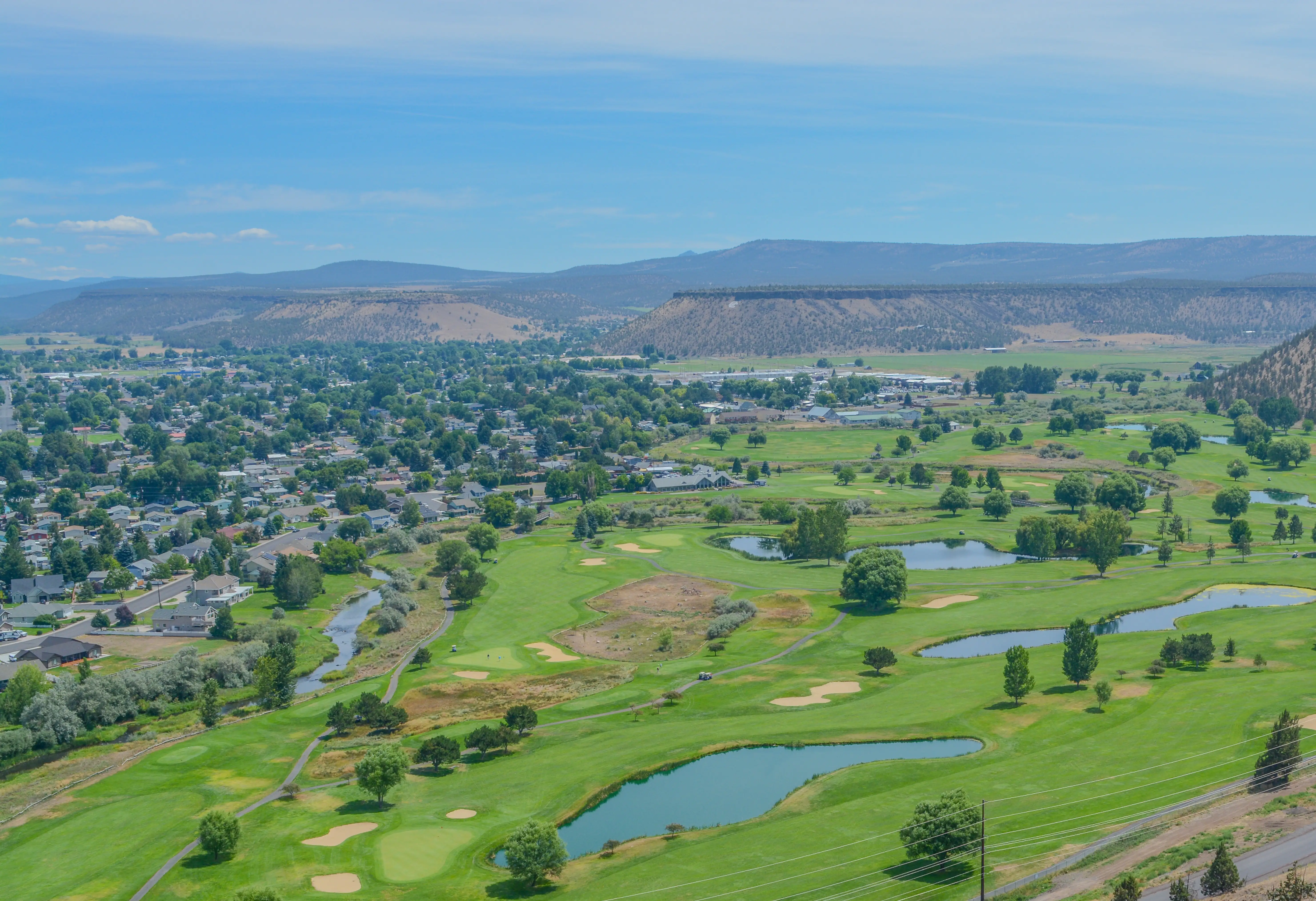
The outdoor draw is real and specific. Prineville Reservoir State Park, the Crooked River Wetlands trail system, Ochoco National Forest, and two golf courses — Meadow Lakes Golf Course and Prineville Golf Club — give active retirees a full calendar without leaving the county. The city's senior infrastructure is modest but genuine: the Prineville Senior Center delivers more than 30,000 meals annually to seniors and disabled residents and runs programming most small towns this size don't sustain. For a fuller picture of what daily expenses look like, the cost-of-living page has the breakdown.
Whether you're comparing Prineville to Bend, Redmond, or a city you're leaving behind, the sections below cover healthcare access, retiree taxes, walkability, the downsizing market, and how this city stacks up against its neighbors — so you can make the call with the full picture in front of you.

Why Retirees Are Choosing Prineville
Prineville fits a specific kind of retiree well: someone who wants low overhead, genuine outdoor access, and a real small-town community — and who doesn't need everything within a ten-minute walk. The typical home price of $433,014 (July 2026) is the entry point into Central Oregon that Bend stopped offering years ago. For buyers coming in with equity from a more expensive market, that gap is meaningful. For buyers on a fixed income without a large equity cushion, it's worth noting that the median household income here sits below what's needed to carry the typical home purchase — the buying process page covers financing options in detail.
The retirees who settle here tend to be people who've done some homework. They know the drive to Bend. They've thought about what it means to live 35 minutes from a Level 2 trauma center. They like that Prineville hasn't been overrun, that the A.R. Bowman Museum and Pioneer Park feel like genuine community anchors rather than tourist amenities, and that they can walk the Crooked River Wetlands trail on a Tuesday morning and see more herons than crowds.
Who should look elsewhere? If you need walkable access to multiple medical specialists, a robust performing arts scene, or the density of services that comes with a larger city, Bend or Redmond will serve you better — at a meaningfully higher cost. Prineville rewards the self-sufficient retiree who plans ahead; it tends to frustrate those who discover after six months that a serious medical appointment, a major shopping trip, or a flight out of town all require the same 35-minute drive west.
Healthcare & Medical Access in Prineville
St. Charles Prineville is the closest hospital to Prineville — a critical access hospital inside city limits with 16 licensed patient beds and more than 198 caregivers. For day-to-day medical needs, the on-site services are more comprehensive than its small size suggests: an Emergency Department, radiology, laboratory services, an outpatient rehabilitation center, an integrated primary care clinic, and an immediate care clinic are all on one campus. That's a meaningful baseline for a city of roughly 12,000 people.
Visiting specialists at St. Charles Prineville cover the categories retirees most commonly need — cardiology, endocrinology, orthopedics, podiatry, urology, and women's health. These are not daily or weekly services; specialist availability varies, and some appointments require scheduling in advance or travelling to the Bend campus. It's worth asking your specific specialist about their Prineville schedule before assuming proximity.
For anything beyond what a critical access hospital handles — complex cardiac procedures, neurosurgery, oncology, advanced imaging — St. Charles Medical Center in Bend is the resource. It is the largest hospital in Central Oregon and a Level 2 trauma center. The drive is about 35 minutes to Bend under normal conditions. That reality is neither alarming nor ignorable: most retirees in Prineville navigate it without issue, but anyone managing a condition that requires frequent specialist visits should factor that round trip into the decision honestly.
What Prineville lacks is the hospital competition and specialist density of a larger metro. There is one system here, one local campus, and one option for emergency care. The upside is that the St. Charles network is integrated — records, referrals, and follow-up care move between the Prineville and Bend campuses without bureaucratic friction.

The Retiree Budget in Prineville
Oregon's Tax Posture for Retirees
Oregon does not tax Social Security benefits at the state level — a genuine advantage for retirees who draw primarily from Social Security. If Social Security is your main income source, Oregon's treatment of it is straightforwardly favorable.
The picture changes for other retirement income. Oregon taxes pension distributions, 401(k) withdrawals, and IRA distributions as ordinary income. The rate reaches 8.75% above $11,400 of taxable income and 9.9% above $125,000. Retirees with significant drawdown income — particularly those pulling from pre-tax retirement accounts — will feel that rate. Oregon has no sales tax, which softens the blow on everyday spending, but the income tax load on retirement distributions is real and worth building into your budget before you move.
Property Taxes and Built-In Protections
Prineville's effective property tax rate sits at approximately 0.56% — well below the Oregon state average and among the lower rates in the region. Oregon's Measure 50 caps assessed value growth at 3% per year for owner-occupied homesteads, regardless of age, which means your annual property tax bill is structurally protected from large jumps even as market values rise. That's a meaningful stability guarantee for anyone on a fixed income.
Oregon also operates a Property Tax Deferral program for homeowners age 62 and older. Qualifying residents with household income at or below $70,000 (the 2026 income cap — this figure adjusts annually, so confirm the current threshold with Oregon Department of Revenue before applying) can have the state pay their property taxes each year. The deferred amount accrues 6% simple interest and is repaid when the home is eventually sold or transferred. For retirees who are asset-rich and income-constrained, this program is worth exploring.
Daily Cost of Living on a Fixed Income
Groceries, utilities, and services in Prineville run at roughly small-town Oregon prices — modestly below Bend, not dramatically so. The city's typical 2BR rent runs $1,510–$1,840 per month, which gives renters a clearer comparison point. The absence of a sales tax means what you see on a price tag is what you pay. For a fuller utility and grocery cost breakdown, the cost of living page has the current figures.
Looking to buy in Prineville? Estimate your payment.
Enter your numbers to see an estimated monthly mortgage payment.
Estimate only. Excludes HOA fees and mortgage insurance. The interest rate above is a starting point, not a quoted rate — replace it with your own to see real numbers. Insurance is a flat placeholder, not a Prineville quote.
Walkability, Community & Staying Active in Prineville
The Walkability Reality
Prineville is not a city where you leave the car behind. Most errands — grocery runs, medical appointments, hardware store trips — require driving. The downtown core is compact and genuinely walkable once you're in it, and the Crooked River Wetlands trail system puts more than five miles of paved in-town path within reach. But the broader city runs on the same car-dependent pattern as most Central Oregon towns of this size.
The terrain is flat enough that walking and cycling are practical for those who want them. The 10-mile bike path that runs through the city connects parks, neighborhoods, and the wetlands corridor. Ochoco Creek Park is a 14.85-acre hub with courts, trails, and a bike path connection — a genuine daily-use space for residents who live nearby. For retirees who want to stay mobile on foot or by bike, the infrastructure is there, but it requires living in the right part of town to make it work without a car.
Senior Center and Community Programming
The Prineville Senior Center is a 501(c)(3) nonprofit serving Crook County seniors with congregate meals, recreational programming — line dancing, pool, ping pong, card games — chair exercise classes, monthly chair massage, foot care, and access to legal guidance. It also delivers more than 30,000 meals annually to senior and disabled residents across the county. For a city of 11,917, that's a serious operation.
Beyond the senior center, community touchpoints include the A.R. Bowman Museum's historical and cultural programming and a summer concert series that draws residents downtown for free live music. Rockhounding is genuinely popular here — Crook County sits in one of Oregon's most productive agate and thunder egg territories, and there are organized clubs that go out regularly. Meadow Lakes Golf Course and Prineville Golf Club serve the golf crowd year-round. Active retirees also find their footing quickly through Ochoco National Forest access, fishing and paddleboarding at Prineville Reservoir State Park, and the hiking at Steins Pillar. The social fabric is smaller-town by nature — you'll recognize people at Pioneer Park within a few months of moving here — which suits many retirees exactly and underwhelms those who want the anonymity and density of a larger city.
Right-Sizing: Downsizing in Prineville
What the Single-Level Market Looks Like
Prineville's housing stock skews toward single-family homes on modest lots — the kind of inventory that works well for downsizers who want to own rather than rent. Single-level ranch-style construction is common, particularly in older neighborhoods like Downtown Prineville and the areas surrounding Ochoco Heights. That physical accessibility — no stairs, attached garage, manageable yard — is one of the practical reasons retirees land here rather than in hillier terrain.
Patio homes and smaller attached units exist but are not abundant. The city has grown in recent years and newer construction has filled some of the inventory gap, particularly in neighborhoods like Ochoco Pointe and Longhorn Ridge, where more recent builds tend toward open floor plans suited to aging in place. Inventory moves; what's available at any given moment varies more than in a large metro. A local agent familiar with single-level listings is worth the conversation early, not after you've already committed to a timeline.
55+ Communities and Assisted Living
No 55+ communities were found in Prineville. This is not a rumor or a gap in research — it reflects the actual market. Age-restricted deed communities simply do not exist here at this time.
Assisted living is a different category. Facilities serving seniors who need support with daily living do operate in Prineville, and they are worth a separate, in-person evaluation if that's the horizon you're planning for. They are not 55+ communities in the sense most buyers mean when they ask the question — no shared amenities model, no deed restriction, no community association governance structured around active adults.
The practical implication: retirees coming to Prineville who want the lock-and-leave lifestyle, the built-in social infrastructure, and the maintenance-free ownership that a purpose-built 55+ community provides will need to look at Redmond or Bend, where that product type exists. Prineville's downsizing path runs through conventional single-family ownership, and for many retirees that's exactly what they want. For others, the absence of that community structure is the reason they ultimately choose a neighboring city instead.
Prineville vs Nearby Retirement Destinations
| City | Cost vs Prineville | Primary Hospital | Walkability | Senior Living Depth | Overall Retirement Fit |
|---|---|---|---|---|---|
| Prineville | Anchor | St. Charles Prineville (critical access, in-city) | Limited; flat terrain, good trails | Senior center strong; no 55+ communities | Best for self-sufficient, outdoors-oriented retirees |
| Bend | Noticeably higher | St. Charles Medical Center (Level 2 trauma) | Better than most Oregon cities its size | Multiple 55+ communities; deep assisted living options | Best for retirees who want full services and don't mind the price |
| Redmond | Noticeably higher | St. Charles Redmond (critical access) | Modest; car-dependent for most errands | Some 55+ product; growing assisted living market | Good middle ground between Bend depth and Prineville price |
| Madras | Noticeably lower | Jefferson County Health District (small critical access) | Very limited | Thin; fewer senior services than Prineville | Best for retirees prioritizing lowest cost above all else |
| Powell Butte | Comparable | None in-city; relies on Prineville or Redmond | Rural; driving is required for everything | Minimal; rural residential only | Best for retirees who genuinely want rural acreage living |
| Culver | Comparable to lower | None in-city; relies on Madras or Redmond | Very limited; small rural town | Very thin | Best for retirees buying rural land near Lake Billy Chinook |
Bend wins on healthcare depth, walkability, and the variety of senior living product — but at a cost that prices out many retirees who don't arrive with significant equity. Redmond is the practical compromise: closer to Bend's services, below Bend's prices, and with a growing senior living market that Prineville currently lacks. Madras is the budget option if cost is the overriding factor, but its senior infrastructure is thinner than Prineville's and its hospital is smaller.
Prineville's case is specific: it suits the retiree who values the lower price point, the authentic small-town texture, and the outdoor access — and who has thought clearly about what the drive to Bend means on the day they actually need it. For those who have weighed that honestly, it often beats the alternatives on value. For those who haven't, it's usually the thing they wish someone had told them before they signed.
Local Expert Takeaway: Prineville is one of the few places in Central Oregon where a retiree on a fixed income can still buy a single-level home at a price that doesn't require liquidating everything. The Prineville Senior Center is a genuine community anchor — not a drop-in table and a bulletin board, but a full-service nonprofit running meals, programming, and foot care at a scale that serves the whole county. The outdoor life here is real: two golf courses, the Crooked River Wetlands trail system inside city limits, Ochoco National Forest a short drive out, and rockhounding clubs that go out regularly. The honest caveat is the drive to Bend — about 35 minutes to the Level 2 trauma center at St. Charles Medical Center. Most retirees navigate it without drama; those managing complex or frequent specialist care should map that distance against their calendar before committing.
Quick Takeaways & FAQs
✅ Oregon exempts Social Security from state income tax, and Prineville's effective property tax rate of approximately 0.56% is among the lower rates in Central Oregon — a real budget advantage for retirees on fixed income.
⚠️ No 55+ communities exist in Prineville, and the drive to advanced medical care at St. Charles Medical Center in Bend is about 35 minutes — both are honest limitations that matter more to some retirees than others.
📍 The Prineville Senior Center delivers more than 30,000 meals annually to county seniors and runs a full roster of programming — a level of senior infrastructure that surprises most people who assume a city of 11,917 wouldn't sustain it.
Is Prineville a good place to retire on Social Security?
What is the closest hospital to Prineville?
Are there 55+ or active adult communities in Prineville?
How does Oregon's income tax affect retirement income in Prineville?
What do retirees wish they had known before moving to Prineville?
Moving to Oregon?
Tell us what you need help with and we'll connect you with local resources.
