
You've probably done the math at least once. Whatever you were paying for a California home — in the Bay Area, Sacramento, the Inland Empire — the number on La Pine listings looks almost implausible by comparison. The typical La Pine home was priced at $406,496 as of July 2026, a figure that can stop a California buyer mid-scroll. But the math is only part of the story. La Pine sits in the high desert of Central Oregon at roughly 4,200 feet elevation, surrounded by ponderosa pine forest, with US-97 as its main artery running north to Bend and south toward the California border. It is a genuine small town of 2,566 people, not a suburb, and the gap between your California expectations and daily La Pine reality is wider than any spreadsheet captures.
California leads all states in new Oregon driver's licenses issued, with 22,306 Californians converting in the most recently tracked period. La Pine itself grew 26% since 2020, driven largely by households priced out of Bend who still wanted access to Central Oregon's trails, rivers, and outdoor culture. The Bend-La Pine School District — which holds a B rating, according to Niche — serves the area, with 16,530 students enrolled in 2025-26. Major employers include the school district, Deschutes County, the City of La Pine, and a regional health system. Many residents commute about 30 minutes to Bend for work, and remote work has made La Pine viable for people who don't need to commute at all.
The cost picture beyond home prices is genuinely favorable. Oregon has no sales tax — none at the state level, none locally — which alone can shift your monthly budget in ways that compound quickly. The full cost-of-living breakdown covers utilities, groceries, and the areas where La Pine runs lean versus where it doesn't. What this guide focuses on is the California-to-La Pine transition specifically: the tax delta, the lifestyle shift, the wildfire reality that Californians often think they already understand (and usually don't, not here), and the honest trade-offs that come with choosing one of Oregon's smaller, more remote communities.
Whether you're drawn by the price gap, the forest setting, or the slower pace, the sections below cover what Californians consistently get right about this move — and what tends to surprise them after the boxes are unpacked.

The Home Price Gap — What It Actually Buys You
California's statewide typical home value of $773,735 (Zillow ZHVI) is the benchmark most California buyers carry in their heads when they start looking at Oregon. La Pine's typical home was $406,496 as of July 2026 — meaningfully below that California figure, and noticeably below Bend's market as well. What that gap buys you in La Pine is real square footage on a real lot, usually with ponderosa pines on the property line and genuine quiet at night.
The housing stock here is predominantly single-family, owner-occupied, and spread across neighborhoods like Ponderosa Pines, Wild River, Lazy River South, and River Pine Estates. These are not urban neighborhoods in the California sense — there are no walkable main streets attached to them. You get a house and land, and you drive for most everything else.
The affordability gradient matters for buyers with specific budgets. Entry-level homes do exist at prices well below the city-wide typical, older construction and manufactured homes being the most common path in. On the upper end, newer builds in areas like Huntington Meadows and Newberry Estates trade closer to — or above — the city median. The catch: the median household income in La Pine is $58,365, which falls short of what is needed to comfortably carry the typical home at current rates. Many buyers arriving from California bring equity that changes that math entirely, which is precisely why the California-to-La Pine move has accelerated.
For California buyers arriving with equity from a sale, La Pine represents one of the cleaner equity-conversion moves in the Pacific Northwest. Selling a median-priced California home and buying at the La Pine median leaves substantial equity to spare, and that difference either buys down the mortgage, funds renovations, or sits as a cushion that Central Oregon's lower cost of living helps preserve. For a deeper look at what different price points unlock neighborhood by neighborhood, the best neighborhoods page lays out what each area feels like on the ground.
| Factor | California | La Pine, OR |
|---|---|---|
| Typical home value | California's statewide typical home value of $773,735 (Zillow ZHVI) | $406,496 (Zillow ZHVI, July 2026) |
| Effective property tax rate | California's effective property tax rate of 0.71% (Tax Foundation) | 0.62% |
| State sales tax | California's statewide base sales tax rate of 7.25% (CA Dept. of Tax and Fee Administration) | None — Oregon has no sales tax |
| Top state income tax rate | California's top state income tax rate of 13.3% (CA Franchise Tax Board) | 9.9% (single filers above $125,000) |
| Nearby city price comparison | — | Sunriver noticeably higher; Gilchrist and Crescent noticeably lower |
One note for Bay Area transplants specifically: if you were paying post-bond-levy property tax rates of 1.20% to 1.28% on a California home, La Pine's 0.62% effective rate is not just lower in the abstract — it is roughly half what you were paying per dollar of assessed value.
The Tax Shift — Income, Property, and the Sales Tax Disappearing Act
The single biggest financial surprise for Californians moving to Oregon is not the income tax — it is the disappearance of sales tax entirely. Oregon has no state or local sales tax. California's statewide base sales tax rate of 7.25% (California Dept. of Tax and Fee Administration) is the highest in the country before local additions push the combined average higher. For a household spending $40,000 a year on taxable goods, that gap is worth roughly $3,600 annually — not a rounding error.
Income tax is more nuanced. Oregon's top rate is 9.9%, reached by single filers above $125,000. California's top state income tax rate of 13.3% (California Franchise Tax Board) applies only to the highest earners — those reporting income over $1 million. For most six-figure California earners, the actual California rate they were paying was well below 13.3%, and Oregon's brackets are compressed enough that the state collects near its maximum from anyone in that range. The headline rate cut is real for the very highest earners; for someone in the $120,000 to $200,000 band, the difference is smaller than it looks.
Oregon does offer one meaningful offset that California does not: residents can subtract a portion of federal income taxes paid from Oregon taxable income. This provision helps lower- and moderate-income households the most, and it partially offsets the compressed bracket structure for anyone who paid significant federal taxes in the prior year.
Property tax is where La Pine consistently wins, particularly for buyers coming out of the Bay Area. California's effective property tax rate of 0.71% (Tax Foundation) is the statewide average, but Bay Area buyers with recent purchase prices and voter-approved bond levies often face effective rates of 1.20% to 1.28%. La Pine's effective rate of 0.62% sits well below both. On a $406,496 home, the difference between a 1.25% effective rate and 0.62% is a real annual dollar figure — and it compounds over a decade of ownership.
For a complete picture of Oregon income and property tax mechanics, the cost-of-living page breaks down how these interact with La Pine's typical household budget.
Wildfire — What California Transplants Get Wrong About This
Californians moving to Oregon frequently assume they already understand wildfire. They've evacuated, or watched friends evacuate, or seen the smoke turn a Bay Area afternoon orange. That experience is real — and it still doesn't fully prepare you for La Pine specifically, because the risk profile here is different in ways that matter for home purchase decisions.
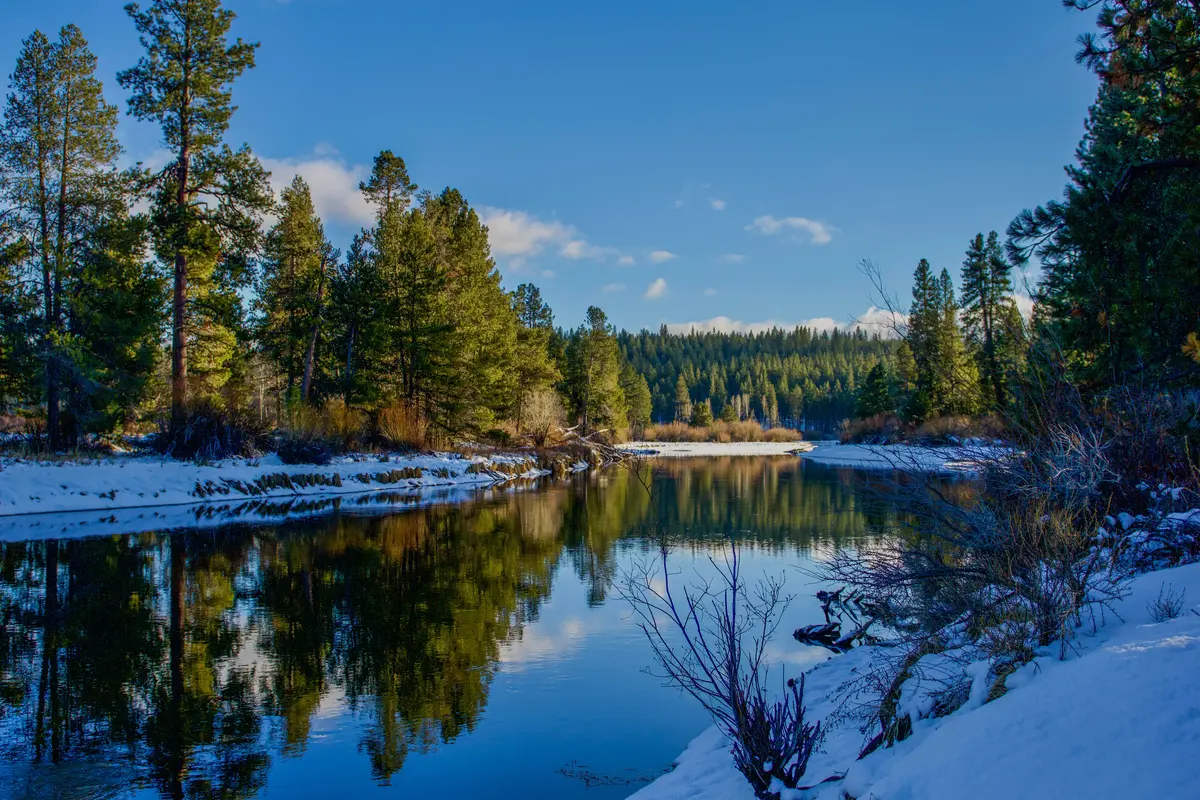
La Pine sits inside a dense ponderosa pine forest. In March 2026, the Riverview Fire triggered the first Level 3 evacuation order — immediate evacuation — of Oregon's 2026 wildfire season, burning 20 acres within the community. That event happened in March, not July or August. Wildfire here is an active, year-round concern, not a seasonal one you watch from a distance.
The backdrop makes it more complicated. Oregon's 2025-26 winter was tied for the warmest on record and produced the smallest snowpack ever measured — conditions state climatologist Larry O'Neill described as having no historical equivalent. The resulting snow drought raises wildfire risk and water availability concerns for the Deschutes region. La Pine is not insulated from those conditions; it sits in the middle of them.
The city has taken this seriously. In 2024, La Pine engaged Community Planning Assistance for Wildfire (CPAW) to review its Community Wildfire Protection Plan and development review process, with recommendations focused on strengthening wildfire resiliency and reducing risk within the urban core. That kind of planning engagement is a good sign — and it is also an honest signal that the risk warranted a formal external review.
What this means practically for a California buyer: before making an offer, understand which fire zone a specific property sits in, what defensible space requirements apply, and what wildfire coverage looks like on a homeowners policy in this area. Insurance markets in high-risk wildfire zones have tightened across the West. A California buyer already navigating FAIR Plan territory knows this pattern; the Oregon version of it is not identical, but it is not unfamiliar either. Do not assume that leaving California ends your wildfire insurance complexity.
What Locals Know
Residents here keep go-bags. They know which way the wind comes from relative to their neighborhood. They track the Deschutes National Forest fire updates the way coastal Californians track surf forecasts — routinely, not obsessively, but as a real part of seasonal life. That cultural fluency around fire risk is worth factoring into your relocation decision alongside the price and the tax picture.
Looking to buy in La Pine? Estimate your payment.
Enter your numbers to see an estimated monthly mortgage payment.
Estimate only. Excludes HOA fees and mortgage insurance. The interest rate above is a starting point, not a quoted rate — replace it with your own to see real numbers. Insurance is a flat placeholder, not a La Pine quote.
Daily Life After the Move — The Gaps Californians Feel First
La Pine has a population of 2,566. That number is not a rounding error — it is the actual scale of the place. The commercial core is functional rather than dense: a handful of local restaurants, a couple of independent coffee shops, a pizza place, a sports pub near Wickiup Reservoir. If your California life included walkable neighborhoods, multiple grocery options, same-day delivery for everything, and a restaurant for every mood within two miles, the adjustment is real and takes longer than most people expect.
Most serious shopping means a drive. The city has locally owned options for everyday needs, and Market Day La Pine brings a seasonal farmers market to town. But a major grocery run, a furniture purchase, a doctor's appointment beyond routine care — those typically mean heading north. The commute is about 30 minutes to Bend, which is where most of the region's retail, dining, entertainment, and employment base sits.
Health coverage is a cost-of-living positive for many transplants. Insurance premiums run noticeably below what most Californians were paying, though you will drive farther for specialist care — that is the honest trade-off for a smaller, more rural community.
The climate surprises people in both directions. La Pine sits at elevation and gets genuine winter — cold, snowy, and longer than the California experience most transplants carry. The flip side is 157 sunny days a year in high desert air, with low humidity and access to Newberry National Volcanic Monument, Paulina Falls, Wickiup Reservoir, and La Pine State Park essentially at the edge of town. The outdoor access is not incidental — it is the reason most people choose this specific place over something cheaper and less remote.
The Six-Month Surprise
Most California transplants say the same thing around month six: they underestimated how much they relied on urban amenity density, and how much they genuinely don't miss it once they stop expecting it. The learning curve is real. So is the adjustment. People who move here expecting a slower version of California suburban life tend to struggle; people who move here specifically for the forest, the pace, and the space tend to stay.
For context on outdoor recreation and daily life in La Pine, those pages go deeper on what a typical week actually looks like here.
Schools, Community, and Whether La Pine Is the Right Fit
The Bend-La Pine School District holds a B rating, according to Niche, and serves a broad geographic area across Central Oregon. With 16,530 students enrolled in 2025-26, it is a substantial district rather than a small-town operation. On 2024-25 state assessments, 41.9% of students reached math proficiency and 53% reached reading proficiency — figures that reflect the district's range, from higher-performing schools closer to Bend to smaller campuses serving more rural communities like La Pine. The district runs active OSAA athletics programs, and Friday night events at local schools carry genuine community weight in a town this size.
For families with school-age children, the school question intersects with the commute question. The district's reach means some La Pine students travel meaningful distances for certain programs. Parents weighing educational priorities against the housing cost savings should read the schools page before anchoring to a specific neighborhood.
The community texture here is different from what most Californians expect. La Pine is not a transplant bubble — it has deep roots as a timber and ranching community, and the newer arrivals from Bend and California have layered onto that rather than replacing it. The tone is independent, neighborly in a low-key way, and oriented toward outdoor life rather than social programming. Volunteer fire departments, school events, and outdoor recreation form the social connective tissue. If you are looking for the kind of curated community activity calendar that comes with a larger city, La Pine will feel sparse. If you are looking for neighbors who wave when you drive by and leave you alone when you want that, it fits well.
Retirees considering La Pine should note that no 55+ communities were found in the city. The retiring in La Pine page covers the full picture for that stage of life. For California buyers weighing La Pine against other nearby options: Sunriver prices run noticeably higher; Gilchrist and Crescent run noticeably lower. The full comparison lives on the cost-of-living page.
Who This Move Works For
The California transplants who thrive in La Pine tend to share a few things. They brought equity and aren't dependent on a local job market that is genuinely thin. They wanted outdoor access — real access, not proximity to a trailhead — as a daily feature of life. And they made peace with the trade-offs before they moved rather than after: the distance to specialists, the smaller retail footprint, the wildfire reality, and winters that are colder and longer than almost anywhere in California. Those aren't surprises for people who researched carefully. For those who didn't, they can be the reasons people move back.

Local Expert Takeaway: La Pine is not a lifestyle downgrade from California — it is a lifestyle replacement. The home price gap is real, the tax picture broadly favors Oregon, and the ponderosa pine forest and proximity to Newberry National Volcanic Monument and Paulina Falls deliver outdoor access that California's coastal markets price out of reach. The honest part: this is a town of 2,566 people, about 30 minutes to Bend for most services, with active wildfire risk and winters that arrive early and stay late. Californians who move here for the equity conversion and the landscape, and who have genuinely reset their expectations about retail density and urban amenity, tend to find it was exactly the move they needed. Those who moved here expecting a cheaper version of their California suburb typically don't last two winters.
Quick Takeaways & FAQs
✅ Oregon's complete absence of sales tax puts real money back in a California transplant's pocket every year — for a household spending $40,000 annually on taxable goods, the difference against California's statewide base rate is roughly $3,600.
⚠️ La Pine's wildfire risk is year-round, not seasonal: the Riverview Fire triggered a Level 3 evacuation order in March 2026, and the 2025-26 snow drought has raised conditions across the Deschutes region heading into summer.
📍 US-97 is the route most California movers travel to reach La Pine — it enters Oregon from the south and runs directly through town before continuing north to Bend, making the corridor both the moving route and the daily commute road.
How much cheaper is a home in La Pine compared to California?
Does Oregon have a lower income tax than California for California transplants?
Is wildfire risk in La Pine similar to what I dealt with in California?
What is the school district like for families moving from California?
What do most California transplants say after six months in La Pine?
Moving to Oregon?
Tell us what you need help with and we'll connect you with local resources.
