
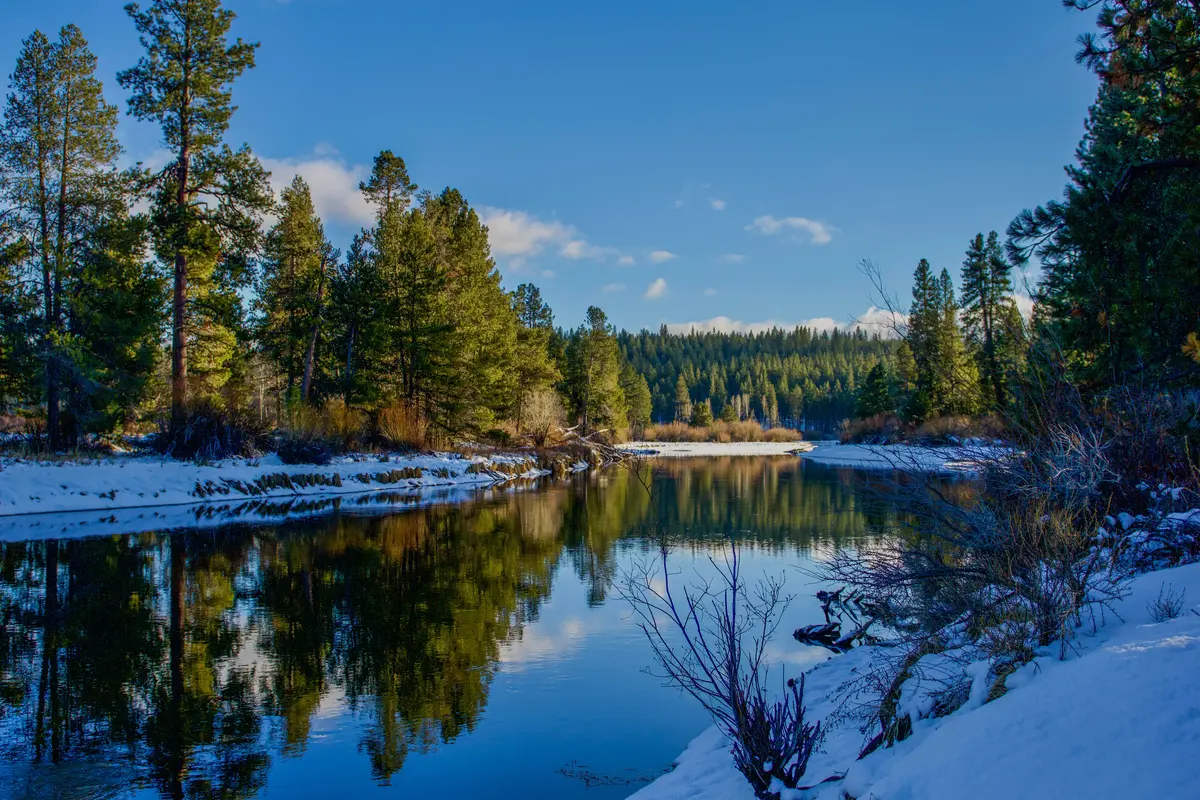
Maybe you've been watching Bend prices climb for two years and someone finally said: have you looked at La Pine? Or maybe you've been renting in Central Oregon and the math on ownership is starting to make sense — just not in the cities everyone else is targeting. La Pine sits about 30 minutes to Bend along US-97, tucked into ponderosa pine forest at 4,236 feet elevation in southern Deschutes County. It became Oregon's youngest incorporated city in 2006, and it still carries that frontier-town quality: genuinely rural, genuinely affordable by Central Oregon standards, and genuinely different from the resort corridor to the north.
The city of 2,566 people is small enough that your neighbors know your truck, but the school district — Bend-La Pine Schools, which holds a B rating, according to Niche — is one of the larger districts in Oregon, with 16,530 students enrolled in 2025-26. Major employers include Bend-La Pine Schools, Deschutes County, and the City of La Pine itself, with a lot of residents also commuting to Bend or working remotely. The lifestyle draw is real: La Pine State Park, Newberry National Volcanic Monument, and the Little Deschutes River corridor are not amenities you drive to on vacation — they are your backyard.
For a first-time buyer, the headline is that the typical home price here, $406,496 as of July 2026 (Zillow Home Value Index), sits well below what you'd pay in Bend or Sunriver — noticeably lower than either. That gap is meaningful. But the median household income of $58,365 still falls short of what's needed to buy at that price point comfortably, which means budgeting honestly, getting pre-approved before you fall in love with a listing, and understanding the local quirks — wells, septic systems, rural permitting — that don't show up in a standard city purchase. For a full cost-of-living breakdown, see the La Pine cost of living page.
Whether you're choosing between renting another year or making your first offer, the sections below walk through what the La Pine market actually looks like for a first-timer, the step-by-step buying process, a realistic budget snapshot, and the specific mistakes that catch new buyers off guard here.

The La Pine First-Time Buyer Reality
The typical home in La Pine carries a price of $406,496 as of July 2026 — making it one of the more attainable entry points in all of Central Oregon. That figure is noticeably below what you'll find in Sunriver and well below Bend. For a first-timer who's been priced out of those markets, that gap is the entire reason this city ends up on the shortlist.
What does that price actually buy? In La Pine, you're generally looking at single-family homes on larger lots, often with ponderosa pines on the property and no HOA governing what you plant or park. Many homes sit in neighborhoods like Ponderosa Pines, Wild River, or Lazy River South — areas that feel distinctly rural even inside the city boundaries. The housing stock skews older, which means you'll find homes that have good bones and need updating, alongside a smaller slice of newer construction.
The market here runs differently from Bend. La Pine carries more supply relative to demand than other Central Oregon cities, which gives buyers more room to negotiate and more time to think. That doesn't mean good homes sit forever — well-priced properties in River Pine Estates or Newberry Estates still attract attention. But you are unlikely to face the same compressed timelines that defined Bend's market in recent years. For a first-timer learning the ropes, that breathing room matters. The catch — and it's worth saying plainly — is that the median household income in La Pine falls well short of what's needed to carry the typical home comfortably at current prices. Honest pre-approval work, before you tour a single listing, is how you protect yourself from that gap.
The Homebuying Process in La Pine, Step by Step
Step 1: Get Pre-Approved — Before You Tour Anything
This is the step most first-timers skip or delay, and it's the one that costs them the most. In La Pine, where a meaningful share of listings involve wells, septic systems, or rural lot conditions, lenders need time to evaluate the property type alongside your financials. Show up to a showing without a pre-approval letter and you're wasting everyone's time, including your own.
Pre-approval means a lender has reviewed your credit score, income documentation, and assets — not just run a quick online estimate. You'll want this in hand before you open Zillow for the first time in earnest. FHA loans are popular with Oregon first-time buyers and require as little as 3.5% down for borrowers with credit scores of 580 or higher; they also carry mortgage insurance premiums, including an upfront fee of 1.75% of the base loan amount (typically rolled into the loan) and ongoing annual premiums. Conventional loans at 3% down are available for qualifying buyers and can avoid or eventually eliminate mortgage insurance.
Step 2: Find an Agent Who Knows Rural Property
Not every buyer's agent is fluent in well inspections, septic records, and Deschutes County permitting. In La Pine, that fluency is essential. Ask specifically whether the agent has closed transactions involving private wells and on-site septic systems — the answer tells you a lot quickly.
Step 3: Shopping, Offers, and Negotiation
With pre-approval in hand, you can make an offer the same day you see a home you want. In a more relaxed market like La Pine's, you'll often have time to make your offer thoughtful rather than panicked — but that doesn't mean you can sleep on a well-priced listing. Work with your agent to understand comparable sales in the specific neighborhood, since Huntington Meadows and Tall Pines can read very differently from each other even at similar list prices.
Step 4: Inspections — Budget for More Than One
Standard home inspection, well inspection, and septic inspection are three separate line items here — and all three are worth every dollar. The USGS has documented that the shallow aquifer underlying the La Pine area has historically shown vulnerability to nitrate contamination from residential septic systems, which makes independent well-water testing a genuine due-diligence step rather than a formality. Do not waive any of these to make your offer look cleaner.
Step 5: Appraisal and Closing
Your lender will order the appraisal after you're under contract. In rural areas, appraisers sometimes struggle to find comparable sales, which can put pressure on the appraised value — something your agent should flag going in. Oregon's Measure 50 caps the annual increase in a property's maximum assessed value at 3%, which is a genuine protection for new owners against rapid tax escalation after purchase. Closing in Oregon typically runs two to four weeks once you're under contract, and you'll sign final documents with a title company or escrow officer rather than in a lawyer's office.
How Much Home Can You Afford in La Pine
The table below gives approximate cash requirements at several purchase price points using two common loan structures. Closing costs are estimated at 2–3% of the purchase price, which is a reasonable working range for Oregon transactions — your actual costs will vary based on lender fees, title charges, and prepaid items. These are estimates, not guarantees; use them for planning, then let the interactive calculator below run the numbers with your specific inputs.
| Scenario | Purchase Price | Down Payment | Est. Closing Costs | Cash Needed at Table |
|---|---|---|---|---|
| FHA (3.5%) — entry-level La Pine | $300,000 | $10,500 (3.5%) | $6,000–$9,000 | ~$16,500–$19,500 |
| Conventional (3%) — entry-level La Pine | $300,000 | $9,000 (3%) | $6,000–$9,000 | ~$15,000–$18,000 |
| FHA (3.5%) — near city typical | $406,000 | $14,210 (3.5%) | $8,120–$12,180 | ~$22,330–$26,390 |
| Conventional (3%) — near city typical | $406,000 | $12,180 (3%) | $8,120–$12,180 | ~$20,300–$24,360 |
| FHA (3.5%) — updated / larger home | $475,000 | $16,625 (3.5%) | $9,500–$14,250 | ~$26,125–$30,875 |
| Conventional (5%) — updated / larger home | $475,000 | $23,750 (5%) | $9,500–$14,250 | ~$33,250–$38,000 |
Oregon has no state sales tax, which means the cash you've saved doesn't take a haircut on purchases the way it would in many other states — a modest but real cash-flow benefit for buyers relocating from sales-tax states. The effective property tax rate in La Pine is approximately 0.62%, and Oregon's Measure 50 caps annual assessed-value increases at 3% — so your tax bill won't spike dramatically the year after you close.
One line item that catches La Pine buyers off guard: well and septic inspections are separate costs from a standard home inspection, and both are worth scheduling. Budget accordingly rather than treating them as optional.
Looking to buy in La Pine? Estimate your payment.
Enter your numbers to see an estimated monthly mortgage payment.
Estimate only. Excludes HOA fees and mortgage insurance. The interest rate above is a starting point, not a quoted rate — replace it with your own to see real numbers. Insurance is a flat placeholder, not a La Pine quote.
Common First-Time Buyer Mistakes in La Pine
Mistake 1: Waiving the Well or Septic Inspection
Many properties in and around La Pine — including some inside city boundaries and certainly those just outside them — rely on private wells and on-site septic systems. First-timers conditioned to city utilities sometimes treat these inspections as optional extras. They are not. A failed septic system or contaminated well is an expensive discovery after closing. Require both inspections, in writing, as part of your offer contingencies.
Mistake 2: Shopping Before Pre-Approval
La Pine's market may be more measured than Bend's, but falling in love with a home in Central La Pine or Wild River before you know what a lender will actually hand you is how first-timers end up heartbroken or, worse, overextended. Pre-approval is not paperwork — it is the honest conversation that tells you your real price ceiling before you develop strong opinions about a specific house.
Mistake 3: Ignoring the Commute Reality
about 30 minutes to Bend is the commute reference that comes up constantly in La Pine conversations. That's a workable drive on a clear summer morning along US-97. It is a different proposition in January, when the elevation — 4,236 feet — means snow and ice on the highway and on rural roads leading to your property. Buyers who visit in August sometimes buy a house whose winter commute they've never experienced. Drive the route in both directions, in shoulder-season conditions if you can, before you close.
Mistake 4: Underestimating the Cash You Need at the Table
First-timers often focus entirely on the down payment and forget that closing costs add another 2–3% on top. On a $406,000 purchase with FHA financing, you're looking at roughly $22,000–$26,000 in combined cash before you get your keys — not $14,000. Add in separate well and septic inspections, any moving costs, and immediate repairs on an older home, and the number climbs further. Build the full cash picture before you start making offers, not after you're already in contract and the numbers start arriving.
Mistake 5: Misreading the School District Boundaries
The Bend-La Pine School District is large — 16,530 students enrolled in 2025-26 — and which specific school your address feeds into matters if you have kids with particular programs in mind. La Pine's attendance boundaries are not identical to the city limits, and a property just outside town may feed a different school than one a half-mile away inside it. Confirm the specific school assignment for any address you're seriously considering rather than assuming the neighborhood name tells you the answer. For more on the district, see the La Pine schools page.

Local Expert Takeaway: La Pine is genuinely one of the more accessible first-time buyer markets in Central Oregon — not because it's overlooked, but because Bend's prices push buyers south and the supply here gives you room to negotiate and inspect properly. The rural character is real: if the property has a well and septic, budget for both inspections separately and don't waive either one. Oregon's Measure 50 property-tax cap is a quiet but meaningful protection once you close. And the commute to Bend is fine in July — make sure you've thought through what it looks like in February before you sign.
Quick Takeaways & FAQs
✅ La Pine's typical home price of $406,496 (July 2026) sits noticeably below both Bend and Sunriver, making it one of the most attainable entry points in Central Oregon.
⚠️ Many properties in and around La Pine rely on private wells and septic systems — both require separate inspections that first-timers from city markets often underestimate or skip.
📍 Oregon's Measure 50 caps annual increases in a property's maximum assessed value at 3%, giving new La Pine homeowners meaningful protection against sudden tax spikes after purchase.
What is the typical home price for a first-time buyer in La Pine, Oregon?
Do I need a well and septic inspection when buying a home in La Pine?
Is La Pine a buyer's market or a seller's market?
How much cash do I actually need to buy a home in La Pine?
What loan types are most common for first-time buyers in La Pine?
Moving to Oregon?
Tell us what you need help with and we'll connect you with local resources.
