
Most people who research Coos Bay spend their first hour looking at the coastline and their second hour confused about why home prices are what they are. The city of 15,801 sits at the edge of one of Oregon's deepest natural harbors, shaped by working port history, fishing culture, and decades of timber economy — and it shows in every neighborhood. This is not a polished Pacific suburb. It is a working Oregon coast city with a wide range of housing character across a surprisingly compact geography, and where you land within it matters more than the city-wide median suggests.
The economic backbone here is healthcare, education, and government. Bay Area Hospital is the dominant private employer, Coos Bay School District 9 — which holds a B- rating, according to Niche — serves the community's 2,923 students enrolled in 2025-26, and Southwestern Oregon Community College anchors the post-secondary side. The people who move here tend to fall into a few clear categories: remote workers escaping coastal California prices, healthcare workers taking positions at the hospital, and retirees drawn to the mild maritime climate. On 2024-25 state assessments, 23.6% of students reached math proficiency and 35.1% reached reading proficiency — figures that matter to families with school-age children choosing a neighborhood near a specific elementary school.
The typical home price sits at $330,015 (July 2026), which is noticeably below what you would pay in Bandon to the south and meaningfully below the Oregon coast average. That price point sounds accessible until you note that the median household income of $56,524 falls short of what it takes to comfortably carry the typical home here — the gap is real, and it shapes the rental market as much as the ownership market. The city gets 186 sunny days a year, which is more than coastal Oregon's reputation implies but still means persistent winter fog and rain. Day-to-day life leans on US-101 as the connective spine; most errands, most commutes, and most drives between neighborhoods flow through it.
Whether you are considering a purchase or just mapping the city before a visit, the sections below break down Coos Bay's eight neighborhoods, who each one suits, the honest trade-offs in each, and where renters and buyers of every profile tend to land.
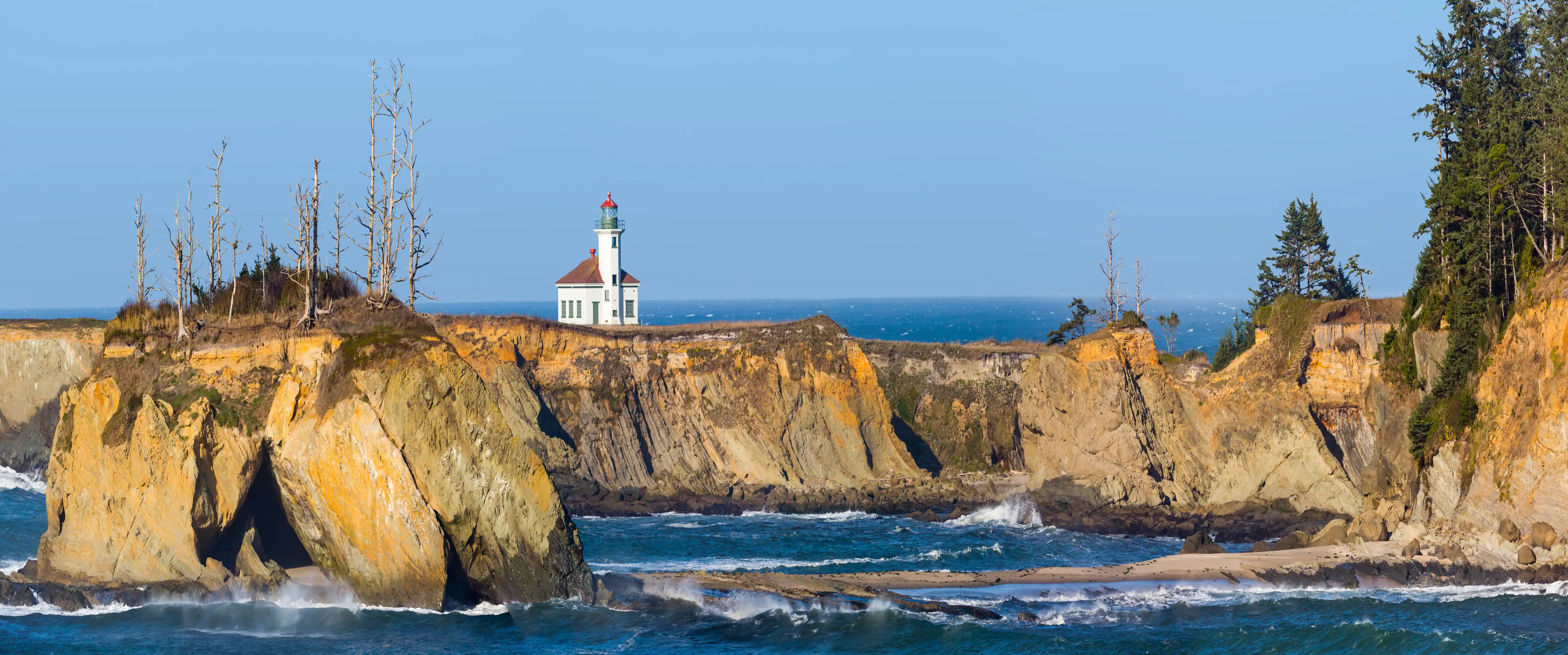
The Coos Bay Reality
The single most important geographic fact about buying in Coos Bay is the east-west split created by US-101 and the working port infrastructure. Neighborhoods west of the highway — Empire, Mingus Park, Marshfield Hill — feel distinctly different from those that sit closer to the bay's working waterfront and the inland zones to the east. That divide affects noise, terrain, commute feel, and the kind of house you will find at a given price point.
Terrain is the second decision-shaper. Marshfield Hill's elevated streets give you partial views and genuine quiet, but steeper driveways become a real consideration in a wet Oregon winter. Empire's coastal flats feel open but are the farthest point from downtown services. Mingus Park sits at a middle elevation with flat walkable streets and the city's most used park within walking distance. Understanding where the hills start and where the flat bay-adjacent land runs is the first thing a serious buyer should do before scheduling showings.
School boundaries matter here too. Blossom Gulch Elementary draws families specifically to the Blossom Gulch neighborhood, and its proximity to the Mill Slough Watershed nature trail makes it a concrete lifestyle draw, not just a school-rating consideration. Buyers who want to be in a specific elementary school's zone should verify boundaries directly with Coos Bay School District 9 before making an offer — the neighborhoods are compact enough that a few blocks can shift your assignment. For the full school picture, see the Coos Bay schools guide.
Neighborhoods at a Glance
| Neighborhood | Best For | Vibe |
|---|---|---|
| Empire | Nature Value | Coastal fishing-heritage character; quiet residential streets near the bay's western edge |
| Mingus Park | Families Walkable | Mid-century homes wrapped around the city's most loved park; the most in-demand pocket in Coos Bay |
| Marshfield Hill | Families Views Quiet | Elevated, wooded, and close to downtown; partial bay views and a strong neighborhood identity |
| Downtown Coos Bay | Walkable Renter | Historic storefronts, the Boardwalk, and the Coos Art Museum; the city's most on-foot-accessible zone |
| Eastside | First-Time Quiet | Flat, close-knit, and owner-occupied; walkable to the waterfront but near port industrial activity |
| Airport Heights | Commuter Value | Inland ranch-house suburban feel; practical US-101 access for North Bend commuters |
| Blossom Gulch | Families School Nature | Elementary-school-adjacent and green; wetland trail access and a genuinely residential pace |
| Green Acres | Privacy Nature | Inland, rural-feeling, and wildlife-rich; the right call for buyers who want space over walkability |
Coos Bay typical home price: $330,015 (Zillow ZHVI, July 2026). Typical rent: $1,603/mo (Zillow ZORI, July 2026). Neighborhood tiers on this page are relative to these figures.

Best Neighborhood by Buyer Type
| Buyer Type | Best Neighborhood | Why |
|---|---|---|
| First-Time Buyer | Eastside | Predominantly owner-occupied single-family stock, flat terrain, and a close-knit feel that rewards staying put as equity builds. |
| Move-Up Buyer | Marshfield Hill | Elevated lots with partial bay views, more privacy than the park neighborhoods, and a short drive to downtown services. |
| Walkability Seeker | Downtown Coos Bay | The Boardwalk, the Coos Art Museum, independent shops, and the Egyptian Theatre are all reachable on foot. |
| Families with Kids | Mingus Park | A pool, disc golf course, skatepark, amphitheater, and tennis courts are literally across the street from mid-century homes that still offer reasonable square footage. |
| Commuters | Airport Heights | Straightforward US-101 access makes the daily run to North Bend or Bay Area Hospital as direct as Coos Bay gets. |
| Large-Lot Buyers | Green Acres | Inland positioning and rural character translate to more land per dollar than any other neighborhood on this list. |
| Renters | Downtown Coos Bay | The highest concentration of rental units, on-foot access to services, and a shorter lease commitment while you learn the city. |
Looking to buy in Coos Bay? Estimate your payment.
Enter your numbers to see an estimated monthly mortgage payment.
Estimate only. Excludes HOA fees and mortgage insurance. The interest rate above is a starting point, not a quoted rate — replace it with your own to see real numbers. Insurance is a flat placeholder, not a Coos Bay quote.
Most Popular Neighborhoods
1. Empire
Empire spent over a century as its own city — founded in 1853, once the Coos County seat — before consolidating with Coos Bay in 1965, and it still carries that independent identity. The neighborhood occupies the city's far western reach, with John Topits Park's 120 acres of coastal forest, protected dunes, and motor-free lakes anchoring its open-space character. The catch is distance: Empire sits farther from the commercial core than anywhere else in the city, which means more windshield time for groceries, medical appointments, and school runs.
Best for: Buyers who want a coastal, outdoorsy feel with genuine quiet and don't mind the extra drive to downtown services.
2. Mingus Park
This is the neighborhood most Coos Bay residents think of first when someone asks where to buy. The park itself — with Choshi Gardens, a public pool, a disc golf course, a skatepark, an amphitheater, and tennis courts — functions as the city's community backyard, and homes along its edge go quickly. Housing stock runs mid-century, built largely between 1940 and 1969, which means charm but also renovation budgets; buyers coming from newer suburban markets often underestimate the maintenance conversation. Prices here run above the city median, making it the most competitive pocket in Coos Bay.
Best for: Families with kids who want park amenities within walking distance, and buyers who prioritize neighborhood identity over square footage.
3. Marshfield Hill
The name itself is a piece of local history — Coos Bay was incorporated as Marshfield in 1874, and this elevated neighborhood carries that founding identity. Partial bay and valley views come with the elevation, and the drive to the Coos Bay Boardwalk and commercial corridors is short enough to feel central. The practical reality is steeper driveways on some lots, which wet Oregon winters make worth testing before you close.
Best for: Families and buyers seeking quiet, elevated streets with views, a strong community feel, and proximity to downtown without living in it.
4. Downtown Coos Bay
About 1,686 residents actually live in the downtown core, surrounded by the historic buildings, the Coos Art Museum — the third-oldest art museum in Oregon — the Egyptian Theatre, and the Boardwalk along the waterfront. On-foot access to services is the genuine draw here, and Nextdoor residents consistently describe it as the city's most walkable zone. The honest counterpoint is that downtown Coos Bay is still a city in transition; some blocks carry the energy of a reviving commercial district and others feel quiet in a way that can read as vacancy.
Best for: Walkability seekers, renters wanting a trial run before buying, and buyers who want to be at the center of whatever the city becomes next.
5. Eastside
Eastside is flat, close-knit, and predominantly owner-occupied — a residential neighborhood where families and retirees have stayed put for decades. The flat terrain makes it one of the more genuinely walkable stretches in the city outside of downtown, with easy waterfront access. The trade-off is proximity to working port infrastructure: industrial traffic is a real ambient factor on certain blocks, and buyers should drive the specific streets they are considering at different times of day before committing.
Best for: First-time buyers and retirees who want flat terrain, waterfront proximity, and a stable owner-occupied neighborhood at an entry-level price point.
6. Airport Heights
Airport Heights and its neighbor Green Acres represent the most conventionally suburban reading of Coos Bay — inland, relatively flat, and ranch-house-heavy in a way that feels more Willamette Valley than Oregon coast. US-101 access is the practical selling point for residents commuting to North Bend or to Bay Area Hospital. Southwest Oregon Regional Airport sits nearby, which matters less for daily life than it does for the occasional out-of-state flight and the associated flight-path noise on some lots.
Best for: Commuters to North Bend, healthcare workers, and buyers who want a low-maintenance suburban layout without the premium of the park-adjacent neighborhoods.
7. Blossom Gulch
Blossom Gulch is purpose-built for families with school-age children, positioned directly adjacent to Blossom Gulch Elementary and the nature trail that explores the Mill Slough Watershed wetlands. The housing mix runs from older stock to more recent construction, surrounded by enough greenery that Nextdoor residents talk about birds and gardens the way other neighborhoods talk about restaurants. The limitation is the same as many of Coos Bay's quieter residential pockets: limited on-foot access to commercial services means most errands require a drive.
Best for: Parents who want to walk their kids to school, buyers who prioritize green surroundings and a calm residential pace over walkability to shops.
8. Green Acres
Green Acres sits at the inland edge of Coos Bay with a rural character that residents describe consistently: trees, woods, wildlife, quiet. For buyers coming from a denser market, the breathing room here is the whole point — more land, more privacy, and a genuine sense that you are at the edge of something larger than a subdivision. The trade-off is that everything requiring a drive gets longer; this is the neighborhood where you learn quickly whether you are a rural-feeling-suburb person or a walkable-urban person.
Best for: Privacy-seekers, large-lot buyers, remote workers, and anyone who wants the inland Oregon character without leaving city limits entirely.
Common Mistakes Buyers Make in Coos Bay
Treating All of US-101 the Same
US-101 is the connective artery of daily life here, but its character shifts significantly depending on where you intersect it. Buyers who assume that being close to the highway means being conveniently located sometimes end up adjacent to port-related industrial traffic patterns that bear no resemblance to the suburban corridor feel they expected. Before you fall in love with a specific address, drive it during a weekday morning and an afternoon when the port is active.
Skipping the Elevation Check in Marshfield Hill
Buyers drawn to Marshfield Hill's views and quiet sometimes discover the driveway situation after they have already made an offer. Steep hillside lots are a real consideration in a climate that delivers persistent winter rain — what feels manageable in July feels like a different property in January. Walk the specific lot in wet conditions before you finalize anything.
Assuming Mingus Park Homes Are Move-In Ready
The neighborhood's appeal is real and the demand is genuine, but the housing stock — largely built between 1940 and 1969 — comes with the renovation realities of mid-century construction. Buyers who budget only for the purchase price and not for electrical panels, plumbing updates, and weatherproofing sometimes find that the most desirable neighborhood in town carries a higher total cost than the listing price suggested. Build the inspection conversation in early, not after you are emotionally committed.
Buying in Empire Without Testing the Commute
Empire's coastal character and John Topits Park make it genuinely appealing on paper. What buyers from outside the area underestimate is the daily distance from Bay Area Hospital, the schools, and commercial services. If your work or your family's schedule involves multiple trips across the city in a day, the far-western position of Empire adds up faster than a weekend drive suggests. The Oregon Coast Highway connects it to everything, but connection time is still time.
Best Areas to Rent in Coos Bay
| Area | Ideal For | Trade-off |
|---|---|---|
| Downtown Coos Bay | Walkability Seeker Renter | Highest concentration of rentals and on-foot access to services; some blocks feel quieter than others in a transitioning commercial district |
| Mingus Park | Families | Park amenities on your doorstep; rentals here move quickly and inventory is thin compared to demand |
| Eastside | First-Time Renter Quiet | Flat terrain and waterfront proximity; industrial port activity on some blocks is worth checking before signing a lease |
| Airport Heights / Green Acres | Commuter Value | Suburban layout and straightforward US-101 access; limited on-foot access means a car is non-optional for daily errands |
| Blossom Gulch | Families with Kids School-Focused | Proximity to Blossom Gulch Elementary and the wetland trail; rental options are limited and tend to be single-family homes rather than multi-unit buildings |
The city-wide typical rent of $1,603 per month (Zillow ZORI, July 2026) reflects a market where demand from healthcare workers and remote workers keeps vacancy low. Renters new to the area often find that starting Downtown or near Eastside gives them the best read on the city's geography before committing to a longer-term lease in a more residential pocket. For the full rental and cost picture, see the Coos Bay cost of living guide.

Local Expert Takeaway: Coos Bay's neighborhood map is smaller than it looks, and the difference between the right and wrong call is usually one specific thing: park access in Mingus Park, school proximity in Blossom Gulch, view lots in Marshfield Hill, or coastal character in Empire. Buyers who get it wrong almost always skipped one step — they looked at the price, liked the listing photos, and never drove the neighborhood at 7:30 on a Tuesday morning when port traffic was moving or the fog was sitting low. Do that drive first. The typical home price of $330,015 (July 2026) buys you meaningfully different things depending on which side of US-101 you end up on.
Quick Takeaways & FAQs
✅ Coos Bay's typical home price of $330,015 (July 2026) is noticeably below comparable Oregon coast markets like Bandon, making ownership accessible for buyers priced out farther south.
⚠️ A property crime rate of 44.6 per 1,000 residents runs well above the state average of 24.5 per 1,000 — something to factor into neighborhood selection, particularly for buyers weighing Downtown versus the residential pockets.
📍 Mingus Park is the city's most in-demand residential neighborhood, anchored by a park with a pool, skatepark, disc golf course, and amphitheater — but its mid-century housing stock means renovation budgets should be part of the conversation from the start.
What is the best neighborhood in Coos Bay for families?
Which Coos Bay neighborhood is most walkable?
Is Empire a good place to buy in Coos Bay?
What should I know about renting in Coos Bay before I buy?
How does the Marshfield Hill neighborhood compare to Downtown Coos Bay?
Moving to Oregon?
Tell us what you need help with and we'll connect you with local resources.
