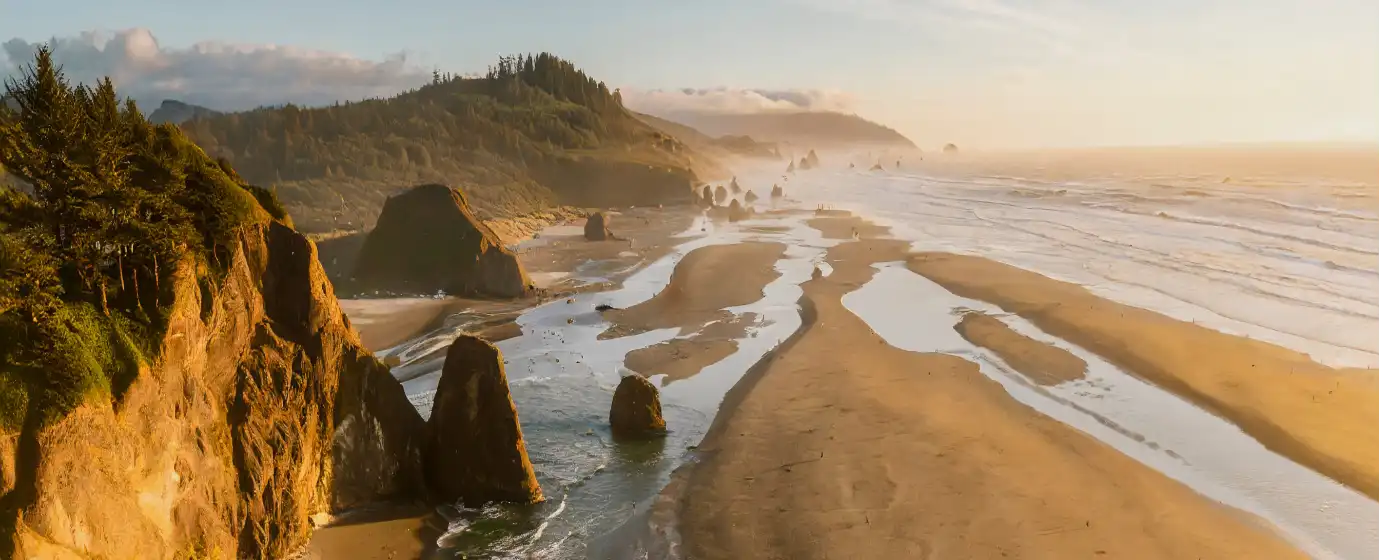
Most people researching the Oregon Coast think of recreation as something you drive to on vacation. In Coos Bay, it's where you live. The three state parks reachable via OR-540 — Sunset Bay, Shore Acres, and Cape Arago — sit roughly 12 to 13 miles from downtown. South Slough National Estuarine Research Reserve, the first of its kind in the country, is in the city's own backyard. And Mingus Park, a 20-acre anchor whose community building was listed on the National Register of Historic Places in May 2025, is a few minutes' walk from downtown streets. The geography here doesn't just allow an outdoor lifestyle — it pressures you into one.
Coos Bay is a working port city of 15,801 people, and the recreation infrastructure reflects both that scale and that identity. The parks aren't polished resort amenities. They're tidal flats where you pull Dungeness crab out of the bay, trails that run through coastal forests and end at cliff-edge views of the Cape Arago Lighthouse, and a downtown boardwalk where the historic tugboat Koos No. 2 sits on permanent display beside fishing access and interpretive panels about the timber trade. The city's biggest annual celebration honors Steve Prefontaine — a son of Coos Bay who became one of America's great distance runners — with a late-summer 10K through downtown. That's the texture of recreation here: specific, earned, rooted in place.
Outdoor access here doesn't come with a high price of admission. The cost of living in Coos Bay runs well below the Oregon average, and most of the recreation covered in this guide is free or low-cost. The tradeoff is weather. Coos Bay averages 186 sunny days a year — less than the rosy marketing of the Pacific Northwest suggests — and coastal fog and rain are facts of life from October through May. Residents who thrive here tend to own rain gear and use it.
Whether you're deciding whether to move or already packing boxes, the sections below cover the city's signature parks, water access, the state park trio to the southwest, and what the seasonal recreation calendar actually looks like.
Mingus Park: The City's Backyard
Mingus Park earns its reputation as the social center of Coos Bay by doing something most city parks don't: it offers something for almost every age group within a single 20-acre footprint. The pond anchors the whole property, and the Choshi Gardens — named for Coos Bay's sister city in Japan — wrap around it with an oriental flower garden that draws serious photographers every spring.
The park's facilities include two playgrounds, a heated outdoor pool, a skate park, a tennis court, a baseball field, and picnic areas, along with walking trails that push up into the wooded hillsides surrounding the lower bowl. That mix is unusual for a city this size, and it's why Mingus Park functions less like a neighborhood amenity and more like a community commons.
The amphitheater is worth understanding on its own terms. It's a large concrete stage set in a grass bowl with the pond as a natural backdrop — the kind of venue that feels like it was designed specifically for a Summer Shakespeare Festival, which it hosts annually. Plays, concerts, and community events fill the calendar through the warmer months.
The Mingus Park Community Building adds a layer of civic weight that most park structures lack. Built between December 1939 and July 1940 as a WPA project using locally sourced timber and quarry stone, it was listed on the National Register of Historic Places in May 2025 — making it one of the only surviving WPA-era structures in Coos Bay. If you're evaluating neighborhoods, Mingus Park is a genuine asset for the surrounding area.
What locals know: On a dry summer evening, the amphitheater lawn fills with families and teenagers who've staked out the same grassy sections for years. The heated pool is the closest thing the city has to a community gathering point for younger kids — and the wait list for swim lessons fills up fast.
The State Park Trio: Sunset Bay, Shore Acres, and Cape Arago
OR-540, the Cape Arago Highway, is the road that defines recreational Coos Bay more than any other single feature. Drive it southwest from downtown and within about 12 miles you reach three state parks that, taken together, represent some of the most varied coastal terrain in Oregon.
Sunset Bay
Sunset Bay State Park is the most accessible entry point into this corridor. Its crescent-shaped beach sits inside a protected cove, which makes the water calm enough for swimming and kayaking in a way most Oregon coast beaches simply aren't. A campground with 139 sites, including tent sites, RV hookups, and yurts, makes it a common base for exploring the whole corridor.
Shore Acres
Shore Acres State Park is the surprise that most newcomers don't expect. The 745-acre park draws crowds from across the region primarily for its botanical gardens — a formal garden, a Japanese-style garden with a lily pond, two rose gardens, and what is documented as the largest Monterey pine in Oregon. This was the private estate of timber baron Louis J. Simpson before Oregon acquired it in 1942, and the formal garden structure still reflects that origin. It's an unusual thing to find on a working coast, and it's genuinely worth the drive.
The winter event is equally unusual. Each year from Thanksgiving through New Year's Eve, Shore Acres hosts a large-scale holiday lights display with illuminated sculptures and decorated trees that draws visitors from well outside the region. Timed entry and advance parking purchase are required — plan ahead, because this is not a spontaneous December outing for residents or visitors.
Cape Arago
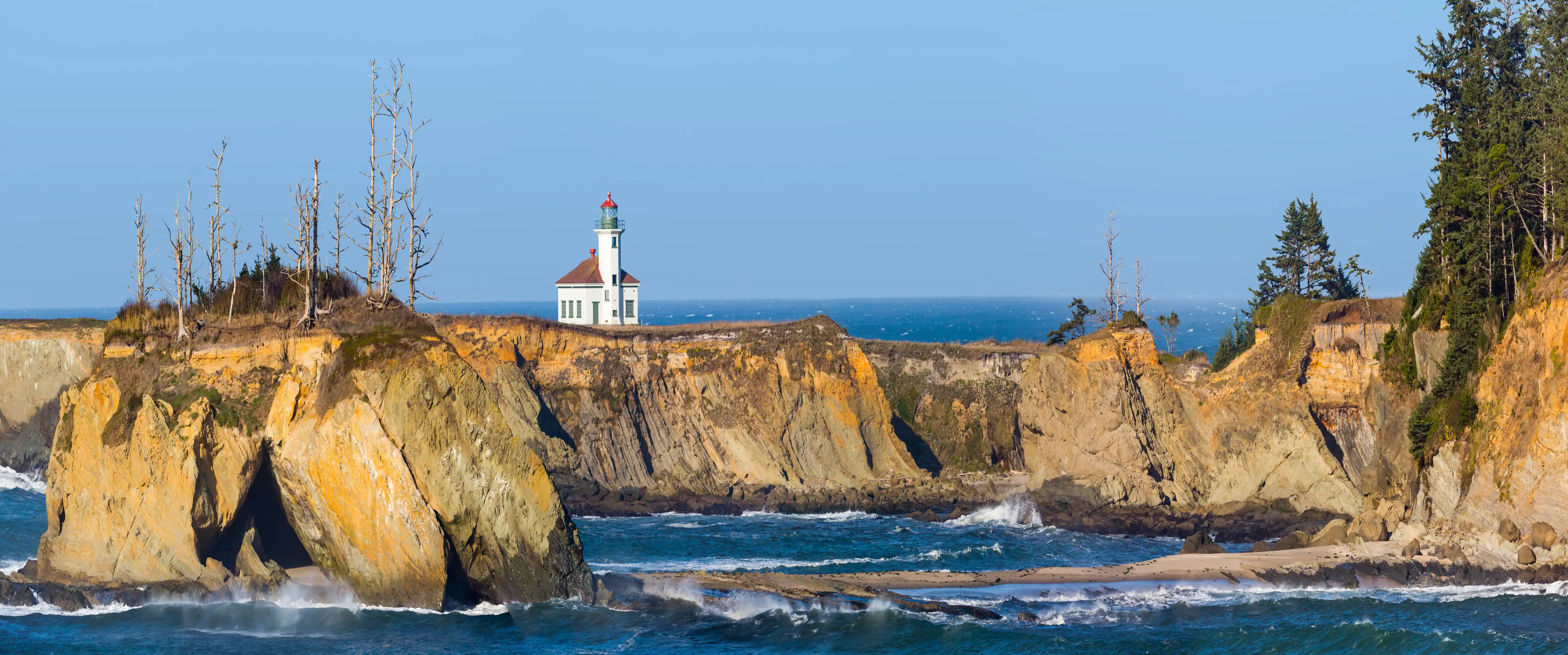
Cape Arago State Park sits at the end of the corridor and offers cliff-top ocean overlooks where gray whales pass during their migration from December through June. The park is where the three-park connecting trail terminates — a coastal hiking route that passes through coastal forests, runs through seasonal wildflower blooms, and delivers cliff-edge views of the Cape Arago Lighthouse along the way. Connecting all three parks on foot is a half-day commitment and one of the better hikes in this part of the coast.
| Park | Distance from Coos Bay | Signature Draw | Best For |
|---|---|---|---|
| Sunset Bay State Park | ~12 miles via OR-540 | Sheltered beach, camping | Families Nature |
| Shore Acres State Park | ~13 miles via OR-540 | Botanical gardens, holiday lights | Nature Views |
| Cape Arago State Park | ~14 miles via OR-540 | Whale watching, cliff-top trail | Nature Views |
All three parks are on the same road and most residents visit them as a circuit rather than individually. The connecting trail is the thread that ties them together on foot.
South Slough Reserve, the Boardwalk, and Water Access
South Slough National Estuarine Research Reserve was established in 1974 as the first of 30 such reserves in the United States — a distinction that matters because it shaped the reserve's development as a public resource rather than a restricted research site. Nearly 7,000 acres of open water channels, tidal and freshwater wetlands, riparian areas, and forested lands make up the reserve in the Coos Bay estuary. The headquarters sits in Charleston, a short drive from Coos Bay, and the reserve functions as a shared asset for the whole area.
Wildlife at South Slough is not a curated experience — you're moving through a working estuary. Salmon, great blue herons, bald eagles, elk, black bear, river otters, and beavers all use the reserve. Hiking paths and boardwalks wind from upland forest down through wetlands to salt marshes and mudflats, with accessible-feature trails available. Paddling is the other major draw: kayak and canoe access through the waterways, including organized paddle-trip classes with rentals, makes the reserve one of the better entry points into coastal paddling on this stretch of the coast.
The Coos Bay Boardwalk handles the downtown end of the water experience. The roughly half-mile wooden promenade runs along the bay with interpretive panels covering the city's maritime and lumber history, views across the water, picnic tables, and fishing access. The historic tugboat Koos No. 2 sits on permanent display — a tangible piece of the port history that shaped this city. It's a genuinely pleasant walk, and one that grounds the city's identity in its working waterfront rather than sanitizing it.
For recreational crabbing, clamming, and fishing, Charleston Marina — just a short drive down OR-540 — is the practical hub. Dungeness crab and razor clams are the primary targets, and the marina draws both serious anglers and families pulling crab rings off the docks. It is not in Coos Bay proper, but it functions as part of the city's water recreation in every practical sense.
Human friction moment: New residents frequently underestimate the tide schedule's effect on recreational planning at South Slough. Mudflat trails that look passable at one hour can be submerged or impassable a few hours later. Learning to read a tide chart is less optional here than it sounds.
Looking to buy in Coos Bay? Estimate your payment.
Enter your numbers to see an estimated monthly mortgage payment.
Estimate only. Excludes HOA fees and mortgage insurance. The interest rate above is a starting point, not a quoted rate — replace it with your own to see real numbers. Insurance is a flat placeholder, not a Coos Bay quote.
Seasonal Recreation and the Annual Calendar
Recreation in Coos Bay follows a rhythm that coastal Oregon imposes, not one the city chooses. The 186 sunny days a year are real — more than many Pacific Northwest cities — but they concentrate heavily from June through September. The practical effect is that summer is the primary outdoor season, and most of the region's visitors arrive within that window. Residents who live here year-round learn to use the shoulder seasons, which offer the state parks nearly to themselves and South Slough at its quietest.
Summer
From late June through early September, the parks along OR-540 fill with out-of-region visitors, the Mingus Park amphitheater runs Shakespeare and community performances, and the heated pool at Mingus Park becomes the social center for younger residents. The Prefontaine Memorial Run — a 10K and 2-mile fun run honoring Coos Bay's most famous native son — anchors the city's biggest late-summer celebration, which also draws live music, a parade, and a vintage car show to downtown.
Fall and Winter
Shore Acres' annual holiday lights display transforms the park from Thanksgiving through New Year's Eve and draws visitors from well outside the region. It's genuinely popular and requires advance planning — timed entry and prepaid parking are not optional. Gray whale migration through the Cape Arago overlooks begins in December and runs through June, which gives the state park corridor genuine value in months when the beach itself isn't particularly inviting.
Spring
The Choshi Gardens at Mingus Park and the formal gardens at Shore Acres both peak in spring — Shore Acres' roses and the lily pond draw serious garden visitors in May and June. South Slough's wildlife is most active through late spring, with salmon moving through the estuary waterways.
What surprises people after six months: The fog. Coos Bay sits at an elevation and exposure that pulls dense coastal fog in even on days the forecast calls sunny. July mornings routinely start gray and burn off by early afternoon — or don't. New residents from inland Oregon or California often find this demoralizing in year one before they adjust to planning around it rather than against it.
For families weighing youth sports and kids' activities alongside the outdoor calendar, the schools page covers what the district and the broader community offer on that front.
Local Expert Takeaway: The strongest case for Coos Bay's recreation isn't any single park — it's the density of genuinely distinct experiences within a short drive of each other. Mingus Park (a WPA-era amphitheater and Choshi Gardens a few minutes from downtown), South Slough (7,000 acres of living estuary), and the Shore Acres botanical gardens along OR-540 are the kind of assets that smaller Oregon cities spend decades trying to build. The catch is the weather window: plan your life around summer and early fall, learn to work with the tides at South Slough, and buy advance parking passes for the Shore Acres holiday lights display before November — they go faster than newcomers expect.
Quick Takeaways & FAQs
✅ Three state parks are connected by a single coastal hiking trail along OR-540 — Sunset Bay, Shore Acres, and Cape Arago — all within about 14 miles of downtown Coos Bay.
⚠️ Coastal fog is a daily reality from fall through late spring, and the 186 annual sunny days concentrate heavily in summer — plan outdoor recreation windows accordingly.
📍 The Mingus Park Community Building, a WPA-era structure built with local timber and quarry stone, was listed on the National Register of Historic Places in May 2025.
What is the most popular park in Coos Bay?
Can you swim at the Oregon coast near Coos Bay?
What is the holiday lights event at Shore Acres State Park?
Is kayaking available near Coos Bay?
When do gray whales pass by Coos Bay?
Moving to Oregon?
Tell us what you need help with and we'll connect you with local resources.
