
Central Oregon · Cost of Living · 2026
Cost of Living in Central Oregon: Every City Ranked
Cities ranked by what it actually costs to own a home and live here — from the working agricultural towns to the resort corridor.
Cities ranked by what it actually costs to own a home and live here — from the working agricultural towns to the resort corridor.
If you're weighing a move to Central Oregon, the first thing to understand is how wide the spread actually is. US-97 runs the spine of this region, connecting small agricultural towns and a high desert city with a resort hub that draws buyers from across the country — and the cost of living shifts dramatically depending on where along that corridor you land. The Cascade Range to the west and the high desert plateau to the east shape not just the scenery but the economies of each city, and what you pay for housing reflects that geography in a very direct way.
At one end of this region, you'll find working towns where ranching, agriculture, and light industry anchor the economy and housing costs reflect that grounded reality. At the other end, resort-town demand, a national outdoor recreation reputation, and an influx of remote workers have pushed prices well above what most Oregon metros outside Portland would consider typical. The cities in the middle reflect the pull between those two forces — proximity to Bend's amenities without fully Bend-level prices, or a quieter community character with fewer services but more breathing room in the budget. The sections below cover what drives costs in each city and which kind of buyer each one actually suits.
All prices reflect 2026 market data sourced from Zillow and cross-referenced with our individual city guides. County tax rates are verified effective rates.
Ranked by overall affordability. Click any city to jump to the full breakdown.
| # | City | Home Price | Monthly PITI | Income to Buy | Est. Rent |
|---|---|---|---|---|---|
| 1 | Madras Jefferson County | $360,658 | $2,210/mo | $92,684/yr | $1,300/mo |
| 2 | La Pine Deschutes County | $406,496 | $2,443/mo | $105,196/yr | $1,300/mo |
| 3 | Prineville Crook County | $433,014 | $2,581/mo | $105,484/yr | $1,665/mo |
| 4 | Redmond Deschutes County | $517,100 | $3,151/mo | $134,716/yr | $1,800/mo |
| 5 | Bend Deschutes County | $732,894 | $4,393/mo | $183,529/yr | $1,989/mo |
| 6 | Sisters Deschutes County | $790,765 | $4,753/mo | $201,245/yr | $1,576/mo |

#1 Most Affordable · Jefferson County
Best for buyers who want attainable ownership in the high desert
Madras sits in Jefferson County at the northern end of the Central Oregon corridor, where the economy runs on agriculture, a state prison, and the small-city services that surround both. A $360,658 typical home price puts it well outside the resort-town orbit that defines costs further south, and that reflects a genuinely different community — one where US-97 and US-26 connect you to the broader region but daily life doesn't depend on Bend's amenities. The trade-off is real: fewer restaurants, fewer employers, and a more limited services landscape, but also a housing market that working households can still reach without an extraordinary income.
Madras suits buyers who want a starter home or a rural pace of life without committing to the remote geography of other small high desert towns. It's a better fit for someone who values owning outright over being close to the trailhead, and who doesn't mind that a serious shopping trip or a specialist appointment means driving south.

#2 Lowest Rent · Deschutes County
Best for buyers who want forest acreage and space to spread out
La Pine is the southernmost city in Deschutes County and one of the newer incorporated cities in Oregon, sitting along US-97 where the ponderosa pine forest thickens and the population thins. A $406,496 typical home price reflects a community that sits within reach of Bend's employment base while offering substantially more land and a quieter pace — many lots here are measured in acres rather than square feet. The cost advantage over Bend is meaningful, but La Pine has limited local commercial infrastructure, so residents tend to drive north for most services, groceries, and medical care.
La Pine is a genuine fit for remote workers, retirees, and buyers who prioritize space and forest surroundings over walkability or local amenity density. If your daily life doesn't require a local coffee shop or a quick errand loop, the Deschutes County setting with room to breathe and prices well below the region's resort end makes a real case.

#3 Crook County Ranch City · Crook County
Best for buyers who want a working small city with its own identity
Prineville is the Crook County seat and one of the more self-contained small cities in Central Oregon, with a working ranching identity, a major tech data center presence, and a genuine downtown that predates the outdoor recreation economy. A $433,014 typical home price reflects a city that has felt some pressure from buyers priced out of Bend but retains a character distinct from the resort corridor — US-26 and OR-126 connect it west toward Bend and east toward the Ochoco Mountains, and the Crooked River canyon defines its southern edge. Prineville has more local services than La Pine and a stronger employment base than Madras, which shows in its cost structure.
Prineville tends to suit buyers who want a small-city feel with genuine local roots rather than a resort-adjacent identity. Compared to Redmond, it offers a more rural pace and a tighter-knit community; compared to Madras, it sits closer to Bend's employment and cultural pull while still feeling like its own place.
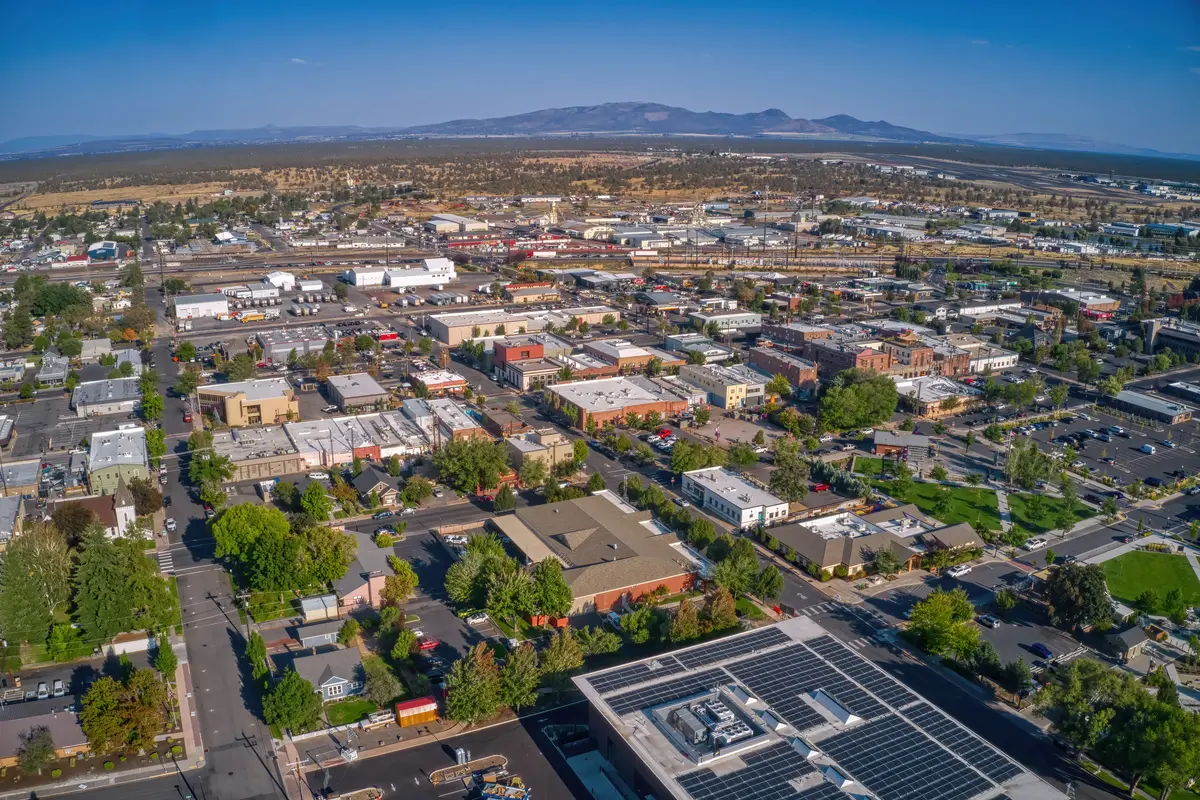
#4 Regional Hub City · Deschutes County
Best for buyers who want full services without resort-level prices
Redmond has grown into Central Oregon's most practical middle ground — among Oregon's larger incorporated cities by U.S. Census count, with a real airport, a commercial core, and a housing stock that ranges from established neighborhoods to newer subdivisions. A $517,100 typical home price reflects a city with genuine infrastructure: US-97 provides the main corridor, the Redmond Municipal Airport connects travelers without requiring a drive to Bend, and Dry Canyon Village gives retirees a dedicated age-restricted community option that doesn't exist in most of the region's smaller towns. The cost premium over Prineville and the towns further north is earned by having more of what most buyers actually need within the city limits.
Redmond suits buyers who want Bend-adjacent access — the commute, the airport, the general services — without Bend-level prices. It's a particularly strong fit for families who want a full-service community and buyers who need regional healthcare or employment options without building their life around the resort economy.
#5 Outdoor Recreation Capital · Deschutes County
Best for buyers who want the complete Central Oregon urban experience
Bend is Oregon's sixth-largest incorporated city by U.S. Census count and the undisputed center of the Central Oregon economy, outdoor culture, and real estate demand. A $732,894 typical home price reflects the compounding effect of a national relocation magnet: remote workers, retirees from California and the Pacific Northwest, and outdoor enthusiasts have sustained demand that far outpaces what the local wage base alone would support. US-97 and US-20 carry both the commuter traffic and the visitor traffic, and the city's amenity density — medical care, dining, employment, recreation — is in a different category from every other city in this region.
Bend suits buyers who want the full Central Oregon experience without trade-offs on services, cultural life, or career access — and who can absorb the cost. For buyers coming from a higher-cost metro, it may still feel attainable. For buyers relocating from elsewhere in the region or from a more modestly priced market, the gap between Bend and cities like Redmond or Prineville is large enough to reshape what ownership actually looks like.

#6 Mountain Western Village · Deschutes County
Best for buyers who are buying into a mountain lifestyle as much as a home
Sisters is a small mountain town in Deschutes County with a carefully cultivated western character, a walkable main street, and a setting between the Cascades and the high desert that draws buyers looking for scenery and community atmosphere above all else. A $790,765 typical home price reflects resort-level demand in a town with limited housing supply and a distinct identity that people pay a premium to be part of. US-20 and OR-126 connect it to both Bend and the Willamette Valley, and The Pines at Sisters gives retirees a named age-restricted community option in the region. Services are limited relative to the price point — Sisters has a small commercial core, and most daily needs require a drive east toward Redmond or Bend.
Sisters tends to suit buyers for whom the lifestyle IS the product — the mountain views, the small-town feel, the arts and quilting culture, the trailhead access — and for whom price-per-square-foot is secondary to place. Compared to Bend, it offers a quieter pace and a more intimate community; in most cases, that intimacy carries a price tag that exceeds even Bend's own demanding market.
Central Oregon's cost of living isn't a single story — it's a corridor where the same region contains both some of Oregon's most attainable housing and some of its most demanding price points. The right city depends less on a ranking and more on whether you're buying into the resort economy or stepping outside it.
Tell us what you need help with and we'll connect you with local resources.
