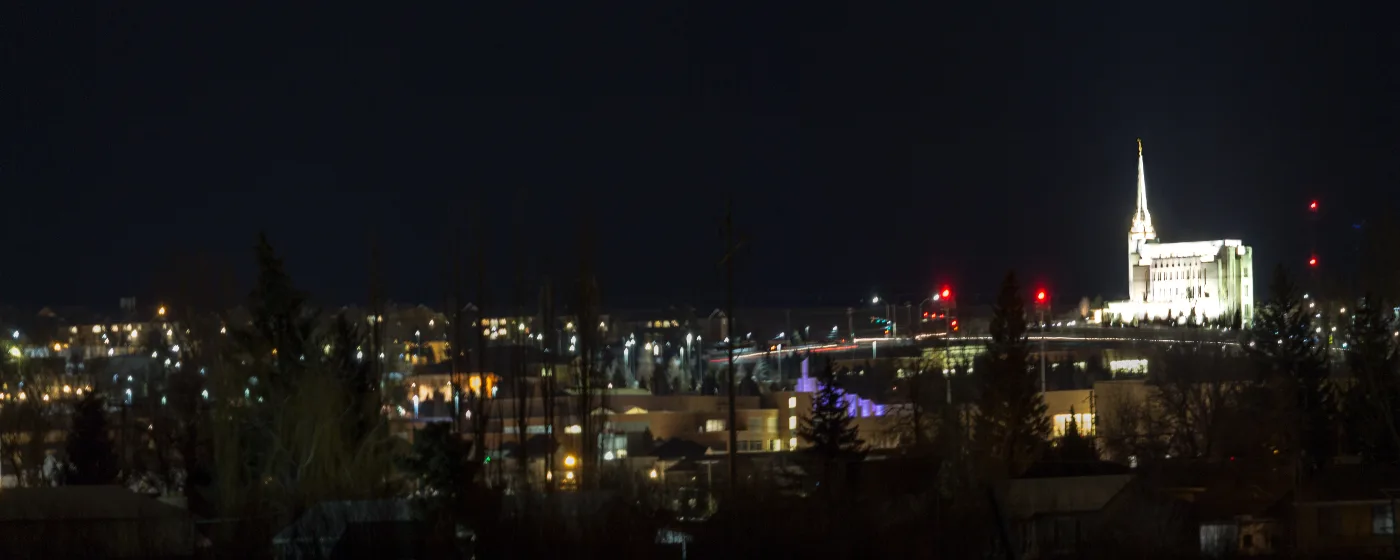
Most retirees who land in Rexburg say the same thing within the first few months: they underestimated how young this city is — and how much they like it anyway. The BYU-Idaho campus shapes almost every dimension of daily life here, from the traffic calendar to the restaurant scene to the way neighbors greet each other at Porter Park. That energy reads as either invigorating or exhausting depending on the person, which makes the retirement calculus here more personal than it is in most eastern Idaho towns.
Rexburg sits in Madison County, roughly 30 minutes north of Idaho Falls on US-20, surrounded by farmland and framed by the Teton Range to the east. The economy runs on the university, Madisonhealth (which operates Madison Memorial Hospital), and local government services — a stable, institutionally anchored base that keeps the city from the boom-bust swings that rattle some Rocky Mountain retirement spots. For retirees who want a small, tight-knit community with a university calendar to keep life interesting, that combination matters.
The cost of living is a genuine draw: a typical home value of $403,386 (Zillow Home Value Index, May 2026) puts Rexburg well below Boise or any Teton-adjacent market, and property taxes are among the lowest in the region. The winters are real — this is the Snake River Plain at 4,800 feet, and January highs hover in the upper 20s — so anyone who needs warm weather year-round should keep reading and then look south. For everyone else, Rexburg offers a surprisingly affordable, safe, and community-oriented place to land.
Whether you're comparing Rexburg to Idaho Falls, weighing the healthcare trade-offs, or trying to figure out what downsizing actually looks like here, the sections below cover the full picture: healthcare access, the retiree tax posture, walkability, senior living options, and how Rexburg stacks up against nearby alternatives.

Why Retirees Are Choosing Rexburg
The retirees who thrive here almost always share a few traits: they're comfortable in a faith-centered community (the LDS faith shapes the local culture deeply), they don't need a major urban center within arm's reach, and they actually want the stimulation that comes from living next to a working university campus. If that sounds like you, Rexburg is likely underpriced for the quality of life it delivers.
The safety profile alone gets people's attention. The combination of low crime, clean streets, and a population that skews toward young families rather than transient workers creates a texture that many retirees describe as genuinely comfortable — not sanitized, just calm. The typical home price of $403,386 (Zillow Home Value Index, May 2026) means you can buy something solid without exhausting a retirement nest egg, and the ongoing cost of ownership stays low once you're in.
Who should look elsewhere? Retirees who want walkable urban streets with independent restaurants and boutique shops within a few blocks will find Rexburg limited. Anyone who needs specialist medical care on short notice — cardiology, neurology, complex oncology — should understand that Idaho Falls is the realistic ceiling for regional care, with Salt Lake City being the true tertiary referral destination. And if you're counting on mild winters to stay active outdoors year-round, the Snake River Plain winters will test that plan. Rexburg rewards flexibility and a love of community; it doesn't pretend to be something it isn't.
Healthcare & Medical Access in Rexburg
What's Right Here
Madison Memorial Hospital — now operating under the brand Madisonhealth — is a community-owned, non-profit, 69-bed acute-care facility at 450 E Main St, less than two miles from most Rexburg neighborhoods. For a city of 41,000, the system is remarkably substantial: it runs six outpatient clinics in addition to the main hospital, employs 720 people, and works with 270 doctors, providers, contracted therapists, and nurse anesthetists. Emergency care, general surgery, orthopedics, women's health, and a cancer care program are all available without leaving the city.
Patient experience scores are strong. U.S. News & World Report data puts Madisonhealth's patient-recommendation rate at 89% — a figure that matters because it reflects the day-to-day experience of actual patients in Rexburg, not just clinical outcomes at an academic medical center. For routine care, post-surgical rehab, and the kinds of visits that become more frequent in your 60s and 70s, having a respected community hospital this close is a meaningful quality-of-life factor.
The Honest Distance-to-Advanced-Care Reality
The gap in Rexburg's healthcare picture is specialist depth. Complex cardiology, advanced neurology, and high-acuity cancer treatment realistically point you toward Idaho Falls — home to Eastern Idaho Regional Medical Center (EIRMC), a 330-bed Level II trauma center — or, for the most complex cases, the 30-minute drive becomes a 3-hour drive to Salt Lake City's Intermountain Medical Center or University of Utah Health.
That's not unusual for a city this size in the Mountain West, but it's worth naming clearly. Retirees managing a serious or progressive chronic condition should factor that drive into the decision — particularly in winter, when US-20 between Rexburg and Idaho Falls can turn unpredictable.
Continuum of Care
For retirees thinking beyond independent living, an assisted living center on the west side of downtown offers 60 units with memory care for dementia and Alzheimer's patients, on-site physician services, and medication administration by licensed nurses. Having that level of care within the city limits — rather than requiring a move to Idaho Falls — gives Rexburg a more complete continuum than many comparably sized Idaho towns can claim.

The Retiree Budget in Rexburg
Social Security and Idaho's Tax Posture
Idaho exempts Social Security benefits entirely from state income tax, with no income cap or phase-out — every dollar of your Social Security check arrives untouched by the state. That's the headline, and it's meaningful for retirees who rely heavily on Social Security as their primary income source.
Other retirement income — 401(k) withdrawals, traditional IRA distributions, and most private pensions — is taxed at Idaho's flat state rate of 4.4% (tax year 2025, per the Idaho State Tax Commission). Idaho does not offer a broad senior exemption on these sources; only narrow categories like certain federal Civil Service Retirement System pensions, Idaho public-safety pensions, and military retirement pay qualify for the Retirement Benefits Deduction. If most of your retirement income comes from an IRA or 401(k), budget for that 4.4%.
Idaho levies no estate or inheritance tax, and the federal estate-tax exemption sits at $15 million for 2026, meaning the overwhelming majority of Rexburg retirees' estates transfer to heirs without any transfer-tax burden at either the state or federal level.
Property Taxes and Relief Programs
Rexburg's effective property tax rate is approximately 0.56% — meaningfully below the national average of around 1.0%, and one of the lower rates in an already tax-friendly state. For homeowners on fixed incomes, that difference in annual carrying cost adds up over a decade of retirement.
If your household income is under $39,130 (the 2025 threshold), Idaho's Circuit Breaker program can reduce your annual property tax bill by $250 to $1,500 once you turn 65. Applications go to the Madison County Assessor between January 1 and April 15 each year — mark that window, because missing it means waiting another full year. The full cost-of-living breakdown covers sales tax, utilities, and day-to-day expenses in detail.
Daily Fixed-Income Reality
Rexburg's 6% sales tax — Idaho's flat statewide rate with no local add-on — applies to most retail purchases but not to groceries or prescription drugs, which matters on a fixed income. The university-town dynamic keeps a handful of budget-friendly dining options alive along the main corridors, and the absence of a luxury-market economy means everyday services — haircuts, auto repair, routine medical co-pays — tend to run at regional rather than resort-town pricing.
The honest friction point is that Rexburg has limited big-box retail variety without driving to Idaho Falls. If your fixed income depends on Costco runs and comparative shopping across multiple stores, plan on that 30-minute trip becoming part of your monthly routine.
Looking to buy in Rexburg? Estimate your payment.
Enter your numbers to see an estimated monthly mortgage payment.
Estimate only. Excludes HOA fees and mortgage insurance. The interest rate above is a starting point, not a quoted rate — replace it with your own to see real numbers. Insurance is a flat placeholder, not a Rexburg quote.
Walkability, Community & Staying Active in Rexburg
The Walkability Reality
Rexburg is flat — genuinely flat, which is rarer than it sounds in the Mountain West and matters considerably when joints stop cooperating. The terrain between most neighborhoods and downtown presents no meaningful elevation challenge. The honest limit is destination density: the core blocks around Main Street and Center Street have sidewalks and some useful retail, but a significant number of daily errands — the pharmacy, a larger grocery run, medical appointments — will require a car or a ride.
Retirees who live in the older neighborhoods within a half-mile of Main Street have the most on-foot access. Those further out in newer subdivisions on the city's edges will find the car essentially mandatory for anything beyond a walk around the block. That's worth weighing seriously if driving becomes a concern in your 70s or 80s.
Where the Community Actually Gathers
Porter Park, a few blocks from downtown, is the de facto community living room — summer evenings there bring out retirees, families with strollers, and BYU-Idaho students in roughly equal numbers. The Idaho Centennial Carousel nearby runs seasonally and draws a cross-generational crowd that gives the park a genuinely neighborly feel rather than just a recreational-amenity feel.
The BYU-Idaho campus is the other anchor. The university opens many of its public lectures, performing arts performances, and sporting events to community members — and a meaningful number of Rexburg retirees treat the semester calendar as their own cultural schedule. It's an unusual retirement perk that costs nothing and changes constantly.
Senior Programs and Social Life
The Madison County Senior Center provides programming, meal services, and social connections specifically for older residents — it's the practical hub for anyone newly arrived who wants to meet peers rather than college students. Volunteer opportunities through the city, local congregations, and the hospital's volunteer program give structure to weekdays for retirees who need it.
For outdoor activity, the parks and trail network including Rexburg Nature Park and the walking paths near the Teton River corridor offer low-impact options across three seasons. Winter narrows the outdoor window considerably; retirees who want year-round outdoor access often supplement with a gym membership at one of the university-adjacent fitness facilities open to the public.
Right-Sizing: Downsizing in Rexburg
What the Market Actually Offers
Rexburg's housing stock skews toward single-family homes built for the family market — three-bedroom, two-bath ranch-style construction from the 1980s through the 2010s dominates most neighborhoods. The good news for downsizers is that the ranch-style prevalence means single-level living is genuinely available without hunting for it. You don't have to pay a premium to avoid stairs the way you might in an older Eastern city with a predominantly two-story inventory.
Patio homes and smaller zero-lot-line properties exist in pockets around the city's quieter residential edges, though inventory at any given moment is limited. Rexburg is not a large enough market to have a deep bench of available units; if a specific floor plan or community matters to you, be prepared to wait or to catch a listing quickly when it appears.
Condos and Attached Housing
The condo market here is substantially driven by student demand near campus, which creates a mismatch for retirees: the available attached-housing units tend to be small, densely built, and surrounded by a young renter demographic. There are exceptions — some newer developments on the quieter southern and eastern edges of the city have attracted non-student buyers — but retirees looking for a true low-maintenance condo lifestyle will find the options thin compared to Idaho Falls, where the attached-housing market has more depth and more age diversity.
Assisted Living and Memory Care
The assisted living center on the west side of downtown provides around 60 units covering assisted living and memory care, with on-site physician services and licensed nursing staff for medication management. Having that in-city means a spouse can remain in the same community when care needs diverge — a practical concern that rarely surfaces in retirement planning until it's urgent.
For a fuller continuum that includes skilled nursing and post-acute rehab, Idaho Falls carries significantly more options. Retirees who anticipate needing that level of care within the next five to ten years may find Idaho Falls the smarter long-term base, even if Rexburg's daily costs and community appeal are stronger on paper today. The downsizing decision here is as much about planning ahead as it is about the current inventory.
Rexburg vs Nearby Retirement Destinations
| City | Cost vs Rexburg | Primary Hospital | Walkability | Senior Living Depth | Overall Retirement Fit |
|---|---|---|---|---|---|
| Rexburg | Anchor | Madisonhealth / Madison Memorial Hospital (69-bed, on-site) | Flat terrain; limited destination density | Moderate — assisted living downtown, limited condos | Quiet Value Strong for community-oriented retirees |
| Idaho Falls | Noticeably pricier | EIRMC — 330-bed Level II trauma center, full specialist depth | Better downtown core; still car-dependent suburbs | Deep — multiple AL, memory care, SNF options | Services Best overall for retirees needing specialist care |
| Rigby | About the same or slightly cheaper | None local — refers to Idaho Falls | Very limited; small-town rural | Minimal in-town options | Privacy Works best for retirees with family nearby and no complex health needs |
| St. Anthony | Slightly cheaper | None local — refers to Rexburg or Idaho Falls | Walkable core but very limited amenities | Very limited | Nature Appeals to outdoors-focused retirees; healthcare access is a real trade-off |
| Driggs | Significantly pricier | Teton Valley Hospital (critical-access, limited); major care in Idaho Falls or jackson | Small but functional downtown | Very limited; market skews toward second-home buyers | Views Stunning setting; expensive and healthcare-thin for a primary retirement base |
| Sugar City | Slightly cheaper | None local — refers to Rexburg | Minimal; residential community adjacent to Rexburg | Essentially none | Quiet Reasonable for retirees who want lower density and will drive to Rexburg for services |
If healthcare access is the primary concern, Idaho Falls is the clear winner — Eastern Idaho Regional Medical Center's specialist depth and Level II trauma designation put it in a different category than anything Rexburg can offer in-city. For retirees on a tighter budget who want community depth, actual amenities, and a hospital within two miles, Rexburg outperforms every other option on this list. Driggs offers the most dramatic scenery in the region but comes with a price premium and healthcare gaps that make it a riskier primary retirement base than its appeal on paper might suggest. St. Anthony and Rigby suit retirees with simple health needs, strong family support locally, and a preference for true rural quiet — but anyone who anticipates regular medical appointments will spend a lot of time on US-20.
The honest comparison: Rexburg and Idaho Falls are the only two towns in this region that offer a real retirement infrastructure. The decision between them usually comes down to whether you want the lower costs and tight-knit character of a university town, or the broader services, specialist access, and senior-housing inventory of a regional city twice Rexburg's size.

Local Expert Takeaway: Rexburg is genuinely underrated as a retirement destination — but only for the right person. The flat streets, the 0.56% property tax rate, the Madisonhealth system two miles from almost any neighborhood, and the BYU-Idaho cultural calendar add up to a retirement lifestyle that costs significantly less than comparable communities in Boise or along the Teton corridor. The catch is that you need to be comfortable in a strongly faith-centered, youth-oriented community, and you need to accept that anything beyond routine medical care means a 30-minute drive to Idaho Falls. If the Circuit Breaker property-tax program applies to your income level, file with the Madison County Assessor before April 15 — that window closes once a year and most newcomers miss it their first year.
Quick Takeaways & FAQs
✅ Idaho exempts Social Security entirely from state income tax and Rexburg's effective property tax rate is approximately 0.56% — a genuinely retiree-friendly combination for fixed-income households.
⚠️ Specialist medical care — cardiology, complex oncology, neurology — requires a 30-minute drive to Idaho Falls, which becomes a real planning factor in winter or if driving becomes difficult.
📍 The Madison County Assessor's Circuit Breaker application window runs January 1 – April 15 only; qualifying homeowners 65+ with household income under $39,130 can reduce their property tax bill by up to $1,500 per year.
Is Rexburg a good place to retire if I'm not a member of the LDS faith?
Does Idaho tax my IRA withdrawals in retirement?
What is the closest hospital to Rexburg and how good is it?
Are there 55+ or active-adult communities in Rexburg?
How bad are Rexburg winters, really, for a retiree?
Moving to Idaho?
Tell us what you need help with and we'll connect you with local resources.
