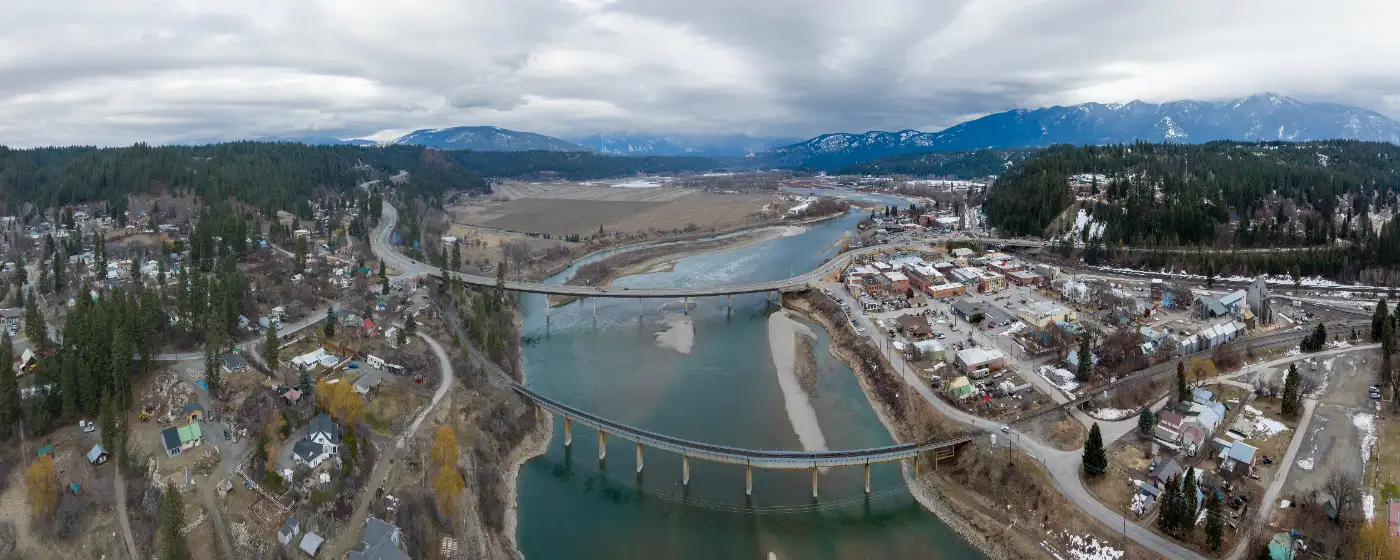
Maybe you've priced out of Coeur d'Alene or Sandpoint and someone mentioned Bonners Ferry. Maybe you've driven US-95 through the Kootenai River valley, watched the Canada geese bank over the wetlands, and thought: this is the place. What surprises most retirees who actually make the move is how small the town really is — a population of roughly 2,669 — and how that smallness turns out to be exactly the point. Life here runs at a different pace, anchored to Main Street, the Kootenai River, and the rhythms of a community where your neighbors know your name inside a month.
The economic backbone is modest and honest: Boundary Community Hospital is both the town's major employer and its primary medical resource, Kootenai Tribe of Idaho operates gaming and hospitality nearby, and Alta Forest Products keeps the timber tradition alive. None of that translates to a booming local economy, but it does mean a stable, working-class community with deep roots — the kind of place where a retired couple from the Pacific Northwest fits in quickly, especially if they're drawn to wildlife refuge walks, fishing the Kootenai, or volunteering with the historical society at the Boundary County Museum. The median home sale price sits at $360,000 (Homes.com, July 2026), which is meaningfully below what comparable acreage and mountain scenery command in most of north Idaho.
Daily life on a fixed income is manageable here in ways it simply isn't in resort towns to the south. Groceries, dining, and general errands are priced for a working community, not for tourists. The tradeoff is honest: Bonners Ferry has no major retail corridor, no Trader Joe's, and no large hospital system. You will drive for specialty care and for certain goods. Idaho's tax structure is genuinely favorable for retirees — Social Security is fully exempt from state income tax — but the physical remoteness of Bonners Ferry is a real consideration that no tax break fully offsets.
Whether you're seriously considering the move or just mapping out your options, the sections below cover what retirees need to know about Bonners Ferry: healthcare access, the full tax picture, what daily costs look like on a fixed income, walkability and community life, downsizing inventory, and how the town stacks up against nearby retirement alternatives.

Why Retirees Are Choosing Bonners Ferry
The retirees who thrive in Bonners Ferry share a specific profile: they want out of traffic, they're comfortable with a long drive for a specialist appointment, and they find meaning in a place where community is built face-to-face rather than through amenities. If that describes you, Bonners Ferry delivers on its promise — quiet streets, genuine neighbors, and landscape that would cost two to three times as much in other parts of the Mountain West.
The median home sale price of $360,000 (Homes.com, July 2026) makes homeownership achievable for retirees selling out of higher-cost markets. A couple cashing out a Seattle or Boise home at current prices can often buy a single-level ranch in Bonners Ferry outright and still have retirement savings intact. That financial cushion matters enormously in a town where supplementing income with part-time work is more limited than in larger cities.
The honest counter-case: if you rely on frequent specialist visits, want walkable access to dining and culture, or plan to age in place without a car, Bonners Ferry will frustrate you. This is a place for active, independent retirees who drive comfortably and genuinely want the rhythm of a small North Idaho town — not a compromise destination for people who couldn't afford Sandpoint.
Healthcare & Medical Access in Bonners Ferry
What Boundary Community Hospital Actually Covers
Boundary Community Hospital, at 6640 Kaniksu Street, is the medical anchor for the entire region — and for most routine retiree healthcare needs, it handles more than you might expect from a small-town facility. Emergency care, outpatient and elective surgery (including general and orthopedic procedures), physical and occupational therapy, speech therapy, and full imaging — MRI, CT, mammography, and DEXA bone-density scans — are all available on-site. For a retiree managing joint issues, monitoring bone density, or recovering from a procedure, that's a legitimate local resource.
The Skilled Nursing Reality
The Extended Care Facility attached to Boundary Community Hospital is a licensed skilled nursing home offering 24-hour skilled nursing care, rehabilitation services, and assistance with daily living. It accepts both Medicare and Medicaid — a critical detail for couples planning for longer-term care needs. Having that facility in town rather than an hour away is something many rural communities of this size can't claim.
Where the Gaps Are
Cardiology, oncology, neurology, and most advanced subspecialties require a drive to Sandpoint — roughly 45 minutes south — or further to Coeur d'Alene or Spokane, Washington. Spokane's regional hospital networks are approximately 90 minutes by car and represent the realistic destination for serious cardiac events or complex cancer treatment. Retirees with active heart conditions or cancer histories should weigh that distance carefully — it isn't a dealbreaker, but it is a real planning factor that warrants an honest conversation with your current physicians before you commit to a move here.
The ambulance response network and air transport options from Boundary Community Hospital do exist for emergencies, but the further truth is that Bonners Ferry rewards retirees who stay proactive with their health. Getting ahead of conditions locally is far easier than managing a crisis from the end of a mountain road.

The Retiree Budget in Bonners Ferry
Idaho's Tax Posture for Retirees
Idaho exempts Social Security benefits from state income tax entirely — no income threshold, no phase-out. That's a meaningful benefit for retirees whose primary income is Social Security. Most other retirement income, including private pensions, IRA withdrawals, 401(k) distributions, and annuities, is taxed at Idaho's flat 5.3% rate (reduced from 5.695% after Governor Brad Little signed House Bill 40 in March 2025). Only certain public-safety and federal retirement system pensions qualify for a narrower deduction — verify your specific pension with a tax professional before assuming it's partially exempt.
Starting with the 2025 tax year, Idaho conformed to the federal One Big Beautiful Bill Act, adding a senior deduction of up to $6,000 for individuals 65 and older, subject to income-based phase-outs. Idaho also has no estate or inheritance tax, and the federal estate tax exemption sits at $15 million for 2026 — largely irrelevant for most retirees but worth noting for those with larger estates.
Property Tax Programs Worth Knowing
Bonners Ferry's effective property tax rate is approximately 0.32% — among the lowest in Idaho, which already runs below the national average. On a home at the city median, that rate produces a genuinely modest annual bill. Idaho layers additional senior relief on top of that low baseline through two programs worth understanding.
The Circuit Breaker program reduces property taxes on a primary residence by $250 to $1,500 for homeowners 65 or older with household income at or below $39,130 after allowable medical deductions (2026 application period, based on 2025 income). Separately, Idaho's property tax deferral program lets residents 65 or older with income of $60,000 or less defer their property tax payments entirely — the taxes accrue with interest and are settled when the property is sold or transferred. For retirees on tight fixed incomes in their first years here, the deferral program can be a genuine cash-flow tool.
Idaho seniors 65 and older also qualify for a grocery tax credit of $140 per person per year, claimable directly on the Idaho income tax return — a small but real offset for household food costs on a fixed income.
Daily Cost of Living
Bonners Ferry is priced for working families, not for tourists, and that distinction shows up in everyday spending. Dining on Main Street runs in line with a working-class North Idaho town rather than a resort corridor. Gasoline, utilities, and groceries reflect the rural northern Idaho market: not cheap by any absolute standard, but notably more approachable than Sandpoint or the Coeur d'Alene lakefront. The one consistent budget pressure: anything requiring a specialty store or major retail chain means a drive, and fuel costs for those trips add up over a year. Retirees who plan a monthly Sandpoint or Spokane run rather than making unplanned trips manage this most efficiently.
Looking to buy in Bonners Ferry? Estimate your payment.
Enter your numbers to see an estimated monthly mortgage payment.
Estimate only. Excludes HOA fees and mortgage insurance. The interest rate above is a starting point, not a quoted rate — replace it with your own to see real numbers. Insurance is a flat placeholder, not a Bonners Ferry quote.
Walkability, Community & Staying Active in Bonners Ferry
The Walkability Reality
Downtown Bonners Ferry is flat along the Main Street corridor — the terrain near the river is forgiving for older adults — but the honest answer is that you need a car to live here. Grocery shopping, medical appointments, and most errands require driving. What the downtown does offer is a compact, walkable core for socializing: the post office, a handful of independent shops, the tavern on Main, and the library are all within a few blocks of each other. For a retiree who drives for essentials but walks for pleasure, that scale is actually comfortable.
Where People Gather
The Boundary County Senior Center is the social hub for the 55-and-older community here. Regular programming, meals, and activity groups give retirees a ready entry point into the local social fabric — something that's genuinely harder to find in smaller rural towns that lack even this level of infrastructure. The Boundary County Library hosts community events and serves as an informal gathering point for older residents, particularly through winter months when outdoor options narrow.
Active Life in the Valley
The Kootenai National Wildlife Refuge, about five miles west of town, offers four hiking trails and an auto tour route through 2,774 acres of wetland and forest habitat supporting over 300 wildlife species, including bald eagles, elk, moose, and more than 223 bird species. Note: as of mid-2025, a floodplain restoration project has temporarily closed the auto tour route, the east parking lot, and part of the Deep Creek Trail — verify current access before planning a visit. The Kootenai River itself draws retirees who fish, kayak, or simply walk the riverside paths through the warmer months. For those willing to drive 45 minutes to Sandpoint, Lake Pend Oreille adds boating, swimming, and a broader trail network to the active retiree's calendar.
Volunteering runs deep in communities of this size. The Boundary County Museum, local food pantry networks, and community events connected to the Kootenai Tribe of Idaho all represent meaningful ways for retirees to stay engaged and build relationships quickly after a move.
Right-Sizing: Downsizing in Bonners Ferry
What the Inventory Actually Looks Like
Bonners Ferry is a small town, and the downsizing inventory reflects that. There are no purpose-built 55+ communities or active-adult gated developments within the city limits — this is not a Sun City situation. What the market does offer is a steady supply of single-level ranch homes and older bungalows in the Downtown Historic District and along the South Hill and North Bench areas, where lot sizes are manageable and single-floor living is common. Retirees willing to take on modest updating in exchange for a lower entry price find real opportunity here.
The Practical Options
For retirees who want minimal maintenance, the realistic choices are a smaller single-story home in the city core, a rural parcel with a manufactured or modular home in the Kootenai River Valley area, or occasionally a duplex unit in the downtown corridor. True patio homes or lock-and-leave condos are scarce — this is the most significant gap in Bonners Ferry's downsizing inventory. Retirees who want to spend winters elsewhere or travel frequently often find the low-maintenance, lock-it-and-leave lifestyle difficult to achieve here without paying for property management on a conventional home.
The Honest Trade-Off
The upside of that thin inventory is that single-level homes in Bonners Ferry are genuinely affordable relative to comparable north Idaho markets. A modest, move-in-ready ranch on a flat lot is accessible at a price point well below what similar footprints command in Sandpoint or Coeur d'Alene. What you give up is selection and competition: when a well-priced single-level home hits the market in good condition, it tends to move quickly in a town this small. Working with a local agent who tracks new listings before they hit the major portals is more important here than in larger markets with deeper inventory.
Retirees with more complex care needs — or those whose mobility may change meaningfully in the next decade — should also evaluate proximity to the Extended Care Facility at Boundary Community Hospital early in the planning process, since in-home care agency options in a town of 2,669 are more limited than in urban or suburban markets.
Bonners Ferry vs Nearby Retirement Destinations
| City | Cost vs Bonners Ferry | Primary Hospital | Walkability | Senior Living Depth | Overall Retirement Fit |
|---|---|---|---|---|---|
| Bonners Ferry, ID | Anchor | Boundary Community Hospital — local, full emergency and imaging; specialists require travel | Flat downtown core; car required for most errands | Senior center, skilled nursing on-site; no 55+ communities | Nature Quiet Best for independent, active retirees who want affordability and scenery |
| Sandpoint, ID | Noticeably pricier | A regional hospital with broader services than Bonners Ferry; still limited subspecialties locally | More walkable downtown; lakefront access on foot | Several assisted living and memory care options; more condo inventory | Walkable Views Better amenities and medical depth; higher cost of entry |
| Naples, ID | About the same or cheaper | Relies on Boundary Community Hospital in Bonners Ferry | Minimal — rural hamlet with no walkable commercial core | Essentially none locally | Privacy Best for retirees who want maximum rural seclusion and already have strong medical relationships elsewhere |
| Moyie Springs, ID | Comparable | Relies on Boundary Community Hospital in Bonners Ferry | Very limited — small community, no walkable core | None locally | Nature Quiet Slightly more rural than Bonners Ferry; fewer services, lower density |
| Coeur d'Alene, ID | Considerably pricier | A major regional medical center with broad subspecialty depth | Strong downtown walkability; lakefront promenade | Multiple 55+ communities, assisted living, memory care | Walkable Luxury The clear choice if medical access and senior living infrastructure outweigh budget concerns |
| Spokane, WA | Considerably pricier overall; varies by neighborhood | Multiple large hospital networks offering full tertiary care | Walkable in several neighborhoods; strong transit relative to rural Idaho | Extensive — full continuum from active adult to memory care | Transit Community Best choice if ongoing specialist care or urban amenities are non-negotiable |
Sandpoint is the most direct comparison for retirees weighing Bonners Ferry: it offers a more walkable downtown, deeper senior living inventory, and meaningfully better local medical services, but you pay a clear premium for all three. Coeur d'Alene and Spokane pull significantly further ahead on healthcare infrastructure and senior living options — and significantly further ahead on cost.
For retirees who genuinely want to minimize their housing footprint, maximize their Idaho tax advantages, and live close to the Kootenai River valley on a fixed income, Bonners Ferry is a serious option that Sandpoint simply can't match on price. The towns of Naples and Moyie Springs offer even more seclusion but surrender essentially all local services in exchange — most retirees considering that level of rurality are better served by the infrastructure Boundary Community Hospital provides.

Local Expert Takeaway: Bonners Ferry is genuinely retirement-friendly on paper — an effective property tax rate of approximately 0.32%, full Social Security exemption, Idaho's Circuit Breaker program for lower-income seniors, and home prices well below the Sandpoint market. What the spreadsheet doesn't capture: the nearest cardiology or oncology appointment is an hour-plus drive south, the senior living inventory is thin, and daily errands require a car without exception. The retirees who love it here tend to be the ones who walked the Kootenai National Wildlife Refuge trail on a November morning, drove back through the valley at dusk, and stopped questioning whether they'd made the right call.
Quick Takeaways & FAQs
✅ Idaho exempts Social Security benefits from state income tax entirely, and Bonners Ferry's effective property tax rate of approximately 0.32% is among the lowest in the state — a real financial advantage for retirees on fixed incomes.
⚠️ Boundary Community Hospital covers emergency care, orthopedic surgery, full imaging, and skilled nursing on-site, but cardiology, oncology, and most subspecialties require a 45-to-90-minute drive to Sandpoint or Spokane.
📍 There are no purpose-built 55+ or active-adult communities within Bonners Ferry city limits — downsizing here means finding a single-level ranch home in the downtown corridor or South Hill area, and inventory moves quickly when good listings appear.
Is Social Security taxed in Idaho if I retire in Bonners Ferry?
What hospital serves Bonners Ferry retirees, and how close is advanced care?
Are there 55+ or active-adult communities in Bonners Ferry?
How does Idaho's property tax Circuit Breaker program work for seniors in Bonners Ferry?
How does retiring in Bonners Ferry compare to retiring in Sandpoint?
Moving to Idaho?
Tell us what you need help with and we'll connect you with local resources.
