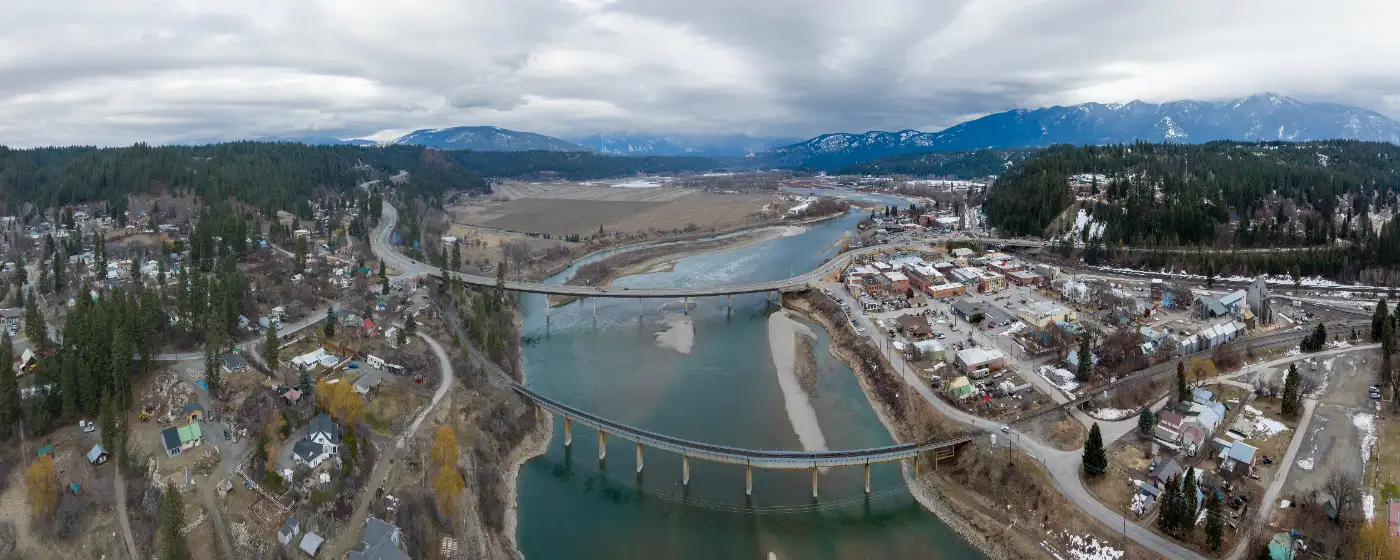
People who move to Bonners Ferry from larger cities often say the same thing around month three: they started leaving their cars unlocked without thinking twice about it. That instinct isn't recklessness — it reflects something real about daily life in a town of roughly 2,669 people tucked into the Kootenai River valley, 45 minutes north of Sandpoint and a handful of miles from the Canadian border. But "small town, so it's safe" is not the same as "look at the data, and it's safe." The numbers here are worth understanding before you decide on a neighborhood.
Bonners Ferry's city-wide crime figures — 7.1 violent crimes per 1,000 residents and 7.6 property crimes per 1,000 residents — sit above what some people expect when they picture a remote northern Idaho community. Context matters enormously. Idaho as a whole recorded the lowest property crime rate of any U.S. state in 2024, at 7.36 offenses per 1,000 residents, and its violent crime rate ran roughly 35.8% below the national average. Bonners Ferry's property crime rate of 7.6 per 1,000 is less than half the national figure of 17.60 per 1,000. These benchmarks are the frame you need.
The trend line is also pointing the right direction. The 2024 crime rate in Bonners Ferry dropped roughly 10% compared to 2023, continuing a multi-year decline. Boundary County — which surrounds the city — recorded only 183 total offenses in 2023, a 13.27% decrease year over year, placing it among the lower-crime counties in northern Idaho. A small-city crime figure can be skewed dramatically by a handful of incidents in a single year; knowing the direction of travel matters as much as the snapshot.
The sections below walk through how Bonners Ferry's numbers compare to state and national benchmarks, what types of crime actually occur here, how the police department is staffed, which areas of town carry different risk profiles, and what practical steps to take before you settle on a specific neighborhood.

Bonners Ferry Crime Rates vs. State and National Benchmarks
The headline figures are 7.1 violent crimes per 1,000 residents and 7.6 property crimes per 1,000 residents. Before those numbers alarm you, put them on a chart next to the national numbers.
| Geography | Violent Crime (per 1,000) | Property Crime (per 1,000) | Trend (Most Recent Year) |
|---|---|---|---|
| Bonners Ferry | 7.1 | 7.6 | ↓ ~10% (2024 vs. 2023) |
| Idaho (statewide) | ~2.3 (est.) | 7.36 | ↓ 8.7% (2024 vs. 2023) |
| United States | 3.59 | 17.60 | ↓ ~3% (2023 vs. 2022) |
| Boundary County | — | — | ↓ 13.27% total (2023) |
* U.S. figures: USAFacts / FBI 2024 data. Idaho statewide: Idaho State Police ISAC dashboard (July 2025). Bonners Ferry: City Fact Sheet, July 2026.
Bonners Ferry's property crime rate of 7.6 per 1,000 is well below the national 17.60 — less than half, in fact. The violent crime figure of 7.1 per 1,000 does run above Idaho's statewide average, which reflects a known dynamic: small-population cities can see their per-1,000 rates swing noticeably when even a few incidents are added or removed. In a city of 2,669 people, five additional reported incidents move the rate by nearly two full points.
Idaho itself is operating from a historically strong safety baseline. The Idaho State Police reported that the state's total offense rate fell to 49.6 per 1,000 residents in 2024 — the lowest recorded in 20 years of tracked data. Bonners Ferry is part of that broader improvement, not an outlier fighting against it.
The state also holds the distinction of recording the lowest robbery rate in the country in 2023, at 9.5 robberies per 100,000 residents. That statewide context matters when you're evaluating what the crime numbers in Bonners Ferry actually mean for your daily life.
What Crime Actually Looks Like in Bonners Ferry
Raw rates tell you how often something happens relative to population. They don't tell you what that something is. In Bonners Ferry, the composition of crime matters a great deal.
Property Crime: Mostly Larceny-Theft
Larceny and theft dominate the property crime picture here. Of 27 property crime reports logged in 2024, 21 were larceny/theft — things like items taken from unlocked vehicles, tools left out on a job site, or merchandise shoplifted from Main Street businesses. That's not trivial, but it's categorically different from burglary or vehicle theft, which registered far fewer incidents.
The practical upshot: don't leave valuables visible in your truck cab on Main Street overnight, and lock your garage. Those habits eliminate most of your realistic exposure to property crime in this town.
Violent Crime: Small Numbers, High Clearance
Law enforcement cleared approximately 80% of violent crimes reported in 2024 — a clearance rate substantially above the national average. A high clearance rate in a small city is partly a function of the tight community: people know each other, witnesses come forward, and there are fewer anonymous urban environments for offenders to disappear into.
Most violent incidents here are domestically or socially connected — disputes among people who already know each other — rather than stranger-danger scenarios. That distinction matters enormously for how you calibrate your daily sense of safety as a newcomer.
The Small-Population Caveat
This is worth saying plainly: in a city of under 3,000 people, a single violent incident in a given year moves the per-1,000 rate by 0.37 points. A year with five additional incidents looks dramatically different on paper from a year with none. The trend — consistently downward over multiple years — is more reliable than any single year's snapshot rate.

Police Coverage and Emergency Response in Bonners Ferry
The Bonners Ferry Police Department has operated continuously since 1899, which makes it one of the older law enforcement agencies in northern Idaho. Eight full-time sworn officers serve the city's roughly 2,669 residents — a ratio of approximately one officer per 334 residents.
For context, the national median for municipal police staffing typically runs around one officer per 400–500 residents in similarly sized cities, so Bonners Ferry is relatively well-covered for its size. Officers maintain 24-hour, 365-day coverage, and the department works alongside the Boundary County Sheriff's Office for county-wide incidents.
How the Department Operates Day-to-Day
The records office sits at 7232 Main Street, which puts it in the middle of the commercial corridor rather than tucked away at the city's edge. That central location is intentional — it keeps officers visible and accessible along the street where most commercial activity happens.
The department runs a Crime Stoppers tip line, which is the primary community tool for reporting suspicious activity anonymously. In a small community where residents are sometimes hesitant to report neighbors directly, the tip line serves a real function — and is part of why the violent crime clearance rate here is notably higher than the national average.
What Six Months Here Teaches You
New residents who arrive expecting the kind of police-response times common in suburbs of Boise or Coeur d'Alene sometimes need to recalibrate. With eight officers covering a 24-hour rotation, any given shift may have one or two officers on duty for the entire city. In practice, most locals say response to a call on Main Street is quick; response to an address out toward Paradise Valley or the rural edges of the Kootenai River Valley can take longer.
That is not a criticism — it's the mathematical reality of rural Idaho policing, and it's consistent with most small northern Idaho communities. Knowing it helps you think clearly about what neighborhood proximity to the city core actually means for safety response.
Looking to buy in Bonners Ferry? Estimate your payment.
Enter your numbers to see an estimated monthly mortgage payment.
Estimate only. Excludes HOA fees and mortgage insurance. The interest rate above is a starting point, not a quoted rate — replace it with your own to see real numbers. Insurance is a flat placeholder, not a Bonners Ferry quote.
Neighborhood Safety Differences Worth Knowing
Bonners Ferry is small enough that no neighborhood is dramatically more dangerous than another in absolute terms. But the character differences between areas translate into meaningfully different everyday safety experiences. For the full neighborhood-by-neighborhood breakdown, see the Bonners Ferry neighborhoods guide.
Downtown Historic District and Main Street Corridor
These two areas carry the most commercial foot traffic and, correspondingly, the highest concentration of larceny incidents in the city. Vehicles parked overnight near Main Street businesses see the bulk of the petty theft reports. The evening scene around Mugsy's Tavern & Grill and the Main Street corridor is generally calm, but this is where you want the locked-car habit.
The flip side: these blocks have the highest police visibility in the city, with officers passing through regularly during all shifts. Opportunistic crime that requires time tends to gravitate away from well-lit, frequently patrolled commercial blocks.
South Hill and North Bench
These residential areas sit above the valley floor and tend to attract families with school-age children and longer-term residents. The quieter streets and lower commercial density translate into fewer property crime reports. This is where the "leaving the car unlocked" instinct most consistently holds up in practice.
Riverside and Kootenai River Valley
The areas closest to the Kootenai River and stretching into the broader valley are more dispersed, with properties farther apart and longer distances to the city core. The distance from the commercial center means fewer larceny incidents but also longer police response windows. For residents whose safety concern is less about theft and more about emergency response, this is the trade-off to weigh.
Paradise Valley
The rural character of Paradise Valley means you're effectively operating more on Boundary County Sheriff coverage than on city police coverage. Neighbors tend to watch out for each other at this distance from town — but self-reliance is a real part of the safety calculus out here.
| Area | Primary Safety Character | Main Risk Type | Best For |
|---|---|---|---|
| Downtown Historic District | High visibility, commercial activity | Larceny/vehicle contents | Walkable |
| Main Street Corridor | Police presence, active foot traffic | Petty theft, overnight vehicle | Commuter |
| South Hill | Quiet residential, stable neighbors | Minimal reported incidents | Families Quiet |
| North Bench | Established residential, low turnover | Minimal reported incidents | Families School |
| Riverside | Lower density, river proximity | Longer response times | Nature Privacy |
| Kootenai River Valley | Rural, dispersed | Longer response times | Nature Privacy |
| Paradise Valley | Very rural, self-reliant | County response, not city | Privacy Views |
Practical Safety Research Before You Choose a Neighborhood
The numbers give you a frame. On-the-ground research gives you the detail that numbers can't.
Talk to People at the Places Locals Actually Gather
In Bonners Ferry, the honest local knowledge lives in conversations — at Mi Pueblo on Main Street over lunch, at the counter of a hardware store, or at events near the Kootenai National Wildlife Refuge parking area on a weekend morning. Ask directly: which blocks do residents avoid after dark? Where have neighbors had issues with vehicle break-ins? The answers you get will be more current than any crime map.
Check the Crime Stoppers Line and the Police Blotter
The Bonners Ferry Police Department at 7232 Main Street makes incident data accessible, and the Bonners Ferry Herald has historically published a police blotter. Spending 20 minutes reading three months of blotter reports tells you more about the real texture of crime here than a single annual rate figure.
Drive Your Candidate Street at Night
This sounds obvious and people skip it constantly. The difference between South Hill after dark and a block adjacent to the Main Street corridor late on a weekend is noticeable. Lighting, parking density, and foot traffic patterns shift the actual risk environment in ways that no map captures.
Understand the Response-Time Reality Before You Commit
If you're considering a property in Riverside or out toward Paradise Valley, call the non-emergency line at the Police Department and ask what typical response times look like for that address. The staff will give you an honest answer. Knowing that figure before you decide on a location is the kind of research that prevents the most common safety surprise people report after six months here: realizing that rural really does mean rural, including for emergency services.
The Honest Reason Some People Leave
The residents most likely to leave Bonners Ferry citing safety concerns are typically not reacting to crime — they're reacting to the combination of geographic isolation and the sense that if something serious happened, help is far away. That feeling is strongest for people in the valley's more dispersed areas, particularly in winter when Highway 95 conditions can delay everything. If that kind of isolation concerns you, it's worth naming it honestly before you settle on a neighborhood that sits far from the Main Street core.

Local Expert Takeaway: Bonners Ferry's property crime rate sits well below the national average — less than half, by the numbers — and the violent crime trend has been moving downward for several consecutive years. The realistic daily-life risk here is leaving something visible in an unlocked vehicle on Main Street, not the kind of random violent crime that drives people away from cities. Eight sworn officers maintain around-the-clock coverage, and the violent crime clearance rate of roughly 80% reflects a tight community where incidents don't go unresolved. The practical advice locals give newcomers: lock your vehicle and your outbuildings, introduce yourself to your neighbors within the first month, and if you're looking at a property more than ten minutes from the city core, call the Police Department and ask about realistic response times for that specific address.
Quick Takeaways & FAQs
✅ Bonners Ferry's property crime rate of 7.6 per 1,000 residents is less than half the 2024 U.S. national rate of 17.60 per 1,000 — a genuinely favorable comparison.
⚠️ The violent crime rate of 7.1 per 1,000 runs above Idaho's already-low statewide average, and in a city of under 3,000 people, a handful of incidents can meaningfully shift that figure year to year.
📍 Law enforcement cleared roughly 80% of violent crimes reported in 2024, and the Police Department at 7232 Main Street operates a Crime Stoppers tip line you can use to check recent local incident patterns before settling on a specific neighborhood.
Is Bonners Ferry, Idaho a safe place to live?
What is the most common type of crime in Bonners Ferry?
How does Bonners Ferry's crime rate compare to the rest of Idaho?
Which neighborhoods in Bonners Ferry are considered safest?
How many police officers does Bonners Ferry have?
Moving to Idaho?
Tell us what you need help with and we'll connect you with local resources.
