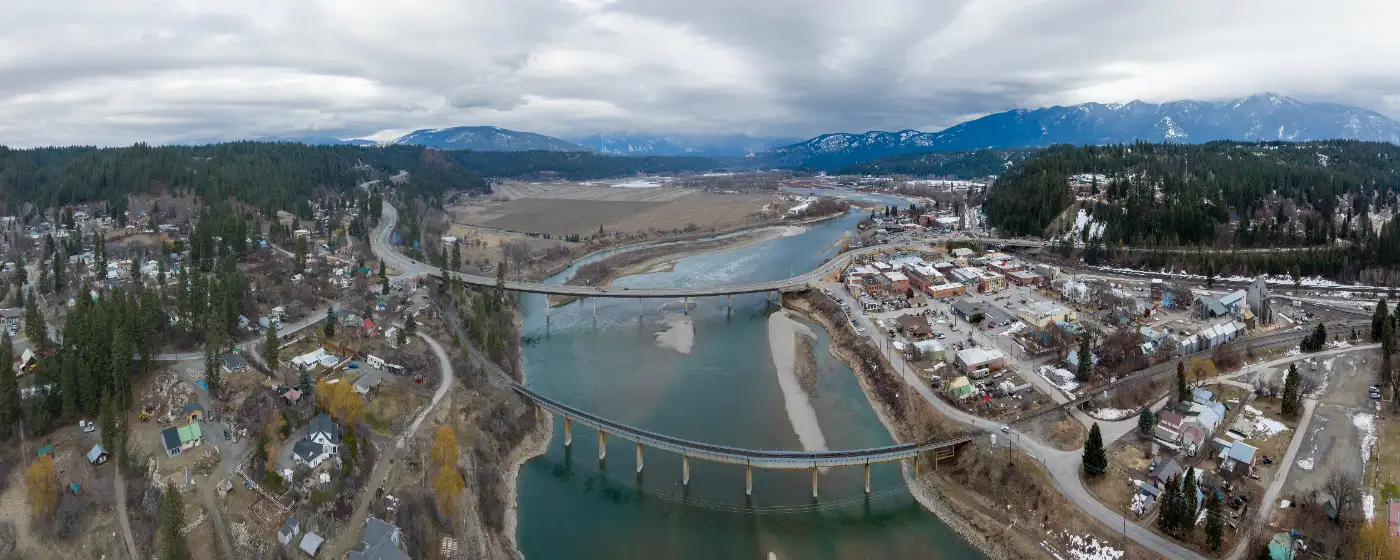
If you've been researching North Idaho and stumbled onto Bonners Ferry, the first thing that surprises most people is how small the price tag looks compared to Coeur d'Alene or even Sandpoint. That surprise is real — but it comes with a context that matters. Bonners Ferry sits at the northern tip of the Idaho Panhandle, about 30 miles south of the Canadian border, connected to the rest of civilization almost entirely by US-95. That geography shapes the cost calculus in ways a simple home-price comparison won't capture: you will own a car, you will drive, and the distance from major retail means some costs that urban dwellers barely notice — fuel, the occasional long errand run — add up over a year.
The economic backbone of Boundary County runs on timber, tribal gaming, and public employment. Alta Forest Products anchors the wood-products sector, and the Kootenai Tribe of Idaho operates gaming and hospitality operations that are among the largest local employers. The median household income sits at approximately $52,500 — below Idaho's statewide median — which means the local housing market, while modest by Boise or Coeur d'Alene standards, still requires careful budgeting for most residents.
On the positive side of the ledger, Bonners Ferry delivers genuine cost advantages that compound over time. The city runs its own municipal utility — electricity, water, sewer, and garbage — as a nonprofit enterprise, which keeps utility bills meaningfully below regional averages. Gas prices in this corridor have tracked noticeably below the national average. And Idaho's property-tax structure, already lean statewide, is even more favorable in Boundary County. Groceries run slightly below the national average. Taken together, the non-housing costs of daily life here are genuinely lower than in most comparable small cities.
Whether you're budgeting for a first purchase, weighing a rental while you get your bearings, or comparing Bonners Ferry against Sandpoint or other North Idaho options, the sections below break down housing prices, rent ranges, utilities, groceries, taxes, and a real monthly budget estimate — everything you need to decide whether this city fits your numbers.

What It Really Costs to Live in Bonners Ferry
The honest posture is this: Bonners Ferry is genuinely affordable by Pacific Northwest standards, but it is not cheap in the way some buyers expect when they hear "small town in rural Idaho." The median sale price as of July 2026 sits at $360,000, which puts it noticeably below Sandpoint and far below Coeur d'Alene — but still out of reach without meaningful savings or solid income at the $52,500 median household income this community earns.
What drives that number is a combination of limited inventory and sustained in-migration pressure. Bonners Ferry has roughly 2,669 residents, a small construction pipeline, and a steady stream of buyers arriving from western Washington, Oregon, and the California coast who find $360,000 looks like a bargain compared to where they left. That demand has pushed prices off historic lows without pushing them into Sandpoint territory — at least not yet.
Beyond housing, the day-to-day cost profile is legitimately favorable. The city's nonprofit municipal utility keeps electricity bills well below state and national averages. Natural gas runs roughly half the national rate. Groceries come in slightly below the national benchmark. The catch is that no public transit exists, the nearest big-box retail is a drive, and fuel costs are a fixed, unavoidable line item every month. Factor those in honestly and the overall cost of living lands moderately below the national average — better than most cities its size, but not the bargain-basement figure some transplants imagine.
Housing: Rent vs Buy in Bonners Ferry
Buying is the dominant tenure here — rentals are sparse, and the supply problem is more acute on the rental side than on the ownership side. The rental market is thin enough that availability at any given time is limited, and prospective renters should budget conservatively and expect fewer options than in larger nearby cities.
On the ownership side, entry-level homes — older construction, smaller footprints, typically in need of some updating — start in the low-to-mid $200,000s. The city-wide median sale price of $360,000 (Homes.com, July 2026) represents a reasonably move-in-ready single-family home on a standard lot. Newer construction or homes with river or mountain views push well past the median. There is no reliable local upper tier the way Sandpoint has its lakefront premium — Bonners Ferry's top end is more about acreage and riverfront access than luxury amenity packages.
The effective property-tax rate in Boundary County is approximately 0.32% — less than half the national median rate and meaningfully below Idaho's already-low statewide average. That is among the lowest carrying-cost rates for homeowners in the Pacific Northwest region. For a mortgage payment estimate based on current rates and your down payment, use the calculator below — it will give you a more accurate monthly figure than any static number here.
Renting makes sense if you are arriving without certainty about staying. But the thin rental market means you may face limited choices and a landlord pool that skews toward small individual owners rather than professional management companies. Buying sooner rather than later has made financial sense for most people who planned to stay — the catch is finding something listed when you're ready to move.
Best for: Buyers who can put 10–20% down on a $300,000–$400,000 purchase and want low ongoing property-tax costs. Renters should expect a tighter-than-average market with limited inventory.

Everyday Costs Beyond Housing in Bonners Ferry
The municipal utility is the headline advantage. The City of Bonners Ferry has operated its own electric utility since 1921, running it as a nonprofit on 100% renewable generation. The average monthly residential electric bill runs approximately $92.91 — about 19% below Idaho's average and dramatically below what most transplants paid in western Washington or Oregon. Water, sewer, and garbage are bundled through the same city system with the same cost-containment philosophy. Natural gas in this area averaged roughly $7.24 per thousand cubic feet in late 2025, about half the national rate — meaningful savings for a high-heating-load climate like northern Idaho winters.
Groceries run approximately 2% below the national average in Idaho broadly, and Bonners Ferry's options are limited to a handful of local and regional stores — no Trader Joe's or Whole Foods within reach; Sandpoint is the nearest city with a wider grocery selection. Gas has tracked noticeably below the national average in this corridor; the AAA-reported regional price near Sandpoint was approximately $2.51 per gallon in January 2026, well below the projected national average for the year.
| Category | Typical Monthly Cost | Notes |
|---|---|---|
| Housing (owned, median) | Use calculator below | Median sold price $360,000; entry-level from low-to-mid $200,000s; use mortgage calculator for payment estimate |
| Electricity | ~$93 | City municipal utility; approximately 19% below Idaho average |
| Natural Gas, Water, Sewer & Garbage | $80–$140 | Bundled through city utility; gas rates roughly half the national average |
| Groceries | $400–$650 | Single adult to small family; Idaho runs ~2% below national average; limited local selection |
| Transportation & Gas | $150–$280 | Personal vehicle required; regional gas prices below national average; factor Sandpoint runs |
| Phone & Internet | $100–$175 | Rural broadband options are more limited than in Sandpoint; plan ahead |
| Misc / Discretionary | $150–$300 | Independent dining on Main Street; outdoor recreation gear and travel |
These are estimates for planning purposes. Your actual totals will vary based on household size, lifestyle, and whether you heat primarily with gas or electricity.
Looking to buy in Bonners Ferry? Estimate your payment.
Enter your numbers to see an estimated monthly mortgage payment.
Estimate only. Excludes HOA fees and mortgage insurance. The interest rate above is a starting point, not a quoted rate — replace it with your own to see real numbers. Insurance is a flat placeholder, not a Bonners Ferry quote.
Bonners Ferry vs Nearby Cities: Cost Comparison
| City | Median Home Price | Typical 2BR Rent | Cost vs Bonners Ferry |
|---|---|---|---|
| Bonners Ferry | $360,000 (July 2026) | Thin market; limited options | — Baseline — |
| Naples | Estimated somewhat below Bonners Ferry | Very limited supply | Somewhat cheaper; fewer services and amenities |
| Moyie Springs | Estimated slightly below Bonners Ferry | Minimal rental market | Slightly cheaper; rural setting, minimal infrastructure |
| Sandpoint | Noticeably higher — roughly double | Proportionally higher | Significantly higher across the board |
| Eastport | Very limited market | Effectively no rentals | Sparse data; border-town context, not a true comp |
| Porthill | Very limited market | Effectively no rentals | Sparse data; rural agricultural area at the border |
The Sandpoint comparison is the one most buyers actually face: you get meaningfully more purchasing power in Bonners Ferry, but you trade away Sandpoint's lake access, dining depth, and faster growth trajectory. Naples and Moyie Springs offer slightly lower price points but with even less infrastructure and service access than Bonners Ferry itself.
Taxes & the Bottom Line for Bonners Ferry
Idaho's tax structure is one of the cleaner arguments for staying in-state rather than crossing into Washington or Oregon. The state income tax is a flat 5.3%, effective January 1, 2025 — reduced from the prior rate via HB 40 signed in March 2025. Idaho does not tax Social Security benefits, which matters for the retiree population filtering into the area. On the Tax Foundation's 2026 State Tax Competitiveness Index, Idaho ranks 9th overall — a meaningful signal that the legislature has consistently prioritized a competitive overall burden.
Sales tax sits at Idaho's statewide rate of 6.0%; Bonners Ferry adds no local sales tax on top of that, so the combined rate stays at 6.0%. Idaho does tax groceries at that rate, but the state offsets it with a food tax credit of $155 per person annually — a real reduction for households buying their own food rather than eating out. Budget shoppers who cook at home benefit more from that credit than the headline 6% rate suggests.
Property tax in Boundary County carries an effective rate of approximately 0.32% — less than half the national median of 0.89% and below Idaho's own statewide average. That rate, applied to the home-price figure discussed earlier in this guide, produces one of the lowest annual property-tax burdens you will find anywhere in the Pacific Northwest. It is a genuine, durable advantage for long-term owners.
The honest bottom line: Bonners Ferry fits households that can manage a purchase or rental at current prices, earn income in the $50,000–$80,000+ range (individually or combined), and are comfortable owning a vehicle as a non-negotiable. Remote workers arriving with coastal salaries find the tax and housing picture genuinely favorable. Local-wage earners — particularly those supporting a family on median household income — will feel the housing-to-income ratio more acutely and may find the monthly math tighter than the headline home price implies. The squeeze, when it comes, is almost always in the gap between what homes cost and what local jobs pay.

Local Expert Takeaway: Bonners Ferry's municipal utility is the under-discussed cost advantage that surprises most newcomers six months in. An average electric bill under $93 per month — on 100% renewable power, run as a nonprofit — is not something you find in most Idaho cities, let alone in Washington or Oregon. Pair that with a 0.32% property-tax rate and gas prices tracking well below the national average, and the non-housing costs here are genuinely lean. The place to watch your budget is the gap between local wages and current home prices, and the unavoidable cost of being a long drive from everything Sandpoint offers.
Quick Takeaways & FAQs
✅ The City of Bonners Ferry's nonprofit municipal electric utility produces average monthly bills around $93 — roughly 19% below the Idaho average — making ongoing ownership costs among the lowest in the Pacific Northwest.
⚠️ With a median sale price of $360,000 and a median household income of $52,500, the housing-to-income ratio is tighter than the raw price suggests — especially for buyers relying on local wages rather than remote income.
📍 There is no public transit in Bonners Ferry; every household needs a car, and Sandpoint — 45 minutes south on US-95 — is the closest city for broader retail and most dining beyond what Main Street offers.
What is the median home price in Bonners Ferry, Idaho?
How tight is the rental market in Bonners Ferry?
How do Bonners Ferry's utility costs compare to the rest of Idaho?
What is the property tax rate in Bonners Ferry?
Is Bonners Ferry cheaper to live in than Sandpoint?
Moving to Idaho?
Tell us what you need help with and we'll connect you with local resources.
