
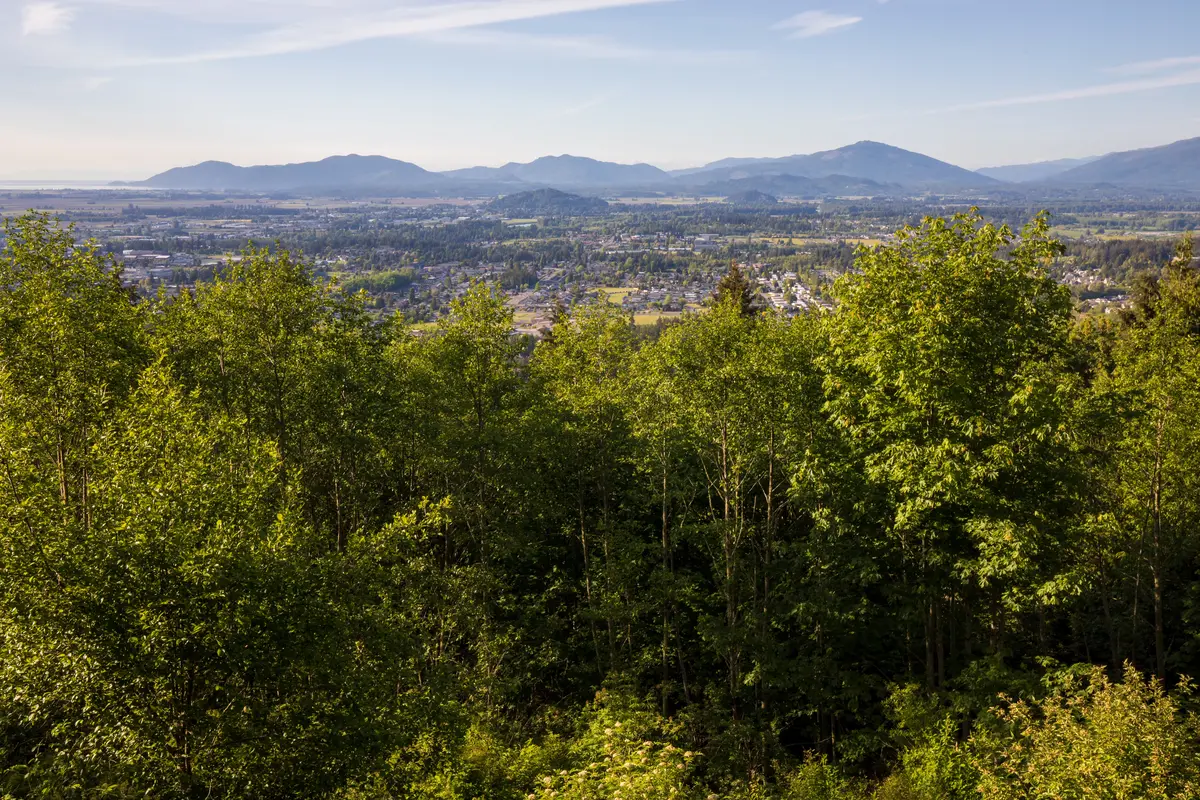
Maybe you've been priced out of Bellingham and someone mentioned Mount Vernon. Maybe your employer is pulling you toward the Skagit Valley and you've done exactly one drive-through of I-5. Either way, the first thing to understand about this city is that it sits at a genuine geographic crossroads — 60 miles north of Seattle, 51 miles south of the Canadian border — and its neighborhoods reflect that tension between agricultural valley floor, hillside suburbia, and a walkable historic core that most people don't expect to find. The Skagit River bends right through the city's western edge, and the hills that rise on the eastern side of I-5 shape almost every conversation about where to buy.
The city's typical home value sits at $590,838 (Zillow Home Value Index, April 2026), and homes are moving fast — going to pending in around 13 days on average. That pace matters because Mount Vernon is no longer a sleepy county seat that people settle for. The PACCAR Technical Center, a major regional medical employer anchoring the Hillcrest corridor, and Skagit Valley College all generate stable, professional-class demand. The Mount Vernon School District serves the city, and understanding its school boundaries before you buy is one of the most consequential decisions you'll make here.
Day-to-day life in Mount Vernon is genuinely distinct from its neighbors. April transforms the entire county — the Skagit Valley Tulip Festival draws more than one million visitors across Skagit County, and the Street Fair fills historic downtown First Street with 140-plus artisan vendors, live music, and food trucks. The rest of the year, that same downtown — where independent restaurants and a brewpub on S 3rd St anchor a directory of more than 20 food and drink spots — belongs to locals. The Riverwalk trail along the Skagit gives the city an outdoor asset most comparably sized Washington cities lack entirely.
Whether you're narrowing a shortlist or just starting to research, the sections below break down Mount Vernon's eight distinct neighborhoods by price, character, buyer type, and the honest trade-offs that don't show up on listing photos — plus a rental zone guide and the specific mistakes that trip up buyers who don't know the city yet.

The Mount Vernon Reality
One divide shapes almost every real-estate decision in Mount Vernon: the I-5 corridor. The freeway doesn't just cut through the city — it separates two fundamentally different experiences of living here. The valley floor on the western side sits close to downtown, the Skagit River, and the tulip fields. The land on the eastern side of I-5 rises sharply into the foothills, and neighborhoods like Fir Hill, Eaglemont, and Waugh Hill sit above the noise and the flood-plain risk, offering views and relative quiet at the cost of needing a car for almost everything.
The second thing that shapes your decision is LaVenture Road. This north-south corridor connects the hillside neighborhoods to the medical district and the I-5 interchange, and it is effectively Mount Vernon's daily-commute spine. Neighborhoods that feed onto LaVenture quickly — Hillcrest-Medical District, Seneca Highlands, Fir Hill — have a meaningfully different commute experience than those that don't. During the April Tulip Festival, every route that touches the valley floor or First Street will slow considerably; residents of the eastern hills often leave early or wait it out entirely.
School boundary lines add a third layer of complexity that buyers frequently underestimate. The Mount Vernon School District's attendance zones do not follow neighborhood names cleanly, and an address on one side of a particular street can mean a different elementary school than the house next door. If a specific school matters to your family, verify the boundary before you make an offer — not after.
Neighborhoods at a Glance
| Neighborhood | Best For | Price Range | Vibe |
|---|---|---|---|
| Fir Hill | Families Views | $620,000–$780,000 | Established hillside suburb with Cascade and valley views |
| Hillcrest-Medical District | Commuter Families | $540,000–$700,000 | Workhorse neighborhood anchored by healthcare employment |
| Seneca Highlands | Luxury Views | $750,000–$1,100,000 | Newer custom homes on large lots with panoramic views |
| Waugh Hill | Privacy Nature | $560,000–$720,000 | Quieter foothills feel, larger parcels, fewer amenities nearby |
| Eaglemont | Luxury Quiet | $680,000–$950,000 | Golf-course-adjacent community navigating an uncertain amenity future |
| Digby Heights | First-Time Value | $480,000–$610,000 | Modest, established grid with genuine entry-level inventory |
| Centerpoint | Walkable Transit | $490,000–$650,000 | Close-in, urban-adjacent, best on-foot access in the city |
| South Mount Vernon | Renter Value | $430,000–$560,000 | Most affordable ownership prices, higher renter density |
Best Neighborhood by Buyer Type
| Buyer Type | Best Neighborhood | Why |
|---|---|---|
| First-Time Buyer | Digby Heights | The most realistic entry-level price band in the city keeps your initial mortgage manageable while you build equity. |
| Luxury Buyer | Seneca Highlands | Newer construction on oversized lots with Cascade Mountain views commands the city's top price tier and delivers it. |
| Walkability Seeker | Centerpoint | You can walk to the Historic Lincoln Theatre, First Street restaurants, and the Skagit Riverwalk without touching your car. |
| Families with Kids | Fir Hill | Established neighborhood layout, proximity to schools, and safe residential streets make it the consistent family favorite. |
| Commuter | Hillcrest-Medical District | Direct LaVenture Road access to I-5 cuts meaningful time off a Seattle or Bellingham commute versus hillside alternatives. |
| Large-Lot Buyer | Waugh Hill | Parcel sizes stretch considerably larger here than the city average, giving genuine separation between neighbors. |
| Renter | South Mount Vernon | The highest concentration of rental inventory in the city means more options and more negotiating room on price. |
Looking to buy in Mount Vernon? Estimate your payment.
Enter your numbers to see an estimated monthly mortgage payment.
Estimate only. Excludes HOA fees and mortgage insurance. The interest rate above is a starting point, not a quoted rate — replace it with your own to see real numbers. Insurance is a flat placeholder, not a Mount Vernon quote.
Most Popular Neighborhoods
1. Fir Hill
Fir Hill is the neighborhood that most buyers from outside the area end up in after their second visit. Perched on the eastern hillside above the LaVenture corridor, it offers Cascade and valley views from established subdivisions built through the 1980s and 1990s, with mature trees lining streets that feel genuinely residential rather than transitional. The catch is that everything — groceries, school drop-off, downtown coffee — requires a drive, and the hill itself means icy mornings in January and February are a real logistical consideration. Prices in the $620,000–$780,000 range reflect the premium for those views and the neighborhood's consistent demand.
Best for: Families with school-age children, buyers who want established surroundings and Cascade views, and anyone willing to trade on-foot access for residential calm.
2. Hillcrest-Medical District
The practical backbone of Mount Vernon's housing market, Hillcrest sits along the N. LaVenture Road corridor that connects directly to I-5 — making it the city's most commuter-efficient neighborhood. A major regional medical campus anchors this area and continues to expand, and that concentration of healthcare employment means the neighborhood draws a disproportionate share of relocating professionals in that field. The trade-off is that you're buying utility over character: the streetscape is functional rather than atmospheric, and the LaVenture corridor itself carries meaningful through-traffic. Expect $540,000–$700,000 for a solid single-family home.
Best for: Commuters, healthcare workers, and families who prioritize I-5 access over neighborhood aesthetics.
3. Seneca Highlands
This is Mount Vernon's top tier — newer custom and semi-custom homes on larger lots, higher on the eastern ridge than Fir Hill, with views that can take in both the Cascades to the east and the agricultural valley floor to the west on a clear day. Inventory is thin and competition is real; when a well-built home comes to market here, it rarely sits past the first weekend. The honest downside is isolation: Seneca Highlands residents are among the most car-dependent in the city, and the winding road access that makes it feel private also makes it feel far during Tulip Festival weekend gridlock. Prices run $750,000–$1,100,000 depending on lot size, construction age, and view quality.
Best for: Move-up buyers seeking the city's most premium addresses, custom-build candidates, and households with flexible remote-work schedules.
4. Waugh Hill
Waugh Hill doesn't get talked about as much as its hillside neighbors, which is partly the point — it draws buyers who specifically want distance from the city's denser activity without paying Seneca Highlands prices. Lots run large, the pace is quiet, and the surrounding foothills give it a genuinely rural-adjacent feel despite being inside city limits. What you give up is proximity to anything: the nearest coffee shop, the school run, a quick errand all involve the same drive, and if LaVenture backs up on a Tuesday afternoon, you feel it. Homes typically land in the $560,000–$720,000 range.
Best for: Buyers who want large parcels, privacy, and a foothills atmosphere without leaving the city boundary.
5. Eaglemont
Eaglemont was built around a golf course identity, and that identity is currently in limbo. The 18-hole championship course has been closed for more than five years; it was purchased at auction in 2024 for $2.9 million, and community advocates are actively pushing for its restoration, but no timeline exists. The homes themselves — many of them larger executive-style properties with course-facing lots — remain occupied and appealing, but buyers should go in with eyes open: the open green space you're looking at may or may not return as a playable amenity. Prices in the $680,000–$950,000 range price in the neighborhood's bones while the course question remains unresolved.
Best for: Buyers who value the neighborhood's layout and lot quality and can accept the golf course uncertainty, or who believe the course restoration effort will succeed.
6. Digby Heights
Digby Heights is where Mount Vernon's real entry-level market lives. The grid is older and the homes are more modest — postwar and early-subdivision stock rather than the newer construction you find on the eastern hills — but the $480,000–$610,000 price band is genuinely achievable for first-time buyers in a city where the citywide typical home value is nearly $591,000. The neighborhood is flat, which helps on-foot access to nearby amenities, and it sits close enough to the South Side commercial strip to handle most weekly errands without a freeway crossing. The honest note: lot sizes are smaller, neighbor proximity is real, and the housing stock requires more maintenance attention than newer alternatives.
Best for: First-time buyers, investors seeking rental-viable single-family homes, and anyone prioritizing entry price over finishes.
7. Centerpoint
Centerpoint is the closest thing Mount Vernon has to a walkable urban neighborhood, and its proximity to the Historic Lincoln Theatre, the Riverwalk, and the First Street restaurant row — where independent restaurants and a brewpub anchor a dining corridor of more than 20 independent businesses — makes it genuinely different from anywhere else in the city. The April Tulip Festival Street Fair, held a few blocks away, is a true community gathering moment; it's also the one weekend each year that Centerpoint residents learn exactly how narrow some of those downtown streets are. Homes run $490,000–$650,000, and condos and attached housing make up a higher share of inventory here than in any other area on this list.
Best for: Buyers who want on-foot access to downtown, renters considering a first purchase, and households without a daily I-5 commute.
8. South Mount Vernon
South Mount Vernon is the city's most affordable ownership zone, with single-family homes reaching as low as $430,000 and a ceiling around $560,000 for move-in-ready stock. The area has a higher concentration of rental housing than anywhere else in the city, which shapes the neighborhood's character — turnover is higher, owner-occupancy rates are lower, and the streetscape is more mixed-use than residential-only. For buyers, that means more inventory and less competition; it also means pricing in the possibility that your neighbors are renting in a place where landlord maintenance standards vary. A regional medical facility anchoring the southern end of the city represents a meaningful investment in this part of Mount Vernon.
Best for: Value-driven buyers, investors, and renters who want maximum inventory and the city's lowest ownership price floor.
Common Mistakes Buyers Make in Mount Vernon
Treating the City as Geographically Uniform
Buyers who look at a map and see a compact city often don't realize that a home on the hillside side of I-5 and a home on the valley floor can have completely different flood-risk profiles, commute patterns, and neighborhood personalities. The valley floor on the western side of the freeway carries documented flood-plain considerations near the Skagit River; the eastern hillside doesn't. Run the address through FEMA's flood map before you get attached to anything on the valley side of I-5.
Underestimating the LaVenture Bottleneck
LaVenture Road is the primary artery connecting the hillside neighborhoods to I-5, and during peak commute hours — and especially during the entire month of April — it backs up in ways that add real minutes to every trip. Buyers who fall in love with a Fir Hill or Seneca Highlands home during a Saturday showing sometimes discover in month three that the Tuesday morning run to I-5 is a different experience entirely. The commute reality is worth understanding before you decide which side of the hill to buy on.
Chasing Square Footage Over School Boundary
South Mount Vernon and Digby Heights offer meaningfully more house per dollar than the eastern hillside neighborhoods. For buyers without kids, that math is straightforward. For families with school-age children, the school attendance zone attached to a specific address can matter as much as the house itself — and those boundaries don't follow neighborhood names cleanly. A $30,000 savings on the purchase price can look different once you factor in a boundary assignment that doesn't match your expectations.
Buying in Eaglemont Without Researching the Golf Course
Eaglemont homes are priced partly on the assumption of a certain neighborhood character — large lots, open green views, a peaceful aesthetic. Some of those lots directly face the fairways of a course that has been closed and unmaintained for more than five years. Buyers who see the open land and assume an active golf amenity are making an error. The course's future is genuinely unresolved, and a buyer who needs that green space to stay green should treat it as a risk, not a given.
Best Areas to Rent in Mount Vernon
| Area | Ideal For | Typical Rent Range | Trade-off |
|---|---|---|---|
| Centerpoint / Downtown | Young professionals, no-car households | $1,400–$1,900/mo (1–2BR) | Limited parking; April festival foot traffic disrupts routine |
| South Mount Vernon | Budget-conscious renters, large households | $1,200–$1,650/mo (2–3BR) | Higher turnover; ownership density lower than hillside areas |
| Digby Heights | First-time renters, small families | $1,350–$1,750/mo (2–3BR) | Older housing stock; maintenance quality varies by landlord |
| Hillcrest-Medical District | Healthcare workers, I-5 commuters | $1,550–$2,000/mo (2–3BR) | Less neighborhood character; LaVenture corridor noise |
| Fir Hill / Waugh Hill | Families wanting space, remote workers | $1,800–$2,400/mo (3–4BR) | Car required for everything; limited rental inventory |
Mount Vernon's rental market is tightest in the Centerpoint and Hillcrest corridors, where employment anchors and downtown access create persistent demand and low vacancy. Renters who need more than two bedrooms will find the best availability and the widest price spread in South Mount Vernon, though patience and multiple applications are typically part of the process in a city where homes go to pending in around 13 days.

Local Expert Takeaway: The single most useful thing to know before buying in Mount Vernon: pick your side of I-5 first and work backward from there. Hillside neighborhoods on the eastern side of the freeway — Fir Hill, Seneca Highlands, Eaglemont — offer views and quiet at the cost of car dependence and LaVenture Road commutes. Valley-floor and near-downtown areas like Centerpoint give you the Riverwalk, First Street dining, and genuine walkability — but the flood plain and April tulip traffic are real factors. Neither side is wrong; they're just different cities in the same zip code.
Quick Takeaways & FAQs
✅ Mount Vernon's typical home value of $590,838 (Zillow Home Value Index, April 2026) sits noticeably below comparable Washington markets closer to Seattle, giving buyers genuine purchasing power for established hillside neighborhoods with Cascade views.
⚠️ Homes go to pending in around 13 days on average — this is not a market where you can take a weekend to think it over, and buyers who need time to research school boundaries before offering often lose out.
📍 The Eaglemont Golf Course has been closed for more than five years with its future unresolved; buyers drawn to that neighborhood's open green views should treat the course's return as uncertain, not assumed.
What is the most affordable neighborhood to buy a home in Mount Vernon, WA?
Which Mount Vernon neighborhoods are best for families with school-age children?
Is Eaglemont still a good neighborhood to buy in given the golf course situation?
How bad is the Tulip Festival traffic for Mount Vernon residents in April?
What's the best Mount Vernon neighborhood for someone who wants to walk to restaurants and downtown?
Moving to Washington?
Tell us what you need help with and we'll connect you with local resources.
