
People researching Cheney often pull up a crime index, see a number that sits above their comfort level, and close the tab. That instinct deserves a second look. Cheney is a small city of roughly 12,800 people where Eastern Washington University enrolls over 12,300 students on a 325-acre campus that is literally embedded in the city limits. That structural reality shapes virtually every crime statistic you will read about this place — and ignoring it leads to a fundamentally distorted picture of what daily life here actually looks and feels like.
The city's 2024 crime index score of 227 (City-Data) came in below the U.S. city average of 235.3 on the same scale, and represented roughly a 10% improvement from 2023. Violent crime runs at 4 per 1,000 residents and property crime at 18 per 1,000, per NeighborhoodScout's analysis of 2024 FBI data. Those headline figures sit in a specific context: Washington state's property crime rate runs roughly 40% above the national average, which means beating the state benchmark — as Cheney does on property crime — is a more meaningful achievement than it might first appear.
The 2025 data introduces some honest caution. Washington's statewide sheriffs and police chiefs association's 2025 Crime in Washington report found that major offenses in Cheney ticked up 12.9% from 2024 to 2025, with burglaries climbing from 25 to 44 cases and simple assaults from 90 to 104. Cheney was the only local agency reviewed to show an increase in that period. The counterweight: Cheney also posted the highest crime clearance rate among those same agencies at 30.4% — meaning reported crimes here are resolved at a meaningfully higher rate than in Spokane (16%) or Liberty Lake (21%).
Whether you are considering a move to Cheney or simply trying to understand what the data actually means, the sections below break down the raw numbers against state and national context, map where risk concentrates within the city, explain the campus-crime dynamic that inflates the headline figures, and walk through what the residential neighborhoods away from the EWU corridor actually look and feel like day to day.
How Cheney's Crime Rates Compare to Washington State and the Nation
Reading any city's crime numbers without a benchmark is close to meaningless. For Cheney, the most important benchmark is Washington state itself — and that state context is not flattering to the state.
Washington's 2024 property crime rate ran approximately 40% above the national average, making it one of the higher-property-crime states in the country. Against that inflated baseline, Cheney's property crime rate coming in below the state average — roughly 1.48 times lower on a daily-rate basis, per AreaVibes' analysis of 2024 FBI data — is a genuinely meaningful result, not a statistical footnote.
The Numbers at a Glance
| Metric | Cheney | Washington State | U.S. Average |
|---|---|---|---|
| Violent crime (per 1,000) | 4 | ~3.3 | ~3.7 |
| Property crime (per 1,000) | 18 | ~26 (est.) | ~19 |
| City-Data crime index (2024) | 227 | — | 235.3 (city avg.) |
| Per-resident cost of crime (est.) | $467/yr | ~$611/yr | ~$464/yr |
| Crime clearance rate (2025, state report) | 30.4% | varies | — |
| Year-over-year trend (2023→2024) | ↓ ~10% | ↓ 14.1% | ↓ 8.4% |
* Sources: NeighborhoodScout (2024 FBI data), City-Data.com, AreaVibes, CrimeGrade.org, Washington state law enforcement crime report (2025).
Violent crime is the one category where Cheney runs modestly above the Washington state figure. The city's violent crime rate of approximately 371 per 100,000 compares to the state's roughly 329 per 100,000 — a gap that closely tracks the national rate and is substantially explained by the college-town structural effect described below.
CrimeGrade.org's estimate of $467 per resident per year in crime costs puts Cheney just $3 above the national average but $144 below the Washington state average. That framing captures the real story: by national standards, Cheney is close to average; by Washington state standards, it is performing better than most of the state.
The College-Town Effect: Why the EWU Campus Changes Everything
Eastern Washington University is not adjacent to Cheney — it is Cheney, at least in terms of how crime data gets counted. The 325-acre campus sits inside the city limits, and its 12,300-plus students are folded into a resident population of roughly 12,800. That math produces a denominator problem: the city's crime-per-resident figures are calculated against the official resident count, not the true daytime population that includes students who live on or near campus but may not show up in census population figures.
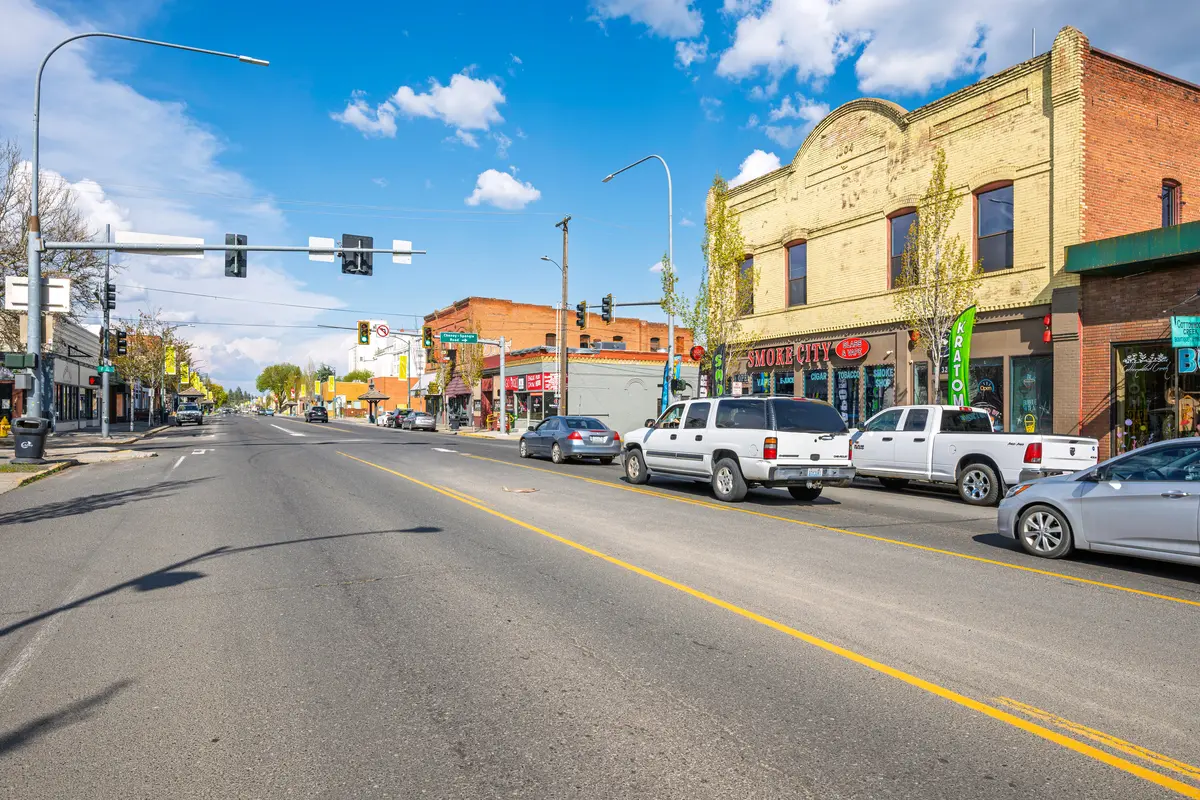
The practical effect shows up in exactly the kinds of incidents you would expect. Campus-adjacent parking lots, the First Street commercial zone, and Patterson Street account for a disproportionate share of reported property crimes — particularly vehicle break-ins and bike theft. These are the corridors where student traffic, foot activity, and opportunity intersect.
Two Separate Safety Environments
The EWU Police Department runs a 15-officer, fully commissioned department that patrols the campus 24 hours a day, 365 days a year, and coordinates patrol of university-owned or leased properties in Cheney jointly with city police. A free after-dark safety escort program is available to students, faculty, and staff by calling 509-359-7676 — a program that itself signals where after-dark risk on campus is taken seriously.
If you are not a student and not living in the campus corridor, you are largely operating in a different safety environment than what the headline figures suggest. The neighborhoods on the west side of the city — Fairway Green, Golden Hills, Amber Meadows, and the Sutton Park area — see significantly lower incident levels than the downtown and campus zones. Choosing a neighborhood away from the EWU corridor is the single most effective decision you can make if minimizing exposure to property crime is a priority. The full neighborhood breakdown covers those areas in more detail.
What surprises many people who move here from outside Washington is how calm the residential streets feel — particularly south and west of campus — compared to what the aggregated statistics imply. The data is real; the distribution of that data is what the numbers alone don't show you.

Where Crime Actually Concentrates in Cheney
Not all of Cheney's 18 property crimes per 1,000 residents fall evenly across every street. Understanding the geography of risk is the most actionable thing you can do before deciding on a specific area.
Higher-Activity Zones
The downtown core along First Street, the Patterson Street corridor running through the heart of campus, and the surface parking lots adjacent to EWU's academic buildings see the heaviest concentration of reported property incidents. Vehicle break-ins are the dominant crime type here, followed by bike theft — consistent with what you see in virtually every university-embedded city in the Pacific Northwest. Late Thursday through Saturday evenings see elevated simple assault reports, which tracks with the 2025 state crime report finding that simple assaults rose from 90 to 104 cases city-wide.
Lower-Activity Residential Areas
Neighborhoods that sit a meaningful distance from the campus footprint operate at noticeably lower risk levels. Fairway Green and Golden Hills, both on the west and southwest side of the city, have a quieter incident profile. Amber Meadows and the Sutton Park area similarly see fewer reported incidents than the campus corridor. The north-side family neighborhood near the elementary school on the north end of the city is considered among the calmer residential zones by longtime residents.
| Area | Relative Risk Level | Dominant Concern | Best For |
|---|---|---|---|
| First St / Downtown | Higher | Property crime, vehicle break-ins | Walkable |
| Patterson St / EWU Campus corridor | Higher | Bike theft, parking lot break-ins | Transit |
| EWU Campus Area | Moderate (policed 24/7) | Managed by EWU PD + city joint patrol | Renters |
| Fairway Green | Lower | Minimal reported incidents | Families Quiet |
| Golden Hills | Lower | Minimal reported incidents | Families Value |
| Amber Meadows | Lower | Minimal reported incidents | Families Quiet |
| Sutton Park area | Lower | Minimal reported incidents | Families Nature |
| North-side residential | Lower | Minimal reported incidents | Families Quiet |
If you are evaluating a specific address, the practical move is to check the Cheney Police Department's public incident reports and cross-reference it against the campus-corridor map above. A home on the outer edge of the west side that backs up to a quiet cul-de-sac will have a meaningfully different day-to-day experience than an apartment one block from Patterson Street, even if both technically fall within Cheney's city limits.
Looking to buy in Cheney? Estimate your payment.
Enter your numbers to see an estimated monthly mortgage payment.
Estimate only. Excludes HOA fees and mortgage insurance. The interest rate above is a starting point, not a quoted rate — replace it with your own to see real numbers. Insurance is a flat placeholder, not a Cheney quote.
The 2025 Uptick: What It Means and What It Doesn't
Washington's statewide law enforcement crime report for 2025 is the most recent data available, and it deserves an honest read. Cheney was the only agency among those reviewed to record an increase in major offenses — up 12.9% from 2024 to 2025. Burglaries climbed from 25 to 44. Simple assaults rose from 90 to 104.
Those are real numbers, and dismissing them would be the wrong move. But context shapes what they mean for someone deciding whether to live here.
The Clearance Rate Story
In the same report, Cheney posted the highest crime clearance rate of any agency reviewed: 30.4%. Airway Heights came in at 29.4%. The Spokane County Sheriff's Office sat at 26.7%. Liberty Lake cleared 21% of cases. The Spokane Police Department cleared 16%.
A higher clearance rate means a higher proportion of reported crimes result in an identified suspect, arrest, or other resolution. It does not undo the fact that more burglaries happened in 2025. But it does suggest that the Cheney Police Department is resolving incidents at a rate that most comparable agencies in the region are not matching — which matters both as a deterrent signal and as a measure of investigative capacity for a small-city department.
One Year Is Not a Trend
The 2024 picture showed roughly a 10% decline from 2023, tracking a state-wide reduction that outpaced the national average. One year's uptick after a decline is not evidence of a deteriorating city — it is noise in a small-population dataset where 19 additional burglaries can move the percentage meaningfully. Watch the 2026 state crime figures when they publish; if the increase continues, that is worth weighting more heavily. A single-year reversal in a city of 12,800 is worth noting but not panicking over.
The honest friction point: if you are moving here expecting to park an unlocked car in a surface lot near First Street and never think about it, you will probably be unpleasantly surprised within the first year. That behavior works in the residential neighborhoods to the west. It does not work near the commercial corridor adjacent to campus.
Practical Safety Research Before You Choose a Neighborhood
Statistics give you the macro picture. Here is how to go deeper before you settle on a specific street.
Use the Right Tools
The Cheney Police Department publishes incident reports that can be filtered by address range and incident type. Pulling six months of data for a specific block — particularly looking at burglary and vehicle prowl incidents — takes about 20 minutes and tells you far more than any city-wide average. The Washington State Patrol also maintains an online crimes database that captures incidents reported to multiple agencies in the same geographic area.
For campus-adjacent searches, the EWU Police Department publishes its own Clery Act Annual Security Report, which covers all crimes reported on or near the 325-acre campus. If you are looking at an apartment within a few blocks of the EWU main entrance, this report is worth reading alongside the city-level data.
What Locals Know That the Data Doesn't Show
The Friday-night energy near the First Street corridor is genuinely lively on EWU home-game weekends — that is part of the texture of living near a mid-size university. People who buy in the Fairway Green or Golden Hills areas specifically because they want distance from that energy often describe the contrast as larger than they expected: quiet enough on a Tuesday night that you can hear the neighbor's dog two streets over, yet active enough downtown on a Saturday that parking near the commercial strip requires patience.
The seasonal quirk newcomers consistently underestimate is move-in weekend in late August and early September, when EWU's 12,000-plus students arrive simultaneously. The First Street corridor and campus-adjacent streets see a sharp but brief spike in property crime reports during that window, primarily vehicle break-ins from moving trucks and unlocked cars. Longtime residents know to be more vigilant during that two-week period and to keep valuables out of visible sight in vehicles parked near campus.
Questions to Ask Before You Decide on an Area
- Is the property within two blocks of the EWU campus boundary or the First Street commercial zone?
- Does the property have off-street or secured parking, or does it rely on surface lots?
- What do the Cheney PD incident reports show for the specific block over the last 6 months?
- Is the neighborhood west of campus (lower historical incident rates) or east and adjacent to the downtown corridor?
None of these questions require alarm. They require the same specific research you would apply to any city — just with an understanding that Cheney's geography means the answer changes substantially depending on which side of the EWU campus footprint you land on.
Local Expert Takeaway: Cheney's crime numbers look worse on paper than they feel on the ground in the residential neighborhoods west of campus. The data is real — the 2025 state crime report uptick in burglaries is worth watching — but the campus-corridor effect concentrates most of that risk along Patterson Street, the First Street zone, and EWU parking areas. If you are settling in Fairway Green, Amber Meadows, or Golden Hills, you are in a quieter residential pocket that the headline figures simply do not reflect. Lock your car everywhere, be more deliberate near campus during EWU move-in weeks in late August, and check the Cheney PD incident map for your specific block before you commit to any address. The clearance rate — highest among all local agencies reviewed in the 2025 state crime report — tells you the department is paying attention.
Quick Takeaways & FAQs
✅ Cheney's 2024 crime index of 227 came in below the U.S. city average of 235.3, and its property crime rate falls below the Washington state average — meaningful in a state with one of the highest property crime rates in the country.
⚠️ The 2025 state crime report flagged a 12.9% uptick in major offenses, with burglaries rising from 25 to 44 — Cheney was the only local agency reviewed to record an increase that year, and the trend is worth monitoring.
📍 Crime risk in Cheney is sharply geography-dependent: Patterson Street, the First Street commercial zone, and EWU parking lots drive the headline numbers, while Fairway Green, Golden Hills, and Amber Meadows operate at significantly lower incident levels.
Is Cheney, WA a safe place to live?
How does Cheney's crime rate compare to Spokane's?
What kind of crime is most common in Cheney?
Is the EWU campus area in Cheney dangerous?
Which Cheney neighborhoods have the lowest crime?
Moving to Washington?
Tell us what you need help with and we'll connect you with local resources.
