
Maybe you've been priced out of Portland and someone mentioned the Washington side of the river. Maybe you already have family in Clark County and Battle Ground keeps coming up. Or maybe you did the math and realized that a city with no state income tax — where your Social Security check, pension, and IRA withdrawals land untouched — changes what retirement looks like on paper. What the spreadsheet doesn't show you is a small city of roughly 23,000 people that still functions at a genuine small-town pace, where the farmers market on East Main Street draws the same crowd every Saturday and neighbors actually know each other's names.
Battle Ground sits in Clark County, about 20 miles north of the Columbia River and roughly 35 minutes from downtown Portland on a good day. The city's economy is anchored by Battle Ground Public Schools, PeaceHealth (healthcare), and a mix of retail and construction employers. None of that matters much in retirement, but the infrastructure those employers support — clinics, services, and a growing commercial base along Main Street — does. The surrounding area is one of the fastest-growing in Washington State, which means new development, expanding medical services, and a steady influx of younger families who keep local businesses and community programming alive.
Cost of living is the headline draw. The Zillow Home Value Index puts the typical home at $523,756 (2026), noticeably below Vancouver to the south and well below Portland-area prices across the river. The effective property tax rate runs approximately 0.82%, among the lower figures in Southwest Washington. Combined with Washington's complete absence of a state income tax, the monthly budget math looks very different here than it does in Oregon, California, or most of the Midwest. The catch — and there is one — is that Battle Ground is car-dependent in a real way. A Walk Score of 32 means errands without a vehicle are genuinely difficult outside of a few blocks of Old Town.
Whether you're comparing Battle Ground to Vancouver, eyeing a smaller community like Ridgefield, or trying to decide if the Pacific Northwest retirement lifestyle suits you at all, the sections below walk through healthcare access, the retiree tax picture, daily budget realities, walkability and community life, downsizing options, and how Battle Ground stacks up against the region's other retirement destinations.

Why Retirees Are Choosing Battle Ground
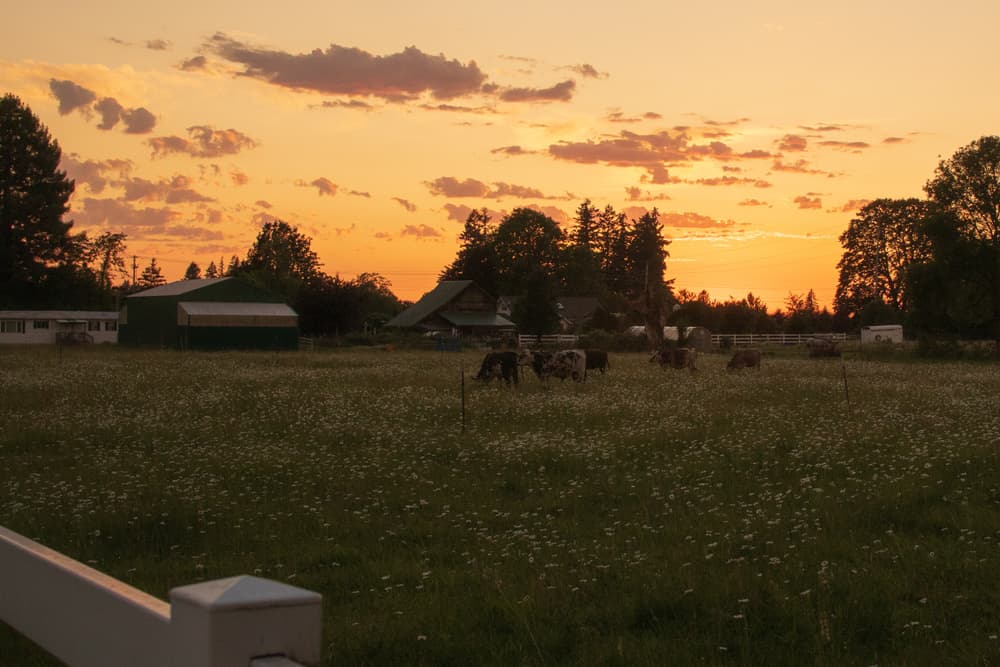
Battle Ground genuinely works for retirees who want small-town texture without complete rural isolation. The city is large enough to support a library, a community center, a farmers market, a handful of independent restaurants along East Main Street, and a brewpub — Barrel Mountain Brewing on E Main St — that doubles as a casual neighborhood gathering spot. It's small enough that you recognize faces at Kiwanis Park and that the pace of life actually slows down in a way that larger Southwest Washington cities don't deliver.
The honest appeal is the combination: Washington's zero state income tax, a home price well below the Portland metro average, and a tight-knit community character that many retirees describe as the Pacific Northwest they imagined before discovering what Vancouver's traffic actually feels like. Battle Ground Lake State Park sits within city limits, offering swimming, fishing, hiking, and camping without a long drive — an amenity that supports active retirement in a very direct way.
Who should look elsewhere? If you don't drive, or anticipate giving up driving within the next few years, the car-dependent reality here is a serious constraint. Vancouver offers far more walkable errands, more transit options, and proximity to major medical centers. Retirees who want to walk to a coffee shop, pharmacy, or grocery store without planning a trip will find downtown Battle Ground's walkable core too limited. And if specialty medical care — oncology, cardiology, neurology — is a current or likely near-term need, the distance to a full-service academic medical center deserves honest consideration before you sign a purchase agreement. The typical home price of $523,756 (Zillow Home Value Index, 2026) is accessible for many buyers but not a bargain by rural standards; see the full cost-of-living breakdown for a complete comparison.
Healthcare & Medical Access in Battle Ground
What's Available In and Near Town
PeaceHealth is the dominant healthcare presence in Battle Ground and the broader Clark County region. PeaceHealth Southwest Medical Center in Vancouver — a full-service, 450-plus-bed acute care hospital — is the anchor of the system and is reachable from Battle Ground in roughly 20 to 30 minutes depending on traffic. For most routine and urgent care needs, that's an acceptable distance. For time-sensitive emergencies, it's worth understanding before you move.
Within Battle Ground itself, PeaceHealth operates primary care and specialty clinic locations that handle a solid range of outpatient needs: family medicine, internal medicine, lab work, imaging, and several specialty referrals without requiring a trip to Vancouver. The local clinic infrastructure has expanded alongside the city's population growth, and most retirees report being able to manage ongoing chronic-condition management locally without constant trips south.
The Honest Distance-to-Advanced-Care Reality
For subspecialty depth — complex cardiac procedures, cancer treatment, neurosurgery, and transplant services — the realistic destination is PeaceHealth Southwest Medical Center in Vancouver or, for the highest-acuity cases, a major academic medical center in Portland, Oregon. That drive runs roughly 40 to 45 minutes from Battle Ground under normal conditions. That's a meaningful commute for regular treatment appointments, and it's the trade-off retirees with existing serious conditions need to weigh honestly.
Clark County's rapid growth has driven ongoing healthcare infrastructure investment, so service depth has improved and will likely continue to — but Battle Ground is not a city where you can assume tertiary care is nearby. Plan for Vancouver as your primary hospital hub and Portland for anything beyond it.
Senior-Specific Services
Clark County's senior services network — including food assistance programs, the Area Agency on Aging of SW Washington, and several community-based support programs — extends to Battle Ground residents. Local assisted living facilities, including Mallard Landing Senior Assisted Living Community (up to 85 units at 813 SE Clark Ave) and Creekside Place (up to 40 residents at 208 SW 20th Ave), provide in-city options for retirees who need or anticipate needing supported living. The area supports roughly 23 to 24 licensed senior and assisted living facilities in total, ranging from small adult family homes to those larger communities.
The Retiree Budget in Battle Ground
Washington's Zero-Income-Tax Advantage
Washington State collects no personal income tax. That means Social Security benefits, pension distributions, IRA withdrawals, and 401(k) income are all untaxed at the state level — a structural advantage that puts Battle Ground ahead of Oregon, California, Idaho, and most states retirees move from. For someone drawing $60,000 to $80,000 a year in retirement income, the difference versus Oregon's income tax can be several thousand dollars annually, every year, for the rest of your life.
Washington does impose a 7% capital-gains tax on long-term gains above a $278,000 annual standard deduction (the 2025 threshold, adjusted annually for inflation). Most retirees never encounter it: the tax explicitly exempts retirement account transactions — 401(k)s, IRAs, Roth IRAs, and defined-benefit pensions — as well as real estate sales. If your income comes from Social Security, a pension, and retirement account draws, this tax is essentially invisible to you.
Property Taxes and Senior Exemptions
The effective property tax rate in Battle Ground runs approximately 0.82%. On a home near the city's typical value, that produces a manageable annual tax bill — well below what most California and Oregon transplants are accustomed to paying as a percentage of value.
Washington also runs an income-based senior property tax exemption program that can freeze a qualifying home's assessed value for older homeowners, providing meaningful additional relief. Eligibility is income-tested and administered through the Washington Department of Revenue; if your household income falls within the program's thresholds, this exemption can meaningfully reduce your annual obligation. Worth researching before you close.
Day-to-Day Costs on a Fixed Income
Groceries, fuel, and services in Battle Ground track close to Clark County averages — neither dramatically cheaper nor more expensive than Vancouver. The city lacks a Trader Joe's or Whole Foods; the nearest options for specialty grocery shopping are in Vancouver. Fred Meyer and Walmart serve the bulk of everyday grocery and household needs in town. The cost-of-living page covers utilities and transportation costs in detail; the short version is that daily expenses here are manageable on a mid-range fixed income, with housing being the largest variable by a wide margin.
Looking to buy in Battle Ground? Estimate your payment.
Enter your numbers to see an estimated monthly mortgage payment.
Estimate only. Excludes HOA fees and mortgage insurance. The interest rate above is a starting point, not a quoted rate — replace it with your own to see real numbers. Insurance is a flat placeholder, not a Battle Ground quote.
Walkability, Community & Staying Active in Battle Ground
The Walkability Reality
A Walk Score of 32 means Battle Ground is car-dependent, and that's the honest starting point. Outside of a concentrated stretch of Old Town along East Main Street — where sidewalks connect to the library, the community center, Kiwanis Park, and a handful of restaurants and shops — most of the city requires a vehicle for errands. The terrain is gently rolling rather than punishing, but the street grid in newer subdivisions wasn't designed with pedestrian connectivity as a priority.
The picture improved meaningfully in September 2025 when C-TRAN launched The Current, a door-to-door on-demand rideshare service covering all of Battle Ground's city limits, seven days a week. It connects to Route 7 for broader regional access, including express service toward Vancouver and Portland. For retirees who are reducing rather than eliminating driving, The Current represents a real safety net — and it's the kind of service that retirement communities in the area have historically had to provide privately because public transit didn't reach here.
Where Community Actually Happens
The Battle Ground Community Center is the social hub for older adults in the city, hosting fitness classes, recreation programs, and community events throughout the year. The Saturday farmers market on East Main Street runs seasonally and functions as the town's informal gathering ritual — the kind of place where you see the same people every week and eventually start knowing their names.
Kiwanis Park and the Veterans Memorial offer a quiet spot for morning walks that many retirees build into their daily routine. Battle Ground Lake State Park — swimming, fishing, hiking, and camping within city limits — makes active retirement genuinely accessible without requiring a day trip. For retirees who want organized volunteering, Clark County's nonprofit and civic organizations extend into Battle Ground, and community programs regularly draw participants from across the city.
What Surprises People After Six Months
Many newcomers underestimate how much of social life in Battle Ground flows through outdoor activity rather than urban amenity. There's no performing arts center, no major museum, and no urban restaurant district. What there is: trails, a lake, a farmers market, a brewpub on Main Street, and the kind of neighbors who show up with tools when you're doing a project. Retirees who arrived expecting a mini-Vancouver sometimes leave. Those who arrived expecting a Pacific Northwest small town almost always stay.
Right-Sizing: Downsizing in Battle Ground
The Inventory Reality
Battle Ground's housing stock skews newer — most homes were built between the late 1990s and 2010s, with construction continuing through the 2020s. That's genuinely useful for downsizers: newer Craftsman-influenced single-family homes frequently feature main-level master suites, open floor plans, and updated mechanical systems. You're less likely to encounter the multi-story layouts and aging infrastructure that complicate downsizing in older cities.
The catch is that dedicated 55-plus or active-adult communities in Battle Ground proper are limited. The area doesn't have the density of age-restricted subdivisions you'd find in larger Southwest Washington markets. What exists is a mix of smaller single-family homes well-suited to aging-in-place and a growing assisted living sector — but the purpose-built active-adult community model is thinner here than in Vancouver or the broader Portland metro.
Senior Living Options
The city supports roughly 23 to 24 licensed senior living and assisted living facilities. At the larger end, Mallard Landing Senior Assisted Living Community (813 SE Clark Ave) offers up to 85 units; Creekside Place (208 SW 20th Ave) serves up to 40 residents. Many of these facilities explicitly advertise transportation services to Vancouver, Portland, and Camas — a tacit acknowledgment that car-dependent Battle Ground requires a mobility plan for residents who are no longer driving.
Adult family homes — small licensed residential settings, typically six residents — are scattered throughout the city's neighborhoods and represent a more intimate, lower-cost alternative to larger facilities. For retirees who want supported living without the institutional feel of a large community, these smaller homes deserve a look.
The Practical Downsizing Decision
If your priority is a newer single-level home in a quiet neighborhood with good bones and manageable maintenance, Battle Ground's inventory delivers. Neighborhoods like Quail Hollow and Parkview Trails offer exactly that kind of housing — relatively recent construction, attached garages, and proximity to the city's commercial core without being directly on a busy arterial. If your priority is a purpose-built active-adult community with a clubhouse, pool, and organized programming on-site, you'll likely find more options in Vancouver or Ridgefield than in Battle Ground itself.
Battle Ground vs Nearby Retirement Destinations
| City | Cost vs Battle Ground | Primary Hospital | Walkability | Senior Living Depth | Overall Retirement Fit |
|---|---|---|---|---|---|
| Battle Ground | Anchor | PeaceHealth clinic in-city; PeaceHealth SW Medical ~25 min (Vancouver) | Car-dependent (Walk Score 32); Old Town core walkable | Moderate — ~24 licensed facilities; limited 55+ communities | Quiet Nature Good for active, car-comfortable retirees |
| Vancouver | Pricier | PeaceHealth SW Medical Center and a second major regional hospital — full hospital access in-city | Far more walkable; transit-served neighborhoods available | Deep — large inventory of senior communities and assisted living | Walkable Transit Best for retirees prioritizing healthcare proximity and walkable errands |
| Ridgefield | About the same | No in-city hospital; relies on Vancouver (~20 min south) | Car-dependent; smaller and quieter than Battle Ground | Limited — small city, fewer dedicated senior facilities | Quiet Privacy Appeals to retirees wanting maximum small-town quiet; thinner services |
| Camas | Noticeably pricier | No in-city hospital; regional hospital access ~15 min | Walkable downtown core; hillier terrain | Moderate; growing senior living options | Views Luxury Scenic and upscale; higher entry price offsets some tax savings |
| La Center | Noticeably cheaper | No in-city services; fully dependent on Vancouver for hospital care | Very car-dependent; rural character | Very limited — small town, minimal senior infrastructure | Privacy Nature True rural retirement; works only if driving is fully reliable long-term |
| Woodland | Noticeably cheaper | PeaceHealth clinic; hospital care in Vancouver or Longview (~30 min either direction) | Car-dependent with a compact small-town downtown | Limited; smaller senior living sector than Battle Ground | Value Quiet Lowest-cost option in the comparison; trade-off is thinner services |
Vancouver wins outright on healthcare proximity and walkability — if either of those is a near-term priority, the higher price is worth examining seriously. Battle Ground beats it on small-town feel, community pace, and for many buyers, price point.
Ridgefield and Battle Ground occupy similar cost territory, but Battle Ground's larger population means more services, more senior facilities, and more community programming. For retirees who don't need the depth of Vancouver but want more infrastructure than Ridgefield offers, Battle Ground is frequently the right answer.
Camas is worth considering if budget allows — its walkable downtown, Columbia River scenery, and proximity to regional hospital care give it a strong retirement profile, but the price premium is real. La Center and Woodland work best for retirees who are confident in their long-term driving ability and genuinely want rural character over urban access.
Local Expert Takeaway: Battle Ground is the Pacific Northwest retirement choice that works when Washington's zero income tax, a newer single-level home near Kiwanis Park, and a genuinely slow-paced small-town life matter more to you than walking to a pharmacy or being three minutes from a hospital. Park yourself in Old Town for Saturday morning farmers market coffee, plan on driving to Vancouver for anything medical beyond a clinic visit, and download the C-TRAN app for The Current when you're ready to leave the car at home. The retirees who love it here aren't the ones who expected a suburb — they're the ones who expected a town.
Quick Takeaways & FAQs
✅ Washington's zero state income tax means Social Security, pensions, and IRA withdrawals are fully untaxed at the state level — a structural advantage that compounds significantly over a long retirement.
⚠️ Battle Ground's Walk Score of 32 makes it genuinely car-dependent; retirees who anticipate giving up driving in the next few years should weigh Vancouver's walkable options before committing.
📍 C-TRAN's door-to-door on-demand rideshare service, The Current, launched in September 2025 and now covers all of Battle Ground's city limits seven days a week — a real mobility option for days you'd rather not drive.
Is Social Security taxed in Washington State for retirees in Battle Ground?
What is the closest hospital to Battle Ground, WA for retirees?
Does Battle Ground have 55+ or active-adult communities?
How car-dependent is Battle Ground for a retiree who may stop driving?
How does Battle Ground's property tax rate compare for retirees on a fixed income?
Moving to Washington?
Tell us what you need help with and we'll connect you with local resources.
