
Most people researching Seguin start with one of two questions: how affordable is it compared to New Braunfels, and is it safe? The affordability question is easy — prices here run noticeably lower than in New Braunfels, Schertz, and Cibolo. The safety question deserves a more careful answer, because the headline numbers and the neighborhood-level reality don't always point in the same direction.
Seguin is a city of 41,048 people anchored by major employers like Caterpillar Inc., CMC Steel Texas, Guadalupe Regional Medical Center, and the Seguin Independent School District. It sits along I-10 and US-90 in Guadalupe County, about 40 minutes to San Antonio. The people moving here are, by and large, families and working adults priced out of the immediate San Antonio metro — and they tend to be asking the safety question before they commit to a neighborhood, which is exactly the right time to ask it.
The city-wide crime picture is genuinely reassuring by Texas standards. Seguin carries a violent crime rate of 3 per 1,000 residents and a property crime rate of 16 per 1,000 residents — both below the state and national benchmarks. But those city-wide averages span neighborhoods that feel meaningfully different from one another. The northeast side is consistently flagged as the calmest residential corridor; the central zone sees meaningfully higher incident rates. Understanding that gradient matters more than any single statistic.
This guide walks through Seguin's crime data in context, maps the safety picture across the city's key areas, explains what the heat maps miss, and lays out what the Seguin Police Department is doing in the community — so you can make a grounded, neighborhood-level judgment rather than a city-wide one.

Seguin Crime Rates vs. Texas and the Nation
The numbers land clearly in Seguin's favor. The city carries a violent crime rate of 3 per 1,000 residents — below the state violent rate of 4 per 1,000 and the national rate of 3.7 per 1,000. It also carries a property crime rate of 16 per 1,000 residents, which comes in under both the state figure of 20.7 per 1,000 and the national figure of 18.4 per 1,000 (Bureau of Justice Statistics, Crime Known to Law Enforcement, 2024, tables 2 and 3). The comparison table below breaks this out side by side.
What those numbers tell you is that Seguin is not a city with a systemic crime problem. Relative to Texas as a whole — a state with several large, high-crime metro cores pulling the averages up — Seguin sits in comfortable territory on both measures.
One honest piece of context: over the past five years, violent crime counts in Seguin have trended upward even as property crime counts have declined. The current rates still sit below state and national baselines, which puts that trend in perspective. But it's worth tracking rather than ignoring, especially if you're comparing the city to where it was five years ago rather than where it sits today against its peers.
For most residents and newcomers, the practical day-to-day concern is property crime — package theft, vehicle break-ins — rather than violent crime. That's consistent with what Seguin residents report on community platforms: the neighborhoods feel quiet and family-friendly, with minor property incidents the most commonly discussed issue.
How Safety Varies by Neighborhood
The single most useful thing to know about crime in Seguin is that it is not evenly distributed. The northeast part of the city is consistently rated the safest residential corridor, seeing noticeably fewer incidents than the central zone. Central neighborhoods — where commercial density is higher and foot traffic heavier — carry measurably higher resident-facing risk than the quieter outer quadrants. That gap matters more than the city-wide average when you're choosing a specific block.
Property crime follows the same pattern. The northeast and the newer outer subdivisions see fewer incidents per resident than the central corridors, where retail activity and higher-volume streets generate most of the reported incidents.
The neighborhoods that tend to land at the quieter end of that range — Arroyo Ranch, Navarro Ranch, and Mill Creek Crossing — are largely newer-construction communities that have grown on the outer edges of the city. Country Club Estates and River Oaks sit in an older, established tier that many long-term Seguin residents consider stable and low-key. Lake Placid, which draws people for its waterfront feel, tends to be discussed more in terms of lifestyle than safety concerns.
Downtown Seguin and the Historic District occupy a different position. The historic core is genuinely worth visiting — the Sebastopol House State Historic Site, the World's Largest Pecan, and the surrounding plaza draw consistent foot traffic — but centrally located urban areas with more retail and pedestrian activity naturally see more reported incidents than quiet residential streets. That doesn't make the area dangerous; it reflects the reality that more people in any space means more reported interactions with law enforcement. For anyone considering a home close to the downtown square, the character of specific blocks matters more than the central-area average.
Cordova Crossing, one of the newer additions to Seguin's residential landscape, sits in a growth area where infrastructure is still catching up with development. Newer subdivisions tend to have fewer incidents simply because they have fewer established commercial corridors nearby — and that pattern generally holds here. For more on how each of these areas actually feels to live in, the neighborhoods guide goes deeper on character and housing stock.
Best for: Families prioritizing the quietest residential environment will find the most consistent safety profile in the northeast quadrant and in the newer outer subdivisions.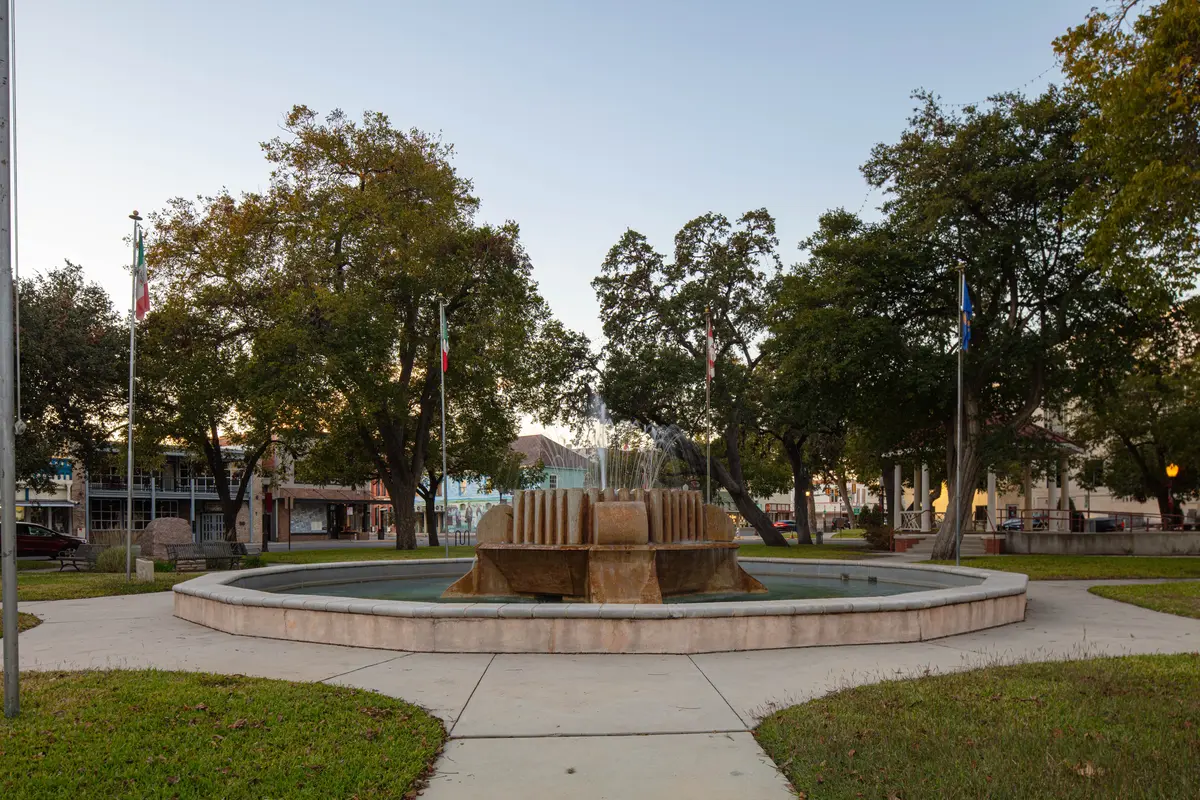
What Crime Maps Don't Tell You
If you spend time on crime heat maps — and most serious home researchers do — Seguin's east side tends to show elevated incident density. That picture deserves a clear-eyed read before it shapes a decision.
Retail corridors and high-traffic commercial areas generate more reported incidents per square mile than residential streets, regardless of how safe those areas actually are for people who live nearby. More customers, more parking lots, more interactions with police — the incident count goes up even when residential crime is unchanged. The same dynamic applies to parks and recreational facilities: Max Starcke Park, which sits at the heart of the city and draws significant visitor traffic, will show up on a heat map in a way that has almost nothing to do with the safety of adjacent neighborhoods.
This matters practically. A heat map that lights up around a commercial strip or a heavily used park is not telling you that the neighborhood behind that strip is dangerous. It's telling you that a lot of people pass through there. Resident-focused aggregators like CrimeGrade.org — which measure who actually gets victimized, rather than where incidents are logged — give a cleaner read on residential safety and are worth checking by address when you're narrowing down a specific street.
The right approach when researching a specific address is to layer the heat map against what you know about the surrounding land use. A zone anchored by a big-box retail cluster is a different conversation than one in a residential grid. Seguin's Community Crime Map, run through the Police Department's Community Engagement Unit, lets you search incident data at the address level — a more precise tool than any regional heat map for narrowing down a specific block.
Looking to buy in Seguin? Estimate your payment.
Enter your numbers to see an estimated monthly mortgage payment.
Estimate only. Excludes HOA fees and mortgage insurance. The interest rate above is a starting point, not a quoted rate — replace it with your own to see real numbers. Insurance is a flat placeholder, not a Seguin quote.
Seguin Police Department: What the Department Is Actually Doing
Accreditation matters more than most homebuyers think to ask about. The Seguin Police Department has held accreditation through the Texas Police Chiefs Association Best Practices program continuously since 2013 — meeting or exceeding 173 professional standards covering use of force, citizen rights, vehicle pursuits, and investigative operations. That's a sustained, third-party-verified commitment to professional practice, not a self-reported stat.
The department's Community Engagement Unit runs the city's public-facing Community Crime Map, which lets residents search local incident data, receive automatic alerts about activity near their address, and submit anonymous tips. For a city of 41,048, that level of transparency is meaningfully above average.
Community programs are active and accessible. The Citizens Police Academy is an 11-week resident program covering police operations, narcotics, DWI enforcement, K-9 units, and tactical operations. More than 10 Neighborhood Watch groups operate across the city, coordinated through the Community Engagement office and including Operation Identification, a property-marking program that makes stolen items easier to trace and recover. Residents who travel can request a patrol check on their home through the department's non-emergency line — a practical, underused tool for anyone who leaves for extended periods. The department also participates in National Night Out each October, which has become one of the more visible community-police touchpoints on the calendar.
None of this eliminates crime. What it signals is a department with external accountability, a resident-facing infrastructure, and a consistent track record of professional standards — which is a meaningful factor when evaluating a city's long-term safety trajectory.
Practical Safety Guidance for Prospective Residents
The data portrait of Seguin is one a reasonable person can feel good about. But the gap between city-wide figures and your specific block is real, and worth narrowing before you choose a neighborhood.
Start with the Northeast Bias
If minimizing crime exposure is a priority, the northeast corridor gives you the most consistent data advantage. Arroyo Ranch and Navarro Ranch land at the quieter end of the city's spectrum. Mill Creek Crossing and Cordova Crossing, in the growth areas, also tend to benefit from the lower-incident profile that newer development brings.
Use the City's Own Tool
The Seguin Police Department's Community Crime Map is the most precise publicly available tool for checking a specific address or block. It is searchable, filterable, and updated with real incident data — more useful than a regional heat map for anyone at the stage of narrowing down a specific street.
Read Heat Maps for What They Are
The east side's elevated heat-map density reflects retail and commercial traffic as much as residential risk. Max Starcke Park and the commercial corridors near it generate incident volume that does not translate directly to residential danger. A block that's quiet and well-established sits differently than a crime map's color suggests, if the heat is driven by a nearby parking lot or store.
One Friction Point Newcomers Don't Expect
Package theft is the issue that comes up most in Seguin neighborhood conversations — not violent crime, not car break-ins at scale. Residents on community platforms report it as the most common low-level nuisance, particularly in newer subdivisions where delivery volume is high and street-level foot traffic is low. A video doorbell and secure delivery instructions handle the practical side of it, but it's worth knowing this is the most common friction point rather than anything more serious.
Talk to the Neighbors Before You Decide
The Neighborhood Watch program's 10-plus active groups mean there are organized resident networks in most parts of the city. Reaching out to a group near a home you're seriously considering is one of the most direct ways to get an unfiltered street-level read — more specific than any aggregate data point, and more current than any published report.
For a fuller picture of how Seguin's neighborhoods compare in character, housing stock, and what daily life actually looks like, the neighborhoods page covers the ground this page doesn't.

Local Expert Takeaway: Seguin's city-wide crime picture — a violent crime rate of 3 per 1,000 residents and a property crime rate of 16 per 1,000 residents — sits below both Texas and national benchmarks, and the police department's sustained accreditation since 2013 backs that up with institutional accountability. The real decision for anyone moving here isn't whether Seguin is safe in aggregate — it is. The decision is which part of the city to prioritize. The northeast corridor and the newer outer subdivisions carry measurably lower incident rates than the central zone. Heat maps showing elevated density near retail corridors and Max Starcke Park tend to overstate residential risk in those areas. Package theft is the day-to-day concern residents actually mention; violent crime is not the practical worry that city-wide averages might imply for a Texas city this size.
Quick Takeaways & FAQs
✅ Seguin carries a violent crime rate of 3 per 1,000 residents and a property crime rate of 16 per 1,000 residents — both below the Texas state average and the national average.
⚠️ Safety varies meaningfully by neighborhood — incident rates in central areas run notably higher than in the northeast, so where you choose within the city matters as much as the city-wide figure.
📍 The Seguin Police Department has held Texas Police Chiefs Association accreditation continuously since 2013, and its Community Crime Map lets residents search incident data down to a specific address.
Is Seguin, TX a safe place to live?
Which part of Seguin is the safest?
How does Seguin's crime rate compare to the rest of Texas?
Why does Seguin's crime map show elevated activity on the east side?
What safety resources does the Seguin Police Department offer residents?
Moving to Texas?
Tell us what you need help with and we'll connect you with local resources.
