What Is Living in Clarksville, Tennessee Like?
Maybe your company relocated you, or Fort Campbell relocated you, or someone mentioned that Clarksville is what Nashville was fifteen years ago — cheaper, growing fast, and about to be unavoidable. The city sits at the confluence of the Cumberland River and the Red River in Montgomery County, connected to Nashville by I-24 and carrying a population of 188,829. That growth is not a blip — new construction runs in every direction, a downtown that has genuinely turned a corner, and a pace of civic investment that catches longtime residents off guard. What you feel when you drive in is a city still catching up to itself.
Fort Campbell, approximately 10 miles from downtown, anchors everything. Home to the 101st Airborne Division (Air Assault), the 5th Special Forces Group, and the 160th Special Operations Aviation Regiment, it is the city's largest employer by a wide margin and the single biggest driver of who moves here and why. But Clarksville's economy has diversified significantly: Hankook Tire and LG Electronics have major manufacturing operations here, Google operates a data center, and Austin Peay State University keeps a steady pipeline of students, faculty, and staff cycling through the community. The region attracted $4.4 billion in capital investment from primary employer projects since 2020. The Montgomery County school district — with 38,646 students enrolled in 2024-25 — holds a B rating, according to Niche, and is large enough to offer genuine programming variety across its schools.
For buyers coming from Nashville or most major metros, the numbers are genuinely striking. The typical home price stands at $319,419 (Zillow Home Value Index, August 2026), and the full cost-of-living breakdown shows what that means alongside Tennessee's no-state-income-tax advantage. Clarksville was named Tennessee's Most Ethnically Diverse City by WalletHub in 2024, with a median age of 31 — a combination that makes it feel more cosmopolitan than its geography might suggest. The Clarksville Greenway stretches 9 miles of paved trail, the Cumberland Riverwalk hugs the river through downtown, and Dunbar Cave State Park preserves a landscape with Mississippian-era Indigenous art, just minutes from suburban neighborhoods.
Whether you are weighing a first home purchase, a military-driven relocation, or a deliberate escape from a pricier market, the sections below break down Clarksville's neighborhoods, housing market, daily commute, schools, local favorites, and what life here actually looks and feels like once you are in it.

Clarksville at a Glance
Looking to buy in Clarksville? Estimate your payment.
Enter your numbers to see an estimated monthly mortgage payment.
Estimate only. Excludes HOA fees and mortgage insurance. The interest rate above is a starting point, not a quoted rate — replace it with your own to see real numbers. Insurance is a flat placeholder, not a Clarksville quote.
Beyond the Monthly Mortgage Payment — What to Factor In
- The property tax rate above — The 0.75% used in the estimate is the median effective rate — tax actually paid as a share of market value — published by Ownwell, 2026. Half of local homes pay more and half pay less: your own bill depends on that property's assessed value and any exemptions it qualifies for, which can differ a lot from its market price. Confirm with the Montgomery County assessor before you budget.
- Total cost of ownership — Your monthly mortgage payment is just the baseline. Depending on the specific city, county, and service district, homeownership costs also include local utility fees, municipal surcharges, and special assessments (such as water, sewer, storm drainage, or local energy taxes) that vary by location.
- Independent due diligence — Because these recurring local costs and municipal fees change depending on the exact property address, buyers must research them independently during their transaction process.
Tax laws, local municipal fees, and utility costs change frequently and individual situations vary. This page is general information, not tax or legal advice — always consult a qualified tax professional, CPA, or local municipal offices for personalized guidance.
Why Are People Moving to Clarksville?
The short answer is opportunity — and the longer answer is Fort Campbell. Every conversation about Clarksville's growth starts there. Active-duty service members and their families account for a significant portion of every incoming wave of residents, which means the city is unusually practiced at welcoming people who arrive knowing almost no one. That culture of turnover has a side effect most newcomers don't expect: Clarksville is one of the friendlier cities in the South for people who show up without a social network already in place.
The manufacturing sector has quietly become the second engine. Hankook Tire is expanding as part of a wave of industrial investment, and LG Electronics operates a substantial appliance manufacturing plant. Google's data center adds a technology dimension that is reshaping the local employer conversation. These are named, operating facilities — not proposals — and they have drawn a class of manufacturing and logistics professionals who are arriving independent of any military connection.
Austin Peay State University draws a different population: students, faculty, and the kind of mid-career professionals who want a university town's cultural texture without university-town prices. The campus anchors a part of the city that feels distinctly different from the military-adjacent neighborhoods, and it supports the arts, music, and athletic programming that give Clarksville its cultural credibility.
Who Tends to Land Here
Military families are the most visible newcomer group, but they are far from the only one. Remote workers priced out of Nashville increasingly look at Clarksville once they do the math. Manufacturing professionals following the Hankook or LG expansions are arriving. And a growing contingent of retirees — many of them veterans — are drawn by Tennessee's tax structure and by a city that has enough medical infrastructure and civic amenity to not feel like a sacrifice. WalletHub's 2024 designation as Tennessee's Most Ethnically Diverse City means the food, faith communities, and social fabric are genuinely varied — a real quality-of-life factor that doesn't show up in spreadsheets but matters enormously once you are here.
The honest tradeoff: Clarksville's safety profile shows a violent crime rate of 4 per 1,000 residents and a property crime rate of 16 per 1,000 residents — below the state figures of 6 per 1,000 violent and 20.8 per 1,000 property crime, though the property crime rate sits above the national figure of 18.4 per 1,000. The picture varies by area, and neighborhood choice matters more here than in smaller cities where the numbers are more uniform.
What Daily Life Feels Like in Clarksville
Six months in, most people say the same thing: Clarksville is bigger than it looked on the map. A city of 188,829 — the 5th-largest incorporated city in Tennessee — has the retail, medical, and dining infrastructure to feel genuinely self-sufficient for most daily needs. You are not driving to Nashville for a routine errand. The surprise is usually the opposite: how much is already here, and how much more is still arriving.
The Texture of an Average Week
The Cumberland Riverwalk and the 9-mile Clarksville Greenway handle a large share of outdoor recreation for residents who want something easy and close. Liberty Park gives families a green anchor near the river. Dunbar Cave State Park, a short drive from the suburban core, offers guided cave tours through a system with Mississippian-era Indigenous art — the kind of place that makes longtime residents sound smarter at parties than they expect. For a fuller look at outdoor options, the parks page covers what each area offers in practical terms.
The Montgomery County school district — with 38,646 students enrolled in 2024-25 — operates at a scale that supports real academic variety, career and technical programs, and active TSSAA athletics. On 2025-26 state assessments, 41.4% of students reached math proficiency and 44.1% reached reading proficiency; the full picture, including what those figures mean at the school level, lives on the schools page. Parents with school-age children tend to focus their neighborhood search around the Rossview and Sango corridors, where newer construction and school proximity overlap.
What People Don't Expect
Clarksville has 210 sunny days a year, which is more than Seattle but less than the South tends to get credit for. Summers are genuinely hot and humid — the kind of July that sends people to the cave tours at Dunbar Cave not just for the history but for the temperature underground. Winters are mild enough that snow rarely sticks for more than a day or two, but the city is not immune to ice events that bring everything to a stop, since Tennessee drivers and the road infrastructure are not built for frozen precipitation. First-winter residents from the Midwest or Northeast are usually caught off guard by how dramatically a quarter-inch of ice can shut things down.
The other adjustment is the rhythm of Fort Campbell. Gate traffic on US-41A during morning and afternoon shift changes is real, predictable, and worth routing around if your commute crosses that corridor. Longtime residents know it; newcomers learn it in the first week.
The Clarksville Housing Market Right Now
The typical home price in Clarksville sits at $319,419 (Zillow Home Value Index, August 2026) — a figure that reads as genuinely affordable compared to most major metros but deserves one honest note: the median household income of $66,786 runs below the income level needed to buy at that price. The gap is real, and buyers close it through down payment assistance, dual incomes, or VA loan benefits that a large share of the Clarksville market is specifically structured to use. For the full breakdown of what ownership actually costs here — taxes, insurance, and the numbers behind the affordability picture — the cost-of-living page has the detail.
The effective property tax rate of 0.75% is among the lower rates in the region, and Tennessee's no-state-income-tax structure means take-home pay stretches further than a raw salary comparison to other states would suggest. Those two factors together are a meaningful part of why Clarksville consistently appears on regional affordability comparisons.
What the Market Feels Like Right Now
Well-priced homes in the Rossview, Sango, and St. Bethlehem corridors move. The city is still growing, construction is active, and new subdivisions keep adding inventory at the outer edges — which gives buyers more options than a similarly priced market in a slower-growth city would. That said, move-in-ready homes in established neighborhoods with good school assignments attract serious competition quickly. Coming prepared matters more than it did a few years ago.
Renters pay a city-wide typical rent of $1,374 per month (Zillow, August 2026), which positions Clarksville well below Nashville and most comparable-sized Tennessee cities. Some areas run above that figure and some below; the neighborhoods page walks through the character and housing feel of each corridor without the false precision of neighborhood-level price ranges that go stale faster than they can be updated.
For buyers exploring the market for the first time, the first-time homebuyer page covers the loan programs — including VA and USDA options that are actively used here — and the process mechanics that matter most in this specific market.
Clarksville Neighborhoods
Clarksville has several distinct areas — each with its own character and appeal. Here’s a breakdown to help you narrow down where to focus your home search.
🏡 Sango
Sango draws parents with school-age children who want newer construction and fast access to Fort Campbell via TN-237 — it has the feel of a community that organized itself around good schools and short commutes, and it delivers on both.
🏠 Rossview
Rossview sits along TN-237 and is consistently among the first areas military families consider — newer subdivisions, school proximity, and a suburban quietness that feels earned rather than sterile.
🌳 St. Bethlehem
St. Bethlehem is the commercial and residential hub of northeast Clarksville — established neighborhoods, dense retail convenience, and the kind of infrastructure that makes daily life genuinely easy without requiring a drive across town.
🏘 Downtown Clarksville
Downtown has turned a real corner, with the Customs House Museum, the Downtown Artists Co-op, Blackhorse Pub & Brewery, and Strawberry Alley Ale Works giving it a walkable cultural core — it suits buyers who want to be in the middle of where the city is heading.
🏔 Greenwood
Greenwood is one of Clarksville's more established and affordable residential areas, offering older housing stock with the character and tree cover that newer subdivisions take decades to develop.
🌆 Tiny Town Road / North Clarksville
The Tiny Town Road corridor runs through a part of the city that feels more rural at its edges but is growing steadily — it attracts buyers who want space, a shorter commute to the northern gate of Fort Campbell, and lower land prices than the more developed corridors to the east.
Pros & Cons of Living in Clarksville
The Pros
- Home prices well below the Nashville metro average
- Strong, diversified job base anchored by Fort Campbell plus global manufacturers like LG and Hankook
- Abundant outdoor recreation along the Cumberland River and Dunbar Cave
- Growing downtown with a walkable riverfront scene
The Cons
- Crime rates run somewhat higher than national and state averages in several categories
- Longer commute (about 45-60 minutes) for those working in downtown Nashville
- Hot, humid summers with high rainfall totals
Getting Around & Commuting in Clarksville
Clarksville is a driving city. That is not a complaint — it is the practical reality of a mid-sized city spread across a landscape without the density that makes transit a first choice. A car is the right tool for daily life here, and the road network, anchored by I-24 and US-41A, generally handles the load well outside of peak hours.
The Nashville Commute
The most important number for anyone considering Clarksville as a Nashville-adjacent market: about 50 minutes to Nashville. That drive runs along I-24, and it is the calculation that determines whether this city works for remote-hybrid workers who need to be in the office some days each week. For a one-way trip of roughly 50 minutes, the math works for many people who are in the office two or three days per week. Daily commuters eventually tire of it — that is the honest version of this conversation, and it is one of the most common reasons people move out after a few years.
A commuter express bus service operates along I-24 between Clarksville and downtown Nashville for commuters who want an alternative to driving on the Nashville leg. It is not a substitute for a car in daily Clarksville life, but it is a real option on days when the drive feels like too much.
Getting Around Within Clarksville
The Clarksville Transit System operates local bus routes covering Montgomery County and extending into Christian County, Kentucky — including service to Fort Campbell. For residents whose work, shopping, and appointments cluster along the main corridors, the bus network covers the essentials. For most people in the outer suburban neighborhoods, it is supplemental at best.
US-41A, US-79, and TN-374 carry most of the intra-city traffic. The Fort Campbell Boulevard corridor — US-41A — is the artery that connects the base to downtown and to the commercial strips where most daily retail is clustered. Learning the shift-change rhythm on that road in the first weeks here is the single most practical piece of local knowledge a new resident can have.
Nashville International Airport (BNA) is approximately 54 miles away — a straight shot down I-24 — and handles the region's air travel needs for most residents. The drive to the airport is predictable on most days, though Friday afternoons and Sunday evenings add time.
Fort Campbell as an Employer Hub
For residents whose work takes them to Fort Campbell, access depends entirely on which gate and which part of the installation they use. The base straddles the Kentucky-Tennessee border, and TN-237 and US-41A are the primary corridors. Neighborhoods along those routes — Rossview, Sango, Tiny Town Road — are popular precisely because they reduce the daily Fort Campbell commute to something measured in minutes rather than highway miles.
Schools in Clarksville
Families relocating to Clarksville have public, private, and higher-education options nearby. Here’s a quick overview.
🎓 School District
Montgomery County serves K–12 students across Clarksville and the surrounding area. Rated B (source: Niche.com).
📊 District Stats
- Enrollment 2024-25
- 38,646 students
- 4-year graduation rate
- 95.4%
- Math proficiency 2025-26
- 41.4%
- Reading proficiency 2025-26
- 44.1%
- Science proficiency 2025-26
- 54.5%
Source: Tennessee Department of Education Data Downloads (district profile, graduation rate and TCAP assessment files).
📚 Higher Education
Tennessee’s public universities — the University of Tennessee, Vanderbilt University, and Middle Tennessee State University — offer four-year degrees statewide, with a statewide community and technical college system of 13 community colleges and 24 colleges of applied technology, with tuition-free options for residents through Tennessee Promise and Tennessee Reconnect providing two-year and workforce programs.
🌐 Online Learning
UT Knoxville Online and MTSU Online offer fully accredited online degrees for remote learners across the state.
Safety in Clarksville
A quick look at how Clarksville compares on the numbers that matter most when weighing a neighborhood or a move.
🛡 Violent Crime
Approximately 4 per 1,000 residents.
🔒 Property Crime
Approximately 16 per 1,000 residents.
Compared to the most recent national figures from the Bureau of Justice Statistics (2024), Clarksville’s violent crime is above the national average (about 3.7 per 1,000), and property crime is below the national average (about 18.4 per 1,000).
Against Tennessee as a whole, Clarksville’s violent crime is roughly two-thirds of the state average, and property crime is somewhat below the state average (Bureau of Justice Statistics, Crime Known to Law Enforcement, 2024 (tables 2 and 3)).
Crime rates can vary a lot within a single city, so the citywide numbers above are only a starting point. Some neighborhoods in Clarksville run well below these averages, while others run higher — the kind of block-by-block detail that matters most when you’re actually choosing where to live. The full guide below breaks it down neighborhood by neighborhood.
Working in Clarksville
Clarksville’s largest employers span several industries — here are some of the anchors of the local job market.
🏛 Fort Campbell
Military/defense
🏭 Hankook Tire
Tire manufacturing
🏭 LG Electronics
Appliance manufacturing
Data center/technology
🎓 Austin Peay State University
Education
Parks & Recreation in Clarksville
Some of the outdoor spaces that shape everyday life in Clarksville.
🌱 Dunbar Cave State Park
🌱 Fort Defiance Civil War Park & Interpretive Center
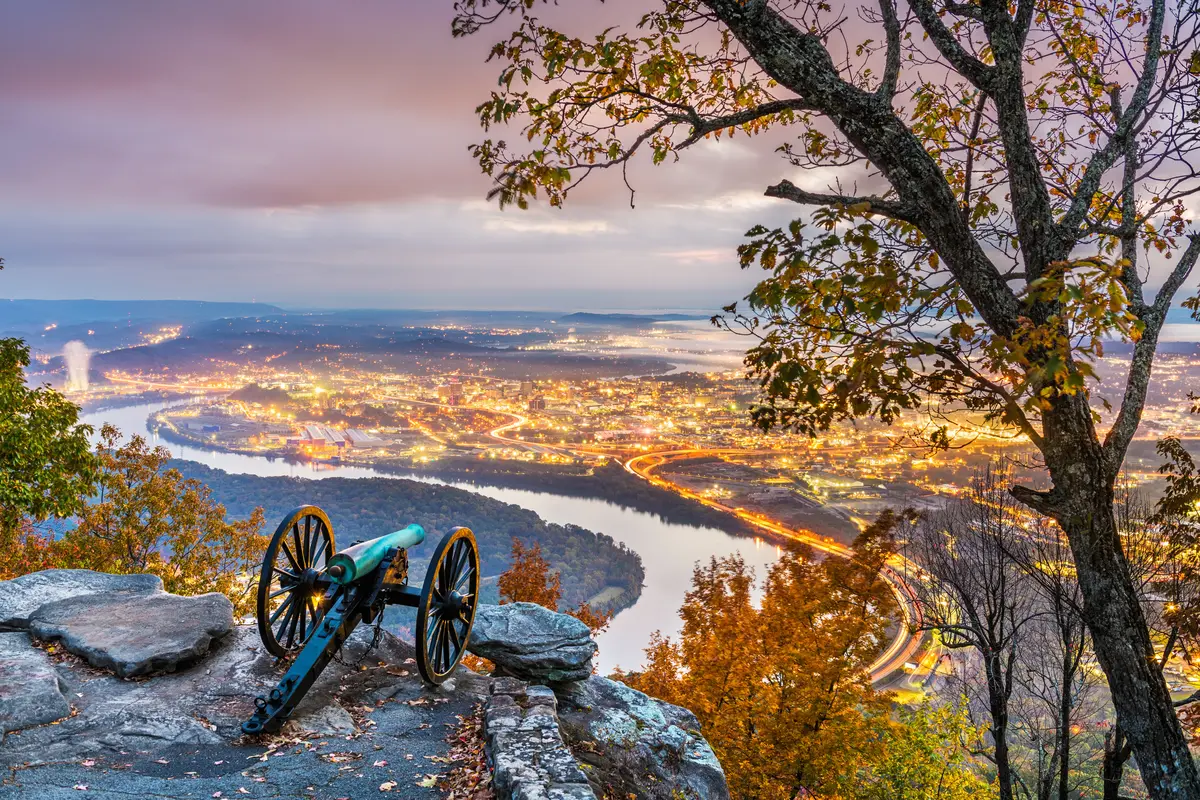
Clarksville residents don’t have to go far for green space — spots like Dunbar Cave State Park and Fort Defiance Civil War Park & Interpretive Center are part of everyday life here, whether that’s a morning walk, a weekend hike, or just somewhere to unwind outside. The full guide below covers more of what Clarksville has to offer for parks and outdoor recreation.
Retiring in Clarksville
Clarksville draws retirees for its balance of amenities, outdoor access, and cost. Here’s what to weigh.
🌤 Climate
Clarksville gets 210 sunny days a year, with warm, humid summers and mild winters. Hard freezes are rare, but ice events a couple of times each winter can disrupt travel briefly. Spring and fall are genuinely pleasant, with the Cumberland Riverwalk and Dunbar Cave State Park both worth working into a regular routine.
🍴 Lifestyle
The Customs House Museum & Cultural Center, the Fort Defiance Civil War Park, and a downtown arts scene anchored by the Downtown Artists Co-op give retirees real cultural infrastructure. The Thursday Night Farmers Market at Old Glory and the Montgomery Farmers Co-Op serve a community that values local produce. Tennessee's no-state-income-tax structure is a genuine financial advantage for retirees on fixed incomes.
🏚 55+ Communities
No 55+ communities were found in Clarksville. Retirees here tend to buy in established single-family neighborhoods or in newer construction along the Sango and St. Bethlehem corridors, where home sizes, lot maintenance, and proximity to services align well with retirement living.
✈ Getting Around
A car is the practical requirement for daily life in Clarksville. The Clarksville Transit System operates local bus routes for essential trips, and the Clarksville Greenway handles recreational travel on foot or by bike. Nashville International Airport (BNA) is approximately 54 miles away via I-24 — a manageable trip for most retirees who travel a few times a year.
🏛 Tennessee Taxes for Retirees — What to Know
- No state income tax — Tennessee has no personal income tax. Social Security, pensions, 401(k) and IRA withdrawals and annuity payments are all untaxed at the state level, with no state return to file. The Hall tax on interest and dividends — the state’s last income-type tax — was fully phased out and repealed effective 2021.
- Sales tax is the tradeoff — The state sales tax is 7.0%, and local add-ons bring the combined rate in Clarksville to 9.5% (Tennessee Department of Revenue (SUT-13, SUT-53); Streamlined Sales Tax rate boundary file TNR2026Q3, Q3 2026). Groceries are taxed at a reduced state rate of 4% plus the local rate; prescription drugs are exempt. Prepared food, candy, dietary supplements and alcohol pay the full rate.
- Property taxes are low, not the tradeoff — Property tax in Tennessee is set county by county, and rates are low by national standards. Unlike Texas, which funds local government through high property taxes in place of an income tax, Tennessee leans on its sales tax instead — so a retiree is not trading one bill for another. Your county trustee publishes the current rate.
- Tax relief for owners 65 and over — The state reimburses part of the property tax bill for low-income homeowners who are 65 or older, and for disabled homeowners of any age, through the Property Tax Relief program administered by county trustees. It is income-tested and must be applied for each year.
- A tax freeze — but only where the county or city adopted it — Tennessee also allows a Property Tax Freeze that locks a homeowner’s bill at the amount owed in the year they qualify, for owners 65 and over under an income limit. It is a local option: each county and city chooses whether to offer it, and sets its own income threshold, so it is available in some parts of the state and not others. Check with the county trustee.
- No estate, inheritance or gift tax — Tennessee has none of the three. The inheritance tax was repealed for deaths occurring in 2016 and after, and the gift tax was repealed effective January 1, 2012.
- No separate capital gains tax — Because Tennessee has no state income tax, capital gains — including on investments and on the sale of a home — are not taxed at the state level at all, unlike states such as Washington that tax capital gains separately from income.
Source: Tennessee Department of Revenue and Tennessee Comptroller of the Treasury.
Tax laws change frequently and individual situations vary. This is general information, not tax advice — always consult a qualified Tennessee tax professional or CPA for personalized retirement tax planning.
Weekends & Local Favorites in Clarksville
Clarksville's identity on a Saturday is genuinely its own. The downtown arts scene has developed real momentum: the Downtown Artists Co-op runs rotating monthly exhibits and First Thursday Art Walks that have become a consistent gathering point for the creative community. The Customs House Museum & Cultural Center — housed in the original 1898 Federal Post Office building and described as the largest general museum in Tennessee — anchors the cultural calendar and surprises first-time visitors who underestimated what a city this size maintains.
Food, Drink, and Coffee
Blackhorse Pub & Brewery Clarksville and Strawberry Alley Ale Works represent the local craft brewing end of the social scene. Liberty Park Grill, The Mailroom, and Storming Crab draw regulars across very different occasions — a casual waterside meal, a neighborhood spot with local loyalty, a group dinner built around a seafood boil. For coffee, the options are more varied than most newcomers expect: Black Rifle Coffee Company, Plumb Line Coffee, The Mad Herbalist, and The Amsterdam Local each carry a distinct character and a following.
Outdoors and Markets
The Cumberland Riverwalk is the city's most-used outdoor corridor — a genuine gathering place on warm evenings, not just a trail. Liberty Park extends that riverfront experience with more room to spread out. Dunbar Cave State Park pulls a more deliberate crowd: the cave tours through passages decorated with prehistoric Mississippian art are worth scheduling ahead, especially in summer when underground temperatures become part of the appeal. Swan Lake at Austin Peay State University offers a quieter outdoor experience woven into the campus landscape.
For local produce and farmers market culture, the Montgomery Farmers Co-Op and the Thursday Night Farmers Market at Old Glory both serve a community that takes local sourcing seriously. The Thursday market has become a weekly social ritual for a cross-section of residents that reflects just how young and diverse Clarksville actually is.
Fort Defiance and History
Fort Defiance Civil War Park & Interpretive Center sits at one of the more historically significant spots in the city — reconstructed fortifications overlooking the confluence of the Cumberland River, with living history events that draw both locals and visitors. It is the kind of place longtime residents take out-of-town guests and end up learning something new themselves.
Local favorites in Clarksville
Restaurants
- Blackhorse Pub & Brewery Clarksville
- Liberty Park Grill
- Storming Crab - Seafood Restaurant
- Strawberry Alley Ale Works
- The Mailroom
Outdoors
- Dunbar Cave State Park
- Cumberland Riverwalk
- Liberty Park
- Clarksville Greenway
- Swan Lake at Austin Peay
Coffee
- Black Rifle Coffee Company
- Miss Lucille's Cafe
- Plumb Line Coffee
- The Mad Herbalist
- The Amsterdam Local
Farmers Markets
- Montgomery Farmers Co-Op
- Thursday Night Farmers Market at Old Glory
Top Things Locals Say About Clarksville
The best intel about a city comes from the people who actually live there. Here’s what Clarksville residents say when newcomers ask the questions everyone’s thinking.
“I expected Clarksville to feel like a small town with a big base, but six months in it felt like a real city — more restaurants, more going on downtown, more variety than I expected. What I didn't expect was how much the Fort Campbell gate traffic on US-41A would shape which route I took to work every single morning.”
— Recent Clarksville home buyer
“What's the most surprising thing about living in Clarksville?”
How much there is here that you wouldn't expect from a city its size. The Customs House Museum is genuinely impressive — people are always surprised to learn it's described as the largest general museum in Tennessee. Downtown has a real arts scene with the Artists Co-op and the breweries, and the food variety reflects how diverse the city actually is. You stop thinking of it as a military town pretty quickly and start thinking of it as just where you live.
“What do locals love most about Clarksville?”
The Cumberland Riverwalk on a warm evening, and the fact that most daily life — groceries, doctors, decent restaurants, kids' activities — doesn't require driving to Nashville. The cost of living relative to what you get here is hard to argue with. And the community is genuinely welcoming to newcomers in a way that not every Southern city is, partly because so many people arrived here from somewhere else themselves.
“What should newcomers to Clarksville know?”
Learn the US-41A shift-change schedule in your first week — it determines which route you take in the morning and afternoon, and ignoring it costs you real time. Also, ice storms hit maybe once or twice a winter and the whole city responds as if it has never seen precipitation before, because the infrastructure isn't built for it. Plan accordingly. And if you're looking at houses in Rossview or Sango, get familiar with TN-237 and TN-374 — those are the arteries that make or break the daily drive depending on where you land.
“How much do you need a car in Clarksville?”
For most residents, a car is essential. The city is spread out, and while the Clarksville Transit System covers the main corridors with local bus routes, the outer neighborhoods are not designed around walkability or transit. The downtown core and the area around Austin Peay State University are genuinely manageable on foot for some errands, but most daily life — school runs, grocery runs, getting to work — means driving. The Clarksville Greenway and Cumberland Riverwalk handle recreational travel well; they're just not a commute solution for most people.
Cities Near Clarksville
Other communities near Clarksville worth a look — each with its own character and price point.
| City | Distance | Best For | Vibe | Median Rent | Median Buy |
|---|---|---|---|---|---|
| Hopkinsville, KY | 20 mi | Budget buyers, rural lifestyle | Small-town, quieter, less growth | $950 | $225,000 |
| Oak Grove, KY | 12 mi | Fort Campbell gate access | Base-adjacent, compact, practical | $1,000 | $240,000 |
| Springfield, TN | 24 mi | Rural character, Robertson County | Agricultural, slower pace, growing | $1,150 | $335,000 |
More Helpful Guides for Clarksville
Going deeper on Clarksville? Our blog series covers everything from first-time buying to retiring here — explore the guides below.
Local Expert Takeaway: Clarksville is not a suburb of Nashville — it is a mid-sized city with its own economy, its own cultural calendar, and its own momentum. The Fort Campbell connection shapes everything from the housing market to the social fabric, and that military presence makes the city unusually welcoming to people arriving without a local network. The Downtown Artists Co-op, the Cumberland Riverwalk, and the Thursday Night Farmers Market at Old Glory are where you start to feel like a resident rather than a newcomer. The 50-minute drive to Nashville works for hybrid schedules; it wears on daily commuters over time. Buy in Rossview or Sango if Fort Campbell access matters; look at the St. Bethlehem corridor if you want established neighborhoods with good commercial convenience.
Quick Takeaways & FAQs
✅ Clarksville's typical home price of $319,419 (August 2026) sits well below Nashville while the city adds jobs at one of the fastest rates in Tennessee.
⚠️ The 50-minute drive to Nashville is manageable for hybrid workers but consistently cited as the main reason daily commuters eventually consider moving closer to the city.
📍 Fort Campbell's gate traffic on US-41A during shift changes is a daily reality — your neighborhood choice relative to that corridor matters more than most online listings will tell you.
Is Clarksville, TN a good place to live if I work at Fort Campbell?
How far is Clarksville from Nashville, and is it realistic to commute?
What are the best neighborhoods in Clarksville for families?
How safe is Clarksville, TN?
What is the housing market like in Clarksville right now?
Helpful Links for Moving to Clarksville
Moving to Tennessee?
Tell us what you need help with and we'll connect you with local resources.
