
If you're choosing between staying in California and starting over in Madras, Oregon, the decision usually comes down to one thing: how much of your income you want tied up in housing. Madras is a high-desert city of 8,117 sitting at the junction of US-97 and US-26 in Jefferson County — two hours from Portland, about 35 minutes to Redmond, and surrounded by basalt canyon country that most Californians only see on a vacation. It is not a suburb of Bend; it is its own town, with its own pace, its own economy, and a geographic remoteness that is either the whole point or a dealbreaker depending on what you're looking for.
The economic backbone here is smaller than you're used to. Jefferson County School District 509J, Jefferson County government, and a regional health system anchor local employment alongside Warm Springs Forest Products Industries. A June 2025 Urban Growth Boundary expansion added 196 acres designated for industrial use — approved by the Oregon Department of Land Conservation and Development after more than a decade of planning — signaling that high-tech and clean-tech manufacturing investment is being actively courted. That matters for anyone considering a move and wondering whether the local job market will thicken over the next decade. For now, many residents work remotely or commute out toward Redmond and Bend.
Housing is the headline. Madras's typical home price stands at $360,658 (July 2026, Zillow Home Value Index) — see the full breakdown on the cost-of-living page. For Californians liquidating equity from a coastal or suburban home, that figure represents a fundamental shift in what a house buys you. The broader cost difference is real too: groceries, utilities, and everyday services run noticeably below what most California metros charge, and Oregon has no sales tax at all — not state, not local — which adds up faster than people expect on everyday spending.
Whether you're ready to make an offer or still weighing the move, the sections below break down the California-to-Madras financial comparison, the tax picture (with some counterintuitive turns), what daily life here actually looks like, where people spend their weekends, and the honest trade-offs that nobody in a Facebook relocation group will tell you upfront.
The Home Price Reality: What Your California Equity Buys Here
The single biggest reason Californians call Madras is the home price gap. California's statewide typical home value of $773,735 (Zillow Home Value Index) is more than double Madras's typical home price of $360,658 as of July 2026. For a household selling a California home at or above that statewide figure, arriving in Madras with a substantial down payment — or buying outright — is a realistic scenario, not a fantasy.
That math changes daily life in practical ways. A mortgage on a Madras home at current rates is likely to run significantly below what many Californians were paying in rent. The freed-up monthly cash flow is often what buyers are actually after — not a lifestyle upgrade, but a budget reset that makes retirement, a career change, or running a small business genuinely viable.
What the Housing Stock Looks Like
Madras is not a market of new construction luxury homes. The inventory runs toward single-family homes on modest lots, some dating to mid-century, alongside newer builds in areas like Bitterbrush Estates and The Pines at Madras. Yarrow and Madras Ranchos attract buyers who want more space and a quieter setting, while Canyon View and Sunrise Estates tend toward families with school-age children. Downtown Madras is walkable in the immediate sense but is not an urban core — it is a small-town commercial center where most errands still require a car.
Palmain sits on the quieter edges of the city and suits buyers prioritizing space over on-foot access. For more detail on how each area compares in character and housing type, the neighborhoods page covers this directly.
The Prop 13 Reset — The Thing Long-Tenure Owners Miss
If you've owned your California home for more than a decade, Proposition 13 has been quietly holding your property tax assessment well below market value — sometimes dramatically so. The moment you purchase in Oregon, that protection disappears. Your new tax basis is the full purchase price, assessed at Jefferson County's effective property tax rate of 0.76%. What catches people off guard is the comparison: their California tax bill was based on an assessed value from 2009 or 2012, not today's market, so the Oregon bill can feel higher even though the rate is comparable. Budget for this shift before you close.
The Tax Picture: What Oregon Gives You and What It Takes Back
Oregon's tax environment is not a straight-line improvement over California. It is a trade. Understanding which side of that trade you fall on depends almost entirely on your income level.
The Sales Tax Win — No Asterisks
Oregon has no state or local sales tax. Full stop. California's statewide base sales tax rate of 7.25% is already the highest state rate in the country, and local additions bring the combined average higher. Over the course of a year, the absence of sales tax in Oregon saves a typical household a meaningful sum on groceries, furniture, vehicles, building materials, and anything else you buy. This one is simple and clean — it benefits everyone regardless of income.
The Income Tax Counterintuitive
Here is what most Californians get wrong: they assume Oregon's lower top rate means lower income taxes. It does not, for most earners. Oregon's top bracket is 9.9%, compared to California's top state income tax rate of 13.3% (California Franchise Tax Board). But Oregon's brackets are compressed — the 9.9% rate kicks in at $125,000 of taxable income for single filers, or $250,000 for joint filers. California's top rate of 13.3% applies only to the highest earners, only above roughly $1 million in income.
The practical result: at a $100,000 income, an Oregon resident owes more in state income tax than a California resident at the same income — Oregon reaches near its ceiling while California is still in its middle brackets. California stays cheaper on income tax alone all the way up to roughly $725,000 in earnings. Above that, Oregon's lower top rate starts to pull ahead.
Oregon does offer one structural offset: single filers may subtract a portion of federal income taxes paid from Oregon taxable income, reducing what Oregon can tax. This benefit phases out at higher incomes and disappears entirely for joint filers with federal adjusted gross income above $290,000. It helps moderate-income earners more than high earners.
Property Tax: A Rate Match, Not a Savings
Madras's effective property tax rate of 0.76% and California's effective property tax rate of 0.71% (California Franchise Tax Board) are nearly identical on paper. The difference for a Californian is not the rate — it's the assessed value it's applied to, which in Oregon resets to full market value at purchase. See the note on the Prop 13 reset in the section above, and the full tax picture on the cost-of-living page.
| Tax Category | California | Madras / Oregon | Net Effect for Most Movers |
|---|---|---|---|
| Sales Tax | 7.25% statewide base rate (plus local additions) | 0% — no sales tax at any level | Clear win for Oregon |
| Top State Income Tax Rate | 13.3% (California Franchise Tax Board) | 9.9% (kicks in at $125K single) | Oregon wins above ~$725K; California wins below that |
| Effective Property Tax Rate | 0.71% (Prop 13-constrained assessed value) | 0.76% on full purchase price | Roughly equal; long-tenure CA owners face a reset |
| Federal Tax Subtraction | Not available | Available for lower/mid incomes; phases out above $290K AGI (joint) | Moderate win for Oregon earners under the threshold |
| Enterprise Zone Incentives | Not applicable for this area | Available in Madras, Metolius, Culver for qualifying businesses | Meaningful for California business owners relocating |
California business owners moving operations to Madras should also look at Jefferson County's participation in Oregon's Enterprise Zone program, which provides qualifying businesses with tax credits, exemptions, and abatements — a real incentive that goes beyond the personal income-tax picture.
Daily Life in Madras: The Adjustment Californians Don't See Coming
Six months after arriving, nearly every California transplant says the same thing: they underestimated the quiet. Not as a complaint — often as a relief — but as something nobody warned them to expect. Madras has a population of 8,117. On a Tuesday afternoon, the streets are genuinely calm. There is no ambient urban noise, no freeway hum, no neighbor's security gate clanging at 2 a.m.
What You Give Up
A serious shopping trip means driving out of town — toward Redmond or Bend — and anything specialized you'll be ordering online. The dining scene, while genuine, runs small and independent. This is not a city where you can be spontaneous about a Friday night out.
Specialist medical care requires a drive. For routine care, you're covered locally, but for specialist care or advanced treatment, you'll be traveling to Bend or beyond. That reality belongs in any honest budget calculation. Health insurance premiums in Oregon tend to run noticeably below California rates, which matters for self-employed transplants who were paying full-freight premiums on the coast — but that savings comes with a smaller local medical market as the trade-off. For a fuller picture of healthcare access, see the retiring in Madras page.
The school picture matters to families. Jefferson County School District 509J serves 2,687 students enrolled in 2025-26. On 2024-25 state assessments, 16.4% of students reached math proficiency and 27.6% reached reading proficiency — figures that fall well below state averages and that California families used to higher-performing suburban districts should factor in honestly. The schools page covers the district in detail.
What Replaces What You Left
Madras gets 153 sunny days a year — a real figure, not a marketing estimate — which in Central Oregon's high desert means dry, clear conditions for most of the year and winters that are cold but rarely the gloomy grey that defines the Willamette Valley. The light here is different: harder, clearer, and familiar to anyone who grew up in the California interior.
The city's Hispanic community — 31.9% of residents identify as Hispanic — brings a dining and cultural familiarity that Californians from the Central Valley or Southern California often find grounding rather than surprising. The agricultural character of the region, the proximity of the Warm Springs Reservation, and the mix of long-time residents and newer arrivals create a community dynamic that is more layered than a first drive-through suggests.
Crime rates are worth understanding rather than assuming. For the full breakdown on safety, see the safety page.
Looking to buy in Madras? Estimate your payment.
Enter your numbers to see an estimated monthly mortgage payment.
Estimate only. Excludes HOA fees and mortgage insurance. The interest rate above is a starting point, not a quoted rate — replace it with your own to see real numbers. Insurance is a flat placeholder, not a Madras quote.
Weekends and Local Favorites
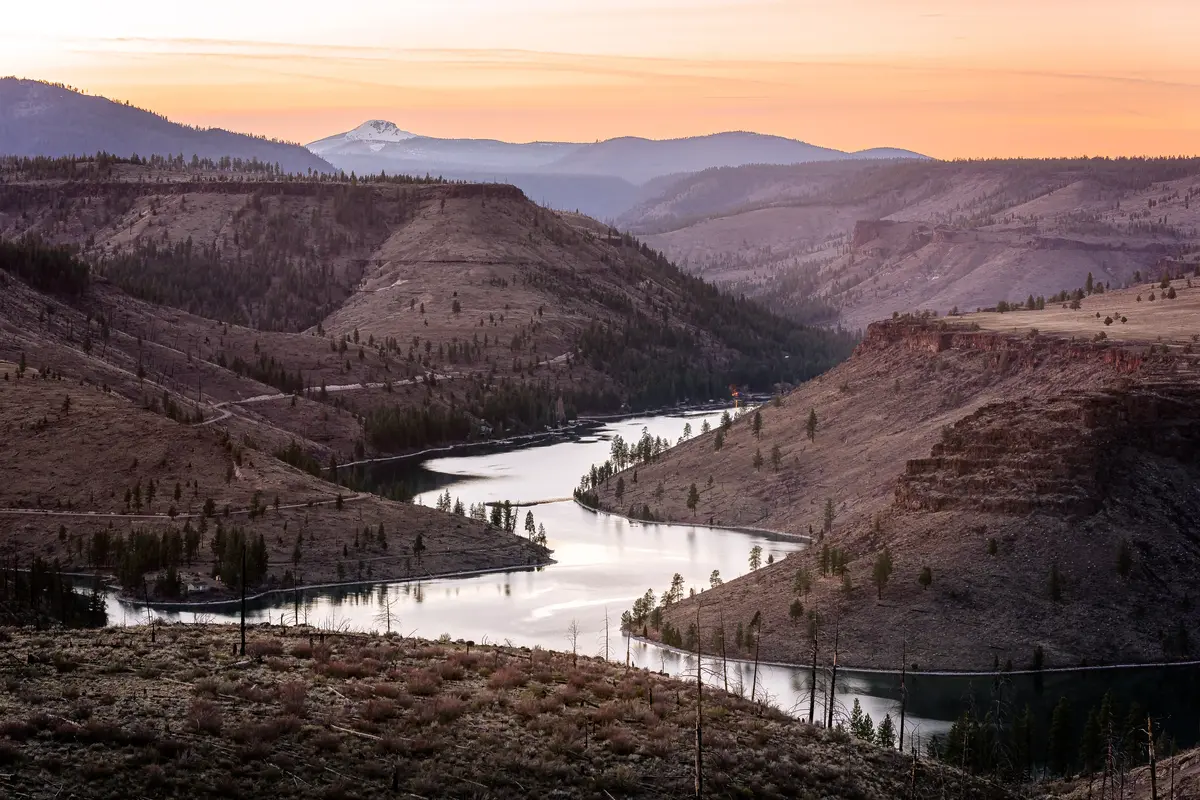
The outdoor access around Madras is the part of this move that Californians consistently underestimate until they're living it. Cove Palisades State Park sits just outside the city, surrounding Lake Billy Chinook — a 4,000-acre reservoir at the confluence of the Crooked, Deschutes, and Metolius rivers, rimmed by basalt cliffs that rise several hundred feet above the water. Nearly 10 miles of hiking trails, a full marina with watercraft rentals, fishing, and houseboating put this on par with recreation that would require a multi-hour drive from most California metros. Lake Billy Chinook is the answer to the question every transplant asks: what do people actually do here on weekends?
Smith Rock State Park is within reach — a world-class climbing and hiking destination that needs no qualification — and the Madras Bike & Skate Park gives younger residents and families a local destination that doesn't require a drive. Cascade Lavender Farm is the kind of place you find yourself at unexpectedly, usually because someone invited you, and it captures something about the pace of the region that is genuinely hard to explain until you've been here a season.
Where People Eat and Drink Coffee
The local food scene centers on a handful of genuinely good independent spots. Rio Distinctive Mexican Cuisine and Mazatlan Mexican Restaurant both have loyal followings, and La Posada Mexican Grill rounds out a Mexican dining scene that punches well above what you'd expect from a city this size — and reflects the community's demographics. The Spot serves as a casual anchor for locals who want something straightforward. Black Bear Diner Madras draws the highway crowd and the regulars in equal measure.
For coffee, the lineup is specific and worth knowing: Eagle Bakery is the morning institution, while Midtown Coffee Company, Coppers Coffee Co., Get Roasted Coffee Co., and The Human Bean give you real options without driving to Redmond. The coffee culture here runs independently minded, and most of these spots double as the informal gathering places the city uses instead of a traditional downtown scene.
The Central Oregon Mural Trail runs through Madras and gives the city a visual identity that newcomers notice before longtime residents do — it's the kind of thing you start pointing out to visiting family within the first few months. The Erickson Aircraft Collection is worth a dedicated visit, and the Jefferson County Courthouse anchors a downtown that is working through its next chapter.
Is Madras Right for You? The Honest California-to-Madras Trade-Off
The case for this move is easy to make. Housing well below California's statewide typical home value. No sales tax. Groceries and everyday costs running below California norms. High desert landscape. Recreation minutes away. A community with real demographic familiarity for many Californians. For buyers who are priced out of their current market or simply tired of what California has become at scale, Madras is a credible answer.
The case against it is shorter but worth reading before you make an offer.
Who Tends to Struggle Here
Californians who move for the price and assume the lifestyle will follow often find the adjustment harder than expected. Madras is a working small town, not a lifestyle destination. If your social life in California depended on density — on being able to walk to three different options on a Friday night, on spontaneous plans that didn't require a drive — you will feel that absence. Some people adapt. Some list their house within eighteen months.
Remote workers are the best-positioned transplants by a significant margin. If your income follows you rather than requiring you to be somewhere, Madras gives you a dramatic housing cost reduction with minimal career trade-off. If you need local employment at a professional level, the job market is genuinely thin outside of education, government, and the trades. The living in Madras overview goes deeper on employment.
Who Tends to Stay and Thrive
Buyers who arrive knowing exactly what they're getting — the quiet, the limited retail, the distance from specialist care, the smaller school district — and who chose those trade-offs deliberately are the ones who build real roots here. Parents with school-age children who are prepared to supplement the district's offerings, retirees building equity without California's cost burden, remote workers who want a mortgage that doesn't consume their income — these are the profiles that fit. The living in Madras page outlines the full buyer-type picture.
The commute reference most buyers start with: about 35 minutes to Redmond, which connects to Bend's larger employment and retail base. That drive becomes the rhythm of life for many Madras households, and whether it feels manageable or exhausting is one of the most personal questions this move raises. Drive it on a February morning before you decide.
Local Expert Takeaway: The buyers who move from California to Madras and never look back are the ones who drove into town, stood at the edge of Lake Billy Chinook at Cove Palisades on a clear afternoon, and realized the equity sitting in their California house could buy them this — outright or close to it — with cash left over. The ones who struggle are the ones who moved for the spreadsheet and didn't account for what a city of 8,117 actually feels like in February. Go in clear-eyed about the school district numbers, the retail gap, and the drive to specialist care. Go in equally clear-eyed about what no sales tax, a $360,658 typical home price, and 153 sunny days a year actually add up to over a decade.
Quick Takeaways & FAQs
✅ Madras's typical home price of $360,658 (July 2026) means Californians selling at or above their state's statewide typical home value often arrive with substantial equity to deploy — a financial reset that is genuinely rare in today's market.
⚠️ Oregon has no sales tax and a comparable property tax rate, but its income tax brackets are steeper than California's for earners below roughly $725,000 — the tax picture is a trade, not a clean win.
📍 The drive to Cove Palisades State Park and Lake Billy Chinook from downtown Madras takes minutes, not hours — that kind of recreation proximity is the lifestyle detail that makes longtime residents say they'd never go back.
How much cheaper is housing in Madras compared to California?
Does Oregon really have no sales tax? How much does that save?
Will I pay less income tax in Oregon than I did in California?
What is the school district like in Madras for families moving from California?
What do Californians most commonly regret about moving to Madras?
Moving to Oregon?
Tell us what you need help with and we'll connect you with local resources.
