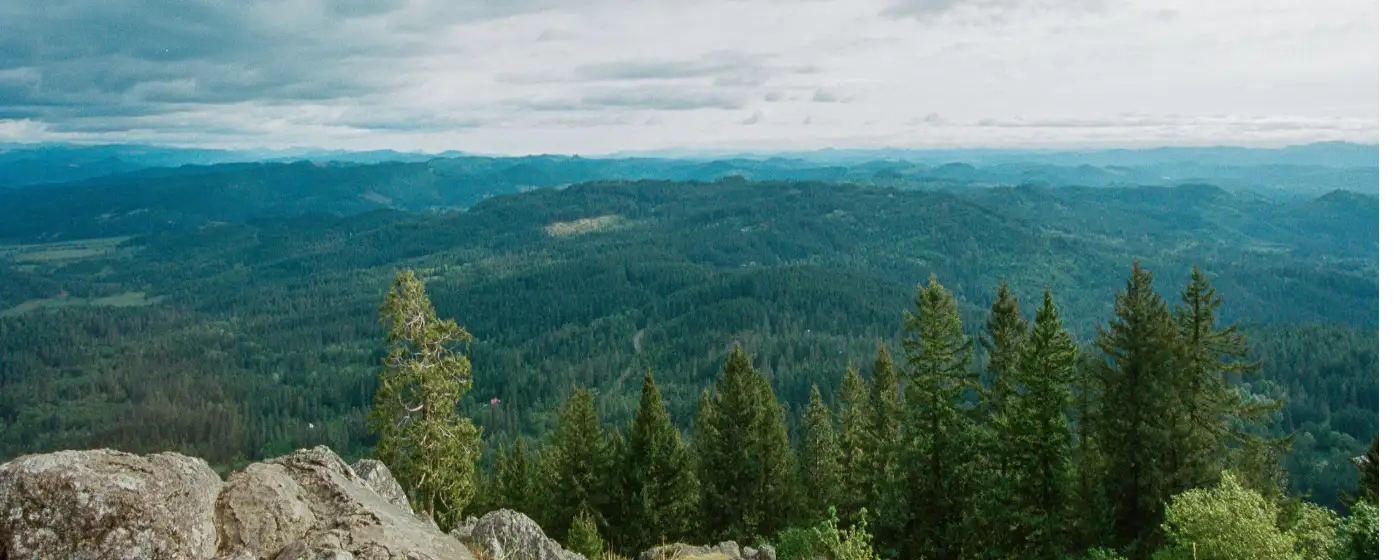
Junction City is a city of 7,256 where the housing stock tells the whole story before you walk through a single door. You have Lennar new-construction on one end, mid-century ranch houses on the other, and two manufactured-home communities that operate on a land-lease model sitting in between. The city sits along OR-99W — the old Pacific Highway — with farmland pressing in on every edge and Eugene just about 20 minutes to the south. That proximity shapes everything: who moves here, what they can afford, and which neighborhood makes sense for their situation.
The economic backbone is modest but stable. The Junction City School District, the Oregon State Correctional Institution, and the City of Junction City itself are the primary employers, supplemented by Lane County and agricultural operations like Hanley Farm. The school district — with 1,558 students enrolled in 2025-26 — holds a C+ rating, according to Niche, which is the honest number buyers with kids need to factor in before choosing a block near the elementary school over a block closer to the freeway. For the full picture on schools, that page covers test scores, boundaries, and what parents actually say.
On cost, the typical home price sits at $489,162 as of July 2026 — meaningfully below Eugene, where competition is fiercer, and noticeably above Harrisburg to the north. The gap between that price and the local median household income of $76,969 means many buyers are stretching. Roughly 40% of Junction City's approximately 2,704 housing units are renter-occupied, which reflects that reality. The cost-of-living page breaks down utilities, taxes, and the full rent picture.
Whether you are comparing subdivisions, figuring out which side of OR-99W suits your commute, or deciding between a fee-simple purchase and a land-lease community, the sections below break down Junction City's seven neighborhoods by character, buyer type, and honest trade-offs.
The Junction City Reality
The single most important thing to understand before buying in Junction City is that OR-99W does not just carry traffic — it organizes the entire city. East of the highway tends to be older, more established, and closer to schools and parks. West of it is where newer development has been landing, with subdivisions like Rolling Meadows pushing toward the agricultural fringe. Buyers who treat the two sides as interchangeable often regret it within six months, especially families whose daily routines involve school drop-offs or after-school activities.
The second divide is ownership structure. Junction City has more manufactured-home communities per capita than most Willamette Valley cities its size, and two of the seven neighborhoods on this list — Farmview Manufactured Homes and The Meadow on Pitney Pond — operate on a land-lease basis. That means you own the home but not the ground beneath it, which affects how you finance the purchase, how the property appreciates, and what your options look like if you want to sell. Scandia Village adds another layer: it is age-restricted, meaning buyers under 55 are simply not eligible. These are not details buried in the fine print — they determine whether a given neighborhood is even an option for you.
The third reality is that Junction City is still building its perimeter. The Reserve and Rolling Meadows are both newer subdivisions that are not fully built out, which means construction traffic, incomplete street grids, and HOA dues that older blocks do not carry. For some buyers that is a fair trade for new mechanicals and contemporary layouts. For others, the established West Side delivers more immediate livability. Knowing which camp you are in before touring homes saves everyone time.
Neighborhoods at a Glance
| Neighborhood | Best For | Vibe |
|---|---|---|
| The Reserve | Luxury Families | New Craftsman construction, HOA community, still building out |
| Rolling Meadows | First-Time Commuter | Suburban townhomes, walking paths, perimeter location |
| Scandia Village | Quiet | Age-restricted manufactured homes, land-lease, low-maintenance |
| Downtown Junction City | Walkable Renter | OR-99W corridor, local shops and restaurants, Scandinavian Festival epicenter |
| West Side | Families Value School | Mature lots, school proximity, established community feel |
| Farmview Manufactured Homes | Value First-Time | All-ages land-lease, open floor plans, lowest entry point |
| The Meadow on Pitney Pond | Nature Views | All-ages manufactured homes, pond setting, Coast Range views |
Junction City typical home price: $489,162 (Zillow ZHVI, July 2026). Neighborhood tiers on this page are relative to these figures.

Best Neighborhood by Buyer Type
| Buyer Type | Best Neighborhood | Why |
|---|---|---|
| First-Time Buyer | Rolling Meadows | Newer construction means fewer immediate repair costs, and townhome-style layouts keep the footprint manageable for a first purchase. |
| Luxury Buyer | The Reserve | Lennar's Craftsman builds represent the city's highest-end non-acreage product, with contemporary finishes above the city median. |
| Walkability Seeker | Downtown Junction City | The OR-99W corridor puts independent coffee shops, restaurants, and the Historic Train Depot within a short walk of front doors. |
| Families with Kids | West Side | Proximity to district schools and Day Memorial Park makes the daily school-run genuinely walkable for many households. |
| Commuter | Rolling Meadows | The perimeter location feeds quickly onto OR-99W for the roughly 20-minute drive south to Eugene. |
| Large-Lot Buyer | The Meadow on Pitney Pond | Farmland borders and Coast Range views give a rural feel that no in-town subdivision can match. |
| Renter | Downtown Junction City | The highest concentration of rental inventory in the city sits along and just off the main OR-99W corridor. |
Looking to buy in Junction City? Estimate your payment.
Enter your numbers to see an estimated monthly mortgage payment.
Estimate only. Excludes HOA fees and mortgage insurance. The interest rate above is a starting point, not a quoted rate — replace it with your own to see real numbers. Insurance is a flat placeholder, not a Junction City quote.
Most Popular Neighborhoods
The Reserve
The Reserve is Junction City's newest and most polished subdivision, developed by Lennar with open-concept floor plans and contemporary Craftsman exteriors that stand out against the city's older housing stock. Prices here run above the citywide typical home price of $489,162 (July 2026), and HOA dues add a monthly cost that older neighborhoods never carry. The neighborhood is still filling in — some blocks remain under construction, which means morning concrete trucks for buyers who moved in early.
Best for: Buyers who want new mechanicals, a warranty, and a consistent aesthetic, and who can absorb the premium over older West Side homes.
Rolling Meadows
Rolling Meadows sits on the outer edge of the city, where the street grid gives way to walking paths and open space between Pacific National Development's townhome-style buildings. It is a younger-feeling neighborhood than anything on the established West Side, and the perimeter location means some errand runs require a car even for things that feel close on a map. The trade-off is a clean, newer product at a price point that first-time buyers can engage with.
Best for: First-time buyers and Eugene commuters who want a low-maintenance footprint without stepping into a land-lease situation.
Scandia Village
Scandia Village is an age-restricted manufactured-home community for residents 55 and older, operating on a land-lease model where buyers own the home — typically around 1,440 square feet with three bedrooms and two baths — but not the underlying land. That distinction matters significantly: land-lease financing is narrower than a conventional mortgage, and resale options are more limited than fee-simple ownership. The community is quiet and lower-maintenance by design, but buyers coming from a traditional homeownership background should read the lease terms carefully before committing.
Best for: Buyers 55 and older who want a right-sized home with low exterior upkeep and understand the land-lease structure going in.
Downtown Junction City
Downtown Junction City runs along OR-99W and is the closest thing the city has to a walkable core — independently owned restaurants, coffee shops, and the pair of historic anchors: the Historic Train Depot and The Lee House Museum. Every August the district transforms for the Scandinavian Festival, a free event founded in 1961 that draws crowds from across the region and has held Oregon Heritage Tradition status since 2014. Living within a few blocks is genuinely lively for a city this size, but the OR-99W traffic noise is real and does not go away after the festival ends.
Best for: Renters, buyers who want on-foot access to dining and civic life, and anyone who values being in the middle of things over quiet.
West Side
The West Side is the neighborhood most longtime Junction City families point to when they describe where they actually want to be — mature trees, established lots, and blocks that put kids within walking distance of district schools and Day Memorial Park. The housing stock is older, meaning buyers should budget for eventual system updates, but the community roots here run deeper than in any of the newer subdivisions. Among the city's conventional-ownership options, the West Side is consistently where families with school-age children end up when they slow down and think through their priorities.
Best for: Families with school-age children, buyers who want fee-simple ownership, and anyone who prefers a lived-in neighborhood over a freshly poured one.
Farmview Manufactured Homes
Farmview is an all-ages manufactured-home community selling homes on a land-lease basis, with listings that include newer Palm Harbor models featuring vaulted ceilings, open floor plans, and covered porches. The purchase price represents the lowest entry point in the city, but buyers should be clear-eyed about what they are buying: the land is not included, conventional mortgage products generally do not apply, and HOA-style community rules govern daily life. For buyers who understand the structure and need an affordable foothold in Junction City, Farmview delivers far more square footage per dollar than anything in The Reserve.
Best for: Cost-conscious buyers who understand the land-lease model and need an accessible entry point into Junction City homeownership.
The Meadow on Pitney Pond
Built in 1998 on 104 lots, The Meadow on Pitney Pond is an all-ages manufactured-home community at the agricultural edge of the city, where Willamette Valley farmland and Coast Range views frame the setting in a way no in-city subdivision can replicate. The community includes a private pond and park, a Sport Court, and a children's play area, and the proximity to Eugene Airport — about 8 miles — is a legitimate convenience for frequent travelers. Like Farmview, it operates on a land-lease basis, so the same financing and resale considerations apply.
Best for: Buyers who prioritize natural surroundings and open views over urban convenience, and who are comfortable with the land-lease ownership structure.
Common Mistakes Buyers Make in Junction City
Treating OR-99W as a Dividing Line, Not a Decision
The most common mistake relocating buyers make is not realizing that which side of OR-99W they land on determines the texture of daily life more than any other single factor. Buyers focused on square footage or price per foot often end up on a block that feels disconnected from schools, parks, and the city's walkable core — and realize it only after they have moved in. Know which side of the corridor serves your actual routine before you make an offer.
Overlooking the Land-Lease Structure
Junction City has a higher share of land-lease housing than most comparable Oregon cities, and buyers new to the format consistently underestimate what it means for their finances. Financing a manufactured home on leased land typically requires a chattel loan rather than a conventional mortgage, with higher rates and shorter terms. Resale is also narrower — you are selling to a buyer who faces the same financing constraints. If you are considering Farmview Manufactured Homes, The Meadow on Pitney Pond, or Scandia Village, talk to a lender who specializes in manufactured housing before touring a single home.
Assuming the Whole City Is One School Boundary
Junction City School District 69 is small — 1,558 students enrolled in 2025-26 — but that does not mean every address feeds the same school or that every school in the district performs identically. Buyers chasing price in a specific neighborhood sometimes discover after closing that the boundary line put their kids in a different attendance zone than they expected. Verify the exact boundary for your address, not just the district rating, before committing. The schools page covers this in detail.
Buying Into a Half-Built Subdivision Without Pricing In the Wait
The Reserve and Rolling Meadows are both still actively developing, which means the neighborhood you buy into today may look and feel different in two or three years — more neighbors, more finished streets, but also more construction traffic and the noise that comes with it in the meantime. Buyers who stretched their budget to afford a new build sometimes find the HOA dues and the ongoing construction timeline more wearing than they expected. If you need a settled, finished neighborhood from day one, the West Side delivers that; the newer subdivisions do not, yet.
Best Areas to Rent in Junction City
| Area | Ideal For | Trade-off |
|---|---|---|
| Downtown / OR-99W Corridor | Renters who want on-foot access to restaurants, coffee shops, and local retail | OR-99W traffic noise is consistent; parking can be tight near the commercial strip |
| West Side | Families who want proximity to schools and parks without owning yet | Rental inventory is thinner here — units move fast and rarely sit |
| Rolling Meadows | Commuters who want a newer unit and a clean suburban setting | Perimeter location means most errands require a car |
| Farmview Manufactured Homes | Budget-conscious renters or buyers testing the land-lease format before committing | Community rules and the land-lease model are different from conventional rentals — read the lease |
| The Meadow on Pitney Pond | Renters who want quiet, open views, and room to breathe at the agricultural edge | The furthest from the OR-99W commercial corridor; daily errands require driving |
Roughly 40% of Junction City's housing units are renter-occupied, which means the rental market is active — but Junction City is a city of 7,256, so total inventory is limited. When a good West Side rental comes available near the schools, it tends not to last. For the city-wide typical rent figure and how it compares regionally, the cost-of-living page has the full breakdown.
Local Expert Takeaway: The West Side is Junction City's most consistently sound buy for families — mature lots, school proximity, and fee-simple ownership in a neighborhood that newer subdivisions are still working to replicate. Buyers attracted to The Reserve's Lennar finishes should run the HOA dues and construction timeline against that baseline before signing. And anyone considering Farmview, The Meadow on Pitney Pond, or Scandia Village needs to have the land-lease conversation with a manufactured-housing lender first — this is not a detail to sort out after you fall in love with a floor plan.
Quick Takeaways & FAQs
✅ The West Side delivers the best combination of school proximity, mature lots, and community depth among Junction City's conventional-ownership neighborhoods.
⚠️ Two of the city's seven neighborhoods operate on a land-lease model, which limits financing options and resale flexibility in ways buyers often underestimate.
📍 The Scandinavian Festival has run every August since 1961 and fills the OR-99W corridor with crowds from across the region — if you live downtown, that week is lively in a way that surprises new residents.
What is the most affordable neighborhood in Junction City, OR?
What is the best neighborhood in Junction City for families with young kids?
Are there age-restricted communities in Junction City?
What does 'land-lease' mean for buyers in Junction City's manufactured-home communities?
How far is Junction City from Eugene, and does the commute affect which neighborhood to choose?
Moving to Oregon?
Tell us what you need help with and we'll connect you with local resources.
