
Maybe you've been priced out of your California market and someone mentioned the Oregon Coast. Maybe you've driven US-101 through Curry County on vacation and started doing the math. The surprise most Californians hit immediately is not the price of the homes — it's how much house you get for them. Gold Beach, a city of 2,466 on the mouth of the Rogue River, sits at the far southern end of the Oregon Coast, connected to the outside world primarily by US-101 running north and south and OR-595 heading inland. There is no freeway, no suburban sprawl, no commuter rail. What there is: ocean bluffs, old-growth corridor, jet boats threading canyon walls, and a pace that either fits your life or doesn't.
The economic backbone here is tourism and public employment. The Wild and Scenic Rogue River has anchored jet boat tours since 1958, and anglers come from across the country to fish the Rogue and its coastal tributaries. Year-round, the largest employers are Curry County government, the City of Gold Beach, a regional healthcare network, the US Forest Service, and Central Curry School District 1 — which holds a C rating, according to Niche, and serves 366 students enrolled in 2025-26. Remote work has reshaped who can realistically call Gold Beach home, and that shift is visible in the buyer pool: Californians who can bring their income with them are now a meaningful part of it. The community also skews older — 27% of residents are 65 or older, compared to Oregon's 19% statewide, according to the city's 2025 Strategic Plan.
The cost picture is where this move gets genuinely interesting for a Californian. Gold Beach's typical home price sits at $439,479 (July 2026), noticeably below California's statewide typical home value of $773,735. Oregon has no sales tax at all — none, state or local — and the property tax rate here runs well below the California effective average. The trade-offs are real: the local job market is thin, amenity density is low compared to any California suburb, and a serious shopping run means driving out of town. But for buyers who can work remotely, those are calculated trade-offs, not deal-breakers.
Whether you are seriously weighing the move or still at the research stage, the sections below break down the California-to-Gold Beach price and tax comparison, what the daily lifestyle reality looks like, what to know about the local school district, and the honest friction points that Californians tend to underestimate before they arrive.

The Home Price Reality: What Your California Equity Can Buy
The single most powerful motivator for Californians moving to Gold Beach is what happens when you apply California equity to an Oregon coastal market. Gold Beach's typical home price stands at $439,479 (July 2026). California's statewide typical home value of $773,735 means the gap between what you are likely selling and what you are buying is substantial — often enough to buy outright or carry a dramatically smaller loan than you left behind.
Entry-level options in Gold Beach start well below that typical figure, mostly older single-family homes and fixer properties. The upper end of the market — newer construction with river or ocean views in areas like Rogue Hills or Indian Hills — runs above it. For context, Brookings to the south and Bandon to the north both come in somewhat higher than Gold Beach; Port Orford, about 27 miles up the coast, comes in somewhat lower. Gold Beach sits in the middle of that coastal range and tends to attract buyers who want more town infrastructure than Port Orford offers without paying Brookings prices.
One thing Californians sometimes miss: if you have owned your California home for many years, you may have been benefiting from Proposition 13's cap on assessed-value growth — paying taxes on an assessed value far below current market price. When you sell and buy in Oregon, you reset to current market value here too. The difference is that Oregon's Measure 50 caps annual assessed-value increases at 3%, giving you predictable, stable property tax growth from your purchase date forward. That structural protection is genuinely comparable to Prop 13's inflation cap, just starting from a transparent current-market baseline rather than a decades-old one.
One caution specific to Gold Beach: if you are drawn to waterfront property near the Rogue River mouth, flood and erosion risk is real. Ask for an elevation certificate and review the property's flood history before making an offer — this is not a standard step California buyers always take, and skipping it here can be costly. For more on the full buying process, see the Gold Beach first-time homebuyer guide.
Taxes: The Honest California-vs-Oregon Comparison
The tax picture between California and Oregon is genuinely favorable for most Gold Beach buyers — but it requires more nuance than "Oregon taxes are lower," because in one category that is not straightforwardly true.
Property Tax
Gold Beach's effective property tax rate is 0.59%. California's effective property tax rate of 0.71% (Zillow ZHVI) is the statewide average, but long-tenured California homeowners often pay far less than that thanks to Prop 13's frozen assessments. A Californian who has owned for 20 years and carries a bill based on a 2004 assessed value will likely see their property taxes increase when they purchase in Gold Beach — not because Gold Beach's rate is high (it isn't), but because the reset to current market value is real. For a recent California buyer paying closer to the effective rate, the move to Gold Beach looks favorable.
Sales Tax
This one is uncomplicated. Oregon has no sales tax — not state, not local. California's statewide base sales tax rate of 7.25% is already the highest in the country, and local additions push the typical combined rate well above that. For a household spending $50,000 a year on taxable goods and services, the absence of Oregon sales tax represents meaningful annual savings, with no asterisks.
State Income Tax
California's top state income tax rate of 13.3% applies only to the highest earners — those with seven-figure incomes. Oregon's top rate of 9.9% is genuinely lower at that level. But Oregon's brackets are steep and compress quickly: a six-figure earner in Oregon reaches near the top bracket much faster than the same earner would in California. For remote workers bringing a California salary to a Gold Beach address, the effective Oregon income tax rate may land closer to — or in some cases above — what they were paying in California. Oregon does allow residents to subtract a portion of federal income taxes paid from their Oregon taxable income, which helps lower- and middle-income earners most; the deduction phases out entirely for joint filers above $290,000 in federal adjusted gross income.
The honest summary: sales tax savings are real and immediate for everyone. Property tax outcome depends on how long you owned in California and what you are buying here. Income tax is the one where a blanket "Oregon is cheaper" claim can mislead — model your specific income before treating it as a given. For the full tax and cost breakdown, see the Gold Beach cost of living page.
| Tax Category | Gold Beach / Oregon | California (for comparison) | Practical Effect for Relocating Buyers |
|---|---|---|---|
| Property Tax (effective rate) | 0.59% | California's effective property tax rate of 0.71% | Favorable for recent CA buyers; may increase for long-tenured Prop 13 holders who reset |
| Sales Tax | 0% (none) | California's statewide base sales tax rate of 7.25% plus local additions | Clear savings on every taxable purchase |
| State Income Tax (top rate) | 9.9% | California's top state income tax rate of 13.3% | Lower at the top; but OR brackets compress — six-figure earners reach near-top rate faster |
| Assessed Value Cap | 3% annual (Measure 50) | 2% annual (Prop 13, for existing owners) | Comparable long-term stability; both reset at purchase |
| Federal Tax Deduction | Partial deduction allowed (phases out above $290K AGI) | No equivalent state deduction | Modest benefit for lower- and middle-income Oregon filers |
Daily Life on the South Oregon Coast: The Adjustment Californians Don't Fully Anticipate
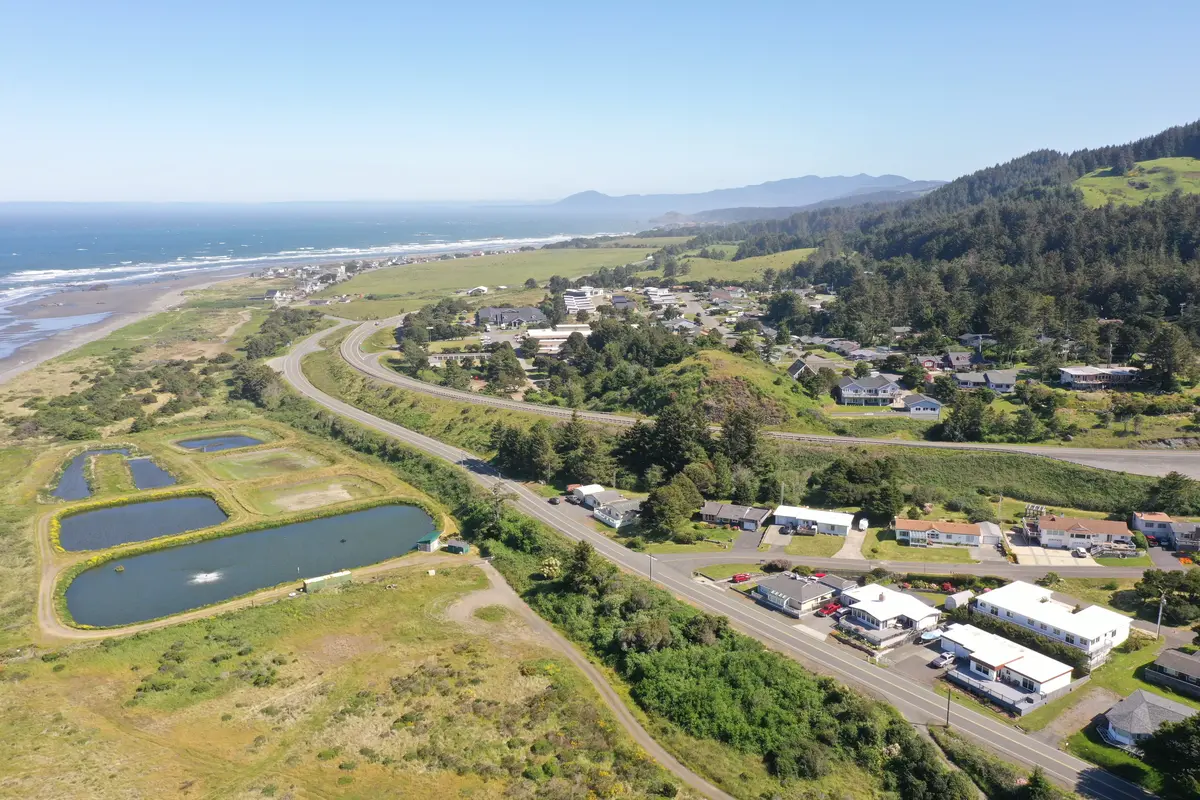
Six months in, almost every Californian who moves to Gold Beach says the same thing: the distance doesn't feel abstract anymore. This is not a city with a Costco two miles away, or a freeway on-ramp that connects you to a regional hub in twenty minutes. Gold Beach has no direct freeway connection to I-5. US-101 is the spine of daily life, running through town and connecting you north and south along the coast. For anything the local shops don't carry, you are ordering online or planning a real road trip.
The Amenity Trade-Off
Gold Beach proper has independent cafés, a handful of restaurants, and the basics for day-to-day living — but not the amenity density of even a mid-sized California city. Californians who moved from inland metros in particular should expect significantly cooler summers: ocean-side temperatures average in the mid-to-upper 60s°F, and Gold Beach sees 192 sunny days a year — solid for the Oregon Coast, but not the 300-day sunshine some coastal Oregon marketing implies. Late fall through early spring brings consistent overcast and rain. That seasonal pattern is either a feature or a dealbreaker, and it is worth visiting in November before deciding.
What Remote Work Changed
The rise of remote work genuinely altered who can live here. Californians who bring their own income — whether salaried remote employees or self-employed — have far more flexibility than buyers who need to find local work. The local job market is seasonal and relatively thin: tourism and outdoor guiding surge in summer, and government, healthcare, and education anchor the year-round base. If you need a local job in a professional field, options are limited and competition is real.
Where People Actually Spend Their Time
The Rogue River is not a background amenity — it is the social and recreational center of the town. Jet boats run the canyon, and fishing the Rogue is a year-round pursuit for residents who came here precisely for it. The Port of Gold Beach is where the community gathers for events, and Cape Sebastian State Scenic Corridor and Samuel H. Boardman State Scenic Corridor put world-class coastal hiking within a short drive. This is a town where outdoor access is the primary lifestyle draw, and buyers who are genuinely here for that find it delivered. Buyers who expected it to be a background perk, while they found a café culture and an arts scene comparable to a California coastal town, tend to be the ones who leave.
Routine health insurance premiums generally run noticeably below what you were paying in California, though you will drive farther for specialist care. For a fuller picture of what retirees and older residents navigate here, see the Gold Beach retiring guide.
Looking to buy in Gold Beach? Estimate your payment.
Enter your numbers to see an estimated monthly mortgage payment.
Estimate only. Excludes HOA fees and mortgage insurance. The interest rate above is a starting point, not a quoted rate — replace it with your own to see real numbers. Insurance is a flat placeholder, not a Gold Beach quote.
Schools, Families, and What Parents From California Should Know
Central Curry School District 1 holds a C rating, according to Niche, and serves 366 students enrolled in 2025-26 — a very small district by any measure. On 2024-25 state assessments, 24.2% of students reached math proficiency and 34.9% reached reading proficiency. Those figures sit below Oregon state averages, and California families moving from higher-performing districts should go in with clear eyes.
The flip side of a small district is that kids are not anonymous. Class sizes are small, teachers know families by name, and the K-12 experience has a community-school character that larger systems rarely deliver. The district runs active OSAA athletics programs, and Friday night football carries real social weight for a town this size — the stands fill, and school events are genuine community events rather than niche ones.
Families with school-age children who are weighing this move typically fall into two camps: those who came specifically for the outdoor lifestyle and find the school trade-off acceptable, and those who arrived hoping the small-district feel would compensate for lower academic benchmarks and found it didn't, entirely. Both responses are honest and worth knowing before you decide. For full district details and school-by-school information, see the Gold Beach schools page.
Youth sports and activities outside school tend to center on the river, the coast, and the surrounding forest — fishing, kayaking, and hiking are legitimate extracurricular pursuits here in a way they simply are not in California suburbs. For parents with kids who want that kind of childhood, Gold Beach is a rare find. For kids who need competitive travel sports programs, the distances to organized leagues are significant.
Who Moves Here — and Who Leaves
Gold Beach attracts a specific kind of Californian: the buyer who has genuinely priced out a decision over years, not weeks. The retired couple who sold in the Bay Area and bought outright with cash left over. The remote worker in their 40s who realized their Sacramento or Fresno salary goes much further when the mortgage is a fraction of what they were paying. The angler or hiker who always said "someday" and finally made the call.
The community's age skew tells the story: 27% of Gold Beach residents are 65 or older, more than eight points above Oregon's statewide share. This is not a city building itself around young families — it is a city that has organically become a destination for people at or near retirement who want a quieter coastal pace and can afford to get out of California to find it. No 55+ communities were found in Gold Beach, but the demographics of the existing neighborhoods reflect that draw without requiring a dedicated development.
People leave Gold Beach for a handful of consistent reasons. The winters — long, grey, and wet — grind on people who underestimated them. The distance to advanced specialist care, and the reality of what that means during a medical event, is a factor some families don't weigh seriously enough in advance. The thin local job market catches people who planned to find work after moving and discovered the options were narrower than expected. And some buyers, particularly those with teenagers, find the social ecosystem for adolescents too limited and make the move back to a larger city when their kids hit high school age.
The buyers who stay tend to share one thing: they moved here knowing what Gold Beach is, not hoping it would become something else. The living in Gold Beach overview covers the broader picture of who the city suits and why.

Local Expert Takeaway: Gold Beach is a genuinely good financial move for most Californians selling at current California prices — the typical home price here is well below California's statewide typical home value, Oregon has no sales tax, and the property tax rate is among the lowest in the state. But the lifestyle adjustment is steeper than the numbers suggest. You are moving to a city of 2,466 people on a remote stretch of coast with no freeway access, a thin local job market, and winters that are genuinely grey. The Californians who are happiest here are the ones who moved for the Rogue River, the Cape Sebastian hiking, and the pace — and who worked out the remote-income or retirement picture before they arrived, not after.
Quick Takeaways & FAQs
✅ Gold Beach's typical home price sits well below California's statewide typical home value, and Oregon's zero sales tax adds immediate, uncomplicated savings on everyday spending.
⚠️ The local job market is seasonal and thin — Californians who need to find local professional employment after moving will face limited options and real competition for them.
📍 Oregon's income tax brackets compress quickly, meaning six-figure remote workers may pay a higher effective state income tax rate than they expect — model your actual income before assuming Oregon is cheaper across the board.
Is Gold Beach actually affordable compared to California, or does the remoteness cost offset the savings?
Will my Oregon income taxes actually be lower than what I paid in California?
What happens to my property taxes when I sell my California home and buy in Gold Beach?
How remote is Gold Beach really, and what does that mean day-to-day?
Is Gold Beach a good move if I have school-age kids?
Moving to Oregon?
Tell us what you need help with and we'll connect you with local resources.
