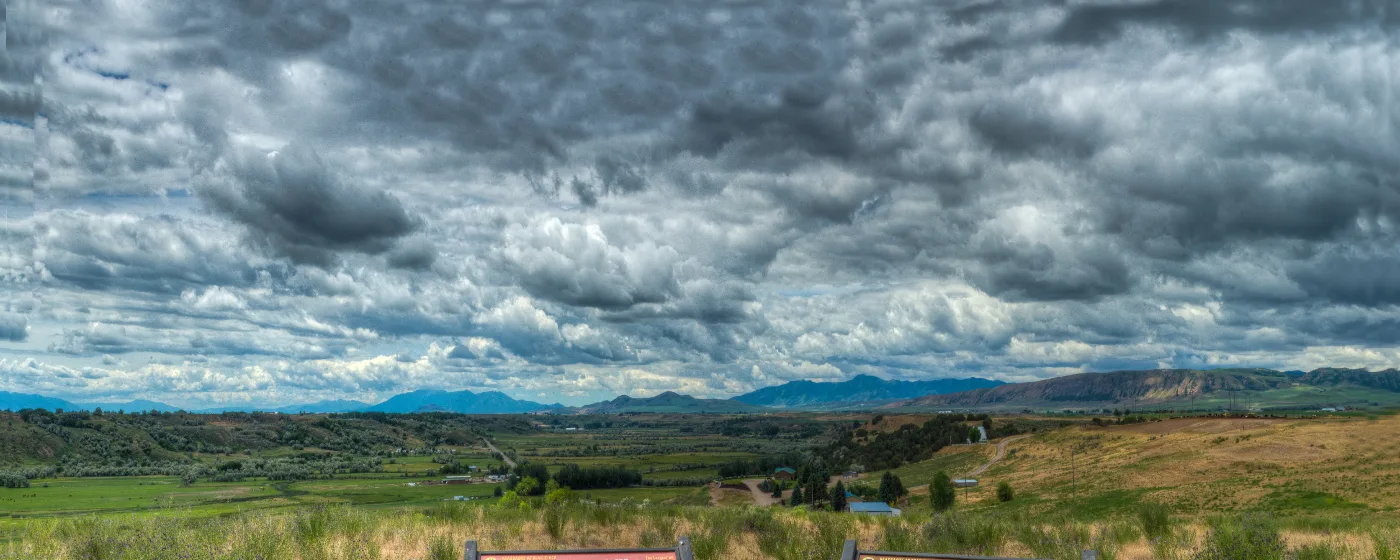
Maybe you've been watching Boise and Logan, Utah eat themselves with appreciation, and someone mentioned Preston as a place where a fixed income still goes far. Maybe you grew up in Cache Valley and want to land close to family without paying Utah prices. Or maybe you pulled off U.S. Highway 91 once, saw the Bear River range in the background and the quiet main street, and thought — this could work. What surprises most people who look seriously at Preston is that it punches above its size on healthcare. For a town of roughly 6,400 people in Franklin County, having a nationally ranked hospital within city limits is not something most rural retirement candidates can say.
Preston sits at the northern tip of Cache Valley, about 27 minutes from Logan, Utah — which means it straddles two states' worth of amenities while keeping Idaho's tax structure. The regional economy runs on county government, agriculture, and the retail and service businesses that serve a self-contained small city. What that means for retirees is a slow-paced, community-rooted daily life where you will recognize faces at the Franklin County Fairgrounds events and at the Worm Creek Opera House long before you've been here a year.
Cost of living is the headline. Preston's overall expenses run noticeably below the U.S. national average, and the full cost-of-living breakdown shows where those savings concentrate. The median home sale price in March 2026 was $470,000 — meaningfully below comparable Cache Valley communities across the state line. Property taxes carry an effective rate of approximately 0.64%, and Idaho's treatment of Social Security income is straightforwardly favorable. Winters are genuine — Bear River country cold, with snow measured in feet — and the trade-off for affordability is accepting that a Target run or a specialist appointment may involve a drive.
Whether you're seriously weighing a move or just running the numbers on eastern Idaho, the sections below cover healthcare access, the retiree tax picture, daily budget realities, community and walkability, downsizing options, and how Preston stacks up against nearby retirement destinations.

Why Retirees Are Choosing Preston
Preston genuinely fits a specific type of retiree: someone who wants a small, cohesive community where the cost of entry is real rather than aspirational, where neighbors know each other, and where the outdoors — the Bear River, the surrounding mountains, the farmland — is not a weekend destination but the daily backdrop. The median home sale price of $470,000 (Homes.com, March 2026) makes a mortgage-free or low-mortgage retirement achievable for buyers arriving from higher-priced markets.
The community's LDS cultural roots run deep. Social life in Preston often flows through the church calendar, community events at the Worm Creek Opera House, and the Franklin County Fairgrounds. If that kind of tight-knit, faith-adjacent social fabric is what you're looking for in retirement, Preston will feel like exactly the right fit. If you prefer a more secular, cosmopolitan scene with a full roster of independent restaurants and arts venues, the catch is honest: Preston is small, and its dining and nightlife options reflect that.
Who should look elsewhere? Retirees who need frequent specialist care and can't drive to Logan, those who prioritize walkable urban amenities, or anyone counting on public transportation to maintain independence. Preston has no meaningful transit network, and a car is not optional — it is the infrastructure. Active retirees who are self-sufficient, community-minded, and want a home base near both Idaho and Utah amenities will find Preston's combination of price, safety, and local character hard to replicate at this cost level.
Healthcare & Medical Access in Preston
Franklin County Medical Center: Surprisingly Strong for a Town This Size
Franklin County Medical Center (FCMC) sits right in Preston — a 20-bed Critical Access Hospital that has been serving the community since 1929. In February 2026, The Chartis Center for Rural Health named it one of the Top 100 Critical Access Hospitals in the United States, making it the only Idaho hospital on that list out of approximately 1,300 eligible facilities nationwide. That recognition is not ceremonial — it reflects measured performance on quality, outcomes, and patient experience.
FCMC recently expanded its on-site specialty services to include urology and gynecology, added a new MRI machine, and completed a full renovation of its medical campus along with a new medical office building. For routine care, preventive screenings, and many common procedures, you will not need to leave town. The attached 35-bed skilled nursing facility means that if a stay-in-place recovery scenario becomes necessary, that option exists locally as well.
The Honest Distance-to-Advanced-Care Reality
Where FCMC's critical access designation has limits is in subspecialty depth — cardiac surgery, oncology treatment centers, neurology, and major trauma all require a drive. The good news is that Preston is part of the Logan, Utah–Idaho Metropolitan Statistical Area, placing Logan Regional Hospital and Cache Valley Hospital (both in Logan and North Logan, Utah) within roughly 27 minutes. That drive is straightforward on Highway 91 and is manageable on a non-emergency basis.
For anything requiring a major medical center — an academic hospital, Level I trauma, or complex cancer care — Salt Lake City is approximately two hours south. That distance is worth factoring honestly into your retirement calculus, particularly if you have a chronic condition that requires frequent specialist visits. Most Preston retirees describe the Logan–Preston healthcare corridor as adequate for daily and urgent needs; Salt Lake becomes relevant only for the most complex cases.
Senior Living and Long-Term Care
Heritage Senior Living in Preston provides assisted living and memory care services for those who need more support than independent living allows. Idaho's average assisted living cost runs approximately $5,310 per month, which is noticeably below the national average of about $5,900 per month — a meaningful difference when you're planning for multi-year care costs. For in-home care and therapy services, FCMC's expanded campus and the proximity to Logan's broader healthcare network give Preston seniors more options than the town's size would suggest.
The Retiree Budget in Preston
How Idaho Treats Retirement Income
Idaho fully exempts Social Security benefits from state income tax — at every income level, with no phase-out. If Social Security is your primary income source, that exemption is worth more in Idaho than in many western states.
The picture is more mixed for other retirement income. Withdrawals from 401(k)s, traditional IRA distributions, and most private-sector pensions are taxable at Idaho's flat rate of approximately 5.695% (the 2024 rate, confirmed through 2026 filings). A Retirement Benefits Deduction exists, but it applies narrowly — covering certain federal retirement pensions, Idaho public-safety pensions, and military retirement. Most retirees with private-sector 401(k)s will not qualify for that deduction.
Idaho has no estate tax, inheritance tax, or gift tax, which matters if you're planning to pass assets to children or grandchildren.
Property Taxes and the Circuit Breaker
Preston's effective property tax rate is approximately 0.64% — above Idaho's statewide median of 0.43% but still well below the U.S. median of 0.89%. The dollar impact on a typical home remains modest relative to most western markets, and the engine's calculator below can run exact scenarios once you have a purchase price in mind.
If your income in retirement is modest, Idaho's Circuit Breaker program is worth knowing. Qualifying seniors age 65 or older with 2025 income under $39,130 can receive a property tax reduction of $250 to $1,500. Applications open January 1 and must be filed by April 15 at the Franklin County Assessor's office. Many Preston retirees living primarily on Social Security will fall within that income threshold.
Daily Cost of Living on a Fixed Income
Preston's overall cost of living runs noticeably below the U.S. national average, with grocery costs running particularly well below national norms. That's a tangible difference on a fixed income — especially if you cook at home and stock up during the Franklin County growing season. Dining out is limited in variety but inexpensive when you do; a meal at a local spot runs a fraction of what the same plate costs in Logan or Idaho Falls.
The cost category that surprises people is vehicle ownership. Because everything — specialty care, big-box retail, and broader restaurant choices — requires a drive to Logan, fuel and vehicle maintenance are genuine recurring budget items. Factor in two cars if you and a partner both value independence; one is a vulnerable single point of failure in this geography.
Looking to buy in Preston? Estimate your payment.
Enter your numbers to see an estimated monthly mortgage payment.
Estimate only. Excludes HOA fees and mortgage insurance. The interest rate above is a starting point, not a quoted rate — replace it with your own to see real numbers. Insurance is a flat placeholder, not a Preston quote.
Walkability, Community & Staying Active in Preston
The Walkability Reality
Preston's downtown core is flat — the city sits in the valley floor — which is the good news for retirees who want to get around on foot. The less good news is that walkability in the traditional urban sense, where you can handle weekly errands without a car, is limited. A handful of shops and services are accessible on foot from the neighborhoods closest to State Street, but a full grocery run, a pharmacy visit, and most services will put you behind the wheel.
Terrain is not the issue — it's scale. Preston simply doesn't have the density of amenities that make a car-optional lifestyle practical. If you buy near Downtown Preston, you'll be within walking distance of a few essentials, but plan your retirement lifestyle around car access rather than hoping to go without one.
Where Retirees Actually Gather
The Worm Creek Opera House on State Street is the anchor of Preston's arts and social calendar — live performances, community theater, and events draw a cross-generational crowd and give retirees a consistent reason to leave the house on a weekend evening. The Franklin County Fairgrounds hosts seasonal events that function as the town's informal community living room.
The Bear River and the surrounding terrain are the real outdoor amenity. Fishing along the river corridor, hiking on nearby trails, and birding in the wetlands draw retirees who want low-intensity outdoor activity year-round. Winters close some of those options, but the proximity to Bear Lake, roughly an hour south, keeps the outdoor calendar full across seasons. For the full parks and trails picture, that page goes deeper.
Senior Community and Social Life
For a city this size, Preston's social infrastructure for older adults is primarily community-based rather than institution-based. Service organizations, faith communities, and volunteer roles at county offices give retirees structured ways to stay connected. The absence of a formal senior center is a genuine gap compared to larger Idaho cities — if you moved here from a metro area with a robust senior recreation center, you'll notice the difference. What Preston offers instead is the kind of organic social density that comes from a small, stable population: you will know your neighbors, your doctor, and your pharmacist by name within months.
Right-Sizing: Downsizing in Preston
What the Inventory Actually Looks Like
Preston's housing stock skews toward single-family homes on larger lots — the kind of older ranch-style and craftsman construction that was built for families, not for retirees looking to shed square footage and yard maintenance. Single-level homes do exist throughout the neighborhoods, but they sell quickly when they hit the market because demand from both local downsizers and incoming retirees competes for limited inventory.
Patio homes and maintenance-free attached housing are the segment where Preston is most constrained. There is no established 55-plus active-adult community within city limits in the way that larger Idaho markets have built out. If that specific product — lock-and-leave, HOA-maintained exterior, peer-age neighborhood — is what you need, you will likely find it more readily in Logan or in the broader Cache Valley market, with Preston as a nearby option rather than the primary search area.
Heritage Senior Living and the Care Continuum
For retirees who are ready for or anticipating assisted living, Heritage Senior Living in Preston covers assisted living and memory care. Having that option in town matters — many small Idaho cities require a drive to the nearest facility, which complicates family visits and logistics. The Idaho average cost of roughly $5,310 per month for assisted living applies here, which is more manageable than national figures.
Independent living at the single-family level remains the dominant model in Preston. If you're downsizing from a four-bedroom home, expect to find three-bedroom ranches and two-bedroom homes as your primary options. Expect competition for any single-level home in good condition near the city's walkable core — those properties tend to move without much time on market.
The Practical Downsizing Sequence
Most Preston downsizers follow a simple path: sell the larger family home, move into a smaller single-level property in the same city, and use the equity difference to pad retirement savings or cover future care costs. Given that the median sale price sits at $470,000 — see the full cost breakdown here — a buyer arriving from a higher-cost market can often purchase a smaller home outright or with minimal financing, which dramatically changes the monthly budget math on a fixed income.
If you're specifically looking for new construction with senior-friendly features — zero-step entry, wider doorways, open floor plans — your options in Preston are limited. Custom builds are possible on available lots, but the spec-home market hasn't produced much in that category. Working with a local builder or identifying older ranch homes that can be modified is the more realistic path for most buyers.
Preston vs Nearby Retirement Destinations
| City | Cost vs Preston | Primary Hospital | Walkability | Senior Living Depth | Overall Retirement Fit |
|---|---|---|---|---|---|
| Preston, ID | Anchor | Franklin County Medical Center (Top 100 Critical Access, 2026) | Flat but car-dependent for errands | One assisted living/memory care facility on-site | Quiet Value Best for self-sufficient, community-minded retirees |
| Logan, UT | Noticeably pricier | Logan Regional Hospital (full-service, multi-specialty) | Stronger — downtown walkable core, more services on foot | Multiple senior communities, assisted living, memory care options | Walkable Best for retirees who want urban amenities and deeper medical access |
| Franklin, ID | About the same or slightly cheaper | Relies on FCMC in Preston (~10 min) | Minimal — very small village, car essential | Essentially none locally | Privacy Best for buyers who want extreme quiet and rural character |
| Richmond, UT | About the same | Cache Valley Hospital in North Logan (~20 min) | Small-town walkable core, limited services | Limited locally; Logan options accessible | Quiet Best for retirees comfortable in very small Utah communities |
| Weston, ID | Noticeably cheaper for raw land; comparable for homes | Relies on FCMC in Preston or Logan hospitals | Minimal — unincorporated feel, car essential | None locally | Nature Best for buyers who want maximum space and minimal neighbors |
| Smithfield, UT | About the same to slightly pricier | Cache Valley Hospital (~15 min) | Better than Preston — small but more walkable retail | Growing senior housing inventory; more options than Preston | Families Commuter Fits retirees who want Utah services with small-town feel |
Logan is the obvious comparison because it's 27 minutes away and offers substantially deeper medical access, more senior living product, and a more walkable downtown — but at a noticeably higher price point for housing. Preston wins on cost and community intimacy; Logan wins on amenities and specialist access.
Franklin and Weston, both minutes from Preston, offer more rural character and potentially lower entry costs, but they give up local healthcare entirely and depend on Preston or Logan for nearly every service. Richmond and Smithfield on the Utah side split the difference — small-town feel with slightly better walkability and Utah's healthcare network, though Utah's income tax structure treats retirement income differently than Idaho's Social Security exemption.
For a retiree whose income is primarily Social Security, whose health is stable, and who values community connection over urban convenience, Preston is the most financially efficient option in this corridor. For a retiree managing a chronic condition that requires quarterly specialist visits, the 27-minute drive to Logan's hospitals is manageable — but Logan itself or Smithfield may be worth the additional housing cost to reduce that friction.
Local Expert Takeaway: Franklin County Medical Center's Top 100 Critical Access Hospital ranking isn't just a ribbon on the wall — it means Preston retirees get better primary and urgent care in-town than almost any comparable rural Idaho city can offer, while Logan's regional hospitals are close enough for specialty needs. Pair that with Idaho's full Social Security exemption, a property tax rate under 1%, and a median home price that still allows equity-rich arrivals to buy outright, and the financial case for retiring here is concrete. The honest catch: you will drive everywhere, senior housing inventory is thin, and the social scene is community-organized rather than curated. If you want a ready-made active-adult lifestyle with shuffleboard courts and a clubhouse, look at Logan. If you want to land in a place where people actually know each other and your fixed income goes further than it has in years, Preston is worth a serious visit.
Quick Takeaways & FAQs
✅ Franklin County Medical Center is one of the Top 100 Critical Access Hospitals in the U.S. for 2026 — the only Idaho hospital on the list — giving Preston retirees unusually strong in-town healthcare for a city this size.
⚠️ There is no formal senior center, no 55-plus active-adult community, and no public transit — a car is essential every single day, and downsizing inventory is genuinely limited.
📍 Idaho fully exempts Social Security from state income tax, and Preston's Circuit Breaker program can reduce property taxes by up to $1,500 per year for qualifying seniors age 65 or older — apply at the Franklin County Assessor's office between January 1 and April 15.
Is Preston, Idaho a good place to retire?
Does Idaho tax Social Security or pension income for retirees?
What hospital serves Preston, Idaho retirees?
Are there 55-plus or active-adult communities in Preston?
What property tax relief is available to Preston seniors?
Moving to Idaho?
Tell us what you need help with and we'll connect you with local resources.
