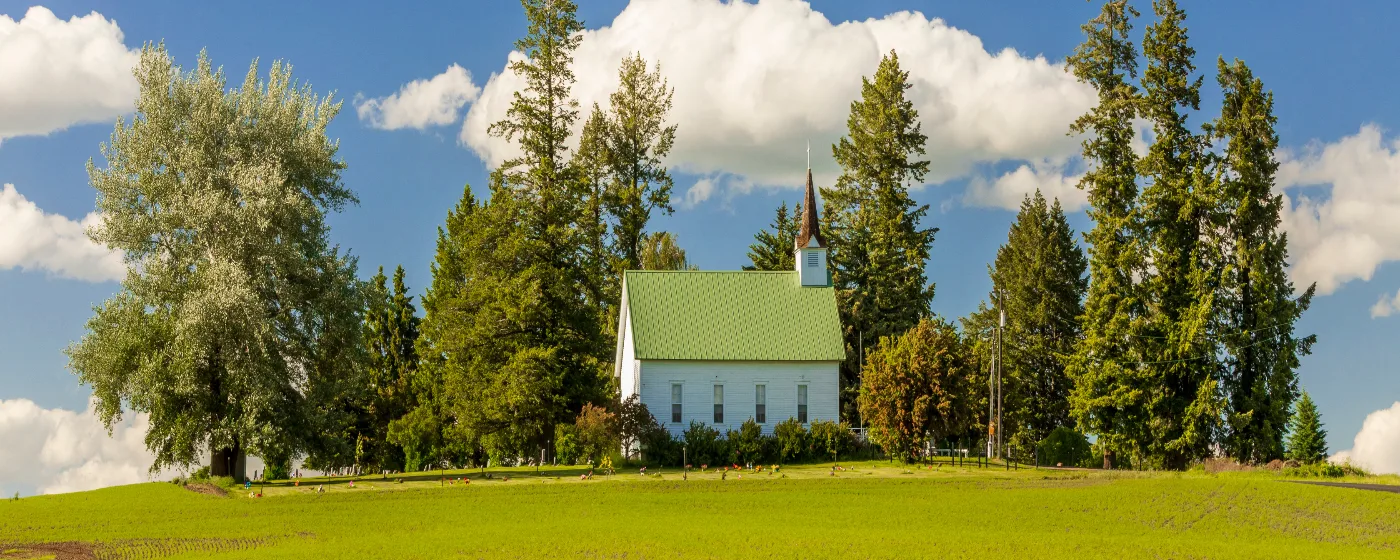
Maybe you did the math on a Sacramento starter home and then looked up Potlatch almost as a joke. Maybe you've been watching Idaho real estate from a Bay Area apartment for two years and someone in a forum mentioned this small mill town on the Palouse. Whatever the path, the number that usually stops Californians cold is the same: a Zillow Home Value Index figure of $219,837 for Potlatch (2026), set against a California statewide average of $775,549. That gap isn't a data error. Potlatch sits in Latah County in north-central Idaho, about 22 minutes north of Moscow on U.S. Highway 95, and it operates on a fundamentally different economic scale than any coastal California market — or even most inland California cities.
With a population of 922, Potlatch isn't a suburb hunting for the next wave of transplants. It's a former lumber company town organized around the Potlatch Historic District, the old WI&M Railway Depot, and the quiet rhythms of a Palouse agricultural county. The regional employment hub is Moscow, where the University of Idaho and Washington State University (just across the border in Pullman) anchor tens of thousands of jobs in education, research, and professional services. Potlatch School District serves families with school-age children locally, and the median household income here is $76,607 — a figure that goes considerably further when housing costs are this compressed. Californians who come for the price and stay for the pace are the most common origin story in this part of Latah County.
Day-to-day costs in Potlatch sit within a hair of the U.S. average — BestPlaces scores the city at 99.1, roughly 0.9% below national norms — which is a sharp contrast to the Bay Area or Los Angeles cost structure most California transplants are escaping. You won't find a Trader Joe's; the nearest is in Moscow. What you will find: morning coffee at Red Fir Coffee House & Boutique on 6th Street, lunch at Tamarack Cafe out on Highway 95, and a pace of life where the Palouse River corridor is twenty minutes from your front door rather than a weekend drive. The trade-off is real: Potlatch is small, services are limited, and the winters are colder and snowier than anything coastal California prepared you for.
Whether you're actively looking or just pressure-testing the idea, this guide breaks down what the California-to-Potlatch move actually looks like across home prices, taxes, daily costs, lifestyle adjustments, and the honest reasons some people turn around and go back.
The Home Price Reality: What Your California Equity Buys Here
The home price comparison between California and Potlatch isn't subtle — it's structural. California's statewide median home sale price was $777,566 in June 2026, per Redfin. Potlatch's Zillow Home Value Index for 2026 sits at $219,837.
That means a buyer arriving from a mid-tier California market with $600,000 to $800,000 in equity isn't shopping at the top of the Potlatch market — they're shopping for everything the town has. In practical terms, California equity frequently buys a Potlatch home outright, with money left over. That's a reality most transplants have to sit with for a moment before it registers.
What the Entry Point Looks Like
Potlatch's housing stock reflects its history as a working-class mill town. You'll find older craftsman-era homes, mid-century ranches, and a modest number of newer builds on the hillside areas — the North Hill and South Hill neighborhoods carry more elevated views and generally represent the upper end of the local market. For detailed neighborhood-by-neighborhood character, see the Potlatch neighborhoods guide.
The key practical point for a California buyer: the entire local price range fits comfortably inside what a single room addition might cost in California's most expensive coastal cities. That compression changes how you think about down payments, renovation budgets, and long-term equity strategy.
What You Give Up on the Way In
Potlatch has essentially no new construction pipeline the way California exurbs do. If you need a 2,400-square-foot open-concept build with a three-car garage, you're more likely to find that in Moscow or the Pullman corridor than in Potlatch proper. Buyers who arrive expecting deep inventory — multiple listings in every price band, open houses every weekend — will need to recalibrate. Listings move slowly but there aren't many of them.
| Market | Typical Home Value (2026) | Effective Property Tax Rate | Source |
|---|---|---|---|
| Potlatch, ID | $219,837 | 0.70% | ZHVI / SmartAsset |
| California (statewide avg) | $775,549 | 1.1%–1.3% (recent purchase) | Zillow / reAlpha |
| California median sale price | $777,566 | — | Redfin, June 2026 |
| Idaho statewide median eff. rate | — | ~0.43% | SmartAsset |
| U.S. national median eff. rate | — | ~0.89% | SmartAsset |
| Potlatch vs. CA statewide avg | Noticeably lower | Lower than CA new-purchase rate | Derived |
* ZHVI = Zillow Home Value Index.
Potlatch's 0.70% effective property tax rate is above Idaho's statewide median of approximately 0.43% — something worth noting since many people assume all of Idaho is uniformly low. It's still meaningfully below what California buyers typically pay on a recent purchase under Proposition 13's full-value reassessment rules, where effective rates on newly purchased homes commonly run 1.1%–1.3%.
Income Tax, Sales Tax, and the Paycheck Difference
The tax shift from California to Idaho is the financial story most transplants underestimate until they see their first Idaho paycheck. The headline is straightforward: Idaho replaced its old progressive bracket system with a flat 5.3% income tax rate effective January 1, 2025. California taxes personal income across nine graduated brackets running from 1% up to 13.3% — the 13.3% top rate applies to income above $1 million, but brackets above $100,000 are already well above what most workers pay in Potlatch.
Where the Math Shifts
The crossover point matters. For a single filer with approximately $81,000 or more in taxable income, Idaho's flat 5.3% rate produces a lower state tax bill than California's progressive structure. Below roughly $81,000, California's lower entry brackets can actually result in a smaller state income tax bill than Idaho's flat rate. Potlatch's median household income is $76,607, which puts many local earners close to that threshold — so don't assume the Idaho rate is automatically a win for every income level.
Idaho's flat rate applies to all taxable income above $2,500 for single filers ($5,000 for joint filers). There's no additional surcharge structure the way California layers on SDI.
The SDI Line Nobody Talks About
California's State Disability Insurance deduction runs at 1.3% of wages in 2026, with no cap — meaning a W-2 employee earning $120,000 in California pays $1,560 per year in SDI alone. Idaho has no equivalent deduction. That's not a dramatic number in isolation, but it compounds with the income tax differential for higher earners considering the full picture.
Sales Tax: A Genuine Trade-Off
Idaho's statewide sales tax is a flat 6%, with no local-option additions outside a handful of resort cities — Potlatch is not one of them. California's minimum combined state-and-local rate is 7.25%, and most metro areas run higher. The catch is that Idaho's 6% sales tax applies to groceries, which California largely exempts. Idaho does provide a refundable Grocery Tax Credit of $155 per person per year — raised from $120 in the 2025 legislative session — which partially offsets that cost at tax filing time, but it doesn't eliminate it at the register.
| Tax Category | California | Idaho (Potlatch) |
|---|---|---|
| State income tax | 1%–13.3% (progressive) | 5.3% flat (effective Jan 1, 2025) |
| SDI / disability payroll deduction | 1.3%, no wage cap | None |
| Sales tax (statewide minimum) | 7.25% + local additions | 6% flat, no local additions in Potlatch |
| Grocery sales tax | Generally exempt | 6% (partially offset by $155/person credit) |
| Property tax — new purchase effective rate | 1.1%–1.3% (Prop 13 reassessment) | 0.70% (Potlatch effective rate) |
| State tax competitiveness (Tax Foundation 2026) | Not in top 10 | 9th overall |
Idaho ranks 9th on the Tax Foundation's 2026 State Tax Competitiveness Index. That ranking reflects the overall structure — not a guarantee that every Californian comes out ahead on every line item.
What Daily Life Actually Costs in Potlatch
The headline tax and housing numbers are real, but the daily-life experience is what either keeps people here or sends them back. Potlatch's BestPlaces Cost of Living score of 99.1 means total day-to-day expenses sit essentially at the U.S. average — and noticeably below the Idaho state average. For the full utilities, groceries, and transportation breakdown, see the Potlatch cost of living page.
The Grocery and Services Gap
This is the adjustment that surprises most California transplants six months in: the nearest large grocery store is in Moscow, 22 minutes south on Highway 95. There is no grocery chain in Potlatch itself. The same is true for most specialty retail and the kind of errand infrastructure that Bay Area or Southern California residents take for granted on a Tuesday afternoon.
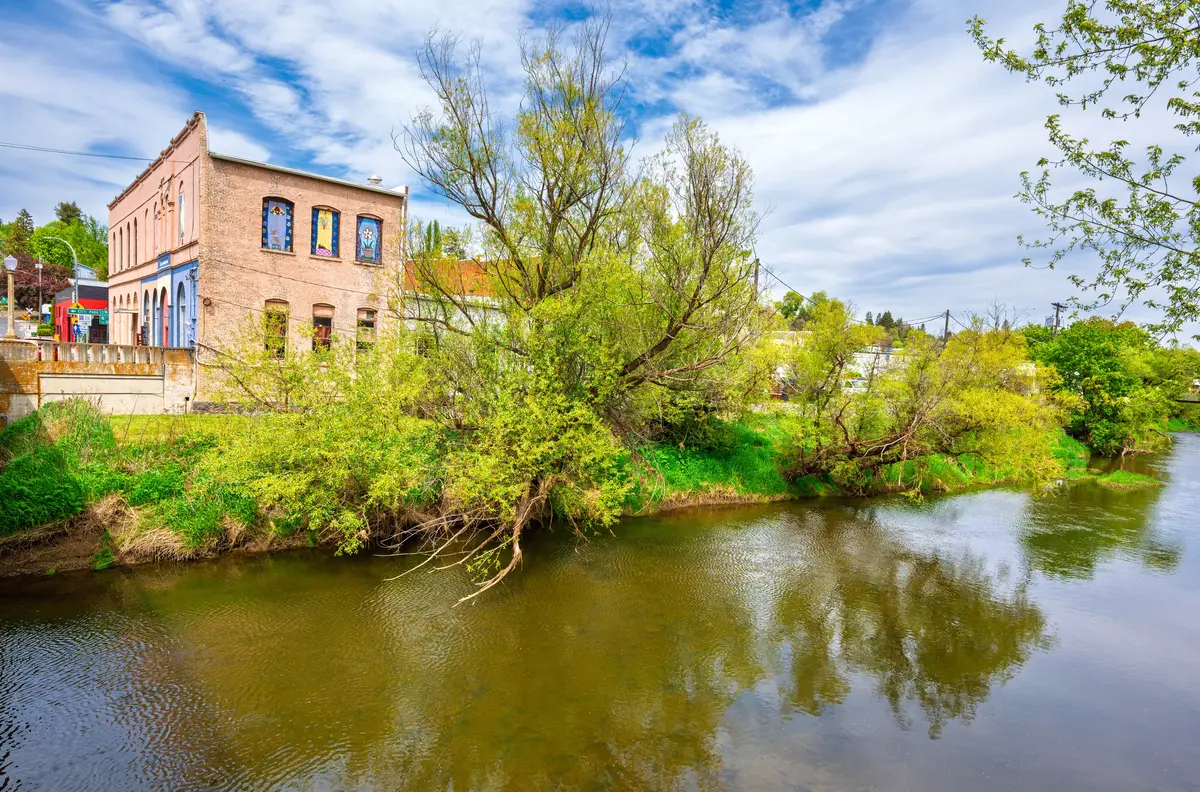
What Potlatch does have is a real, functioning small-town commercial strip along 6th Street. Red Fir Coffee House & Boutique is where you'll find locals starting their mornings. Tamarack Cafe on Highway 95 covers the lunch crowd. Codi Jo's Wagon Wheel Bar & Grill on 6th Street is the Friday-night gathering spot — the place where you'll figure out, usually within your first three visits, whether small-town social life is something you're genuinely comfortable with or just romanticizing from a California living room.
The Moscow Relationship
Moscow is not just a nearby city — it's functionally part of how Potlatch residents live. University of Idaho sits there. The farmers market, the independent restaurants, the hardware stores, the Walmart, the Saturday morning coffee culture — all of it is in Moscow. The 22-minute drive is easy enough that most Potlatch residents don't think of it as an inconvenience, but it's a genuine shift if you're used to walking-distance errands. Anyone who wants on-foot access to daily services and isn't willing to drive will find Potlatch genuinely difficult.
What Californians Don't Expect: Winter
North-central Idaho's winters are not Sierra Nevada ski-weekend winters, where you ski on Saturday and wear a light jacket to brunch on Sunday. Potlatch gets real snow — and cold that settles in for weeks. Californians who bought the lifestyle on the strength of a summer visit often find January and February a harder sell. Budget for a proper vehicle, actual winter tires, and a higher heating bill than anything a Sacramento or San Diego house prepared you for.
Looking to buy in Potlatch? Estimate your payment.
Enter your numbers to see an estimated monthly mortgage payment.
Estimate only. Excludes HOA fees and mortgage insurance. The interest rate above is a starting point, not a quoted rate — replace it with your own to see real numbers. Insurance is a flat placeholder, not a Potlatch quote.
Who Thrives Here — and Who Doesn't
The California transplants who settle into Potlatch happily tend to share a profile: remote workers with income above roughly $80,000, families with school-age children who want a genuinely small-town school environment through the Potlatch School District, and equity-rich buyers who want to own outright and eliminate housing cost as a variable in their lives. For a deeper look at what draws different buyer types to this area, see the living in Potlatch guide.
The Remote-Work Equation
Potlatch has solid enough internet infrastructure for remote work — the University of Idaho corridor drives regional connectivity investment — but it's not a Boise-level tech hub. If your job requires in-person presence in a California city, this doesn't work. If you're fully remote and your income is in the bracket where Idaho's flat 5.3% rate beats California's progressive structure, the math is genuinely compelling. You'd be trading a California housing payment for a Potlatch home you might buy outright.
Where People Leave For
The honest attrition story: Californians who move to Potlatch and then leave within two years typically cite the same cluster of reasons. The distance from services starts feeling like friction rather than simplicity. The social world is smaller than expected — not unwelcoming, but genuinely small, in a way that's hard to fully appreciate before you've lived it. And some people discover that what they actually wanted was a more affordable version of California city life, which doesn't exist in Potlatch. Moscow gets some of those people; Boise gets others; a portion goes back to California.
What You Would Not Do
If you need walkable daily errands as a non-negotiable, don't buy in Potlatch proper and expect that to change. The town's footprint is small, 6th Street has genuine character, and the Historic District around the old WI&M Railway Depot is worth exploring — but this is a drive-everywhere daily life, and buyers who don't accept that find it genuinely wearing. Buying first and then stress-testing the lifestyle is the most common expensive mistake California transplants make here.
Families with School-Age Children
Parents with kids in the Potlatch School District get the experience that's genuinely rare in California's larger districts: a school where your child is known by name, sports through the IHSAA at a small-school competitive level, and a community that still shows up to Friday-night games. For a full picture of school performance and what the district offers, the Potlatch schools guide covers it in detail.
Making the Move: Practical Steps for California Buyers
California buyers arriving in Potlatch with equity from a home sale are in a fundamentally different position than first-time buyers or renters. The purchase process in Idaho is straightforward compared to California's disclosure-heavy, multiple-offer environment — but the local market has its own rhythms that require adjustment.
Inventory Moves Differently Here
Potlatch doesn't have a weekly parade of new listings. Inventory turns slowly, and when something comes on at a price that reflects the market accurately, it doesn't sit for long. California buyers used to weeks of open houses and offer deadlines sometimes miss the window by waiting for a negotiation dynamic that doesn't exist here at the same scale. Having your financing or cash position confirmed before you're actively looking is more important in a thin market than in a deep one.
The Equity Deployment Decision
The most consequential decision for California equity-buyers isn't which neighborhood — it's whether to pay cash, put a significant down payment down, or finance conventionally. At Potlatch's price point, many California sellers can purchase outright and redirect the freed monthly cash flow to savings or investment. The mechanics of loan programs and down payment approaches are covered on the Potlatch first-time homebuyer page, which applies equally to equity-transfer buyers exploring their financing options.
Tax Residency Timing
One practical point California transplants sometimes learn too late: California's state tax authority tracks residency aggressively. Simply purchasing a home in Idaho doesn't terminate California tax residency. You need to establish Idaho domicile — driver's license, voter registration, primary bank account, and a clear break in California ties — to stop owing California income tax. If you're planning a mid-year move, consult a CPA who knows both states before you close, not after. The income tax savings that motivated the move can be partially clawed back if the residency transition is sloppy.
What Month Three Actually Feels Like
Almost every California transplant who sticks around longer than a year says the same thing: the first fall is the revelation. The Palouse turns gold, the larch needles go orange on the drives toward Bovill, the air smells like nothing coastal California ever offered, and the evenings cool fast in a way that makes a fire feel earned rather than performative. That's the moment when the square footage of the house and the absence of a Trader Joe's stop being the story. The people who leave before October often never get there.

Local Expert Takeaway: Potlatch is not a compromise version of somewhere better — it's a specific kind of place that works extremely well for a specific kind of buyer. If you're arriving from California with real equity, a remote income above $80,000, and a genuine preference for small-town rhythms over suburban convenience, the numbers here are hard to argue with. Morning coffee at Red Fir Coffee House on 6th Street, a quick drive to Moscow for the week's groceries, and a home you might own outright: that's the actual daily life on offer. What it isn't is walkable, service-dense, or a soft landing for someone who wants affordable California. Know which version you're after before you make an offer.
Quick Takeaways & FAQs
✅ California equity buyers can often purchase a Potlatch home outright — the Zillow Home Value Index figure of $219,837 (2026) sits noticeably below the statewide California average of $775,549.
⚠️ Idaho's 6% sales tax applies to groceries (unlike California), and there's no grocery store in Potlatch itself — plan on a weekly 22-minute drive to Moscow for regular shopping.
📍 Red Fir Coffee House & Boutique on 6th Street and Codi Jo's Wagon Wheel Bar & Grill, also on 6th, are the two spots where you'll figure out fastest whether small-town Potlatch social life fits you.
Is it worth moving from California to Potlatch, Idaho for the lower home prices?
Does moving to Idaho from California reduce your state income tax bill?
What is the property tax rate in Potlatch compared to California?
Does Idaho have a sales tax on groceries, and how does that compare to California?
How do I make sure I'm no longer a California tax resident after moving to Potlatch?
Moving to Idaho?
Tell us what you need help with and we'll connect you with local resources.
