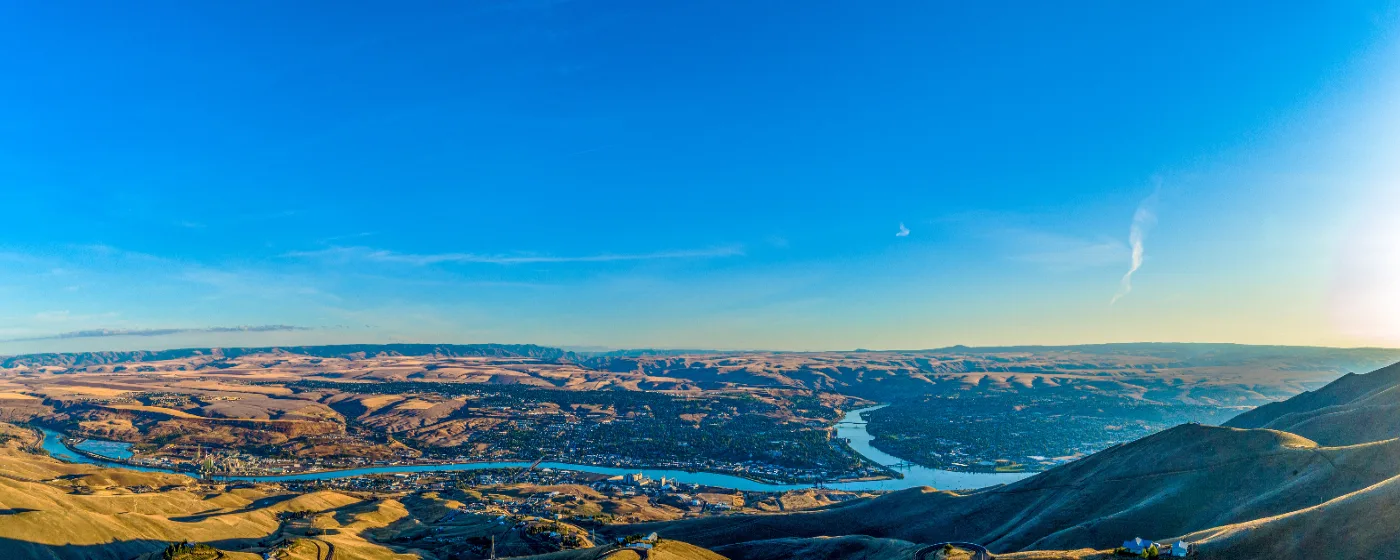
Most retirees researching Idaho picture ski towns, mountain passes, and brutal winters. Lewiston breaks every one of those assumptions. At roughly 738 feet above sea level — Idaho's lowest-elevation city — it sits at the confluence of the Snake and Clearwater Rivers in a canyon basin that produces winters mild enough that snow rarely sticks for more than a few days. That climate surprise, combined with home prices well below what you'd find in Boise or Coeur d'Alene, is what keeps pulling retirees here who almost didn't look.
The city of about 35,000 anchors the Lewis-Clark Valley alongside Clarkston, Washington, just five minutes across the Snake River. That cross-state pairing matters in retirement: it doubles your retail, dining, and healthcare options without doubling your drive. St. Joseph Regional Medical Center is Lewiston's primary hospital and a genuine community-hospital overachiever. Lewis-Clark State College brings a steady calendar of public lectures, theater, and athletic events. The Port of Lewiston — the farthest inland port on the Pacific Coast — gives the city an economic identity that goes back generations, and that working-town rootedness shapes the culture in ways that retirees from coastal metros sometimes find refreshingly unpretentious.
Cost of living is Lewiston's most practical argument for retirement. Overall daily expenses run noticeably below the U.S. average, and the full cost-of-living breakdown covers the specifics. Idaho's tax treatment of Social Security income — fully exempt — is one of the most retiree-friendly provisions in the Mountain West. The 13-mile Snake River Levee trail system and Hells Gate State Park give active retirees year-round outdoor access without the altitude that makes exertion punishing elsewhere in Idaho.
Whether you're weighing a full relocation or trying to decide between Lewiston and a handful of other Northwest retirement options, this guide covers healthcare access, the retiree tax picture, daily budget realities, walkability, downsizing inventory, and an honest comparison with nearby alternatives.

Why Retirees Are Choosing Lewiston
Lewiston fits a specific kind of retiree well: someone who wants a real city's services — a full hospital, a regional airport, chain retail and independent restaurants within a short drive — without paying a real city's prices. The Zillow Home Value Index for Lewiston stood at $360,841 as of May 2026, a figure that looks like a typo to anyone recently priced out of the Pacific Coast or the Boise metro. For a buyer coming from Portland or Seattle, that number can mean eliminating a mortgage entirely and redirecting the equity into retirement income.
The mild winter climate is a genuine differentiator. Retirees who moved to northern Idaho expecting a Sandpoint-style winter and discovered Lewiston's canyon climate often describe it as the unexpected bonus. The growing season runs longer here than anywhere else in the state, the Snake River trail is walkable in January, and the sun appears reliably even when Moscow, just 30 miles north, is buried under snow and fog. For anyone managing joint pain or simply done with shoveling, that matters every single day of the year.
Lewiston is not the right call for retirees who need a major academic medical center within 30 minutes, who want a walkable downtown neighborhood in the way a mid-sized university city offers one, or who prize an arts-and-culture scene over outdoor access and community stability. If those are the priorities, Moscow or Spokane deserve a serious look. But for retirees who want a low-cost, low-altitude, four-seasons-without-the-extremes base — with a solid community hospital and a neighbor state five minutes away — Lewiston is consistently underrated.
Healthcare & Medical Access in Lewiston
St. Joseph Regional Medical Center (SJRMC) is the backbone of healthcare in the Lewis-Clark Valley, and for a community hospital in a city of 35,000, it punches well above its weight. The 145-bed, JCAHO-approved facility covers emergency care, primary care, cardiology, orthopedics, oncology, and stroke care — the specialties that matter most to retirees making a long-term location decision.
SJRMC earned a Level II Stroke Center designation from Idaho's Time Sensitive Emergency System, which means stroke protocols here meet a documented statewide standard — not just a hospital marketing claim. The American College of Cardiology awarded the hospital its Platinum Performance Achievement Award for 2024 through the NCDR Chest Pain–MI Registry, placing SJRMC among roughly 259 hospitals nationally at that recognition level. Becker's named it to its 2025 list of Great Community Hospitals — one of only two Idaho hospitals on the list.
The honest limitation: SJRMC is a strong community hospital, not a quaternary academic medical center. Highly complex oncology cases, advanced cardiac surgery, or specialized neurology beyond stroke response will typically require travel to Spokane's major regional medical system, about 100 miles north on US-95. That's a real-world constraint for anyone managing a serious or progressive condition at retirement. Most routine and moderate-complexity care — the bread and butter of healthy retirement — is handled locally without that drive.
Beyond the hospital, the Lewis-Clark Valley supports a network of primary care physicians, specialist clinics, and outpatient services. Neighboring Clarkston, WA adds additional provider options under Washington's insurance networks. Veterans in the area have access to services through the Walla Walla VA Medical Center, approximately 75 miles southwest. If proximity to a transplant center or major cancer center is non-negotiable, Spokane is the realistic answer — but for the majority of retirees, SJRMC provides dependable, award-recognized local care.
The Retiree Budget in Lewiston
Idaho's treatment of Social Security is the first thing to put on the ledger: the state fully exempts Social Security benefits from income tax, regardless of how much you receive or what other income you have. That's a clean exemption — no phase-out, no income threshold — that makes a meaningful difference for retirees drawing primarily from Social Security.
Other retirement income — IRA distributions, 401(k) withdrawals, pension payments — is taxed at Idaho's flat state income tax rate. That rate has been reduced in recent years; confirm the current rate at tax.idaho.gov before filing, as it has shifted multiple times since 2023. Idaho has no estate or inheritance tax, and for 2026 only estates exceeding the federal exemption threshold face any federal estate tax, meaning most Lewiston retirees won't encounter either.
Property Tax Relief for Seniors
Lewiston's effective property tax rate is approximately 0.78%, below the national average. If you qualify for Idaho's Circuit Breaker program — available to homeowners aged 65 and older with 2025 income below $39,130 — your property tax bill can be reduced by $250 to $1,500 annually. Applications run January 1 through April 15 at the Nez Perce County Assessor's office. It's worth filing every year you qualify; the relief is meaningful on a fixed income, even before you factor in that Lewiston's base tax rate is already lower than most of the country.
Daily Cost of Living
Lewiston's overall cost of living runs noticeably below the U.S. average, and grocery costs are especially favorable — well below national norms. That gap shows up in the weekly shopping run in ways retirees on fixed incomes feel immediately. Dining at an established local steakhouse runs at prices that would read as budget dining in Boise, let alone the Coast. The full cost-of-living breakdown has the category-by-category detail; the short version is that a retirement budget that felt tight in your previous city will breathe more easily here.
Looking to buy in Lewiston? Estimate your payment.
Enter your numbers to see an estimated monthly mortgage payment.
Estimate only. Excludes HOA fees and mortgage insurance. The interest rate above is a starting point, not a quoted rate — replace it with your own to see real numbers. Insurance is a flat placeholder, not a Lewiston quote.
Walkability, Community & Staying Active in Lewiston
Lewiston's walkability depends sharply on where you live and what you're trying to do on foot. The terrain is the main variable: downtown Lewiston and the Snake River Avenue corridor are essentially flat, while Normal Hill and the Orchards areas sit on the benchlands above the canyon and require a car for most errands. If walkable daily life is a priority, the lower elevation neighborhoods deserve a hard look first.
The levee trail system is the city's standout active-retirement asset. The Lewiston Levee Parkway Trail runs 13 miles from Hells Gate State Park along the Snake River and up the Clearwater River to Locomotive Park. The full two-city system — connecting Lewiston and Clarkston — stretches 19 miles and is fully wheelchair-accessible. On any dry morning, you'll find retirees walking, cycling, and birdwatching along this corridor. It's flat, paved, and genuinely beautiful in a way that riverside canyon trails tend to be.
Senior Services and Community Infrastructure
The Area Agency on Aging serves Lewiston-area seniors with in-home meal delivery, transportation assistance, and support services designed to help older adults stay in their homes longer. For retirees who don't drive or who anticipate eventually needing non-driving transportation options, this is worth mapping before you move — Lewiston is not a city where you can realistically manage without a car for most needs, and knowing what support exists matters.
The Nez Perce County Historical Society Museum runs community events year-round and offers free admission to members — a low-cost, walkable cultural anchor for retirees who want regular engagement with the city's remarkable Indigenous and frontier history. Lewis-Clark State College's public programming calendar adds lectures, theater productions, and athletic events. The college's presence keeps the social calendar fuller than you'd expect for a city this size.
Where Retirees Actually Gather
Weekend mornings on the levee trail are the closest Lewiston has to a community gathering ritual — the flat, river-level path draws a consistent crowd of walkers and cyclists across age groups. Hells Gate State Park hosts concerts and community events through the warmer months, and the park's marina gives boat-owning retirees a launch point into Hells Canyon. The cross-river dynamic with Clarkston also means social options don't stop at the Idaho state line.
Right-Sizing: Downsizing in Lewiston
Lewiston's housing stock skews toward mid-century single-family homes, which is both an asset and a limitation for downsizing retirees. The asset: prices are low enough that selling a larger home can yield cash-out equity even buying a smaller replacement. The limitation: the purpose-built 55+ community inventory is thin compared to a Boise suburb or a larger retirement market. You're more likely to find your downsized home in a conventional neighborhood than in a gated active-adult development.
Single-level ranches are the most practical search target for retirees prioritizing accessibility, and they exist across most of Lewiston's neighborhoods. The flat lower-elevation areas — Snake River Avenue, the downtown edges — offer the most walkable versions. The benchland neighborhoods like The Orchards and Normal Hill have more of the larger, multi-level homes that many retirees are moving out of; single-level inventory there exists but requires a more patient search.
Condo and Patio Home Options
Condo inventory in Lewiston is limited but present, particularly in and near downtown. Patio-home style developments — smaller footprint, low-maintenance lots — appear scattered through newer residential areas rather than concentrated in any single development. If you need elevator-accessible or zero-threshold construction specifically, expect to either build, convert, or expand your search radius into Clarkston, which has some newer residential development that may better serve mobility-focused buyers.
What Six Months Actually Reveals
Retirees who move to Lewiston for the cost and stay for the climate often report a version of the same six-month surprise: the canyon creates a weather bubble that genuinely feels warmer and sunnier than the regional forecast suggests. The catch that catches some people off guard is geographic isolation — the nearest major metro is Spokane, roughly 100 miles north. Retirees who assumed they'd make frequent weekend trips to a larger city sometimes find the drive more tiring than anticipated. If regular access to a major city's cultural offerings is important to you, factor that drive honestly into the decision.
The retirees who leave Lewiston most often cite two reasons: limited specialist healthcare requiring repeated long drives, and the desire to be closer to adult children who've settled in the Boise or Pacific Northwest metros. Neither is a knock on the city itself — they're realistic constraints of a mid-sized, geographically isolated community. If your family is already distributed across the Mountain West, Lewiston's regional airport (with connections through Seattle and Salt Lake City) makes it workable.
Lewiston vs Nearby Retirement Destinations
| City | Cost vs Lewiston | Primary Hospital | Walkability | Senior Living Depth | Overall Retirement Fit |
|---|---|---|---|---|---|
| Lewiston, ID | Anchor | St. Joseph Regional Medical Center — strong community hospital, Level II Stroke Center | Flat near the river; car-dependent on the benchlands | Thin purpose-built 55+ inventory; single-level ranches available | Best for value-driven, outdoors-active retirees who want a real hospital nearby |
| Clarkston, WA | About the same | Shares SJRMC access; some local clinics | Comparable flat-valley walkability | Some newer residential construction; modest senior-specific options | Good secondary option; Washington state tax rules differ — worth comparing if pension income is significant |
| Moscow, ID | Slightly pricier | Gritman Medical Center — smaller community hospital; Pullman Regional nearby | More walkable university-town core | Limited; University of Idaho drives housing demand from students | Better for retirees who want arts, lectures, and walkable coffee-shop culture; winters are colder and snowier |
| Pullman, WA | About the same | Pullman Regional Hospital; Spokane specialists accessible | Hilly; walkable near campus, car-dependent otherwise | Thin senior-specific inventory; college-town rental market dominates | Strong intellectual community via WSU; less practical for retirees than Moscow or Lewiston |
| Spokane, WA | Noticeably pricier | Major regional medical system with full tertiary and quaternary services | Better urban walkability; good bus transit | Deep — active-adult communities, CCRCs, multiple senior living options | Best for retirees who need advanced specialty care or want big-city amenities; meaningfully higher cost |
| Asotin, WA | Noticeably cheaper | Relies on Clarkston/Lewiston facilities | Very limited; small rural town | Minimal | Rural quiet and very low cost; right for retirees who are fully self-sufficient and want to be left alone |
Spokane is the clear answer if advanced specialty care is non-negotiable — the city's major regional medical system offers a depth of cardiac, oncology, and neurology services that no community hospital in the region can match, and its senior living ecosystem is the most developed within a 100-mile radius of Lewiston. The trade is cost: housing and daily expenses in Spokane run noticeably higher than Lewiston.
Moscow wins on walkability and college-town culture for retirees who want a more urbane daily rhythm, but its hospital is smaller than SJRMC and its winters are meaningfully harder. Clarkston is essentially Lewiston's other half — worth comparing on Washington's specific tax treatment of pension and retirement income before assuming Idaho is always better. For retirees who want the lowest possible overhead and genuinely don't need nearby services, Asotin's rural setting on the Snake River is the region's budget floor — but you're fully dependent on Lewiston or Clarkston for everything medical.

Local Expert Takeaway: Lewiston's retirement case comes down to three things that don't show up in search rankings: a canyon climate that makes outdoor life genuinely comfortable through winter, a community hospital that outperforms its size by nearly every measurable standard, and home prices that let retirees arrive with equity in hand rather than depleting it. The levee trail along the Snake and Clearwater rivers is where you'll see who actually lives here — walkers and cyclists in their 60s and 70s, year-round, on flat paved paths that run 19 miles through one of the most scenic river confluences in the Pacific Northwest. The city is isolated, and it knows it. But for the right retiree, that isolation is the point.
Quick Takeaways & FAQs
✅ Idaho fully exempts Social Security from state income tax, and Lewiston's 0.78% property tax rate — plus the Circuit Breaker program for seniors — makes the ongoing ownership cost genuinely low on a fixed income.
⚠️ Advanced specialty care means a 100-mile drive to Spokane — St. Joseph Regional Medical Center is an excellent community hospital, but retirees managing complex or progressive conditions should map that drive before committing.
📍 The 19-mile wheelchair-accessible Lewiston Levee Parkway Trail along the Snake and Clearwater Rivers is the city's most underrated retirement asset — flat, paved, and usable nearly year-round thanks to Lewiston's canyon climate.
Is Idaho a tax-friendly state for retirees?
How good is the healthcare in Lewiston for retirees?
Are there 55+ or active-adult communities in Lewiston?
What is the winter weather actually like in Lewiston?
How does Lewiston compare to Moscow, Idaho for retirement?
Moving to Idaho?
Tell us what you need help with and we'll connect you with local resources.
