
What Is Living in La Grange, Texas Like?
Most people driving US-77 between Austin and Houston pass through La Grange without stopping. That's their loss — and increasingly, it's what's drawing a different kind of buyer to Fayette County's county seat. La Grange sits on the Colorado River at the crossroads of US-77, TX-71, and TX-159, a genuine small-town center with a working courthouse square, a Main Street program, and a 19th-century downtown that 73 historic properties call home. The city covers just 4.15 square miles at an elevation of 305 feet, but what it packs into that space — Czech and German heritage festivals, a world-class quilt museum, a state historic site on a bluff above the river — makes it feel considerably larger than its population of 4,509 suggests.
The economic backbone here is exactly what you'd expect from a county seat: La Grange Independent School District, Fayette County, the City of La Grange, and H-E-B anchor the local job market. Retail trade and manufacturing also carry significant weight in the local economy, with construction and public administration among the highest-paying sectors for those who work locally. La Grange ISD operates three PK–12 campuses, and the district holds a C rating, according to the Texas Education Agency. Families with school-age children move here knowing the tradeoffs — the district is improving but not a headline performer — and many weigh that against housing prices that are well below what comparable square footage would cost closer to Austin.
The typical home price in La Grange stands at $391,399 (Zillow Home Value Index, July 2026), which puts real, substantive houses within reach for buyers priced out of the Austin metro. The effective property tax rate runs approximately 1.03%, modest by Texas standards. Day-to-day life here runs on a car — most errands mean a drive — but the average one-way commute for local workers is just 13.1 minutes, which is one of the genuine pleasures of small-town Texas living. The Colorado River provides a natural backdrop for paddling and outdoor recreation, and the calendar fills reliably with the Fayette County Fair every Labor Day weekend, the spring Slavnost festival, and the December Schmeckenfest on the town square. For a city this size, La Grange punches well above its weight in things to actually do.
Whether you're considering a move or just researching the area, the sections below break down La Grange's neighborhoods, housing market, commute realities, school district, local favorites, and what daily life here is really like.

La Grange at a Glance
Looking to buy in La Grange? Estimate your payment.
Enter your numbers to see an estimated monthly mortgage payment.
Estimate only. Excludes HOA fees and mortgage insurance. The interest rate above is a starting point, not a quoted rate — replace it with your own to see real numbers. Insurance is a flat placeholder, not a La Grange quote.
Why Are People Moving to La Grange?
The case for La Grange is easy to make. Price. Space. A real town with a real history, not a subdivision that appeared between two fields five years ago. The case against it is shorter but worth reading: the commute to Austin is real, the school district is middling, and if you need big-city amenities close at hand, you will feel the distance.
What's drawing buyers here is the triangle. La Grange sits roughly equidistant from Austin, Houston, and San Antonio — no Texas city of this size has better access to all three metros without being absorbed by any of them. Remote workers in particular have noticed: you can live on the Colorado River in a historic county seat and be at Austin-Bergstrom International Airport in about 70 minutes when you need to travel.
The Economic Picture
Local jobs are concentrated in government, education, and retail. La Grange ISD is the single largest employer, followed by Fayette County and the City of La Grange. H-E-B anchors retail employment in a meaningful way for a city this size. Construction and public administration are the highest-paying sectors for workers who stay local, but many residents commute out — or work from home.
The city has also been quietly investing in its economic base. A Business Expansion and Relocation Grant Program offers reimbursable matching grants for businesses operating within city limits, and a Second Floor Development Pilot Grant Program is encouraging conversion of upper floors in the historic district to residential units — which tells you something about the direction downtown La Grange is heading.
Who Actually Moves Here
| Buyer Type | What Draws Them | What to Watch For |
|---|---|---|
| Commuter | Austin prices without Austin crowding; genuine small-town pace | The drive to Austin is about 70 minutes — every day, both ways |
| Families | Affordable homes, tight community, active UIL athletics programs | District holds a C rating; proficiency scores below state average |
| Remote Workers | Low cost of living, fast fiber in some areas, scenic setting on the Colorado | A serious shopping trip means driving out of town |
| First-Time Buyers | Entry points well below Austin metro; real houses, real yards | Median household income here runs below what the typical home requires |
| Retirees | Historic downtown walkability, cultural calendar, slower pace | No 55+ communities were found in La Grange; healthcare means a drive |
| Value Seekers | Texas property tax rate of ~1.03% is competitive; prices below metro norms | Income growth in Fayette County lags the Austin metro significantly |
Texas Highways noted in March 2026 that La Grange's new businesses have proven the small town is more than just a pass-through between Austin and Houston — and that shift in perception is part of what's moving the needle on buyer interest.
What Daily Life Feels Like in La Grange
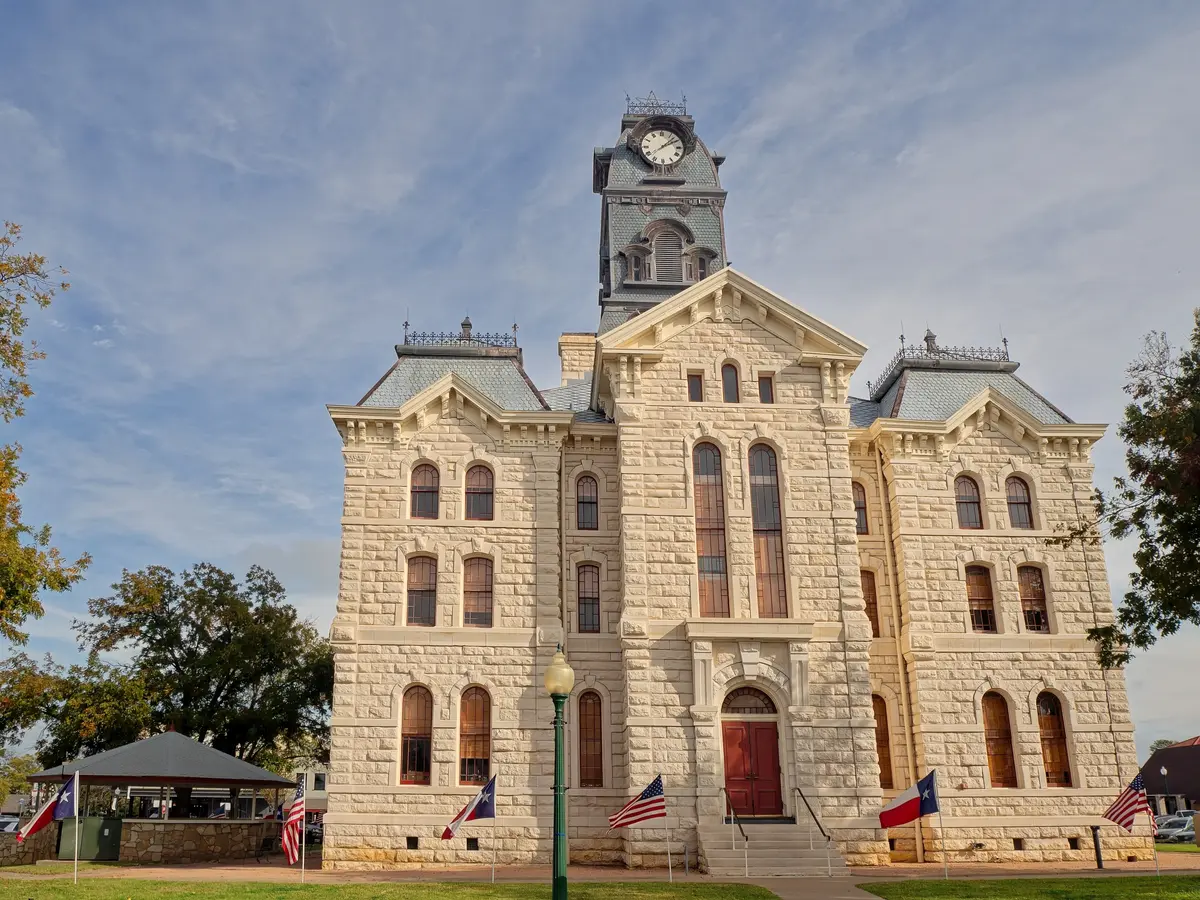
On a Tuesday morning in La Grange, the Fayette County Courthouse — a Romanesque Revival landmark completed in 1891, with a limestone façade, red granite accents, and a clock tower that reads as absurdly grand for a city this size — anchors a square where people actually stop and talk. That is not a small thing. The courthouse square is the social center of town in a way that has almost entirely vanished from Texas communities this close to a major metro.
The Rhythm of the Week
Most errands in La Grange require a car. The downtown core is genuinely walkable once you're in it — the Texas Quilt Museum, with its rotating exhibits and adult classes, is steps from the square; the La Grange Farmers' Market draws locals for produce and local goods through the growing season. But for anything beyond the essentials, you'll be driving, and that's simply the reality of a city of 4,509.
The local calendar is denser than most newcomers expect. Slavnost each spring brings Czech food, polka music, and a classic car show that takes over the square. The Fayette County Fair — running since 1927 — fills Labor Day weekend with a livestock show, barbecue cook-off, and carnival. The Fayette County Sheriff's Posse Rodeo runs in late summer. The Best Little Cowboy Gathering in Texas claims the fairgrounds in early March. Schmeckenfest in December closes out the year on the town square with a wassail-tasting festival rooted in the city's German heritage.
What Surprises People After Six Months
Newcomers consistently underestimate how social this town is. The festivals, the square, the high school football games — they're not tourist events, they're where La Grange gathers. Residents who moved from larger cities often say in month three that they know more of their neighbors here than they did in a decade in a subdivision outside Austin.
The flip side: if you moved here expecting easy access to the kind of cultural and dining variety you had in a larger city, that adjustment takes longer. A serious shopping run means driving out of town. The school district holds a C rating from the Texas Education Agency, and on 2024-25 state assessments, 45% of students reached math proficiency and 54% reached reading proficiency — figures that sit below state averages and are worth weighing honestly before you commit. For a full picture of school performance and what the district is doing about it, see the La Grange schools page.
The Colorado River isn't scenery — it's infrastructure for daily life here. Paddling and swimming in the Colorado, walking the grounds at Monument Hill and Kreische Brewery State Historic Site above the bluff, or spending a morning at White Rock Park are the kinds of things La Grange residents actually do on a Saturday, not weekend-trip aspirations.
Czech and German Heritage — Still Alive
The mid-1800s wave of Czech and German immigrants didn't just shape the town's architecture — it shaped the food, the music, and the civic calendar in ways that are still visible and felt. That heritage isn't performed for visitors; it's maintained by families who have been here for generations. It's one of the things that makes La Grange feel rooted in a way that new-build Texas suburbs simply don't.
The La Grange Housing Market Right Now
The typical home price in La Grange sits at $391,399 (Zillow Home Value Index, July 2026). For context on what that gets you: real square footage, often on real land, in a historic small-town setting that is noticeably more affordable than comparable communities inside the Austin metro. Nearby Schulenburg, Flatonia, and Smithville each come in noticeably lower than La Grange's typical price, which reflects La Grange's status as a county seat with a denser service base and more established amenities. For a full breakdown of what those prices buy and how the city's cost of living stacks up, see the La Grange cost of living page.
What the Market Looks Like on the Ground
The historic district and neighborhoods closest to the courthouse square tend to attract buyers who want proximity to the town's civic and cultural life. Newer subdivisions on the edges of the city suit buyers who want newer construction and more standardized floor plans. The housing stock is genuinely mixed — Victorian-era homes on quiet streets, modest mid-century ranches, and newer builds in planned neighborhoods like Sunset Ridge Estates and Northpointe coexist within the city's 4.15 square miles.
One honest tension in the La Grange market: the median household income of $53,547 sits below the income level needed to comfortably carry the typical home price here. That gap is meaningful, particularly for first-time buyers relying entirely on local wages. Many buyers who purchase in La Grange are either bringing Austin or Houston incomes with them, or are remote workers whose pay scales don't match local earnings. For buyers exploring financing options, the first-time homebuyer page covers down payment programs and loan types in more detail.
Property Taxes
Texas has no state income tax, and La Grange's effective property tax rate of approximately 1.03% is on the lower end for Texas. That rate, combined with prices well below the Austin metro, is a meaningful part of the financial case for moving here. Full tax and cost comparisons are on the cost of living page.
Some areas of La Grange cost more than others — neighborhood character and housing type vary considerably across the city. The best neighborhoods page breaks that down in detail.
La Grange Neighborhoods
La Grange has several distinct areas — each with its own character and appeal. Here’s a breakdown to help you narrow down where to focus your home search.
🏡 Downtown / Historic District
The heart of La Grange — 73 historic properties centered on the Fayette County Courthouse square — suits buyers who want to walk to the farmers' market, the Texas Quilt Museum, and the civic events that define the town's calendar. Housing here ranges from Victorian-era homes to modest storefronts with residential upstairs conversions encouraged by the city's Main Street program.
🏠 Sunset Ridge Estates
A newer subdivision on the edges of the city that draws families and buyers who prefer more standardized floor plans and modern construction over the character and upkeep demands of historic housing stock. It's the kind of neighborhood where newer builds sit on well-kept lots with clear HOA structure.
🌳 Thomas Estates
A residential area suited to buyers looking for established single-family homes away from the density of the historic core, with a neighborhood feel that appeals to families who want space and quiet without straying far from La Grange's services.
🏘 Northpointe
Northpointe offers newer residential development on the northern edge of the city, attracting buyers who want more recently built homes and a neighborhood setting that still keeps Austin commuters within reach of TX-71.
🏔 Woodland Meadows
A residential area with a suburban feel that suits buyers prioritizing yard space and neighborhood quiet — a practical choice for families or remote workers who want room to spread out in a setting that's still within the city limits.
Pros & Cons of Living in La Grange
The Pros
- Walkable, historic downtown square on the Colorado River
- More affordable than Austin while still within day-trip range
- Strong Czech-German heritage, festivals, and small-town community feel
- Central location between Austin and Houston
The Cons
- No full-service hospital or ER inside city limits since St. Mark's Medical Center closed in 2023
- Limited local job market and nightlife options
- Longer commute for anyone working in Austin or Houston
Getting Around & Commuting in La Grange
La Grange sits at the junction of US-77, TX-71, and TX-159 — three routes that make it unusually accessible for a city its size, connecting residents to Austin, Houston, and the broader Hill Country corridor. That geography is the city's single biggest practical asset for anyone who needs to leave town regularly.
The Austin Commute
The most important number for most buyers considering La Grange: about 70 minutes to Austin. That's a real commute, five days a week. People do it — the city has attracted a meaningful contingent of Austin-income earners who made the trade consciously — but it shapes daily life in ways you need to understand before you commit to it. An early-morning or late-afternoon drive on TX-71 toward Austin is the rhythm a lot of La Grange households build their days around.
For residents who work locally, the picture looks entirely different. The average one-way commute for La Grange workers is 13.1 minutes — a figure that reflects just how compact this city actually is. Most of what locals need day-to-day is reachable in under 15 minutes by car.
How People Actually Get Around
The overwhelming majority of La Grange residents drive. Most errands need a car, and the downtown core is the only part of the city that functions on foot in any meaningful way. The Texas Quilt Museum, the courthouse square, the La Grange Farmers' Market — these are genuinely walkable from each other. Everything else means driving.
Austin-Bergstrom International Airport (AUS) is the nearest major airport, at 56 miles. For frequent travelers, that's an important variable — figure it into your time budget the same way you'd factor in the commute to the city itself.
Remote Work Changes the Equation
For buyers whose income doesn't depend on being in Austin daily, La Grange's location becomes a different kind of asset. You're close enough to make the drive when it matters — a client meeting, an airport run, a concert — without paying Austin prices to do it. That calculation is driving a real share of the buyer interest in Fayette County right now.
| Destination | Route | What to Know |
|---|---|---|
| Austin (downtown) | TX-71 | About 70 minutes; heaviest traffic on weekday mornings |
| Austin-Bergstrom Airport (AUS) | TX-71 | 56 miles; the nearest major airport option |
| Houston | US-77 / TX-71 | Roughly 100 miles east; a significant but manageable drive |
| San Antonio | US-77 / TX-183 corridor | Roughly 110 miles south; not a daily commute destination for most |
| Within La Grange | Local streets | Average local commute is 13.1 minutes one-way |
Most daily movement in La Grange is by personal vehicle — a car is the practical backbone of getting around, whether you're running errands in town or heading out to Austin for a meeting.
Schools in La Grange
Families relocating to La Grange have public, private, and higher-education options nearby. Here’s a quick overview.
🎓 School District
La Grange Independent School District serves K–12 students across La Grange and the surrounding area. Rated C (source: Texas Education Agency, 2025 A-F accountability rating (2024-25 school year)).
🏆 Graduation Rate
The 4-year high-school graduation rate here is approximately 91.1%.
📚 Higher Education
Texas’s public universities — the University of Texas at Austin, Texas A&M University, and the University of Houston — offer four-year degrees statewide, with one of the largest community college systems in the country (50+ public community college districts) providing two-year and workforce programs.
🌐 Online Learning
UT Austin Online and Texas A&M University Online offer fully accredited online degrees for remote learners across the state.
Safety in La Grange
A quick look at how La Grange compares on the numbers that matter most when weighing a neighborhood or a move.
🛡 Violent Crime
Approximately 4 per 1,000 residents.
🔒 Property Crime
Approximately 12 per 1,000 residents.
Compared to the most recent national figures from the Bureau of Justice Statistics (2024), La Grange’s violent crime is above the national average (about 3.7 per 1,000), and property crime is below the national average (about 18.4 per 1,000).
Against Texas as a whole, La Grange’s violent crime is about the same as the state average, and property crime is roughly half the state average (Bureau of Justice Statistics, Crime Known to Law Enforcement, 2024 (tables 2 and 3)).
Crime rates can vary a lot within a single city, so the citywide numbers above are only a starting point. Some neighborhoods in La Grange run well below these averages, while others run higher — the kind of block-by-block detail that matters most when you’re actually choosing where to live. The full guide below breaks it down neighborhood by neighborhood.
Working in La Grange
La Grange’s largest employers span several industries — here are some of the anchors of the local job market.
🎓 La Grange Independent School District
Education
🏛 Fayette County
County government
🏛 City of La Grange
Municipal government
🛒 H-E-B
Retail grocery
Retiring in La Grange
La Grange draws retirees for its balance of amenities, outdoor access, and cost. Here’s what to weigh.
🌤 Climate
La Grange gets 222 sunny days a year, with warm summers that run long into October and mild winters that rarely require more than a jacket. The central Texas humidity is real in July and August, but the Colorado River setting provides some relief and makes the shoulder seasons — spring and fall — genuinely pleasant for outdoor life.
🍴 Lifestyle
The courthouse square, the Texas Quilt Museum, the La Grange Farmers' Market, and a full civic calendar anchored by Slavnost, Schmeckenfest, and the Fayette County Fair give retirees a meaningful cultural calendar without requiring a drive to Austin. The dining scene is small but real, with options from casual barbecue to a proper seafood and steaks dinner.
🏚 55+ Communities
No 55+ communities were found in La Grange. Retirees who settle here typically buy into the general market — the historic district, established neighborhoods, or newer subdivisions on the city's edges — and often cite the affordable property tax rate and small-town pace as the primary draws.
✈ Getting Around
A car is essential for daily life in La Grange. The downtown core is walkable for those living near the square, but most services and medical appointments mean driving. Austin-Bergstrom International Airport is the nearest major airport, at 56 miles — a realistic option for retirees who travel periodically.
🏛 Texas Taxes for Retirees — What to Know
- No state income tax — Texas has no personal income tax — constitutionally protected under Article VIII, Section 24. Social Security, pensions, 401(k)/IRA withdrawals, and annuity payments are all untaxed at the state level, with no state return to file.
- Sales tax is the tradeoff — The state sales tax is 6.25%, and local add-ons bring the combined rate in La Grange to 8.25% (Texas Comptroller of Public Accounts, city sales and use tax rates, July 2026). Groceries and prescription drugs are exempt.
- Property taxes — the real tradeoff — Texas’s effective property tax rate averages about 1.40%, among the highest in the country, since property tax (not income tax) funds most local government and schools.
- Over-65 homestead exemption and school-tax freeze — Homeowners 65+ (or disabled) get an additional $60,000 exemption from their home’s value for school district taxes, on top of the general homestead exemption — $200,000 off school taxable value combined, following November 2025’s Proposition 11 (SB 23), which raised the over-65 exemption to $60,000, and Proposition 13 (SB 4), which raised the general homestead exemption to $140,000. Once claimed, your school district tax bill is frozen at that year’s amount and cannot increase as home values rise, and the ceiling can transfer if you move to a new home within Texas.
- Deferral option if cash is tight — Homeowners 65+ can defer property tax payment entirely for as long as they live in the home, rather than paying it currently — interest accrues, but no forced sale.
- No estate or inheritance tax — Texas has no estate tax, no inheritance tax, and no gift tax.
- No separate capital gains tax — Because Texas has no state income tax, capital gains — including on investments and home sales — are not taxed at the state level at all, unlike states such as Washington that tax capital gains separately from income.
Tax laws change frequently and individual situations vary. This is general information, not tax advice — always consult a qualified Texas tax professional or CPA for personalized retirement tax planning.
Weekends & Local Favorites in La Grange
A city of 4,509 that fills the courthouse square for a wassail-tasting festival in December is doing something right. La Grange's weekend life is rooted in its historic square, its river, and a food and coffee scene that has been quietly maturing over the past decade.
Food and Coffee Worth Knowing
Las Fuentes is the go-to for Tex-Mex in a town where that matters, and Sealand Seafood & Steaks rounds out the higher-end dining options. Reba's Deli and Pizzeria fills the casual lunch slot reliably. Back Porch BBQ & Grill is exactly what it sounds like — unpretentious Central Texas barbecue in a setting that fits the town.
For coffee and bakeries, Weikel's Bakery is an institution on the highway corridor, drawing travelers who know about it and locals who don't need a reason. Latte Cafe and Riverside Cafe both serve as the kind of low-key, familiar spots where La Grange residents actually work and catch up. Leopard Donuts and Lukas Bakery round out a morning-pastry scene that's better than you'd expect for a city this size.
History and Outdoors
Monument Hill and Kreische Brewery State Historic Site is the defining landmark above the Colorado River — a bluff-top park that preserves one of the first breweries in Texas, established by German immigrant Heinrich Kreische, and the burial site of heroes of the Republic of Texas. It's the kind of place that residents take for granted until they're showing it to a visitor and remember how remarkable it actually is.
The N.W. Faison House, built from the 1840s through the 1880s, gives a genuinely immersive look at 19th-century Texas domestic life, with original furnishings that haven't been staged for effect. The Texas Quilt Museum on the downtown square runs rotating exhibits and classes year-round — it draws serious quilters from across the state and is consistently cited as one of La Grange's most underestimated assets by newcomers.
White Rock Park and the Colorado River provide the outdoor infrastructure for paddling, swimming, and slow Saturday mornings that don't require a drive to access. The La Grange Farmers' Market brings local produce and goods to the square through the growing season.
The Civic Calendar
The Fayette County Fair — running since 1927 every Labor Day weekend — is the event that defines the La Grange calendar: livestock show, parade, barbecue cook-off, carnival, and the kind of community density that makes newcomers understand immediately why people stay. Slavnost each spring brings Czech food, polka, and a classic car show. The Fayette County Sheriff's Posse Rodeo is a genuine local institution held in late summer. The Best Little Cowboy Gathering in Texas in early March fills the fairgrounds. Schmeckenfest in December closes out the year on the square. This is a small town with a full calendar — that's not nothing.
Local favorites in La Grange
Restaurants
- Las Fuentes
- Sealand Seafood & Steaks
- Reba's Deli and Pizzeria
- Back Porch BBQ & Grill
- Kreische Brewery & Monument Hill State Historic Sites
Outdoors
- Monument Hill and Kreische Brewery State Historic Site
- White Rock Park
- Faison House
Coffee
- Weikel's Bakery
- Latte Cafe
- Riverside Cafe
- Leopard Donuts
- Lukas Bakery
Farmers Markets
- La Grange Farmers' Market
Top Things Locals Say About La Grange
The best intel about a city comes from the people who actually live there. Here’s what La Grange residents say when newcomers ask the questions everyone’s thinking.
“I knew the drive to Austin would be long, but I didn't realize how fast I'd stop minding it — once you're living on the Colorado River and your mortgage is half what friends pay in Pflugerville, the calculation shifts pretty quickly.”
— Recent La Grange home buyer
“What's the most surprising thing about living in La Grange?”
How much actually happens here. Before we moved, we thought we'd be driving to Austin every weekend out of boredom. In practice, the Fayette County Fair, Slavnost, Schmeckenfest, the Fayette County Sheriff's Posse Rodeo — there's something real going on most months, and it's the kind of thing where you see the same faces and actually get to know people. The courthouse square is a real gathering place, not a photo backdrop.
“What do locals love most about La Grange?”
The river and the pace. The Colorado running through town means you can paddle or swim or just sit above the bluff at Monument Hill on a weekend morning, and that never gets old. And the town is small enough that things work at a human scale — you know your neighbors, you know the people at the farmers' market, you know who's behind the counter. That's genuinely rare this close to Austin.
“What should newcomers to La Grange know?”
Don't underestimate the distance to things you're used to having nearby. A serious shopping trip, a specialist doctor's appointment, a concert — those mean planning a drive, and that's just life here. Also: get involved in the festivals early. Slavnost and Schmeckenfest aren't touristy, they're how this town actually socializes, and newcomers who skip them take a lot longer to feel like they belong.
“How much do you need a car in La Grange?”
Completely. The downtown square is walkable once you're in it, and if you live close enough you can walk to the farmers' market or the Texas Quilt Museum without trouble. But for groceries, most services, and anything beyond the historic core, you're driving. Most people who work locally find their daily routine involves very short drives — the average is just over 13 minutes — but a car is non-negotiable for anything resembling a full errand list.
Cities Near La Grange
Other communities near La Grange worth a look — each with its own character and price point.
| City | Distance | Best For | Vibe | Median Rent | Median Buy |
|---|---|---|---|---|---|
| Schulenburg | 20 mi | Value buyers & quiet small-town living | Slower pace, more affordable, deep Czech roots | $1,150 | $245,000 |
| Flatonia | 25 mi | Remote workers & affordability seekers | Tiny, laid-back, highway-accessible | $1,100 | $220,000 |
| Smithville | 21 mi | Families & Colorado River access | Artsy, river-town character, growing | $1,300 | $320,000 |
More Helpful Guides for La Grange
Going deeper on La Grange? Our blog series covers everything from first-time buying to retiring here — explore the guides below.
Local Expert Takeaway: La Grange works best for buyers who are deliberately trading Austin proximity for space, price, and a town that has actual civic roots. The 70-minute commute to Austin on TX-71 is the central variable — it's manageable for two or three days a week, harder as a daily grind. What you get in return is a $391,399 typical home price (July 2026), a courthouse square that functions as a genuine community center, a Czech and German heritage calendar that fills the year with real events, and a Colorado River setting that remote workers in particular find impossible to give up once they've lived it.
Quick Takeaways & FAQs
✅ La Grange's typical home price of $391,399 (July 2026) delivers real space and historic-town character that Austin money can't replicate at that price point.
⚠️ The drive to Austin is about 70 minutes each way — a trade that works well for remote workers and occasional commuters, but that daily commuters find grinding over time.
📍 The Fayette County Courthouse square — a Romanesque Revival landmark from 1891 — is the genuine civic and social center of town, not a preserved backdrop, and it shapes daily life here in a way newcomers don't fully expect.
How far is La Grange from Austin?
What are the schools like in La Grange?
Is La Grange, Texas a good place to retire?
What is the crime rate in La Grange, TX?
What is it like to live in La Grange on a day-to-day basis?
Helpful Links for Moving to La Grange
Moving to Texas?
Tell us what you need help with and we'll connect you with local resources.
