The crime numbers for Gonzales, Texas stop a lot of people cold the first time they see them. A city of 7,239 with a violent crime rate that runs well above state and national averages — that's the headline, and it's real. But the headline doesn't tell you that most longtime residents describe Gonzales as a place where they feel safe, that the northeast quadrant of the city sits meaningfully quieter than the rest, or that the aggregate rate is pulled upward by a concentrated set of incidents rather than a city-wide pattern of danger. Understanding that distinction is the whole point of this guide.
Gonzales sits at the crossroads of US-90A, US-183, and SH-97 in Gonzales County, roughly 65 minutes from San Antonio. It is a small South Texas town built around deep historical roots — Independence Square, the Gonzales Memorial Museum, and the famous "Come and Take It" cannon are the civic anchors — and an economy grounded in the Gonzales Independent School District, city government, Gonzales Healthcare Systems, Kitchen Pride Mushroom Farms, and Adams Extract & Spice. These aren't big-city employers, and the median household income of $51,929 reflects that reality. What the city offers in return is a tightly-knit community where people tend to know their neighbors, and where policing is both active and community-oriented.
Context matters enormously when reading small-city crime data. A single incident in a neighborhood of a few hundred people can swing a per-capita rate dramatically. The city carries a violent crime rate of 13.9 per 1,000 residents — significantly above the Texas state rate of 4 per 1,000 and the national rate of 3.7 per 1,000. That gap is real. But that same aggregate figure masks how sharply conditions vary by part of town: the northeast quadrant records the fewest incidents in the city, while the southwest and northwest carry the bulk of the activity. Property crime, by contrast, nearly matches statewide averages, which is a more routine picture for a small Texas town with a commercial corridor.
Whether you're weighing a move to Gonzales or trying to understand which neighborhood makes the most sense for your family, the sections below break down what the data actually shows, where the variation falls across the city's neighborhoods, how the Police Department's community programs work in practice, and what locals say when they're being honest about living here.
Gonzales Crime Rates vs. Texas and National Averages
Gonzales carries a violent crime rate of 13.9 per 1,000 residents — significantly above the Texas state rate of 4 per 1,000 and the national rate of 3.7 per 1,000, both reported by the Bureau of Justice Statistics, Crime Known to Law Enforcement, 2024 (tables 2 and 3). That gap is the first honest thing to say about safety here. It cannot be wished away, and any guide that tries to is doing you a disservice.
The property crime picture reads differently. Gonzales carries a property crime rate of 20 per 1,000 residents — just below the Texas state rate of 20.7 per 1,000 and modestly above the national rate of 18.4 per 1,000. For property crime, Gonzales is essentially a typical Texas small city, not an outlier.
One methodological point worth understanding before you start cross-referencing other websites: different analytical platforms — NeighborhoodScout, CrimeGrade, Nextdoor — use different reporting series and different base populations to calculate their rates. That's why you'll see figures that look wildly different from the ones on this page. The Bureau of Justice Statistics' Crime Known to Law Enforcement tables are the authoritative series used here for all state and national comparisons, and mixing series would make a gap look real when it's really just a difference in methodology. If you want to look up a specific address, CrimeGrade and NeighborhoodScout are useful starting points — just don't compare their city-level numbers directly against the figures on this page.
The broader direction of Texas crime is worth keeping in mind as context: rates across the state have generally been trending in a favorable direction, meaning Gonzales sits within an improving environment even if its own numbers remain elevated.
Where the Risk Is Concentrated: Gonzales by Quadrant
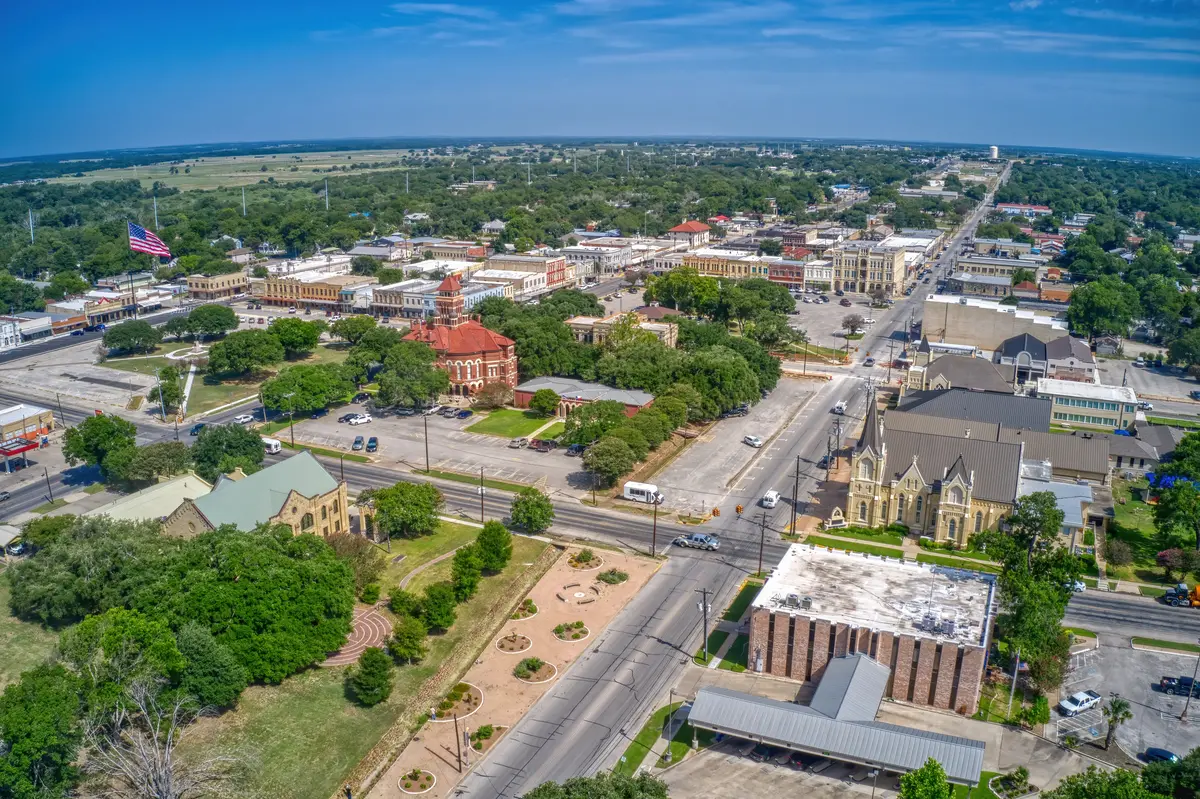
The most useful safety fact about Gonzales isn't the city-wide rate — it's how sharply that rate varies by part of town. The northeast side of the city is consistently the quietest, recording the fewest crime incidents of any quadrant. The southwest and northwest carry the bulk of the city's criminal activity, both for violent and property crime. That directional difference is meaningful for anyone deciding where to focus their neighborhood search.
For property crime specifically, the northeast records the fewest incidents in the city, while the northwest logs the most. The south side of Gonzales holds more of the city's retail establishments, which tends to push reported crime figures upward in that area — incidents are counted per resident, not per person present, so a commercial corridor with heavy foot traffic can look riskier than the surrounding residential streets actually are.
A statistical nuance worth knowing: areas with higher visitor and retail traffic often show inflated crime rates because incidents are counted per resident, not per person present. If a crime map shows a concentration near a commercial strip, it doesn't automatically mean the residential streets nearby are unsafe — it often just means more people move through that area.
What This Means for Neighborhood Selection
Neighborhoods like High Ridge Meadows, Whispering Oaks, and Creekwood — which sit in the northern and eastern portions of the city — align more closely with the quieter northeast quadrant profile. Historic Downtown Gonzales and areas near the main commercial corridor require a more nuanced read: the foot traffic and retail density can inflate numbers without proportionally increasing residential risk. Rivercrest and East Rivercrest, Las Palmas, Shady Oaks, and Lafayette Place each sit in parts of the city where conditions vary enough that a block-by-block look matters more than a quadrant average.
The honest guidance: if safety is your primary filter, weight your search toward the northeast and northern neighborhoods, and visit the areas you're considering at different times of day. No data point replaces that kind of firsthand assessment. For a fuller picture of how these neighborhoods differ in character and housing stock, see the Gonzales neighborhoods guide.
What Residents Actually Say About Living Here
Numbers and resident experience don't always align — and in Gonzales, that gap is real. Despite the elevated violent crime rate relative to state and national benchmarks, local residents on platforms like Nextdoor generally describe Gonzales as a safe place to live. That's not denial; it reflects something the per-capita rate can't capture: the degree to which crime in a small city is concentrated among a specific population of people who know each other, rather than spread as random risk across all residents.
People who move to Gonzales from larger Texas metros often note the same thing in the first few months: they expected to feel more exposed based on what they'd read, and instead found a neighborhood culture where porch-sitting is normal, people wave from their cars, and kids ride bikes in the street. That's not universal across every block, but it's a genuine feature of the quieter residential areas — particularly toward the north and east sides of the city.
The Friction Moment New Residents Don't Expect
What does catch newcomers off guard is the visibility of the police presence in certain parts of town. The Gonzales Police Department runs an active Community Policing Program, which includes a formal Neighborhood Watch Program. The Gonzales County Sheriff's Office reinforces that with donated Neighborhood Watch signage across surrounding communities. You'll see the infrastructure of crime prevention more actively displayed here than in a comparable-sized Texas town where the numbers are lower — because the department is leaning into prevention rather than coasting on a quiet baseline.
National Night Out, held each fall in Gonzales, is the most visible expression of how the city frames its safety culture: as a community responsibility, not just a police function. Turnout at those events is a decent informal proxy for how engaged a neighborhood is. The streets that show up are the ones where residents feel both safe enough to be outside and invested enough to stay that way.
Looking to buy in Gonzales? Estimate your payment.
Enter your numbers to see an estimated monthly mortgage payment.
Estimate only. Excludes HOA fees and mortgage insurance. The interest rate above is a starting point, not a quoted rate — replace it with your own to see real numbers. Insurance is a flat placeholder, not a Gonzales quote.
School Safety and Campus Policing
For families with school-age children, school safety is its own category of concern — separate from neighborhood crime rates but shaped by the same community dynamics. The Gonzales Independent School District operates its own campus police department, a level of dedicated school security that is not universal in South Texas towns of this size.
With 2,516 students enrolled in 2025-26, the district is large enough to warrant the infrastructure but small enough that officers know students by name — an aspect of small-city school policing that residents consistently cite as meaningful. The district holds a C rating, according to the Texas Education Agency, based on 2025 A-F accountability ratings for the 2024-25 school year. Academic performance and campus safety are different metrics, but both matter for families weighing the full picture.
Active UIL athletics programs and a broad slate of student activities mean campuses are in use beyond school hours, and the campus police presence extends to those events. Friday night football at Gonzales draws a crowd that functions as much as a community gathering as a sporting event — the kind of recurring, high-attendance, all-ages presence that tends to reinforce the informal safety networks that make a town feel cohesive.
For deeper detail on schools, enrollment boundaries, and what the district's programs look like on the ground, the Gonzales schools guide covers all of it.
How to Think About Safety When Choosing a Neighborhood in Gonzales
The single most common mistake people make when reading Gonzales crime data is treating the city-wide rate as if it applies equally to every block. It doesn't. A 7,239-person city where the northeast records the fewest incidents and the southwest and northwest record the most is not the same as a city where risk is evenly distributed. Knowing which part of town you're looking at changes the picture substantially.
A Practical Research Approach
Before settling on a neighborhood, look at more than the city-wide statistics. The directional data here gives you a starting point: the northeast side of Gonzales is the quietest by nearly every measure, and the southwest and northwest quadrants carry the highest activity. Within that framework, individual streets and blocks vary. Talk to people on the block, not just people who've moved to Gonzales generally.
The Neighborhood Watch Program is a useful signal: blocks that have organized watch programs tend to be ones where residents are engaged enough to notice and report unusual activity. Ask whether the street you're considering participates. The Gonzales County Sheriff's Office has distributed signage widely, so this isn't limited to the city core.
What You Give Up by Optimizing Purely for Safety Stats
The quietest neighborhoods in the northeast tend to be newer residential areas with less of the historic character that defines Gonzales at its most appealing — the walkable blocks near Independence Square, the Gonzales County Courthouse, and the Pioneer Village Living History Center. The tradeoff is real: the most historically interesting parts of Gonzales are not the same parts that post the lowest crime numbers. Families willing to live a few minutes from the historic core in exchange for a calmer residential environment will find it; those who want both will need to look carefully street by street.
The broader cost-of-living context is worth keeping in mind as you weigh neighborhood options — see the Gonzales cost-of-living guide for how pricing across different areas fits a realistic household budget. The safety picture here is genuinely mixed: elevated at the city level, meaningfully better in the right neighborhoods, and backed by a police department that is actively engaged rather than reactive.
Local Expert Takeaway: Gonzales is not a city where you look at the city-wide crime rate and stop reading. The northeast quadrant records dramatically fewer incidents than the southwest and northwest, and families who do their neighborhood research — who look at the directional data, talk to residents, and check whether their target block participates in the Neighborhood Watch Program — consistently land in places that feel nothing like the aggregate statistics suggest. The Gonzales Police Department's active Community Policing Program, the annual National Night Out turnout, and the GISD's own campus police department are all signs of a community that takes safety seriously rather than one that accepts elevated numbers as inevitable. The honest answer to 'Is Gonzales safe?' is: it depends which part of Gonzales, and it depends on whether you do the neighborhood-level homework.
Quick Takeaways & FAQs
✅ The northeast part of Gonzales records the fewest crime incidents in the city — a meaningfully quieter environment than the city-wide rate alone suggests.
⚠️ Gonzales carries a violent crime rate of 13.9 per 1,000 residents, significantly above both the Texas and national averages, and that gap is real even after accounting for small-city statistical volatility.
📍 The Gonzales Police Department runs a formal Neighborhood Watch Program and hosts National Night Out each fall — asking whether your target block participates is one of the most useful safety questions you can ask before deciding on an area.
What is Gonzales, TX's violent crime rate compared to the rest of Texas?
What is the safest part of Gonzales, Texas?
Why do crime maps show high crime in Gonzales's commercial areas?
What is the Gonzales Police Department doing about crime prevention?
Is Gonzales safe for families with children?
Moving to Texas?
Tell us what you need help with and we'll connect you with local resources.
