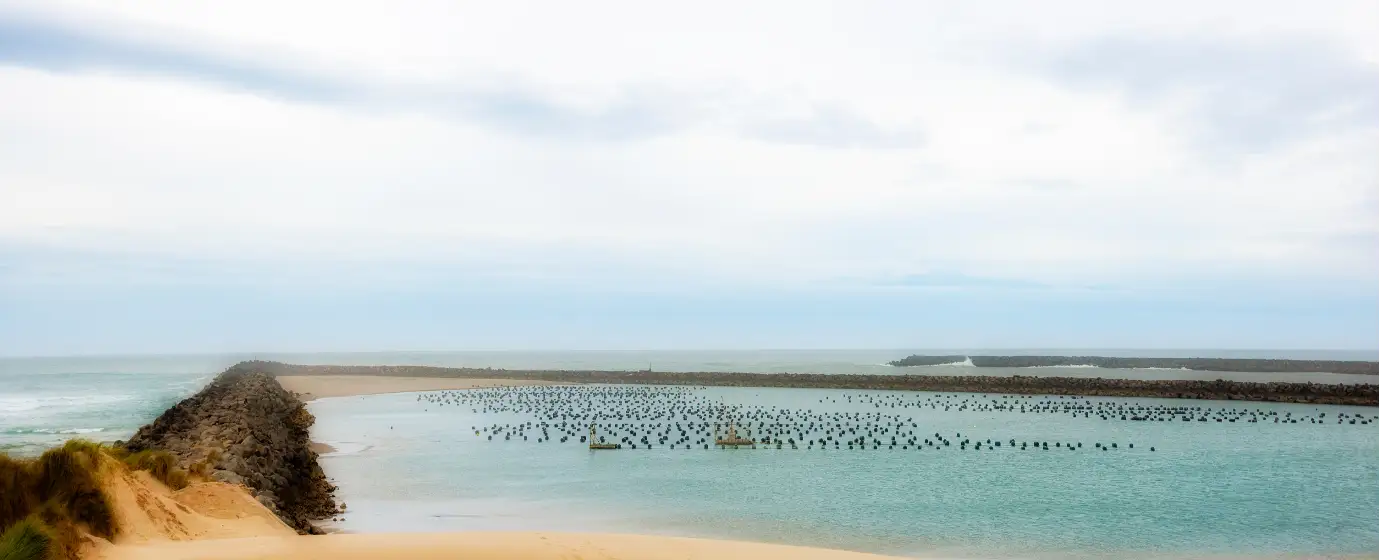
The question people ask most often about Reedsport — right after "what's the weather like?" — is whether it's safe. It's a fair question to ask about any small coastal town with a population of 4,317, and the honest answer is more reassuring than you might expect. Reedsport sits where US-101 and OR-38 meet, at the mouth of the Umpqua River, which means it absorbs a meaningful amount of through-traffic and seasonal visitor activity. That context matters when you look at crime maps, because a town built around recreational access looks statistically busier than a residential suburb of identical size.
The numbers, compared against both Oregon and the nation, tell a story that many people considering a move here don't anticipate. Violent crime here is below the state average and meaningfully below the national figure — a fact worth sitting with before you absorb localized crime-map heat zones that don't distinguish between a resident neighborhood and a commercial pull-off. Property crime runs above the national per-capita rate, but below the state benchmark, and the breakdown matters: the vast majority of recorded offenses are theft and vehicle-related, not crimes against people.
This guide breaks down what the data actually says, how different parts of Reedsport compare, what the local police presence looks like, and how emergency services are structured across this stretch of the Oregon Coast. Whether you're deciding on a specific neighborhood or simply trying to understand whether Reedsport belongs on your list, the sections below cover violent and property crime in context, the geographic safety picture by area, police and emergency response, and what residents say about day-to-day life here.
Reedsport Crime Rates vs. Oregon and the Nation
Reedsport carries a violent crime rate of 2.97 per 1,000 residents — below Oregon's state benchmark of 3.3 per 1,000 and noticeably below the national figure of 3.7 per 1,000 (Bureau of Justice Statistics, Crime Known to Law Enforcement, 2024, tables 2 and 3). For a city this size on a heavily traveled coastal corridor, that's a meaningful distinction.
The property side of the picture is more nuanced. Reedsport carries a property crime rate of 23.9 per 1,000 residents, which sits below Oregon's state rate of 24.5 per 1,000 — but above the national property crime rate of 18.4 per 1,000. That gap is real, and it's worth understanding rather than dismissing.
The raw numbers behind the property rate put it in sharper focus: FBI data for 2024 recorded 104 property crimes in the city alongside just 7 violent crimes. Serious personal-safety offenses are rare. What pushes the property rate above the national average is petty theft and vehicle-related incidents — the category of crime most directly connected to visitor traffic, commercial corridors, and recreational pull-outs. A city that draws dune riders, crabbers, and coastal travelers year-round will generate this kind of activity at a higher rate per resident than a landlocked suburb of the same size.
The trend direction is also worth noting. Tracking over the last five years shows decreasing violent crime and decreasing property crime in Reedsport, with a notable drop in the overall crime index from 2024 to 2025. This is not a city whose numbers are moving in the wrong direction.
The Geographic Safety Picture: Where Reedsport's Neighborhoods Stand
Reedsport's neighborhoods feel different from each other in ways that crime data can reflect — but that data requires some interpretation before you act on it.
The West Side Advantage
Residents consistently identify the western residential areas as the quieter end of the city. The Longwood and Highland area, Master Heights, and Forest Hill Subdivision sit away from the commercial center and the US-101 corridor traffic. These neighborhoods have the character of settled residential streets — the kind of places where crime-map heat fades because there's simply less foot and vehicle traffic cycling through.
Downtown Reedsport and the Commercial Core
Downtown Reedsport, centered on the main commercial strip, concentrates the activity that inflates raw crime counts. Retail areas attract more people — including more opportunistic theft — and that pattern shows up in localized crime mapping. This doesn't mean Downtown Reedsport is dangerous in the personal-safety sense; the 7 recorded violent crimes across the entire city in 2024 underline that. But it does mean that raw incident counts in the commercial zone look higher than they would in a purely residential neighborhood of the same size.
Winchester Bay: Reading the Numbers Carefully
Winchester Bay sits just south of Reedsport proper at the mouth of the Umpqua River, with a permanent resident count of roughly 191 people. It draws heavy seasonal traffic for dune access and crabbing. When crime incidents are divided by that small permanent population, per-capita rates can appear alarming — but those incidents are largely visitor-driven, spread across a tiny denominator. Assessing Winchester Bay's safety purely from a per-resident rate is one of the more common mistakes people make when researching this area.
Wildwood Dunes and River Bend
Wildwood Dunes (also known as Pacific Wildwood Dunes) and River Bend offer more removed residential settings, further from commercial traffic patterns. CrimeGrade data notes that Reedsport has three designated recreational areas that can skew localized crime maps — a reminder that proximity to a trailhead or a park access point, not just a commercial strip, can affect how a neighborhood reads on a heat map without reflecting the actual lived experience on that block.
For a deeper look at how these areas compare on other dimensions, see the neighborhoods guide.

Police Coverage and Community Policing in a Small Coastal City
The Reedsport Police Department runs around the clock, every day of the year. The department is small enough that officers know the city block by block — the kind of department where patrol presence is visible downtown and a community-oriented structure is possible because officers aren't spread thin across a large urban service area.
The department's stated mission frames its approach directly: to reduce victimization, address the effect of crime on victims, and maintain the quality of life in Reedsport. In practice, that translates to community-oriented policing strategies — neighborhood watch initiatives, public safety awareness campaigns, and active collaboration with local schools and organizations. For a city of 4,317, those aren't generic checkboxes; they reflect the kind of direct relationship between officers and residents that only works when a police department is embedded in a community rather than managing it from a distance.
What this means practically is that response times in most of the city are faster than they would be in a larger urban service area, and residents who engage with the neighborhood watch programs tend to have a direct line to the officers assigned to their part of town. That community-oriented structure is part of why resident perception of safety runs so high here, even among people who are aware of the property crime figures.
Looking to buy in Reedsport? Estimate your payment.
Enter your numbers to see an estimated monthly mortgage payment.
Estimate only. Excludes HOA fees and mortgage insurance. The interest rate above is a starting point, not a quoted rate — replace it with your own to see real numbers. Insurance is a flat placeholder, not a Reedsport quote.
Emergency Medical Response: What You Should Know
Emergency medical coverage in Reedsport is anchored by a resource that cities of this size often lack: a hospital inside city limits. Lower Umpqua Hospital operates a 24/7 emergency room with full Emergency Medical Services, surgical capabilities, and rehabilitation — and its hospital-based ambulance service covers over 650 square miles of western Douglas County and northern Coos County, fielding around 1,500 calls per year.
That geographic reach matters because it means EMS response is coordinated across the broader coastal community — not just the city core. The district service area explicitly includes Reedsport, Winchester Bay, Lakeside, Gardiner, and Scottsburg. If you're considering a home in Winchester Bay or along the river beyond the city boundary, you're still within the same emergency response umbrella.
One detail that reflects how seriously this coastline takes its particular hazards: the EMS fleet includes a dedicated sand-rail vehicle for dune emergencies. The Oregon Dunes National Recreation Area generates its own category of rescue calls, and the local hospital has built the infrastructure to handle them. For a city this size, that level of specialized emergency readiness is unusual and worth noting for anyone who plans to spend time in the dunes regardless of where they live.
For more on healthcare options and what retirement looks like on this stretch of the coast, see the retiring in Reedsport guide.
What Residents Actually Say — and What to Watch For
The Resident Perception
Community perception data from Nextdoor, where Reedsport residents rate the city 99 out of 100 for safety and 98 out of 100 for friendliness, lands well above what you'd expect from a city whose property crime rate exceeds the national average. The description that comes up repeatedly in resident comments is a peaceful, quiet town where the community makes it feel safe and welcoming. That's user-generated sentiment, not an independent measurement — but when perception runs that high in a place where the numbers are already favorable on violent crime, it's telling you something about lived experience versus statistical abstraction.
The Honest Friction Point
The property crime figure is the thing to take seriously, and it's worth being specific about what it means in practice. Unlocked vehicles and items left visible in cars are the most common targets in a coastal tourist corridor — and that's true whether you live near the commercial center or in a quieter residential pocket. Residents who've been here a few years tend to say the same thing: you adapt your habits, the way you would in any town with seasonal foot traffic and highway-adjacent retail. The crime isn't random or predatory in the personal-safety sense; it's opportunistic, and reducing your exposure to it is largely within your control.
Seasonal Dynamics
Summer brings a sharp increase in the number of people passing through Reedsport — dune riders staging from the Oregon Dunes National Recreation Area, campers moving along US-101, and crabbers working Salmon Harbor Marina. The commercial corridors absorb most of that activity, and the property crime rate in those months reflects it. Residential neighborhoods further from the main corridor feel little of this seasonal surge in practice. If you're evaluating a neighborhood, the question worth asking is how directly it connects to those high-traffic zones — not whether the city-wide summer numbers look elevated compared to February.
What to Check Before You Decide on a Neighborhood
Look at the specific block's relationship to the US-101 commercial corridor and to recreational access points rather than relying on city-wide or even neighborhood-wide heat maps. A street in the Longwood area that backs up to residential parcels reads very differently from one that fronts a commercial strip, even within the same general part of town. The city-wide violent crime picture — a violent crime rate of 2.97 per 1,000 residents against a national rate of 3.7 — should anchor your overall assessment. The property crime context should sharpen how you think about parking habits and visible valuables, not whether Reedsport belongs on your list at all.
Local Expert Takeaway: Reedsport's violent crime rate sits below both Oregon's state average and the national figure — that's the baseline for any honest safety conversation here. The property crime rate exceeds the national per-capita mark, but the mechanics behind it are almost entirely theft-driven and tourist-corridor-concentrated, not a reflection of neighborhood instability. Residents on the west side, in Master Heights, Forest Hill, and the Longwood area, report the quietest day-to-day experience. The city has a hospital inside its limits, a round-the-clock police department with community-oriented programs, and a five-year trend of falling crime. For a small coastal city of 4,317 on one of Oregon's busiest recreational corridors, that's a stronger safety picture than most people expect going in.
Quick Takeaways & FAQs
✅ Reedsport carries a violent crime rate of 2.97 per 1,000 residents — below both Oregon's state average and the national figure, a genuine strength for a coastal city with heavy tourist traffic.
⚠️ Property crime runs above the national per-capita rate, driven almost entirely by theft in commercial and visitor-heavy corridors rather than crimes against residents in quieter neighborhoods.
📍 Lower Umpqua Hospital operates a 24/7 emergency room inside city limits and its EMS service covers over 650 square miles — including a dedicated sand-rail vehicle for dune rescues.
Is Reedsport, Oregon a safe place to live?
What type of crime is most common in Reedsport?
Which neighborhoods in Reedsport are considered the safest?
How does Reedsport's crime rate compare to the rest of Oregon?
What is the emergency response situation in Reedsport?
Moving to Oregon?
Tell us what you need help with and we'll connect you with local resources.
