
Most Californians who land in Moscow, Idaho say the same thing in month three: they can't believe how quiet it is — and they don't mean that as a complaint. Moscow sits at the center of the Palouse, a rolling agricultural landscape in north-central Idaho, about eight miles east of the Washington state line and roughly ten minutes from Pullman, WA. U.S. Highway 95 is the main north-south spine, and Moscow Mountain rises just northeast of town. What drives daily life here isn't a freeway interchange or a tech campus — it's the University of Idaho, which enrolled 12,383 students in Fall 2025 and anchors the economy, the cultural calendar, and frankly the entire character of this city of about 26,000.
The University of Idaho isn't just the largest employer — it shapes who moves here and why. Faculty, staff, graduate students, and the engineers at Schweitzer Engineering Laboratories form the core of the professional class. The Moscow School District rounds out the public-sector base. Californians who relocate here tend to fall into a few predictable groups: remote workers who cashed out of the Bay Area or Southern California and want space, academics following a position at UI, and families priced out of the Pacific Coast who want a college town with actual seasons. The living in Moscow overview covers the full employer and lifestyle picture.
Moscow's combined cost of living sits at or just below the U.S. national average, with housing costs estimated 13–14% below the national norm — a figure that looks almost absurd compared to most California metros, where housing runs two to four times the national baseline. The city's typical home value as tracked by the Zillow Home Value Index was $444,039 in May 2026; see the cost of living page for the full breakdown. Day-to-day, you'll find a walkable downtown, the UI Arboretum and Botanical Garden, East City Park, a genuine arts scene anchored by the Kenworthy Performing Arts Centre and the 1912 Center, and a farmers market that locals treat as a Friday-morning social institution.
Whether you're a Bay Area remote worker running the numbers, a Sacramento family looking for breathing room, or an academic following a UI position, this guide covers the California-to-Moscow financial comparison, the tax picture, what the transition actually feels like on the ground, what surprises people after six months, and where the honest trade-offs are.
The Home Price Reality: What California Money Buys in Moscow
If you're selling a median-priced home in San Jose, Los Angeles, or San Diego before moving to Moscow, you are not buying a house here — you are buying a house and likely eliminating your mortgage entirely. The Zillow Home Value Index placed Moscow's typical home value at $444,039 as of May 2026. California's median sale prices, depending on metro, run anywhere from roughly double to more than four times that figure.
That gap creates a specific kind of financial whiplash. Buyers who arrive from the Bay Area describe the experience of touring a four-bedroom craftsman near the Fort Russell Historic District and spending fifteen minutes trying to find the catch. There isn't one — the price is just that much lower.
What the Price Difference Actually Means
A Californian selling at or above the state's median and buying at Moscow's typical price often has enough equity to put 50% or more down, dramatically changing monthly carrying costs. That freed-up capital is one of the primary reasons remote workers from the Bay Area have targeted Moscow specifically — it converts coastal equity into a paid-down mortgage and a lower monthly burn rate simultaneously.
Entry-level in Moscow typically means older construction on smaller lots, starting in the low-to-mid $300,000s. The Fort Russell Historic District and College Hill command higher prices given their architecture and proximity to campus. For a granular look at what each part of the city delivers, the neighborhoods guide breaks it down specifically.
| Market Comparison | Moscow, ID | California Context |
|---|---|---|
| Typical home value (May 2026) | $444,039 | Noticeably lower than even inland CA metros |
| Entry-level price range | Low-to-mid $300,000s | Far below most CA starter-home markets |
| Historic / walkable districts | Higher end of the Moscow range | Still a fraction of comparable CA neighborhoods |
| Effective property tax rate | ~0.70% | Significantly below California's typical effective rate on newly purchased property |
| 1BR rent, city center | ~$886/month | Well below CA coastal cities ($2,000–$3,000+) |
| Cost of living vs. national avg. | At or just below average | Most CA metros run well above |
Moscow's effective property tax rate of approximately 0.70% also contrasts sharply with what California buyers are accustomed to. Idaho has no estate tax or inheritance tax, which matters to buyers who arrive with significant California equity and assets.
The First-Time Buyer Picture
For Californians who were renters back home, Moscow may represent the first realistic path to ownership they've encountered. The first-time homebuyer page covers Idaho-specific loan programs and down payment structures in detail — worth reading before you make any assumptions about what you'll need to bring to closing.
Taxes: The Idaho vs. California Comparison
This is where the Moscow case gets genuinely compelling for high earners moving from California. Idaho's flat individual income tax rate is 5.3% as of January 1, 2025 — reduced from the prior 5.695%. There is no separate city or county income tax layered on top. You pay 5.3%. Full stop.
California's state income tax is progressive, reaching 13.3% for the highest earners. For a household earning $250,000 in California, the marginal rate difference alone represents a substantial annual savings when moving to Idaho — a reduction that compounds every year.
The Full Tax Stack, Side by Side
| Tax Category | Moscow, Idaho | California (General) |
|---|---|---|
| State income tax (top rate) | 5.3% flat | Up to 13.3% progressive |
| City / county income tax | None | Varies (some cities add surcharges) |
| Sales tax rate | 6.0% (state only, no local add-on) | 7.25%+ state; local rates push many cities to 9–10.75% |
| Effective property tax rate | ~0.70% | Typically higher on newly purchased property |
| Estate / inheritance tax | None | None at state level |
| Capital gains treatment | Taxed as ordinary income at 5.3% flat | Taxed as ordinary income at progressive rates |
Moscow's total sales tax is 6.0% — Idaho's flat statewide rate with zero local add-on. In contrast, many California cities layer local sales taxes on top of the base rate, pushing effective totals to 9% or higher in places like Los Angeles and Oakland.
What This Means Year Over Year
For remote workers earning California salaries while living in Moscow, the income tax differential is the single largest financial lever of the move. A household that was paying California's upper marginal rates and shifts to Idaho's 5.3% flat rate keeps a meaningful amount of additional income annually — income that in Moscow's cost environment goes considerably further.
Property tax in Idaho is also structured favorably for owner-occupants. The homeowner's exemption reduces the taxable value on a primary residence, which effectively lowers the bill below what the raw 0.70% rate implies for many buyers. That said, the exact calculation depends on your purchase price and assessment, so run the numbers specifically rather than relying on a rule of thumb.
One honest caveat: California's Proposition 13 capped property taxes for long-term homeowners at artificially low effective rates. If you've owned a California home for 20 years, your effective rate may actually be lower than Moscow's 0.70% on assessed value — because your assessed value hasn't kept pace with the market. Newcomers to California, by contrast, pay on current market value. Moscow's 0.70% applies to assessed value, which in Idaho tends to track market value more closely than California's frozen-assessment system does.

Daily Life Adjustment: What Californians Actually Notice
The financial math is easy. The lifestyle adjustment is where it gets interesting — and where most California transplants admit they underestimated something.
The Size of the Place
Moscow has about 26,000 people. That is not a typo. Many Californians who move here come from metro areas with millions of residents, and the psychological shift from scale alone takes several months. The upside: no traffic in any meaningful sense. The one genuine chokepoint locals cite is the intersection of US-95 and Pullman Road during the afternoon shift change at Schweitzer Engineering Laboratories — it backs up reliably between 4:30 and 5:30 p.m. on weekdays. Outside that window, a cross-town commute is ten to twelve minutes regardless of where you're going.
The Pullman, WA campus of Washington State University is about ten minutes west. Many Moscow residents split their shopping and dining between the two cities — a practical habit worth adopting early. WSU's facilities, Pullman's restaurants, and Moscow's downtown form a de facto twin-city ecosystem that residents use interchangeably.
The College Town Reality
Living near the University of Idaho means access to Division I athletics, a performing arts calendar at the Kenworthy and the 1912 Center that punches well above a city this size, and a population that skews young and educated. It also means August move-in week turns Moscow's normally quiet streets into genuine gridlock, football Saturdays change parking across half the city, and the rental market tightens around the academic calendar in ways that don't apply to most small cities.
The UI's enrollment has grown five consecutive years, hitting 12,383 students in Fall 2025. That growth is a net positive for Moscow's economy and cultural energy, but it also puts upward pressure on housing — something buyers should factor in when evaluating long-term investment.
Where People Actually Gather
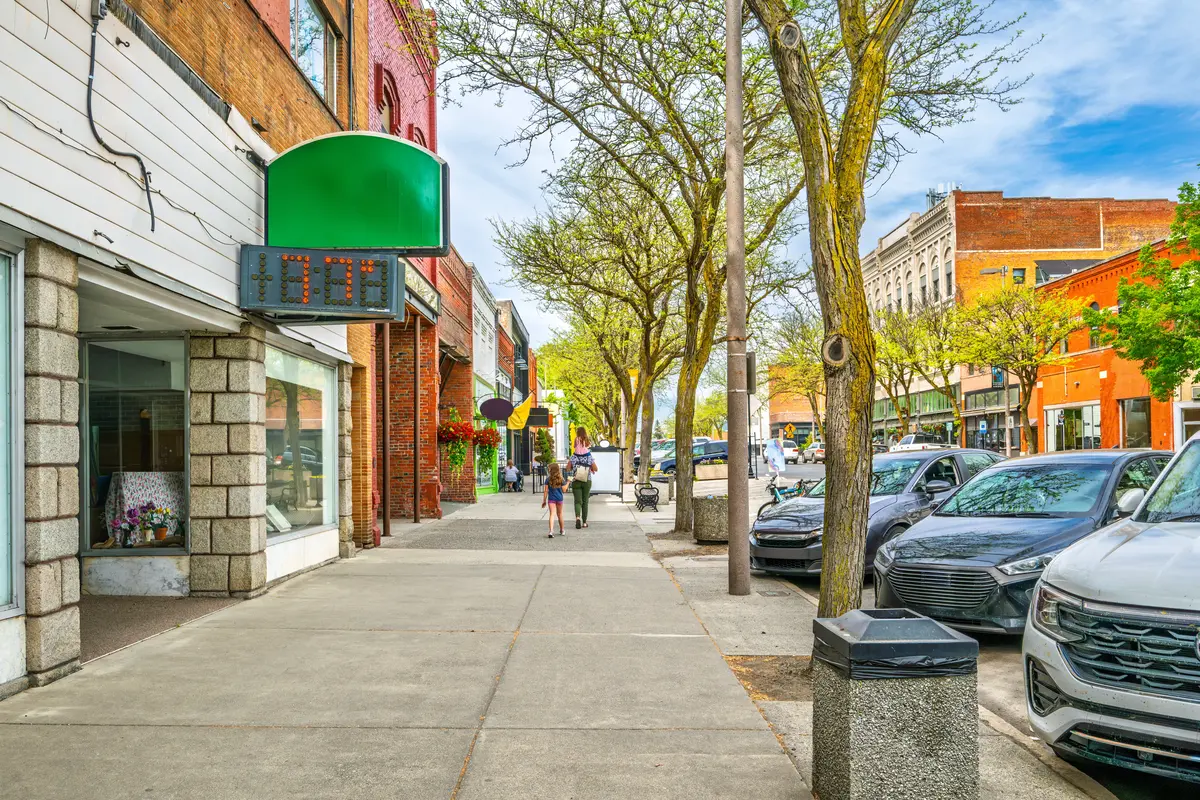
The Saturday farmers market on East City Park's lawn is genuinely where you learn who your neighbors are — it runs spring through fall and draws a cross-section of the city that no other event quite replicates. Downtown Moscow's main strip along Main Street and Jackson Street holds independent cafés, restaurants, and Hunga Dunga Brewing Co. on N Jackson St, a taproom that functions as a reliable after-work gathering spot for the Schweitzer engineering crowd and UI faculty alike. Silos & Social operates out of the Latah County Grain Growers complex and has become a morning anchor for the northwest side of the city. Maialina Pizzeria Napoletana draws people who were skeptical that a city this size could support serious Neapolitan pizza — and then converts them.
What Surprises People After Six Months
Almost universally: the winters. Moscow gets real snow — not Bay Area dusting but weeks of accumulation — and the Palouse sits in a geographic pocket that produces ice fog in January that Californians simply have no reference point for. Roads ice overnight. A front-wheel-drive vehicle that was fine in Sacramento is a liability on Moscow Mountain Road in February. Buy all-season tires at minimum; locals who grew up here drive winter tires from November through March.
The second surprise is more pleasant: the outdoor access. Moscow Mountain's trail network and the beginning of the Clearwater National Forest both sit within twenty to thirty minutes of downtown. For Californians accustomed to driving ninety minutes to reach any trailhead, the proximity resets expectations quickly. The parks and recreation page covers the full outdoor picture.
Looking to buy in Moscow? Estimate your payment.
Enter your numbers to see an estimated monthly mortgage payment.
Estimate only. Excludes HOA fees and mortgage insurance. The interest rate above is a starting point, not a quoted rate — replace it with your own to see real numbers. Insurance is a flat placeholder, not a Moscow quote.
Why People Leave California for Moscow — and Why Some Move Back
Understanding both sides of this equation saves you from arriving with the wrong expectations.
The Reasons That Hold Up
The financial case is real and durable. Lower home prices, a substantially lighter income tax burden, no local sales tax surcharge, and a cost-of-living environment that runs at or below the national average combine into genuine structural savings — not just a cheaper cup of coffee. Families who arrive from California frequently describe the first year as financially disorienting in a good way: they're spending less and accumulating equity at a pace that was impossible on the coast.
The community is also tighter than Californians expect. Moscow's size means you will run into your neighbors at East City Park, at the farmers market, at UI basketball games. For people who moved out of dense California cities feeling anonymous and disconnected, that reconnection to a legible community is often what makes the move feel permanent rather than temporary.
Safety is worth mentioning once: Moscow's crime figures are low relative to California's urban centers, per city data. The safety page has the full breakdown.
The Reasons People Move Back
Some California transplants leave Moscow within two to three years. The reasons are consistent and worth knowing in advance.
Career ceiling is the biggest one. If you are not employed by the University of Idaho, Schweitzer Engineering, or a regional employer, and you are not a remote worker, the job market in a city of 26,000 is genuinely limited. Mid-career professionals in finance, entertainment, law, or specialized tech who need an in-person professional ecosystem find Moscow isolating. The lack of a direct flight from Moscow's regional airport to any major hub compounds this — Spokane International, about 90 miles north, is the practical commercial airport, which adds friction to any role requiring frequent travel.
The other common departure reason is harder to articulate but real: Moscow's political and cultural environment is more conservative than California's coastal metros, though the university presence creates a notable counterbalance. The city has had genuine public debates in recent years around issues that Californians who moved here for lifestyle reasons sometimes didn't anticipate navigating. This is not a warning — it is context. Know what you're walking into socially, not just financially.
Finally, some people simply miss density. After eighteen months in a town where 10 p.m. on a Friday feels quiet, a subset of California transplants realizes they didn't actually want small-town life — they wanted cheaper housing in a city. Those are different things, and Moscow delivers the former, not the latter.
The Honest One-Line Version
Moscow works exceptionally well for remote workers, academics, outdoor-focused families, and anyone who genuinely wants a college town — and tends to disappoint buyers who expected California urban amenities at Idaho prices.
The Practical Checklist: Before You Make an Offer
Buying in Moscow from out of state has a few specific friction points that California buyers consistently underestimate. Working through these before you're under contract saves real money and stress.
Establish Idaho Residency Deliberately
Idaho's tax advantages only apply once you are a legal Idaho resident. Changing your voter registration, updating your driver's license, and establishing a primary residence in Idaho are the practical steps — but timing matters if you have capital gains from a California home sale in the year of your move. Consult a tax professional who understands both California's exit tax implications and Idaho's treatment of income earned during a split residency year. This is not a generic suggestion: California's Franchise Tax Board actively audits high-income departing residents, and the rules around what income California can still claim after you've moved are more complex than most people expect.
Understand the Idaho Homeowner's Exemption
Idaho's homeowner's exemption reduces the assessed value of your primary residence for property tax purposes. You must apply for it — it is not automatic. File with Latah County after closing, not before. Missing the application window means paying on full assessed value for that tax year, which is a straightforward mistake to avoid if you know it's coming.
Budget for the Winters Before You Need To
If you are moving from anywhere south of Sacramento, assume your vehicle needs winter tires and your home needs to be assessed for insulation before your first November. Moscow's winters are real, and a house that feels drafty in October is a problem you want to catch before January, not during it. Sellers in Moscow are accustomed to buyers requesting inspections that include roof condition, insulation, and heating system age — these are not unusual asks.
The Remote-Work Infrastructure Question
Moscow has reliable broadband in most areas, but coverage is not uniform. If your livelihood depends on consistent high-speed internet, confirm service availability at the specific address before closing — not at the neighborhood level, at the address level. Rural addresses on the edges of Moscow's postal area can fall into a coverage gap that the neighborhood's reputation doesn't reflect.
Time Your Search Around the Academic Calendar
Moscow's real estate inventory tightens in spring as the academic year wraps, and a wave of listings typically appears in May and June as faculty and staff relocating for new positions list their homes. If you can be flexible, shopping in late summer after the post-graduation rush has passed gives you more negotiating room and less competition. The worst time to search — and to rent, if you need temporary housing — is August through early September, when the student population returns and landlords have their pick of applicants.
| Pre-Move Task | Why It Matters in Moscow Specifically | Timing |
|---|---|---|
| Consult CA/ID split-year tax advisor | California FTB audits departing high earners; rules are complex | Before listing your CA home |
| File Idaho homeowner's exemption | Not automatic — must apply with Latah County post-closing | Within 30 days of closing |
| Confirm internet service at the address | Coverage gaps exist at specific rural addresses | During due diligence |
| Inspect insulation and heating system | Moscow winters are real; older homes vary significantly | Before removing inspection contingency |
| Budget for winter tires | All-seasons are minimum; Moscow Mountain Road ices hard | Before your first November |
| Target late-summer inventory window | Post-graduation listings, less student-season competition | July–August search window |
The first-time homebuyer guide covers Idaho loan programs and closing cost structures for buyers working through the purchase mechanics for the first time in this state.

Local Expert Takeaway: The Moscow move works best when the math and the lifestyle both make sense. On the math side: Idaho's 5.3% flat income tax versus California's rates up to 13.3%, a $444,039 typical home value, a 0.70% effective property tax rate, and a 6.0% sales tax with zero local add-on are all real numbers that compound into genuine structural savings. On the lifestyle side: a 26,000-person college town built around the University of Idaho, where the Saturday farmers market at East City Park is a weekly social institution, Hunga Dunga Brewing on N Jackson St is where engineers and faculty decompress after work, and the trail network on Moscow Mountain is twenty minutes from downtown. File the Idaho homeowner's exemption within thirty days of closing, buy winter tires before November, and confirm your internet service at the specific address — not the neighborhood. Do those three things and the transition is smoother than most California transplants expect.
Quick Takeaways & FAQs
✅ Idaho's flat 5.3% income tax rate — compared to California's progressive rates reaching 13.3% — is the most durable financial advantage of the Moscow move, and it compounds every year you stay.
⚠️ Moscow's job market outside the University of Idaho, Schweitzer Engineering, and a handful of regional employers is genuinely limited — mid-career professionals who need a dense in-person professional ecosystem often leave within two to three years.
📍 The Saturday farmers market at East City Park is where newcomers actually meet their neighbors — show up in May when the season opens and introduce yourself; it works faster than any neighborhood Facebook group.
How much cheaper is it to buy a home in Moscow, Idaho compared to California?
What is Idaho's state income tax rate compared to California's?
Will California still tax me after I move to Moscow?
What surprises California transplants most about living in Moscow, Idaho?
Is Moscow, Idaho a good fit for remote workers from California?
Moving to Idaho?
Tell us what you need help with and we'll connect you with local resources.
