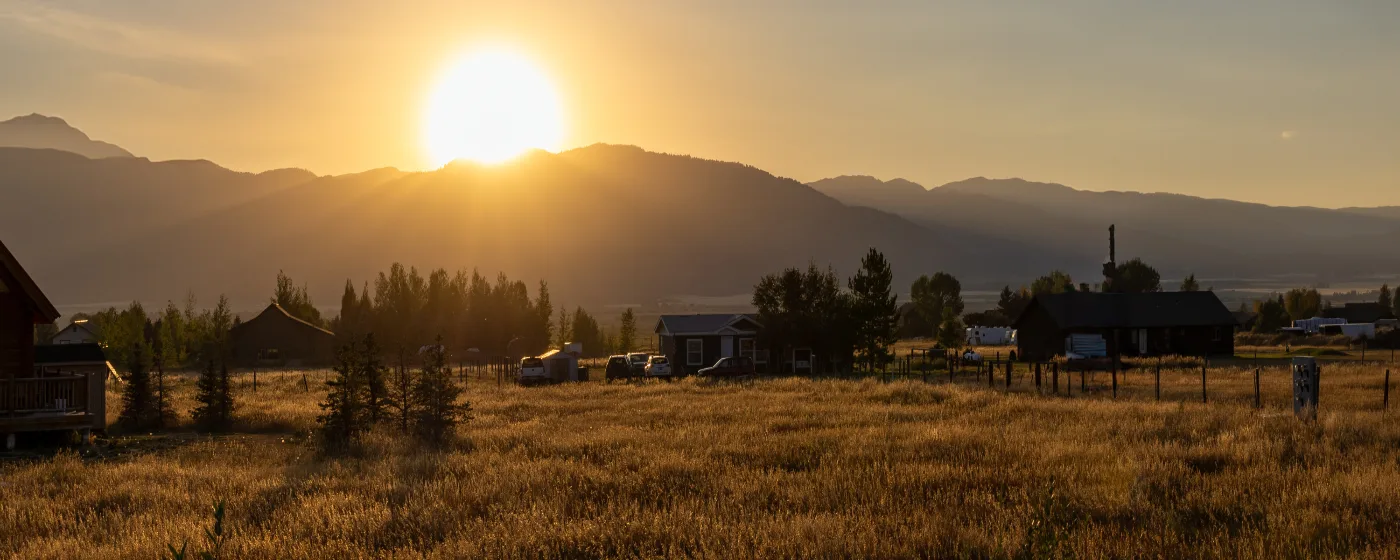
You've probably looked at Jackson, Wyoming — and flinched at the price tag. Victor, Idaho sits just 35 minutes west over Teton Pass, but the financial reality is entirely different. The Zillow Home Value Index pegged the typical home at $797,530 in May 2026, which still feels significant but is a fraction of what comparable properties fetch on the Wyoming side of the range. What you're trading into is a small-town Idaho community of roughly 2,600 people, a genuinely walkable downtown core anchored by Pierre's Playhouse and the Knotty Pine Supper Club, and a valley floor that looks directly at the Tetons — without the Wyoming price premium attached to that view.
The draw for retirees is specific. Victor is not a golf-course retirement enclave or a 55+ campus community. It's an outdoor-oriented, arts-friendly small town where the Thursday evening Music on Main concert series at Victor City Park becomes a standing social commitment from June through August, and where neighbors tend to know one another by name within a season. The trade-off is real: there's no hospital in city limits, no big-box pharmacy, and no memory-care facility within the immediate community. Retirees who need frequent specialist care or who anticipate needing skilled nursing within five years need to map that reality carefully before committing.
Idaho's tax posture is genuinely favorable for people living on Social Security — the state exempts those benefits entirely with no income cap. Property taxes run at an effective rate of approximately 0.36%, well below the national average. Daily costs for groceries, gas, and services are broadly in line with rural Idaho, though some premium categories run higher in Teton Valley due to the resort-market effect. For the full cost-of-living picture, see the Victor cost-of-living page.
Whether you're planning a full retirement move or exploring this corner of Eastern Idaho as a part-time base, the sections below cover what you actually need to know: healthcare access and its honest limitations, the retiree tax picture, daily walkability, downsizing options, and how Victor stacks up against the nearby towns most retirees compare it to.

Why Retirees Are Choosing Victor
The retirees who land in Victor and stay share a recognizable profile: they want mountain access without mountain-resort prices, they'd rather walk to a local bar for live music than drive to a strip mall, and they are comfortable with the tradeoffs of small-town rural life. Victor fits that profile well. A typical home price of $797,530 (Zillow Home Value Index, May 2026) puts ownership within reach for buyers who've sold a home in a more expensive market — though it is not the bargain it was five years ago, and it is not cheap by any rural Idaho standard.
What Victor offers beyond scenery is genuine community density for a town its size. The Spud Drive-In, the Victor Emporium, the Music on Main venue at City Park — these aren't tourist attractions that retirees watch from the sidelines. They're the actual social infrastructure of the town, and newcomers get folded in quickly. The low violent-crime rate — well below the national average — also matters to retirees making a permanent move; see the Victor safety page for the full picture.
Who should look elsewhere: if you need walkable medical access beyond primary care, require urban amenities like a large hospital system, specialist network, or major-chain pharmacy within a few miles, or if you'd struggle with harsh winters at 6,000-plus feet elevation, Victor will frustrate you. It rewards people who plan ahead, maintain their health actively, and genuinely want to live smaller and slower — not people who are settling for small-town life because the price was right.
Healthcare & Medical Access in Victor
What's Inside Victor
Victor has no hospital of its own, but it does have a primary-care anchor worth knowing: the Victor Health Clinic at 283 N. First St., operated by Teton Valley Health. It holds federal Patient-Centered Medical Home (PCMH) certification and provides primary care, chronic disease management, vaccinations, and lab work. For retirees whose day-to-day healthcare needs center on a good internist or family physician, this clinic is a serious asset — not just a rural stopgap.
The Nearest Hospital
Teton Valley Health Care's critical-access hospital is in Driggs, roughly 7 miles north on Highway 33. Critical-access designation means it operates with a limited number of inpatient beds and is equipped for emergency stabilization, imaging, and outpatient procedures — but not for complex cardiac, oncology, or neurosurgical cases. The drive to Driggs is straightforward year-round.
Advanced Care: The Real Distance
For anything beyond what Driggs can handle, the realistic destinations are St. Luke's Wood River Medical Center in Ketchum (about 1.5 to 2 hours west) or the major systems in Idaho Falls, roughly 90 minutes south on US-26. Jackson, Wyoming — just over Teton Pass — has St. John's Medical Center, which carries more specialty depth than Driggs, but the pass itself closes periodically in winter storms. That road reality matters for anyone with a cardiac history or other conditions requiring emergency transport.
Retirees with serious ongoing specialist needs should be honest about this before committing. Victor works well for people who are in good health and focused on staying that way — it is not the right base for someone who will need quarterly specialist visits and expects them to be a short drive away. Building a relationship with the Victor Health Clinic early, and establishing a specialist relationship in Idaho Falls or Jackson before you need it urgently, is the standard approach for long-term residents.

The Retiree Budget in Victor
Idaho's Tax Position for Retirees
Idaho exempts Social Security benefits from state income tax entirely — no income cap, no age threshold, no phase-out. If your retirement income is predominantly Social Security, Idaho's flat 5.8% income-tax rate barely touches you.
The picture is different for 401(k) withdrawals, IRA distributions, and most private pensions. Those are taxed at Idaho's flat 5.8% rate on taxable income. A narrow Retirement Benefits Deduction exists, but it applies only to specific categories: CSRS federal civil-service retirees, Idaho public-safety personnel, and qualifying military retirees. If you don't fit one of those categories, plan your withdrawal strategy with Idaho's flat rate in mind.
Idaho also levies no estate or inheritance tax. The federal estate-tax exemption threshold for 2026 is $15 million, meaning estate-tax exposure is not a realistic concern for the vast majority of retirees planning their wealth transfer.
Property Tax Reality
Victor's effective property-tax rate is approximately 0.36% — well below the national average and a meaningful advantage for retirees on fixed incomes who own their home outright. If you qualify for Idaho's Circuit Breaker program — homeowners aged 65 and older with 2025 income under $39,130 — you can reduce your annual property-tax bill by $250 to $1,500. Applications run January 1 through April 15 at the Teton County assessor's office. It's worth filing if you're anywhere near that income threshold.
Daily Cost of Living
Victor sits in a resort-adjacent valley, and some prices reflect that. Specialty groceries, dining out, and some services run higher than in a comparable non-resort Idaho town. Basic staples are broadly in line with rural Idaho pricing. For the full breakdown of groceries, utilities, and transportation costs, the Victor cost-of-living page has the detail; this section focuses on the tax and housing side of the retiree budget.
Looking to buy in Victor? Estimate your payment.
Enter your numbers to see an estimated monthly mortgage payment.
Estimate only. Excludes HOA fees and mortgage insurance. The interest rate above is a starting point, not a quoted rate — replace it with your own to see real numbers. Insurance is a flat placeholder, not a Victor quote.
Walkability, Community & Staying Active in Victor
On-Foot Access: Honest Assessment
Victor's downtown core is genuinely walkable in a small-town sense — you can reach the Victor Emporium, a handful of independent restaurants including Knotty Pine and Guidepost Brewing, and Victor City Park on foot from the central blocks. The terrain is flat, which matters for older adults. What you cannot do without a car is reach a full-service grocery store, a pharmacy, or most medical appointments.
The Centennial Trail is the standout infrastructure piece for active retirees. It's a two-mile paved, ADA-accessible path running from Moose Creek to the Trail Creek Campground — flat, maintained, and usable by people with mobility limitations. It connects residential areas to the park and gets genuine daily use from walkers and cyclists across age groups.
Where People Actually Gather
Music on Main is the weekly social anchor from June through August: free outdoor concerts at Victor City Park most Thursday evenings, drawing a cross-generational crowd. It's the kind of event where you see the same faces week after week and introductions happen naturally. The Grand Teton Brewing Company taproom on Old Jackson Highway draws a consistent evening crowd and functions as a low-key community gathering spot year-round.
Highpoint Cider and Guidepost Brewing add to the local taproom circuit that many Victor retirees make part of their regular social rotation. Pierre's Playhouse hosts live performances and community events through the year — a real arts venue, not just a rental hall.
Active Outdoor Life
At over 6,000 feet, Victor's outdoor calendar is serious. Winter brings Nordic skiing on groomed trails in the valley and downhill access to Jackson Hole Mountain Resort less than 30 miles east. Summer brings hiking and mountain biking into the Caribou-Targhee National Forest's 3 million acres directly to the west. Retirees who came here for the outdoors find that it remains central to daily life well into their 70s, particularly for lower-impact activities like Nordic skiing, cycling, and trail walking. The elevation adjustment takes a few weeks — take that seriously if you're moving from sea level.
Right-Sizing: Downsizing in Victor
The Inventory Reality
Victor does not have a purpose-built 55+ active-adult community or a dedicated continuing-care retirement campus. That is an important fact to state plainly. If you're looking for a maintenance-free patio-home community with a clubhouse, a pool, and on-site management, you will not find that within Victor's city limits — and Driggs to the north offers limited options in that category as well. Jackson and the broader resort corridor are the nearest places where some planned senior-oriented communities exist, but at substantially higher price points.
What Victor does offer is a small-inventory market where single-story homes on modest lots do come available, particularly in the established residential sections around the downtown core and Trail Creek. Buyers willing to do a targeted search for single-level construction, no-step entries, and smaller footprints will find options — but inventory turns slowly, and competition from non-retiree buyers (remote workers, second-home buyers) means you need to move decisively when the right property appears.
Practical Downsizing Considerations
Condos and townhomes exist in small numbers in Victor and represent the closest equivalent to low-maintenance living in the market. HOA-covered units that handle exterior maintenance are the sensible target for buyers who don't want to manage a large lot through Teton Valley winters. Prices in that segment track the overall market — there is no meaningful discount for smaller square footage relative to a comparable single-family home on a price-per-foot basis.
For retirees who need assisted living or memory care within a reasonable distance, Idaho's statewide average for assisted living is approximately $3,961 per month (2026), noticeably below the national average. The nearest facilities with those services are in Driggs or further south toward Idaho Falls — so the practical planning question is not whether you can afford assisted living in Idaho, but whether you've identified which facility and how the transition would work logistically from Victor.
The Right Sequence
The retirees who make Victor work long-term tend to buy earlier than they think they need to — while they can handle the physical demands of a slightly larger property — and plan the eventual transition to assisted living or closer family support as a second-chapter move rather than a permanent one. Victor is an exceptional place to spend active retirement years; it is not designed to carry you through every stage of aging in place.
Victor vs Nearby Retirement Destinations
| City | Cost vs Victor | Primary Hospital | Walkability | Senior Living Depth | Overall Retirement Fit |
|---|---|---|---|---|---|
| Victor, ID | Anchor | Victor Health Clinic (primary care); Teton Valley Health in Driggs 7 mi | Flat downtown core; Centennial Trail ADA-accessible | Very limited — no 55+ community, no skilled nursing on-site | Strong for active, self-sufficient retirees; gaps for those needing care |
| Driggs, ID | About the same | Teton Valley Health Care critical-access hospital (on-site) | Small-town walkable; similar flat terrain | Slightly more options than Victor; still limited | Marginally better for healthcare proximity; similar lifestyle feel |
| Jackson, WY | Noticeably pricier | St. John's Medical Center — broader specialty depth | Walkable town square; good on-foot access | Some senior-oriented communities available | Superior healthcare; much higher cost of entry and ownership |
| Tetonia, ID | Somewhat cheaper | None in town; dependent on Driggs or Idaho Falls | Very limited — rural, car-dependent | Minimal | Quieter and lower-cost but fewer amenities; suits very rural preference |
| Swan Valley, ID | Somewhat cheaper | None; nearest in Idaho Falls (~75 mi) | Minimal walkability; rural highway setting | Essentially none | Scenic and peaceful but requires full car-dependence and medical planning |
| Idaho Falls, ID | Noticeably cheaper | Eastern Idaho Regional Medical Center — full-service regional hospital | Moderate; river greenway, some walkable districts | Multiple 55+ communities and skilled nursing facilities | Best overall infrastructure for retirees needing full care spectrum |
On pure healthcare depth and senior-living infrastructure, Idaho Falls is the honest winner in this comparison — it has a full-service regional hospital, a genuine continuum of senior-care options, and home prices well below Victor's. Driggs edges out Victor slightly on hospital proximity (the Teton Valley Health facility is there rather than 7 miles away), but lifestyle and community character are nearly identical.
Jackson beats Victor on specialist access and has a more developed social scene, but the price premium is substantial — buyers who've already decided they can't afford Jackson are usually the ones comparing it to Victor in the first place. Tetonia and Swan Valley appeal to retirees who genuinely want rural solitude and are comfortable managing all healthcare logistics from a distance. Victor's real competitive position is for the buyer who wants walkable small-town character, genuine mountain access, Idaho's favorable tax structure, and is healthy enough that the healthcare distance is a planning consideration rather than an immediate crisis.

Local Expert Takeaway: Victor rewards retirees who arrive healthy, plan proactively, and genuinely want outdoor-oriented small-town life — not those who need a full care ecosystem nearby. Build a relationship with the Victor Health Clinic at 283 N. First St. before you need it urgently, establish a specialist in Idaho Falls or Jackson while you're still making elective appointments, and file for Idaho's Circuit Breaker property-tax relief at the Teton County assessor's office if your income qualifies. Thursday evenings at Music on Main in Victor City Park from June through August are where you'll meet your neighbors — show up, and you'll feel like a local within a summer.
Quick Takeaways & FAQs
✅ Idaho exempts Social Security benefits from state income tax entirely, and Victor's effective property-tax rate of approximately 0.36% makes the ownership cost of a typical home here meaningfully lower than most Western resort-adjacent markets.
⚠️ Victor has no hospital within city limits and no 55+ or memory-care community — retirees who anticipate needing specialist care or assisted living within a few years should map those logistics carefully before committing to a purchase here.
📍 The Centennial Trail — a two-mile paved, ADA-accessible path running through town — and the free Music on Main concerts at Victor City Park every Thursday in summer are the two daily-life amenities that most distinguish Victor from comparable-priced Idaho small towns.
Is Victor, Idaho a good place to retire on Social Security?
What hospital is closest to Victor, Idaho?
Are there any 55+ or active-adult communities in Victor, Idaho?
Does Idaho tax retirement income like 401(k) withdrawals and IRA distributions?
What do most people not realize about retiring in Victor until after they've moved?
Moving to Idaho?
Tell us what you need help with and we'll connect you with local resources.
